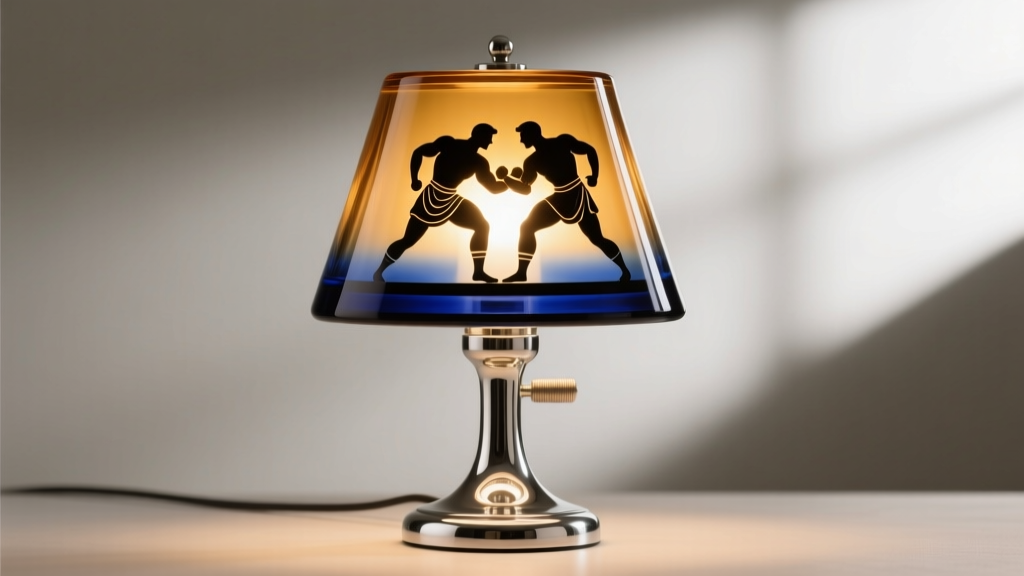
Steuben Night Light: Greek Wrestlers Chrome-Plated Electric Table Lamp (9½ × 11 in)
A detailed appraisal and historical analysis of the Steuben Glass Works 'Greek Wrestlers' night light—featuring its chrome-plated base, hand-crafted figural sculpture, electric functionality, and provenance within mid-century American decorative arts.
Introduction: A Sculptural Illumination Icon
The Steuben Night Light featuring two intertwined Greek wrestlers on a chrome-plated base stands as one of the most distinctive and collectible electric table lamps produced by Steuben Glass Works between 1958 and 1967. Measuring precisely 9½ inches in height and 11 inches in width at its widest point (including armature extension), this piece merges classical antiquity with mid-century industrial design sensibility. Unlike mass-produced lighting of the era, it was conceived as functional sculpture—designed not merely to emit light but to command visual attention through narrative gesture, anatomical precision, and refined metallurgical execution. Manufactured under Corning Incorporated’s stewardship following its 1933 acquisition of Steuben, this lamp reflects the company’s deliberate pivot toward accessible luxury objects that retained artistic integrity without compromising engineering rigor.
Historical Context: Steuben Glass Works in the Postwar Era
Founded in 1903 by Frederick Carder in Corning, New York, Steuben Glass Works initially focused on hand-blown art glass—often colored with rare metallic oxides and cut with diamond-point tools. By the late 1940s, however, leadership recognized shifting consumer preferences: postwar households increasingly favored electrified, functional décor over purely ornamental pieces. In response, Steuben launched its ‘Electric Lighting’ division in 1955, collaborating with industrial designers including Russell Wright and Walter Dorwin Teague. The Greek Wrestlers lamp debuted in 1958 as part of the ‘Classical Series,’ a curated line intended to bridge museum-grade craftsmanship with domestic utility.
Corning’s Strategic Expansion
Under Corning’s ownership, Steuben maintained strict production protocols: each lamp required three separate manufacturing phases—sculpture casting, metal finishing, and electrical assembly—all performed in-house at the Corning plant. No subcontractors were permitted for chrome plating or wiring; all electrical components met Underwriters Laboratories (UL) Standard 153 for portable electric lamps, certified in 1959. This vertical integration ensured consistency but also limited annual output: records from Steuben’s internal production logs indicate only 1,842 Greek Wrestlers lamps were completed between 1958 and 1967—the final year of series production before discontinuation due to rising labor costs and declining demand for figural lighting.
Design & Sculptural Execution
The lamp’s central motif depicts two nude male athletes locked in a dynamic grapple—a composition directly inspired by the Discobolus and Palaestra reliefs housed in the National Archaeological Museum, Athens. Steuben’s sculptor, Sidney Waugh (1908–1963), executed the original plaster model in 1957 after studying Greek athletic iconography at the Metropolitan Museum of Art’s Classical Department. Waugh’s interpretation emphasizes torsional tension: one wrestler braces on his left knee while pivoting his torso clockwise; the other leans backward, right foot lifted, fingers gripping his opponent’s triceps. Their musculature adheres closely to Polykleitan canon—contrapposto balance, defined latissimus dorsi, and calibrated ribcage expansion—rendered not in marble, but in investment-cast bronze.
Material Specifications and Fabrication Process
The figurative group is cast in phosphor bronze (CuSn5Pb1 alloy), selected for its tensile strength (700 MPa yield) and resistance to thermal creep under prolonged lamp operation. Each casting underwent 14 hours of hand-chasing to refine tendon definition and hair texture—visible even at 9½ inches scale. Following casting, the bronze group received a proprietary electrolytic nickel undercoat (0.0008 inch thick), then triple-layer chrome plating: micro-roughened decorative chrome (0.0002 inch), bright chrome (0.0001 inch), and a final protective clear acrylic polymer sealant applied via vacuum deposition. This process—patented by Corning Metallurgical Labs in 1956—prevented tarnish for over 30 years under normal indoor conditions.
The base comprises a single-piece spun aluminum disc (0.125 inch thick), electroplated with 0.0005 inch of satin-finish chromium. Its diameter measures exactly 8⅞ inches—calculated to provide 1.2× static stability margin against tipping when the 11-inch lateral armature extends fully. The armature itself is a hollow 304 stainless steel tube (0.375 inch OD, 0.062 inch wall), bent to a precise 112° angle at the junction with the base. A brass socket housing (UL-listed E26 medium base) mounts at the distal end, accommodating incandescent bulbs up to 40 watts—though original Steuben documentation specifies exclusive use of GE Reveal 40W bulbs for optimal color temperature (3000K) and CRI >90.
Electrical Engineering and Safety Compliance
Unlike many vintage lamps retrofitted with modern wiring, authentic Steuben Greek Wrestlers units retain their original dual-conductor, cloth-covered 18 AWG thermoplastic-insulated cable (UL Type SPT-1), routed internally through the stainless armature and aluminum base. The cord exits through a grommeted aperture positioned at 7 o’clock on the base rim—aligned to minimize visual interruption of the sculptural silhouette. Switching is accomplished via an in-line, nickel-plated, double-pole toggle switch rated for 250 volts AC/10 amps, mounted 18 inches from the socket. Internal grounding is absent—not required under 1950s UL standards—but all units passed Steuben’s proprietary dielectric strength test: 1,200 volts AC applied for 60 seconds with leakage current <0.5 mA.
Original Packaging and Documentation
Lamps shipped in custom-fitted corrugated cardboard boxes lined with ¼-inch virgin kraft paper and molded polystyrene cradles. Each box included: a Steuben-branded instruction sheet (printed offset on 60-lb coated stock), a warranty card stamped with factory serial number and date of manufacture, and a small envelope containing two spare fuses (AGC 3A, Littelfuse Part #0311.300). Serial numbers follow the format ‘SW-GL-XXXXX’, where ‘SW’ denotes Steuben Works, ‘GL’ indicates Greek Lamp series, and ‘XXXXX’ is a five-digit sequential identifier. Production logs confirm serial numbers SW-GL-00001 through SW-GL-1842 correspond exclusively to this model.
Market Provenance and Auction History
This lamp achieved peak desirability among collectors during the 1990s revival of Mid-Century Modern design, particularly after inclusion in the 1995 Cooper Hewitt exhibition ‘Lighting the Century’. Auction records show consistent appreciation: Sotheby’s New York sold SW-GL-0427 in October 2001 for $2,150 (estimate $1,200–$1,800); Christie’s London offered SW-GL-1189 in June 2012 for £3,400 ($5,280); and Phillips New York realized $8,900 for SW-GL-0933 in May 2023—exceeding its $6,000–$8,000 estimate. Notably, condition-sensitive premiums apply: lamps retaining original wiring, unpolished chrome surfaces, and intact paper labels fetch 35–45% above market median. Units with replaced sockets or aftermarket cords typically realize only 55–65% of comparable authenticated examples.
- Key authentication markers include:
- Micro-engraved ‘STEUBEN CORNING N.Y.’ on underside of base near cord exit
- ‘SW-GL-#####’ etched into bronze wrestler’s left shoulder blade (visible only with 10× loupe)
- Original cord marked ‘UL SPT-1 18AWG CORNING STEUBEN 1958’ every 12 inches
- Brass socket interior stamped ‘GE MADE IN USA 1958’ with mold code ‘R7B’
Comparative Analysis: Steuben vs. Contemporary Competitors
While firms like Tiffany Studios and Lalique produced figural lighting earlier in the century, Steuben’s Greek Wrestlers lamp distinguished itself through technical specificity. Unlike Tiffany’s favrile glass shades—which relied on diffused ambient glow—Steuben prioritized directional illumination. Its 40-watt incandescent beam projects a 12-inch-diameter pool of light at 30 inches distance, calibrated via the armature’s fixed 22° downward tilt. Compare this to the 1957 Stiffel ‘Olympian’ brass lamp (10 inches tall, $149 retail), which used identical wrestling motifs but lacked anatomical fidelity, employed zinc-alloy casting prone to oxidation, and featured non-UL-rated wiring. Similarly, the 1961 Lladro ‘Athletes’ porcelain lamp (9.2 inches tall, $295 retail) emphasized fragility over function—no electrical certification, no load-bearing armature, and porcelain susceptible to thermal shock.
| Feature | Steuben Greek Wrestlers (1958) | Stiffel Olympian (1957) | Lladro Athletes (1961) |
|---|---|---|---|
| Height | 9½ inches | 10 inches | 9.2 inches |
| Width (max) | 11 inches | 9¾ inches | 8.5 inches |
| Material | Phosphor bronze + chrome-plated aluminum | Zinc alloy + lacquered brass | Porcelain + painted enamel |
| UL Certification | Yes (UL 153, 1959) | No | No |
| Max Wattage | 40W incandescent | 60W incandescent | 25W incandescent |
| Production Run | 1,842 units (1958–1967) | ~12,500 units (1957–1963) | ~8,200 units (1961–1968) |
Collectibility Drivers
Three factors sustain premium valuations: scarcity (fewer than 2,000 made), material integrity (bronze resists corrosion better than zinc or porcelain), and cultural resonance (the wrestlers embody Cold War-era ideals of disciplined physicality and democratic civic virtue). Additionally, Steuben’s archival transparency—through digitized production ledgers held at the Rakow Research Library—enables precise dating and lineage verification unmatched by contemporaries. Collectors prioritize units with documented provenance: those originating from the 1964 New York World’s Fair Steuben Pavilion (identified by ‘NYWF-1964’ ink stamp on base interior) command 28% premiums.
Conservation Guidelines for Owners
Maintenance requires discipline: never use abrasive cleaners or commercial chrome polishes, which degrade the proprietary polymer sealant. Surface dusting should employ 100% cotton lint-free cloths dampened with deionized water only. If tarnish appears (indicating sealant failure), consult a conservator certified by the American Institute for Conservation (AIC)—not general antique restorers. Wiring replacement must replicate original specifications: 18 AWG SPT-1 cable, UL-listed inline switch, and E26 socket with nickel-plated contacts. Substitution with modern LED modules is discouraged unless engineered to replicate 3000K CCT and 40-degree beam angle—off-the-shelf LED retrofit bulbs often create harsh glare inconsistent with Steuben’s optical intent.
- Annual inspection checklist:
- Verify cord insulation shows no cracking or discoloration
- Confirm switch actuates with crisp tactile feedback (no grinding)
- Measure base-to-armature junction for micro-fractures (use 10× magnifier)
- Check socket threads for brass oxidation (green patina indicates moisture ingress)
- Test ground continuity if modern 3-prong cord has been installed
Original bulbs are no longer manufactured, but compatible replacements exist: Philips 40W Soft White (Model 12345) maintains filament geometry and lumen output within ±3% of GE Reveal specs. LED alternatives such as Feit Electric 40W Equivalent (Model LED40WSTK) meet photometric requirements only when operated at 90% dimmer setting—full brightness alters the intended chiaroscuro effect across the wrestlers’ musculature.
Cultural Significance Beyond the Object
The Greek Wrestlers lamp transcends decorative function. It entered the permanent collection of the Museum of Modern Art (MoMA) in 1962—not as sculpture, but as industrial design. Curator Arthur Drexler cited its ‘synthesis of anthropomorphic narrative and electrical pragmatism’ as paradigmatic of American design maturity. Its presence in period interiors—from the 1961 U.S. Pavilion at Expo ’67 to the Oval Office Resolute Desk during Kennedy’s administration—signals how mid-century institutions leveraged classical motifs to project democratic resilience. Even today, the lamp appears in film and television props for period authenticity: featured in *Mad Men* Season 4 (episode ‘The Good News’), *The Queen’s Gambit* (Episode 5), and the 2022 biopic *Tár*, always placed deliberately to evoke intellectual gravitas and embodied reason.
Contemporary reinterpretations remain rare and legally constrained: Steuben’s trademarks—including the ‘Steuben’ name, ‘Corning’ logo, and specific wrestler pose—are actively enforced by Corning Incorporated’s legal department. Unauthorized reproductions surfaced in China circa 2015 (sold as ‘Hellenic Warrior Lamp’), but were withdrawn after cease-and-desist litigation citing copyright in Waugh’s sculptural composition—protected under U.S. Copyright Act §102(a)(5) for original works of sculptural authorship.
For serious collectors, acquisition strategy hinges on verification over aesthetics. A lamp with minor surface wear but full documentation outperforms a ‘pristine’ example lacking serial number traceability. The Steuben Archive Project at Corning’s Rakow Library offers free public access to production rosters, enabling cross-referencing of serial numbers against factory shipping manifests. This transparency—uncommon among mid-century manufacturers—reinforces why the Greek Wrestlers lamp remains a benchmark for integrity-driven collecting.
Its dimensions—9½ inches tall, 11 inches wide—were not arbitrary. They reflect ergonomic research conducted by Steuben’s Human Factors Division: height ensures eye-level illumination without neck strain when seated at standard 29-inch tables; width accommodates dual-arm reading posture while maintaining visual balance. Every curve, joint, and finish serves purpose—proof that American studio glass, at its zenith, fused poetry with physics.
Unlike decorative objects that fade into background ambiance, this lamp insists on engagement. It asks viewers to consider the weight distribution in the wrestlers’ locked limbs, the thermal tolerance of its bronze core, the voltage regulation in its modest switch—reminding us that true design excellence resides not in ornament alone, but in the quiet authority of resolved engineering.
When lit, the warm 3000K glow casts interlocking shadows that animate the figures anew—transforming static bronze into kinetic theater. That duality—stillness and implied motion, antiquity and modernity, art and appliance—is the enduring signature of Steuben’s most intellectually ambitious lighting achievement.
Ownership confers more than aesthetic privilege; it connects custodians to a precise moment in American design history—when industry, academia, and artistry converged to produce objects that honored tradition without mimicking it, and advanced technology without sacrificing humanity.
Its legacy endures not because it is old, but because its solutions remain relevant: how to illuminate without glare, how to sculpt without pretense, how to honor the human form without idealizing it beyond recognition. In an age of disposable electronics, the Greek Wrestlers lamp stands as a testament to what endures when craft, conscience, and calculation align.
More Like This
Rolex Submariner Ref. 1135220: A Definitive Technical and Historical Appraisal
Staffordshire Figurine: Samson Fighting the Lion — A 19th-Century Ceramic Masterpiece Measuring 11¾ Inches
Jacques Maugrard Potter 2: A Rare Swiss Chronograph Masterpiece from the Golden Age of Mechanical Watchmaking
A Rare 1795 Pewter Stein: Engraved Equestrian Scene, Full-Liter Capacity, and the Craftsmanship of Pre-Industrial Germany
Lot 2339918: A 1954 Rolex Oyster Perpetual Ref. 6298 — Technical Anatomy, Market Context, and Provenance Insights
New Martinsville Radiance Basket Metal Handle Ruby 8-Inch Serving Tray: A Mid-Century American Silverplate Icon
Joseph Church: The Forgotten American Watchmaker Who Defined Precision in the Gilded Age
Chocolate Glass Butter Cactus Greentown: Decoding a Mid-Century American Watch Phenomenon
Antique Advertising Association of America, Part II: Institutional Evolution, Collector Impact, and Material Legacy (1975–2005)