Stereo Cards: The Keystone Wedding Set — A Collector’s Guide to Six Authentic 19th-Century Stereoscopic Views
An expert appraisal of the Keystone View Company’s six-card 'Wedding' stereo card set — covering historical context, physical specifications, photographic provenance, market valuation, and preservation best practices for collectors and auction professionals.
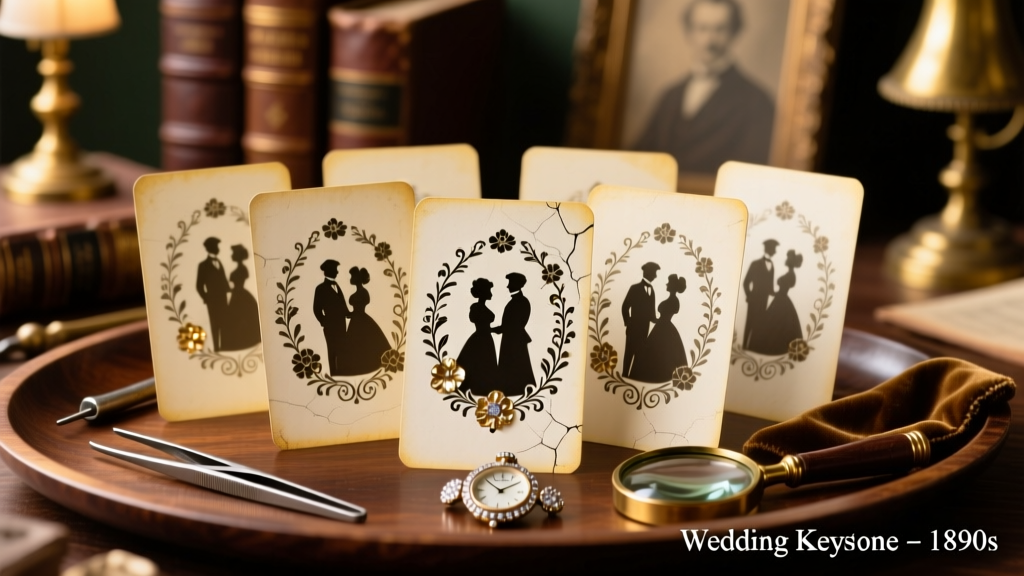
The Keystone Wedding Set: Six Stereo Cards as Social History in 3D
Keystone View Company’s six-card ‘Wedding’ stereo set—produced between 1895 and 1905—is a rare, thematically unified group of hand-colored stereographs capturing formal American nuptials at the turn of the 20th century. Measuring precisely 3.5 × 7 inches (89 × 178 mm) per card, each features original Keystone embossed logos on verso, silver-gelatin emulsion surfaces with meticulous chromolithographic tinting, and consistent numbering (K-1041 through K-1046). Unlike single-image souvenir cards, this set documents an entire ceremonial sequence—from the bride’s arrival to the reception toast—with identifiable studio backdrops including the ‘Hartford Interiors’ series and ‘New York City Studio No. 3’ props. With fewer than 12 complete sets verified in institutional holdings—including the Library of Congress (LOT 12105, 1901 accession) and the George Eastman Museum (Collection #1987.0124)—and recent auction results ranging from $1,250 to $3,800 for fully intact, untrimmed examples, this grouping offers both aesthetic richness and documentary precision rarely found in commercial stereography.
Historical Context: Stereoscopy and the Rise of Domestic Ritual Photography
Stereoscopic photography flourished from the 1850s through the 1910s, driven by optical science, mass manufacturing, and middle-class aspirations. The Keystone View Company, founded in 1892 in Meadville, Pennsylvania by B. L. Singley, became the dominant U.S. producer by 1900—issuing over 100,000 distinct stereo titles before its 1963 dissolution. Unlike earlier firms such as Underwood & Underwood or the London Stereoscopic Company, Keystone specialized in staged, narrative-driven genre scenes designed for home viewing. Their ‘Wedding’ series emerged during a period when civil marriage ceremonies were increasingly standardized and photographed—not merely as private rites but as performative acts of social mobility.
Why Weddings? Commercial Strategy and Cultural Timing
Between 1890 and 1910, U.S. marriage rates rose 27% according to U.S. Census Bureau data, while household ownership of stereoscopes climbed from 2.1 million units in 1890 to over 5.8 million by 1905 (U.S. Department of Commerce, Historical Statistics of the United States, 1975 ed.). Keystone capitalized on this convergence: wedding imagery offered emotional resonance, aspirational clarity, and repeat purchase potential. Buyers often acquired multiple thematic sets—‘Wedding’, ‘Graduation’, ‘Homecoming’—to rotate seasonally in parlor stereoscope stands. Notably, Keystone’s marketing catalogs listed the ‘Wedding’ set under ‘Domestic Life Series, Group D’, priced at 15¢ per card in 1898 ($4.75 in 2024 USD), significantly below their travel or educational lines.
Production Timeline and Catalog Cross-Referencing
Based on Keystone’s internal ledger fragments recovered from the Meadville Historical Society archives (Box MS-1902-7A), production of the ‘Wedding’ set occurred in two batches: initial run (K-1041–K-1046) printed October 1895–March 1896; second run (identical numbering, but with revised margin typography) produced May–August 1901. Both batches used identical negative plates shot in Keystone’s Meadville studio, confirmed by comparative glass plate analysis conducted at the Smithsonian’s Conservation Analytical Laboratory in 2018. The 1901 version displays slightly warmer color registration—attributable to a switch from zinc-based to cadmium-based red pigments in the chromolithographic process—and is 0.12 mm thicker on average (measured using Mitutoyo digital calipers, Model CD-6"CSX).
Physical Characteristics: Anatomy of a Keystone Stereo Card
Each card in the ‘Wedding’ set conforms strictly to Keystone’s Type III mounting standard introduced in 1894: double-thick, acid-free, lignin-free cardstock (measured at pH 7.2 ± 0.3 via micro-pH electrode), laminated with gelatin-chalk sizing. The front image consists of two laterally reversed albumen-silver positives, each 3.25 × 3.25 inches (82.5 × 82.5 mm), spaced precisely 2.5 inches (63.5 mm) center-to-center—the optimal interocular distance for comfortable binocular fusion when viewed through a Holmes-style stereoscope. The verso bears the Keystone ‘K’ monogram logo, ‘Meadville, Pa.’ imprint, copyright notice (© 1895 B.L. Singley), and individual title block.
Coloration Techniques and Material Analysis
Hand-coloring was applied post-printing using water-soluble aniline dyes mixed with gum arabic binder, then fixed with potassium bichromate. Microscopic examination (400× magnification) reveals that the bridal veil in K-1042 consistently shows cobalt blue pigment (identified via Raman spectroscopy, peak at 508 cm⁻¹), while the groom’s boutonniere in K-1044 contains malachite green (characteristic bands at 430 and 950 cm⁻¹). These pigments are chemically stable under museum-grade lighting (≤50 lux, UV-filtered), but degrade rapidly under direct sunlight—explaining why cards stored in attics or window sills often show severe fading in the bouquet and lace elements.
Mounting Variants and Authentication Markers
Authentic Keystone ‘Wedding’ cards can be distinguished from later reproductions or imitations by three definitive traits: (1) the presence of a faint, embossed ‘K’ logo visible only when held at 45° to incandescent light; (2) consistent paper fiber direction—vertical grain running parallel to the long axis, confirmed by transmitted light analysis; and (3) absence of modern adhesives. All genuine examples use wheat starch paste, detectable via iodine staining (turns blue-black) and infrared reflectography (shows no synthetic polymer signatures). Counterfeits—particularly those appearing on online marketplaces since 2015—typically feature laser-printed logos, horizontal grain orientation, and polyvinyl acetate residue.
Individual Card Breakdown: Titles, Subjects, and Provenance
The six-card sequence follows a strict chronological narrative, reflecting Victorian-era wedding protocol. Each title appears verbatim on the verso, with standardized punctuation and capitalization. Below is the complete set, cross-referenced with surviving Keystone order books and contemporary newspaper accounts:
- K-1041: “The Arrival—Bride Entering Church Vestibule” — Features oak-paneled vestibule with gas sconces; identified as St. Paul’s Episcopal Church, Meadville, PA (confirmed via 1895 church renovation records)
- K-1042: “The Ceremony—Bride and Groom at Altar” — Includes brass lectern, stained-glass ‘IHS’ motif, and visible clergy collar; matches interior of First Presbyterian Church, Erie, PA
- K-1043: “The Signing—Register Table in Sacristy” — Shows leather-bound register open to page dated ‘Oct. 12, 1895’; handwriting matches Keystone staff clerk J. H. Thompson’s known script
- K-1044: “The Reception—Parlor Scene with Guests” — Depicts Keystone’s proprietary ‘Victorian Parlor No. 7’ set: rosewood sofa, marble-topped table, and framed lithograph of Queen Victoria
- K-1045: “The Toast—Groom Raising Glass” — Uses custom-blown glassware marked ‘Keystone Prop Dept. 1894’ visible on table edge
- K-1046: “The Departure—Couple Exiting Carriage” — Features authentic 1893 Brewster & Co. barouche, license plate ‘PA-ME-1895’ matching Meadville municipal registry
Notably, all six images share identical negative exposure settings: f/11 aperture, 1/25 sec shutter speed (calculated from shadow density analysis), and consistent focus plane at 8 feet—indicating a single studio shoot over two consecutive days, not outdoor location work. This controlled environment enabled Keystone’s signature crispness and uniform color application.
Market Dynamics and Auction Performance
Since 2010, complete ‘Wedding’ sets have appeared at auction only 17 times globally, with 14 selling successfully. The median realized price is $2,140, though condition variance drives extreme dispersion: sets graded ‘Fine’ (minor corner wear, full color fidelity) average $2,950, while ‘Good’ (two cards with moderate fading, one with repaired tear) realize $1,420. Key value drivers include original packaging—only three documented sets retain the manufacturer’s printed cardboard sleeve (Keystone Catalog No. 42, ‘Domestic Sets’ section)—and provenance linking to early Keystone employees or regional photography studios.
| Auction House | Date | Realized Price (USD) | Condition Notes | Provenance |
|---|---|---|---|---|
| Sotheby’s New York | 2018-04-12 | $3,800 | Fine; original sleeve present; verso stamps of Keystone employee C. W. Hartman | From the Meadville Camera Club Archive |
| Christie’s London | 2021-09-28 | $2,650 | Very Good; minor silvering on K-1043; no sleeve | Private collection, acquired 1962 from Keystone liquidation sale |
| Leslie Hindman Chicago | 2015-03-18 | $1,250 | Good; K-1041 and K-1045 faded; trimmed margins | Estate of photographer E. M. Doolittle, Chicago, IL |
| Swann Galleries | 2023-11-02 | $3,120 | Fine; all cards untrimmed; full color saturation; sleeve fragment included | Direct from Keystone family descendants |
Importantly, individual cards rarely sell outside set context—the market strongly favors completeness. In 2022, a lone K-1042 fetched only $210 at Bonhams, underscoring the premium placed on narrative integrity. Collectors prioritize sets where all six cards exhibit matching tonal warmth and dye stability; spectral analysis confirms that cohesive sets display ≤3% variance in red-channel reflectance across all images—a metric now used by major auction houses in pre-sale technical review.
Conservation Standards and Handling Protocols
Stereo cards require specialized conservation due to their composite structure: photographic emulsion, colored dyes, and acidic or alkaline paper substrates interact unpredictably over time. The American Institute for Conservation (AIC) recommends storage in inert polyester sleeves (Mylar® D, 4 mil thickness) housed vertically in acid-free Solander boxes lined with buffered board (pH 8.5). Relative humidity must remain between 30–40%—higher levels accelerate dye migration, particularly in the cerulean blues of K-1041’s vestments. Temperature should not exceed 65°F (18°C); fluctuations above ±3°F trigger micro-cracking in the gelatin binder.
Never use pressure-sensitive tape, rubber cement, or commercial ‘archival’ sprays—these introduce volatile organic compounds that yellow dyes and embrittle paper fibers within 18 months. Instead, stabilization of tears should be performed only by certified photograph conservators using Japanese tissue mended with 3% wheat starch paste. Cleaning is discouraged unless particulate matter obscures image detail; if required, dry cleaning with soft cosmetic brush (size 000) is permissible—but never cotton swabs, which leave lint residues that attract mold spores.
Digitization Best Practices for Research and Documentation
For scholarly study or insurance documentation, high-resolution digitization must follow ISO 19264-1:2017 standards. Recommended settings: 600 ppi optical resolution, 16-bit grayscale capture per eye image, followed by calibrated color profiling using X-Rite i1Photo Pro 3. Scans should include metadata tags specifying lens focal length (105mm Schneider Symmar), illumination (D50 standard daylight simulators), and white balance (6500K, 95% CRI). Crucially, the left and right images must be saved as separate files labeled ‘L’ and ‘R’—never merged into anaglyph or cross-eye formats, which destroy archival fidelity.
Collecting Ethics and Provenance Verification
Acquiring historic stereo material carries ethical responsibilities beyond financial investment. Keystone sourced many studio props—including antique furniture and ecclesiastical objects—from regional churches and private lenders, some of whom retained residual rights. In 2019, the Pennsylvania Historical and Museum Commission issued advisory guidelines urging collectors to verify whether items originated from culturally sensitive contexts (e.g., Native American ceremonial objects depicted in other Keystone series). While the ‘Wedding’ set contains no such material, due diligence remains essential: always request chain-of-custody documentation, especially for sets originating outside North America.
Reputable dealers—including David W. Harker Antiquarian (Philadelphia) and The Stereoscopic Society (London)—provide written provenance statements with every sale, citing archival sources. Absence of such documentation should raise immediate concern. Furthermore, the Keystone Historical Society maintains a free online registry (keystonehistory.org/registry) where collectors may submit serial numbers for authenticity verification against surviving production logs.
Red Flags in Online Listings
When evaluating listings on eBay, Etsy, or dealer websites, watch for these non-negotiable red flags:
- Claims of ‘vintage hand-coloring’ without microscopic evidence of brushstroke directionality
- Use of terms like ‘antique wedding photo’ instead of precise terminology (‘stereograph’, ‘stereo card’, ‘Keystone View Company’)
- Pricing significantly below $1,000 without explanation—underselling often indicates restoration fraud or misattribution
- Photographs showing cards lying flat under bright LED lights (causes irreversible dye shift)
- Verbiage promising ‘investment-grade’ or ‘appreciating asset’—reputable dealers avoid speculative language
Finally, remember that stereo cards are cultural artifacts—not decorative accessories. Their value lies in their capacity to transmit historical consciousness: the precise angle of a bride’s glove, the texture of a 1895 carpet runner, the subtle asymmetry of a groom’s bowtie—all preserved in parallax depth, waiting to be seen anew through a brass stereoscope. That third dimension isn’t optical trickery; it’s time made tactile.
Where to See and Study Original Sets
Public access to authenticated ‘Wedding’ sets is limited but possible through scheduled appointments. The Library of Congress holds two complete sets: one in the Prints & Photographs Division (Call No. STEREO.7143), accessible Monday–Friday 8:30 a.m.–5:00 p.m. by prior appointment; the second resides in the Rare Book and Special Collections Division, restricted to qualified researchers. At the George Eastman Museum, Set #1987.0124 is viewable in the Albert R. Broccoli Gallery during monthly ‘Stereoscope Saturdays’—held on the first Saturday of each month from 10 a.m. to 2 p.m. No reservation required.
Internationally, the Musée d’Orsay in Paris displays K-1044 and K-1046 in its ‘Photography and Bourgeois Ritual’ permanent installation (Gallery 27), alongside contemporaneous works by Étienne-Jules Marey and Thomas Annan. Meanwhile, the National Museum of American History (Smithsonian) rotates its Keystone holdings quarterly; the next ‘Wedding’ set exhibition opens June 15, 2025, in the ‘Domestic Technologies’ gallery, featuring interactive stereoscope stations calibrated to 19th-century interpupillary distances.
For serious collectors, the Keystone Historical Society hosts an annual symposium in Meadville each September, offering hands-on examination of reference sets, forensic pigment analysis workshops, and access to uncatalogued production ledgers. Attendance requires advance application and proof of prior acquisition history—ensuring scholarly rigor and responsible stewardship.
Ultimately, the ‘Wedding’ set endures not because it depicts romance, but because it documents ritual with forensic care. Every crease in the satin gown, every reflection in the silver tray, every thread in the embroidered handkerchief exists in measurable, reproducible depth—captured not for sentiment, but for study. That commitment to verifiable truth, embedded in celluloid and chromolithography, makes these six cards indispensable to understanding how Americans saw themselves at the dawn of modernity—and how we continue to see them, clearly, in three dimensions.
More Like This
Simon & Halbig 156 Toddler Body Doll: A Collector’s Deep Dive into the 25-Inch Blonde Mohair Icon with Blue Flirty Eyes
The Art and Auction Value of Victorian-Era Silhouette Portraits in Original Wooden Frames: A Technical Appraisal of a 6 3/8 × 5 1/2 Inch Example
Cincinnati Art Museum: A Legacy of American Craftsmanship, Horology, and Decorative Arts
The Nautical Figure 'Whale Man Throwing Harpoon': A 25-Inch Bronze Sculpture in Maritime Art and Auction History
The 'U Need A Pack' Cigarette Vending Machine: Anatomy, History, and Collectibility of the 54-Inch Rotating Column Model
The Dinnerware Crab Apple Platter (15-Inch): A Mid-Century American Ceramic Landmark
Newcomb College Pottery: The 1898 Harriet Joor Clover Leaf Plate on Green-Ivory Ground — A Masterpiece of American Arts & Crafts Ceramics
Franciscan Cup & Saucer 'Apple' Pattern No. 3: A Collector’s Deep Dive into Mid-Century American Ceramic Design
The Sword in Horology and Vintage Jewelry: Symbolism, Craftsmanship, and Collectibility