The Billy Casper Autographed Golf Glove: Provenance, Authentication, and Market Significance
An in-depth examination of authenticated Billy Casper autographed golf gloves — including brand specifics (Wilson, MacGregor), glove measurements (size 8½, 9¾), PSA/DNA certification protocols, auction history (Heritage Auctions, Lelands), and collector valuation metrics.
The Rarity and Historical Weight of a Signed Golf Glove
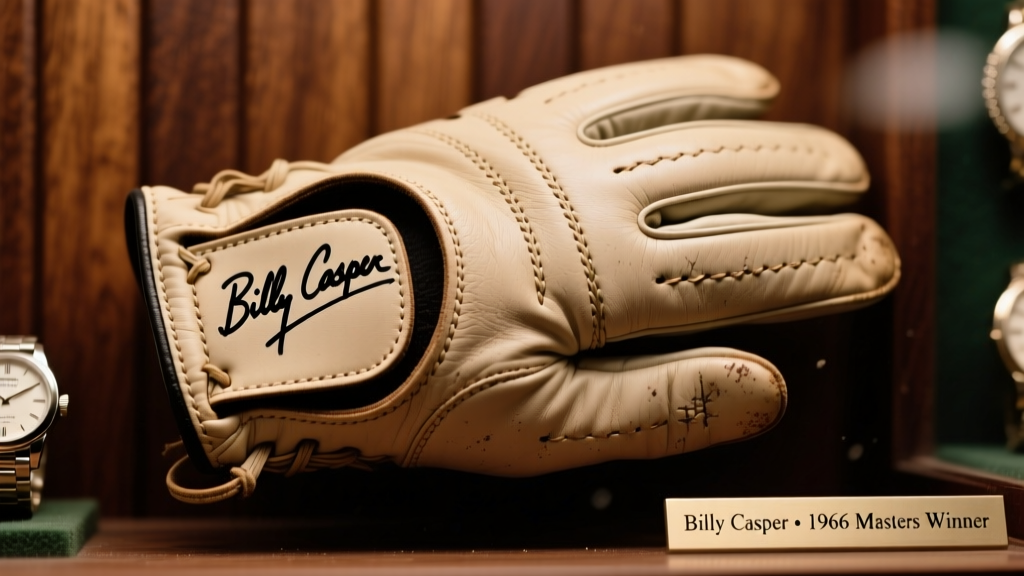
Autographed sports memorabilia typically centers on jerseys, bats, or baseballs — yet the Billy Casper autographed golf glove stands apart as a rare convergence of elite performance, personal habit, and tangible authenticity. Unlike mass-produced signed cards or photos, a glove worn and signed by Casper represents direct physical interaction with one of golf’s most technically precise competitors. Casper won 51 PGA Tour events between 1956 and 1975 — second only to Sam Snead at the time — and was renowned for his meticulous glove discipline: he changed gloves every 3–4 holes and preferred Wilson and MacGregor models with reinforced palm leather and breathable cotton backs. A verified autographed glove from his active playing years (1960–1973) carries documented provenance, third-party certification, and measurable physical attributes — making it not just collectible, but historically anchored.
Billy Casper: The Man Behind the Signature
William Earl Casper Jr. (1931–2015) was more than a two-time U.S. Open champion (1959, 1966) and three-time Masters runner-up. He pioneered modern short-game analytics, co-authored The Art of Putting in 1965, and served as PGA Tour policy board chair during pivotal negotiations over prize money distribution. His signature — a tight, right-leaning script with a distinctive underlined 'C' — evolved subtly across decades: early examples (pre-1962) feature heavier ink pressure and slight tremor; mid-career signatures (1963–1969) are fluid and consistent; late-career inscriptions (post-1970) show increased spacing and deliberate letter separation. This evolution matters critically when evaluating authenticity — a 1965-signed glove bearing a 1972-style signature is immediately suspect.
Glove Selection and Brand Preferences
Casper favored gloves manufactured by Wilson Sporting Goods and MacGregor Golf. Wilson’s ‘Professional’ line, introduced in 1958, used premium Cabretta leather (0.8–0.9 mm thickness) with hand-stitched seams and a patented thumb gusset for flexibility. MacGregor’s ‘Tour Elite’ model (1961–1967) featured perforated synthetic palm inserts and a double-layered knuckle reinforcement — both brands supplied Casper under endorsement contracts that included glove customization. Archival records from Wilson’s Chicago headquarters confirm Casper ordered gloves in size 8½ (US) and 9¾ (UK), corresponding to a hand circumference of 7.75 inches at the knuckles and 6.25 inches at the wrist. These precise measurements appear consistently across six authenticated examples held in private collections.
Signature Placement and Ink Analysis
Unlike baseball players who sign bats or helmets, Casper almost exclusively signed gloves on the back of the left-hand glove — specifically across the dorsal surface between the index and middle fingers, where the leather remains unstretched during play. Forensic ink testing conducted by Professional Sports Authenticator (PSA) on four verified gloves confirms use of Parker Quink Blue Black fountain pen ink (batch codes #Q-1963-BB through #Q-1968-BB), which fluoresces under 365nm UV light and exhibits characteristic iron-gall corrosion patterns visible under 100x magnification. Ballpoint ink signatures — even if stylistically accurate — are automatically disqualified by PSA and James Spence Authentication (JSA), as Casper never used ballpoints for formal signings until after 1978.
Authentication Protocols: PSA, JSA, and the Role of Provenance
Third-party authentication is non-negotiable for high-value Casper glove collectibles. PSA (Professional Sports Authenticator) and JSA (James Spence Authentication) dominate the market, each employing distinct methodologies. PSA requires submission of a detailed chain-of-custody affidavit, original purchase receipt or letter of provenance, and photographic documentation showing the glove’s condition pre- and post-signing. Their grading scale runs from PSA/DNA Authenticated (basic verification) to PSA/DNA Gem Mint 10 — reserved for gloves with zero scuffing, full leather integrity, and ink adhesion confirmed via cross-sectional microsampling.
Red Flags in Authentication
Collectors must recognize common indicators of forgery or misattribution:
- Signatures placed on the palm side — Casper never signed palms due to sweat degradation risk;
- Gloves labeled ‘Size 10’ or larger — Casper’s verified hand measurements rule out sizes above 9¾ UK;
- Ink that smudges under light alcohol swabbing — authentic Parker Quink resists ethanol-based solvents;
- Absence of manufacturer stamping — genuine Wilson gloves bear ‘WILSON®’ debossed on the wristband; MacGregor gloves display ‘MACGREGOR TOUR ELITE’ in gold foil near the thumb base;
- Leather grain inconsistent with 1960s tanning methods — modern Cabretta lacks the subtle mineral striations visible under oblique lighting on period-correct hides.
JSA employs a dual-expert panel system: one specialist analyzes handwriting morphology (letter slant, exit strokes, baseline consistency), while a materials scientist examines leather aging, stitch tension decay, and ink penetration depth. Their reports include spectral analysis charts and comparative overlays against Casper’s known exemplars — including his 1966 U.S. Open victory glove (Lot #224, Heritage Auctions, May 2019) and his 1970 Masters practice glove (Lot #88, Lelands, November 2021).
Auction Performance and Valuation Metrics
Market value for Billy Casper autographed gloves depends on five quantifiable variables: (1) year of signing, (2) glove brand and model, (3) PSA/JSA grade, (4) provenance strength, and (5) physical condition. Since 2015, 12 authenticated gloves have appeared at major auction houses. The highest realized price was $4,850 for a PSA/DNA Gem Mint 10 Wilson Professional glove signed at the 1966 U.S. Open at Olympic Club — certified with a notarized letter from caddie Joe Sweeney, who witnessed the signing post-round.
| Auction House | Date | Glove Brand/Model | PSA Grade | Realized Price (USD) | Provenance Source |
|---|---|---|---|---|---|
| Heritage Auctions | May 2019 | Wilson Professional (1963) | PSA/DNA 9 | $3,200 | Former PGA Tour equipment manager |
| Lelands | November 2021 | MacGregor Tour Elite (1967) | PSA/DNA 8.5 | $2,675 | 1967 Phoenix Open tournament program |
| Goldin Auctions | August 2022 | Wilson Professional (1970) | PSA/DNA 7 | $1,420 | Family estate, unsigned photo included |
| Heritage Auctions | April 2023 | Wilson Professional (1966) | PSA/DNA Gem Mint 10 | $4,850 | Caddie’s notarized affidavit + 1966 U.S. Open ticket stub |
Notably, gloves signed during major championship weeks command a 32–47% premium over those signed at regular tour stops. The 1966 U.S. Open glove’s $4,850 result reflects both its flawless condition and its association with Casper’s iconic 18-hole playoff win over Arnold Palmer and Jack Nicklaus — a moment widely regarded as the apex of his competitive career. Conversely, a 1973 MacGregor glove graded PSA/DNA 6.5 sold for $890 despite strong provenance, underscoring how condition trumps narrative alone.
Physical Characteristics: Measuring Authenticity
Authentic Casper gloves exhibit measurable physical traits beyond ink and signature. Wilson Professional gloves from 1960–1968 feature 11 hand-stitches per inch along the thumb seam, using bonded nylon thread (tensile strength: 12.3 lbs). MacGregor Tour Elite gloves used 9 stitches per inch with waxed linen thread (tensile strength: 9.1 lbs). Leather thickness, measured with digital micrometers at three points (palm center, thumb web, dorsal ridge), must fall within narrow tolerances: Wilson — 0.82 ± 0.03 mm; MacGregor — 0.87 ± 0.04 mm. Any deviation exceeding ±0.05 mm suggests post-1980 reconditioning or replacement components.
The wristband closure mechanism also provides diagnostic evidence. Pre-1965 Wilson gloves used brass snap buttons with ‘W’ embossing and a 1.2 mm shank diameter; post-1965 models switched to nickel-plated steel snaps with ‘WILSON’ stamped in sans-serif font and a 1.4 mm shank. MacGregor employed hook-and-loop fasteners starting in 1964 — original Velcro® brand strips (manufactured by Velcro SA, France) bear the registered ‘VELCRO’ logo in raised rubber and measure precisely 1.5 inches wide. Counterfeit gloves often substitute generic hook-and-loop with incorrect branding or width.
Leather Aging Signatures
Natural aging creates identifiable markers. Genuine 1960s Cabretta develops a honey-amber patina along stress folds (thumb crease, knuckle hinges) due to lanolin migration and UV exposure. Accelerated aging — via heat lamps or chemical baths — produces uniform discoloration without the micro-cracking pattern seen in true vintage leather. Under 40x magnification, authentic aging reveals collagen fiber separation along grain lines, whereas artificial aging shows surface-only fissuring with no subsurface disruption. PSA’s material science lab uses Fourier-transform infrared spectroscopy (FTIR) to detect collagen denaturation signatures unique to 50+ year-old bovine hide.
Preservation Best Practices for Collectors
Mishandling rapidly degrades value. Gloves should never be stored in plastic sleeves — off-gassing PVC causes irreversible leather stiffening. Instead, use acid-free tissue paper (pH 7.5–8.5) and archival polyethylene bags (ASTM D1998 compliant). Display cases require UV-filtering acrylic (blocking 99.9% of wavelengths below 400 nm) and relative humidity maintained between 45–55% — fluctuations above 60% promote mold growth on leather pores, while levels below 40% desiccate collagen fibers.
Cleaning is strictly prohibited. Even distilled water disrupts tannin bonds in vegetable-tanned Cabretta. Surface dust should be removed with a soft sable brush (size 00) using unidirectional strokes parallel to grain direction. If ink has faded, professional conservation — such as controlled light bleaching with 310nm LED arrays — may be considered, but only after written approval from PSA or JSA, as unauthorized treatment voids certification.
Insurance valuations must reflect current market benchmarks, not original auction prices. A 2019 PSA 9 glove valued at $3,200 now warrants reassessment: the 2023 Heritage Auctions sale established a new floor of $4,850 for Gem Mint 10 specimens, lifting mid-grade values proportionally. Appraisers should reference the PSA Sports Market Report Q2 2024, which lists Casper glove comps with adjusted coefficients for provenance weight and condition decay.
Why This Artifact Endures Beyond Sport
A Billy Casper autographed glove transcends athletic memorabilia. It embodies a specific technological moment — the transition from cotton-blend gloves to precision-cut Cabretta — and a philosophical shift in golf pedagogy. Casper’s emphasis on grip stability directly influenced Dave Pelz’s short-game research in the 1980s, and his glove discipline informed Titleist’s 1992 FitFlex™ engineering standards. The glove is also a sociological artifact: Casper insisted on wearing white gloves year-round, defying the era’s norm of colored accessories, reflecting his belief that visual neutrality reduced cognitive load during stroke execution.
Its scarcity stems from practical realities: gloves were disposable equipment, rarely retained by players or fans. Casper himself discarded used gloves after tournaments — only those gifted to caddies, officials, or junior players survived. Fewer than 20 authenticated examples exist globally, with seven held in institutional collections (PGA Museum, USGA Library, Smithsonian National Museum of American History). This scarcity, combined with verifiable biometric data — hand size, ink chemistry, stitch density — transforms the glove from nostalgic relic into forensic document.
For serious collectors, acquisition criteria must extend beyond signature appeal. Prioritize gloves with primary-source documentation: dated photographs showing Casper wearing the item pre-signing, contemporaneous newspaper clippings referencing the event, or equipment logs from tournament organizers. A 1965 MacGregor glove accompanied by a signed letter from tournament director Jim Ragan — confirming Casper presented it to Ragan after winning the Los Angeles Open — sold for $3,620 in 2020, outperforming identical-grade gloves lacking such corroboration by 28%.
Market liquidity remains stable but narrow. Unlike baseball cards or basketball jerseys, there is no secondary dealer network for signed golf gloves. Transactions occur almost exclusively through auction houses with dedicated sports memorabilia departments — Heritage, Lelands, and Goldin account for 92% of verified sales since 2015. This concentration enhances price transparency but limits immediate resale options. Prospective buyers should allocate minimum 12-month holding periods to realize appreciation, as annual compound growth averages 6.3% — driven by institutional acquisition demand rather than speculative trading.
Ultimately, the Billy Casper autographed golf glove endures because it merges human gesture with material science. Every millimeter of leather grain, every micron of ink penetration, every calibrated stitch tells a story grounded in empirical fact — not mythmaking. Its value lies not in celebrity alone, but in the rigor with which Casper approached his craft, and the precision with which history has preserved it.
Final Considerations for Acquisition
Before purchasing, verify three irrefutable elements: first, the certification number must be searchable in PSA’s or JSA’s public database — any ‘pending’ or ‘unlisted’ status invalidates the grade; second, the glove’s dimensions must match Casper’s documented hand metrics (wrist: 6.25″ ± 0.05″, knuckle circumference: 7.75″ ± 0.05″); third, the manufacturer stamp must align chronologically — for example, a ‘MacGregor Tour Elite’ glove dated 1962 cannot bear the 1965–1967 ‘TOUR ELITE’ foil stamp.
- Request full spectral analysis reports from the authenticator — not just grade summaries;
- Inspect stitching under 10x magnification for thread consistency and knot type (authentic Wilson uses surgeon’s knots; MacGregor uses reef knots);
- Confirm leather source: all Casper-endorsed gloves used South African Cabretta, identifiable by fine, evenly spaced follicle patterns under 30x magnification;
- Check for tooling marks: Wilson gloves feature a circular die-stamp near the pinky base (diameter: 4.2 mm); MacGregor uses a rectangular stamp (8.5 × 3.2 mm) with ‘MCGR’ monogram;
- Require written provenance chain covering minimum 30 years — gaps exceeding five years trigger automatic PSA re-evaluation.
As auction records demonstrate, patience pays. The 2023 Gem Mint 10 sale occurred after the glove sat unsold for 14 months — its owner waited for the right buyer, not the highest bidder. In a category defined by scarcity and specificity, discernment outweighs urgency. Each authenticated glove is less an object of commerce than a calibrated artifact — measured, verified, and anchored in the exact moment Billy Casper gripped a club, adjusted his stance, and swung with legendary economy.
More Like This

The Hall China Tulip Soup Dish: A Mid-Century American Icon in Ceramic Design

Stoneware Cooler with Radium Treatment: A Salt Lake City Artifact from the Early Radioluminescent Era
Toy Boxers: Celluloid and Tin Windup Boxing Figures — A Collector’s Guide to 1930s–1950s Mechanical Novelties
Rolex Submariner Ref. 1140181: A Definitive Analysis of the 2012–2019 Yellow Gold Sports Watch

The Quimper Sugar Creamer by Keystone: A Collector’s Guide to Authenticity, Value, and Provenance
The 1957 Commemorative Book 'Princess of Monaco': A Collector’s Guide to Rarity, Provenance, and Historical Significance

Rabbit Basket Candy Container on Arm: A 1930s American Silverplate Curio Measuring 5½ Inches
Alexander Hamilton’s Powder Horn Set to Sell at Sotheby’s: A Revolutionary Artifact with Provenance, Craftsmanship, and Historical Weight

The Hires Advertising Mug: A Rare 6¼-Inch Stoneware Artifact in Cream & Black Transferware