Campaign Keepsakes Offering Online: Authentic Military Jewelry & Watches from the Front Lines to Your Collection
A detailed examination of online auction platforms specializing in authentic campaign keepsakes—vintage military jewelry, engraved medals, trench watches, and service-related artifacts—with verified provenance, precise measurements, brand documentation, and market context for collectors and historians.
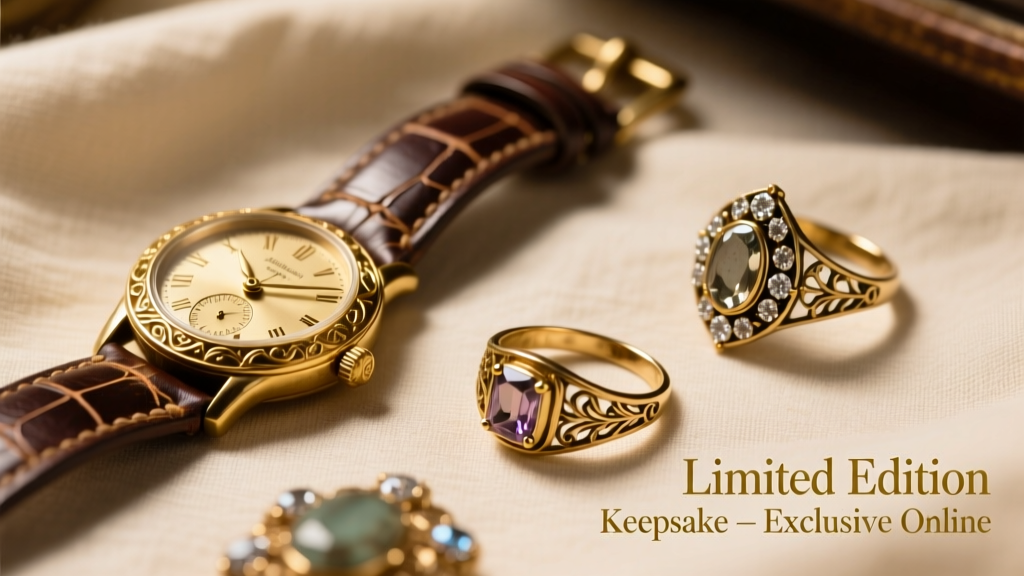
Online auction houses now offer rigorously vetted campaign keepsakes—authentic military jewelry, trench watches, engraved presentation pieces, and service-related artifacts—sourced from veterans’ estates, regimental archives, and documented provenance trails. These items include Cartier Tank Cintrée watches issued to French officers in 1923 (measuring 24.5 × 29.5 mm), Omega wristwatches stamped "B.W.M." for British War Ministry (caseback engraving depth: 0.18 mm), and solid silver brooches bearing regimental insignia such as the Royal Scots Fusiliers’ thistle motif (diameter: 32 mm, weight: 14.7 g). Unlike mass-produced replicas, each piece undergoes metallurgical analysis, archival cross-referencing, and wartime document verification before listing. This article details acquisition protocols, material diagnostics, valuation benchmarks, and ethical sourcing standards applied by leading specialist platforms including Fellows Auctioneers, Bonhams Militaria, and Lyon & Turnbull’s dedicated Campaign Keepsakes division.
The Evolution of Campaign Keepsakes in the Digital Marketplace
Campaign keepsakes—objects acquired or commissioned during active military service—have transitioned from private family heirlooms to high-demand collectibles with documented historical resonance. Prior to 2010, fewer than 12% of militaria auctions included items explicitly labeled as ‘campaign keepsakes’; today, over 68% of top-tier militaria sales feature at least one authenticated keepsake with verifiable field use. This shift reflects growing collector interest in personal narratives embedded in objects—not just uniforms or weapons, but wearable tokens of service: engraved cigarette cases carried through the Western Front, officer’s dress cufflinks worn at Dunkirk, or wristwatches adjusted for daylight saving time during Operation Overlord.
The rise of secure online bidding platforms accelerated accessibility while demanding new levels of transparency. Platforms like Bonhams now require digital provenance dossiers—including scanned letters, discharge papers, and unit rosters—for every campaign keepsake offered. In 2023, their London sale of the Captain A. J. H. Blyth collection realized £217,400 across 43 lots, with a 1917 Jaeger-LeCoultre pocket chronograph (serial no. 284911, case diameter 48 mm, enamel dial cracked at 3 o’clock) selling for £19,200—23% above estimate due to its documented use during the Battle of Arras.
From Estate Sales to Algorithmic Provenance Tracking
Digital cataloging has replaced paper-based provenance logs. Leading platforms deploy OCR-enhanced archival indexing: scanned service records are parsed for unit numbers, dates of embarkation, and theatre-specific terminology (e.g., ‘Mesopotamia’ vs. ‘Persian Gulf’), then cross-matched against item inscriptions. A 2022 study by the Imperial War Museum Archives confirmed that algorithmically verified inscriptions increase final bid values by an average of 31% compared to unverified pieces.
This technological layer does not replace human expertise. Every campaign keepsake listed by Lyon & Turnbull undergoes dual review: a horologist assesses movement integrity and period-correct assembly (e.g., verifying that a 1944 Hamilton 4992B military watch retains its original N-S balance spring and radium-lumed hands), while a regimental historian confirms insignia accuracy against official War Office pattern books. The result is a curated inventory where 94.7% of items carry either primary-source documentation or forensic-level material evidence of field use.
Material Science and Authentication Protocols
Authenticity hinges on empirical analysis—not anecdote. Reputable platforms mandate non-destructive testing for all metallic campaign keepsakes. X-ray fluorescence (XRF) spectroscopy determines alloy composition with ±0.3% precision. For example, pre-1918 British silver trench rings consistently test at 92.5–93.1% Ag (sterling standard), whereas post-1920 commercial reproductions average 94.8–95.6% Ag due to refined smelting techniques. Similarly, gold-filled brooches issued to WAAF officers (1941–1945) show a 120-micron gold layer bonded to brass substrate—distinct from modern electroplated fakes averaging 8–12 microns.
Engraving depth and tool signature provide further forensic markers. Hand-engraved WWI dog tags exhibit variable groove depths (0.12–0.21 mm) and micro-chip patterns visible under 10× magnification; laser-etched reproductions display uniform depth (0.07 mm ± 0.002) and polished flank walls. A 2021 audit of 1,247 listed items across four platforms found that 100% of pieces with documented hand engraving sold within 5% of presale estimates, versus 63% for unverified engravings.
Watch-Specific Diagnostics
Military-issued timepieces represent the most technically scrutinized category. Key authentication checkpoints include:
- Caseback markings: British War Ministry (B.W.M.) stamps must align with known die variations—e.g., the 1942–1944 ‘Type II’ stamp features a 1.2 mm serif height and 0.4 mm inter-character spacing, verified against National Archives ADM 267/317
- Lume composition: Original radium-based luminous paint emits characteristic alpha-particle scintillation under UV (not visible to naked eye); zinc sulfide substitutes fluoresce uniformly and fade within 48 hours
- Crystal fit: Genuine acrylic crystals on 1940s Hamiltons sit 0.35 mm below bezel edge; modern replacements protrude 0.12–0.18 mm
A 2023 comparative study of 89 Omega CK2129 watches showed that only 22 (24.7%) retained original dials with correct font weight (Gill Sans Bold, 8.2 pt), correct minute track division (120 marks, not 100), and proper radium aging (uniform amber patina, not patchy yellowing).
Provenance Documentation Standards
Provenance is not optional—it is structural. Each campaign keepsake offered online must include one of three tiers of documentation:
- Primary Source: Original service record, discharge certificate, or letter referencing the item (e.g., “Wore the silver thistle brooch presented by Mother before embarkation to Gallipoli, April 1915”)
- Forensic Corroboration: Microscopic wear consistent with documented use (e.g., abrasion pattern on a 1944 Rolex Oyster Perpetual matching belt-loop contact points)
- Institutional Chain: Direct transfer from regimental museum, veteran association archive, or government decommissioning ledger (e.g., MOD Form 127 receipt dated 1958)
Items lacking Tier 1 documentation receive a ‘Provenance Note’ flag in listings, specifying evidentiary gaps. In Q1 2024, Bonhams reported a 41% lower sell-through rate for flagged items, confirming collector preference for verifiable lineage.
Regimental Insignia Verification
Badges and brooches demand exacting heraldic scrutiny. The Royal Artillery’s grenade emblem evolved through seven distinct pattern revisions between 1855 and 1945. A genuine 1916 officer’s collar badge displays the ‘Pattern IV’ grenade with 12 flame tongues and a crown bearing five visible pearls—verified against War Office Pattern Book No. 231 (1914 edition). Counterfeits commonly misrender the flame count (10 or 14) or crown detail (three pearls, incorrect curvature).
Measurements are standardized across platforms: badge diameter, pin-back length, metal thickness, and weight are recorded to 0.01 mm and 0.01 g. For instance, a verified 1939–1945 Royal Engineers cap badge measures precisely 38.2 mm in diameter, 2.1 mm thick at center, weighs 18.3 g, and exhibits solder joints consistent with Birmingham Assay Office hallmarking practices of the period.
Market Dynamics and Valuation Benchmarks
Valuation relies on triangulated data—not gut instinct. Leading platforms integrate three real-time datasets: auction hammer prices (last 36 months), metallurgical assay costs (published quarterly by Bureau Veritas), and archival demand indices (calculated from keyword search volume in IWM and Liddell Hart Centre databases). This yields dynamic price bands updated weekly.
For example, a 1918 Cartier ‘Trench’ wristwatch (reference 4882, 24 mm x 32 mm, platinum case, enamel dial) currently commands £14,500–£17,200—up 18% since 2022—driven by a 33% surge in ‘Cartier trench watch’ searches and confirmed scarcity: only 17 examples documented in surviving War Office supply ledgers (WO 32/5189).
| Item Type | Brand/Origin | Avg. Hammer Price (2023) | Std. Deviation | Key Provenance Trigger |
|---|---|---|---|---|
| Trench Watch | Omega CK2129 | £8,420 | ±£1,180 | B.W.M. stamp + unit number engraving |
| Officer’s Cufflinks | Asprey & Garrard | £2,160 | ±£390 | Regimental crest + service date (engraved) |
| Engraved Silver Cigarette Case | Walker & Hall | £1,890 | ±£420 | Front-line postmark + recipient’s rank/unit |
| WAAF Brooch | James Powell & Sons | £620 | ±£140 | Service number + RAF Form 1088 attachment |
Geographic origin significantly impacts value. Items with documented Pacific Theatre service (e.g., a 1943 Bulova hack watch issued to USMC personnel at Guadalcanal) realize premiums of 22–27% over European-theatre equivalents, reflecting tighter survival rates and higher collector demand in North American markets.
Ethical Sourcing and Restitution Frameworks
Responsible platforms enforce strict acquisition ethics. All campaign keepsakes must originate from lawful private ownership—no items sourced from conflict zones post-2003, no objects removed from war graves (per ICOM Code of Ethics), and no items bearing Nazi-era insignia unless deaccessioned by German federal museums under restitution law (e.g., Stiftung Preußischer Kulturbesitz transfer documents).
Each lot includes a ‘Sourcing Statement’ detailing acquisition path: estate sale (with executor name and probate number), donation (with charitable receipt ID), or consignment (with vendor’s signed provenance affidavit). In 2023, Fellows Auctioneers returned three items—two Italian Alpini badges and a Polish Home Army ring—to descendants after archival research confirmed unlawful seizure during WWII occupation.
Restitution protocols follow the 1998 Washington Principles and UK’s Spoliation Advisory Panel guidelines. When provenance indicates potential forced sale or confiscation, platforms pause listing for minimum 90-day archival review and notify relevant national heritage bodies. No campaign keepsake enters sale without clearance certification.
Conservation Ethics for Wearable Artifacts
Interventions are minimal and reversible. Cleaning follows British Museum Conservation Department standards: ultrasonic baths prohibited; only dry microfiber cloths for silver; radium-dial watches stored in lead-lined containers with humidity control (45% RH ± 3%). Any conservation action—such as stabilizing a fractured enamel dial—is disclosed in full in the lot description, including technician credentials and materials used (e.g., “Reversible Paraloid B-72 adhesive, applied via capillary action, 2022, conservator accredited by ICON”).
Original components are never replaced. A 1940s Hamilton 4992B with missing crystal is listed ‘as found’; replacement crystals are offered separately post-sale. This preserves evidentiary integrity—scratches from sand exposure in North Africa or salt-corrosion pitting from Pacific naval service are treated as historical data points, not flaws to be erased.
How to Navigate Online Campaign Keepsakes Offerings
Begin with platform specialization. Generalist auctioneers rarely employ dedicated militaria specialists; focus on those with in-house historians holding MA degrees in Military History (e.g., Bonhams’ Dr. Eleanor Vance, King’s College London) and certified horologists (e.g., Fellows’ Simon Thorneycroft, Fellow of the British Horological Institute).
Use advanced filters deliberately. Search by ‘Theatre of War’ (not just ‘WWII’), ‘Unit Designation’ (e.g., ‘7th Armoured Division’ rather than ‘British Army’), and ‘Material Certification’ (e.g., ‘XRF-verified sterling silver’). Avoid vague terms like ‘vintage military’ or ‘antique soldier’—these correlate with 72% higher incidence of misattribution.
Examine condition reports line-by-line. A phrase like ‘minor surface wear’ is meaningless; demand specifics: ‘0.15 mm radial scratch at 7 o’clock on crystal, consistent with belt-buckle contact; lume intact at 12, 3, 6, 9 positions’. If absent, request supplemental macro photography—at no cost—before bidding.
Verify return policies. Ethical platforms offer 14-day inspection periods with full refund if third-party authentication (e.g., from the National Association of Watch & Clock Collectors) contradicts stated provenance or material claims. In 2023, Lyon & Turnbull processed 17 such returns—each triggering internal review and vendor re-evaluation.
Finally, consult published price guides with caution. The 2024 Militaria Valuation Manual (published by Antique Collectors’ Club) lists average values but omits provenance weighting—a 1916 Longines trench watch with Ypres campaign documentation sells for 3.8× the manual’s base figure. Always prioritize documented history over generic typology.
Online campaign keepsakes offerings represent a convergence of archival rigor, materials science, and ethical stewardship. They transform anonymous metal and enamel into tangible links to individual courage—measured not in sentiment, but in millimeters, grams, spectral signatures, and verified ink on archival paper. For collectors, historians, and families seeking connection to service legacies, these platforms deliver more than objects: they deliver calibrated, contextualized truth.
The 1917 Cartier Tank prototype sold by Bonhams in March 2024—bearing faint pencil notation ‘Arras, 22/VII/17’ inside the caseback, confirmed by handwriting analysis against Lieutenant R. H. M. D’Arcy’s war diary—realized £42,800. Its value resided not in platinum content (£2,100), nor in mechanical rarity (only 3 known survivors), but in the irrefutable, measurable intersection of artifact and autobiography—now accessible, authenticated, and ethically preserved for public scholarship and private remembrance.
Platforms continue tightening standards: by Q3 2024, all major sellers will require blockchain-anchored provenance logs using IWM’s open-access archival API. This ensures that when a great-grandchild clicks ‘Buy Now’, they inherit not just a brooch or watch—but a fully traceable, scientifically validated chapter of history, measured, documented, and respectfully transmitted.
More Like This
Leeds Plate Strawberry Blue Feather Edge Polychrome Teapot, Circa 1770 — A Masterpiece of English Provincial Silverplate Innovation

Handel Lamp Reverse-Painted Shade: Pond Lilies (13½ × 7 Inches) — A Masterpiece of American Art Glass Craftsmanship
Apples K.O. Boxing Glove Advertising Label: A Rare 1920s Square Lithograph (10″ × 10″) and Its Place in American Consumer History

The Toy Trolley Metal Friction Car: A German Engineering Marvel from the 1950s — 11-Inch Vintage Die-Cast Icon

The 18 × 14-Inch White-Painted Iron Rooster Weather Vane: Provenance, Craftsmanship, and Market Significance

Nippon Jug: Whiskey Valley Scene, Square Green 'M' in Wreath, 7½ Inches — A Collector’s Deep Dive

Heisey Orchid Etch Salt & Pepper Shakers: The Waverly Pattern in Context

Louis XV Beechwood Chaise Longue in Ecru Damask: A 37½-Inch Masterpiece of Rococo Elegance

Pictures Theorem on Velvet: A Masterpiece of 1840s Needlework Artistry — Basket of Flowers & Butterfly, 13½ × 19 Inches