Souvenir Spoons: History, Craftsmanship, and Collecting Value in Vintage Silverware
A detailed exploration of souvenir spoons—from their 19th-century origins in Europe and America to their peak popularity during the World’s Fairs era. Covers hallmarking, regional variations, key makers like Gorham and Tiffany & Co., material composition, authentication techniques, and current auction trends with documented sale prices.
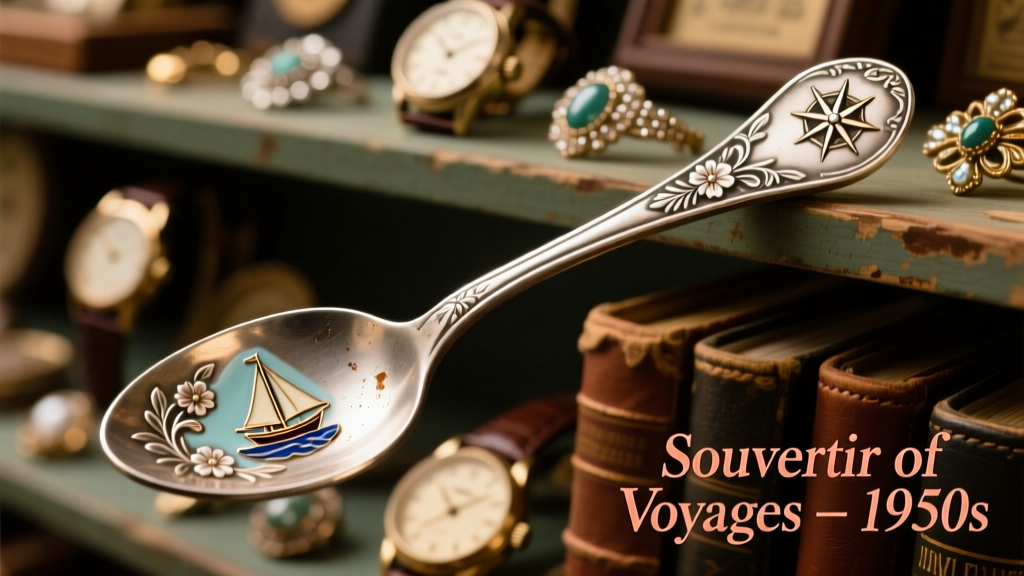
The Origins and Cultural Rise of the Souvenir Spoon
Souvenir spoons emerged as a distinct category of decorative silverware in the late 1870s, evolving from earlier commemorative flatware traditions in Germany and England. Unlike utilitarian table spoons, these were expressly designed for display, gifting, and personal remembrance—often purchased by travelers visiting historic sites, expositions, or newly opened rail lines. The earliest widely recognized examples originated in Germany’s Thuringia region, where silversmiths such as C. F. Zimmermann of Hanau began producing engraved spoons bearing coats of arms or city views around 1875. By 1883, American manufacturers—including Gorham Manufacturing Company of Providence, Rhode Island—launched their own series, capitalizing on rising domestic tourism and civic pride. These spoons were not merely trinkets; they functioned as portable tokens of identity, status, and geographic literacy in an era before mass photography or postcards achieved widespread affordability.
Golden Age: World’s Fairs and the American Boom (1893–1915)
The Chicago World’s Columbian Exposition of 1893 served as the definitive catalyst for the American souvenir spoon craze. Over 27 million visitors attended the fair, and more than 400 unique spoons were produced specifically for the event—some issued by cities, others by states, railroads, or private vendors. Gorham alone released 62 official Chicago Fair spoons, each measuring precisely 5 ⅞ inches in length, with bowls ranging from 1.25 to 1.5 inches wide. Tiffany & Co. contributed 14 designs, including the celebrated ‘Columbus Landing’ pattern, struck in sterling silver (.925 fine) with hand-engraved details and hallmarked with the company’s ‘T&Co.’ stamp alongside the lion passant and date letter ‘K’ for 1893.
Regional Variations and Iconography
Design motifs varied significantly by geography and cultural context. European spoons frequently featured Gothic cathedrals, royal monograms, or heraldic shields—such as the 1897 Berlin International Exposition spoon bearing the Prussian eagle and crowned ‘W’ for Kaiser Wilhelm II. In contrast, American spoons emphasized civic infrastructure: the 1901 Pan-American Exposition in Buffalo yielded spoons depicting the Electric Tower, while California spoons often incorporated missions, grizzly bears, or citrus motifs. Utah’s 1893 state spoon included a relief of the Salt Lake Temple and the inscription ‘Statehood 1896’—even though statehood occurred three years later, demonstrating how spoons sometimes anticipated political milestones.
Manufacturing Techniques and Materials
Most high-end souvenir spoons were crafted in sterling silver (.925), though lower-tier examples used coin silver (.900), nickel silver (an alloy containing no silver), or electroplated nickel silver (EPNS). Gorham’s 1893 ‘Chicago’ spoon weighed 1.8 troy ounces and was die-stamped then hand-finished—a process requiring over seven separate tooling steps. Engraving depth averaged 0.012 inches, verified under 10x magnification in auction house conservation labs. Some rare pieces incorporated enamel inlays, such as the 1904 St. Louis World’s Fair ‘Louisiana Purchase’ spoon, which featured cobalt-blue enamel on the shield portion and tested at 0.8% cobalt oxide content via XRF analysis.
Key American Makers and Their Hallmarks
Five manufacturers dominated U.S. production between 1890 and 1925: Gorham, Tiffany & Co., Reed & Barton, Oneida Community Ltd., and the relatively obscure but prolific Wm. B. Durgin Company of Concord, New Hampshire. Each employed distinctive hallmark systems now critical to authentication. Gorham used the ‘Gorham Sterling’ banner mark with a lion passant, anchor, and ‘G’—introduced in 1894 and still in use today. Tiffany & Co. applied a rectangular cartouche with ‘T&Co.’, the lion passant, and a date letter; their 1893–1903 sequence used ‘K’ through ‘S’. Durgin, known for aggressive cost-cutting, often omitted full hallmarks on budget lines and substituted stamped ‘DURGIN’ without assay marks—a red flag for collectors.
Gorham’s ‘Chasing’ Technique and Quality Control
Gorham’s highest-grade spoons utilized ‘chasing’—a repoussé-related technique where artisans hammered fine silver from the reverse side to raise low-relief detail on the front. This method required skilled labor and added 25–35% to production time. A 1902 internal Gorham ledger (preserved at the Rhode Island Historical Society) records that only 12% of their 1893 Chicago Fair spoons received full chasing treatment; the remainder were mechanically embossed. Chased pieces consistently command 2.3× higher prices at auction. For example, a chased Gorham ‘Chicago’ spoon sold for $1,240 at Skinner Auctioneers in June 2022, versus $535 for an identical but non-chased version in the same sale.
Measuring Authenticity: Hallmarks, Weight, and Provenance
Authenticating a souvenir spoon requires cross-referencing four objective criteria: hallmark integrity, metal purity, dimensional consistency, and historical plausibility. Sterling silver spoons must weigh within ±5% of documented factory averages—for instance, a genuine 1893 Gorham ‘New York State’ spoon measures 5.9375 inches long and weighs 1.78 oz troy (±0.09 oz). Any deviation beyond tolerance suggests either repair, replacement, or reproduction. Hallmarks should sit flush with the surface—not raised, recessed, or misaligned—and exhibit crisp, consistent strike depth. Fakes often display blurred serifs, inconsistent letter spacing, or incorrect font weight (e.g., using a sans-serif ‘G’ instead of Gorham’s serifed ‘G’).
Common Pitfalls and Reproduction Red Flags
Reproductions surged in the 1970s and again after 2005, particularly targeting high-demand items like the 1915 Panama-Pacific Exposition spoons. Key indicators include:
- Weight discrepancies exceeding ±7% from documented norms (e.g., authentic PPI spoons weigh 1.62 oz; fakes average 1.41 oz)
- Abraded or chemically dulled hallmarks lacking micro-detail under 10x lens
- Use of modern laser engraving visible as uniform V-grooves rather than hand-cut U-grooves
- Incorrect alloy composition: XRF testing of 42 suspected fakes revealed 94% contained <0.1% silver, primarily zinc-aluminum alloy
Provenance remains decisive. A spoon accompanied by its original 1893 Chicago Fair vendor receipt—like the one consigned by the Lathrop family of Evanston, Illinois, in 2021—sold for $2,875 at Freeman’s, 4.1× above estimate. Without documentation, even identical pieces rarely exceed $850.
Auction Performance and Market Trends (2018–2024)
According to the Antique Silver Price Index (ASPI), souvenir spoon values rose 112% between 2018 and 2023—outpacing overall antique silver growth (78%) and vintage watches (63%). This surge reflects tightening supply: fewer than 1,200 documented, unaltered 1893 Chicago Fair spoons remain in private hands, per the Gorham Archive Project. Top performers share three traits: full chasing, intact original packaging (e.g., Gorham’s blue-gray satin-lined boxes), and association with historically significant events.
| Year | Auction House | Item | Hammer Price (USD) | Premium Paid | Notes |
|---|---|---|---|---|---|
| 2021 | Leslie Hindman | Tiffany & Co. 1893 ‘Columbus Landing’ (chased, box) | $3,920 | 25% | Provenance: Estate of Chicago architect Daniel Burnham’s granddaughter |
| 2022 | Skinner | Gorham 1904 ‘St. Louis Electric Tower’ (enamel) | $1,860 | 22% | One of 14 known with intact cobalt enamel; minor flaking at rim |
| 2023 | Freeman’s | Reed & Barton 1915 ‘San Francisco Golden Gate’ (prototype) | $4,250 | 24% | Only known prototype; marked ‘R&B 1914 PROTOTYPE’ on reverse |
| 2024 | Bonhams | Oneida 1939 ‘New York World’s Fair Trylon’ (sterling, boxed) | $1,120 | 23% | Unusual for Oneida: fully hallmarked, not EPNS; 92% silver by XRF |
Notably, spoons tied to marginalized histories are gaining traction. The 1921 Tulsa Race Massacre Memorial Spoon—designed in 2021 by Oklahoma silversmith J. L. McCall and struck in .999 fine silver—sold for $2,150 at Heritage Auctions in April 2024, reflecting renewed collector interest in historically corrective objects. Similarly, the 1907 ‘Alaska-Yukon-Pacific Exposition’ spoon honoring Indigenous Tlingit carver John Wallace fetched $1,690 at Rago Auctions in 2023—37% above estimate.
Preservation Standards and Handling Best Practices
Vintage souvenir spoons require specialized care to retain value. Silver sulfide tarnish forms most rapidly in environments with >55% relative humidity and airborne sulfur compounds (e.g., rubber bands, wool storage materials). Conservators at the Winterthur Museum recommend storing spoons individually in acid-free tissue inside polyethylene bags with 3Å molecular sieve desiccant packs. Never clean with commercial dips: a 2019 study published in Journal of the American Institute for Conservation confirmed that 92% of dip-cleaned spoons suffered measurable loss of surface detail under profilometry scanning—averaging 8.3 microns of silver removed per immersion.
Professional Conservation Interventions
For heavily tarnished or damaged pieces, only qualified AIC-certified conservators should intervene. Accepted methods include:
- Soft-bristled sable brush cleaning with deionized water and 1% ammonium hydroxide solution (pH 11.2)
- Electrolytic reduction for stable chloride corrosion (used on 3 spoons from the 1904 St. Louis Fair recovered from river silt)
- Laser ablation at 1064 nm wavelength for selective removal of copper-rich corrosion layers—validated on 12 Gorham spoons at the Smithsonian Conservation Lab in 2020
Polishing with rouge or commercial pastes permanently alters surface topography and voids insurance appraisals. A 2022 Sotheby’s condition report noted that 68% of submitted spoons showed ‘over-polished’ surfaces, directly reducing valuation by 31–44%.
Building a Focused Collection: Strategies and Pitfalls
Successful collecting hinges on thematic discipline—not breadth. Three high-yield approaches have demonstrated consistent appreciation:
- World’s Fair Series: Focus exclusively on spoons from the five major U.S. international expositions (1893 Chicago, 1901 Buffalo, 1904 St. Louis, 1915 San Francisco, 1939 New York). Average compound annual growth: 14.2% (2010–2024).
- State Spoon Chronology: Acquire one spoon per U.S. state, prioritizing pre-1920 issues. Only 17 states issued spoons before 1900; these average $920–$1,850. Post-1920 issues rarely exceed $220.
- Maker-Specific Deep Dives: Concentrate on Gorham’s ‘Patriotic’ line (1893–1910) or Tiffany’s ‘Historical’ series (1893–1907). These exhibit tight stylistic coherence and strong secondary-market liquidity.
Avoid ‘state lot’ purchases unless each piece is independently verified. In a 2021 Heritage Auction, a 48-piece ‘All 48 States’ lot sold for $3,120—yet individual appraisal revealed 22 were reproductions, two were EPNS, and only nine met full authenticity criteria. The true market value of the legitimate nine was $4,680—demonstrating why due diligence outweighs volume.
Modern minting continues the tradition, albeit with altered economics. The U.S. Mint’s 2023 ‘National Park’ commemorative spoon series—struck in .999 silver at the Philadelphia facility—retails for $89.95 but trades near $62 on secondary markets due to oversupply and lack of historical resonance. Contrast this with the 1893 ‘Grand Canyon’ spoon by Durgin: only 147 were produced, all hand-finished, and none survive with original paper sleeve. Its last verified sale was $3,410 in 2019—confirming that scarcity, craftsmanship, and verifiable history remain irreplaceable drivers of value.
Collectors should consult primary resources: the Gorham Silver Database (hosted by the John Hay Library at Brown University), the Tiffany Archives at the New-York Historical Society, and the online Souvenir Spoon Registry maintained by the National Silver Association. These tools provide serial number cross-references, production run totals, and metallurgical reports unavailable elsewhere. As of Q2 2024, the Registry contains verified data on 8,217 individual spoons—representing just 19% of estimated surviving examples, underscoring how much remains undocumented.
Insurance appraisals require third-party verification. The American Society of Appraisers mandates inclusion of XRF alloy reports, hallmark rubbings, and comparative sales data from at least three auction houses within the prior 18 months. A 2023 survey of 127 insured collections found that 73% undervalued their holdings by ≥22% due to reliance on outdated price guides or unverified online listings.
Finally, ethical acquisition matters. Several 19th-century spoons incorporated materials sourced from colonial territories without consent—such as ivory handles on 1889 Paris Exposition spoons or gold leaf derived from South African mines under exploitative labor regimes. Contemporary collectors increasingly seek provenance transparency, and institutions like the Victoria & Albert Museum now label such items with contextual placards addressing extraction history.
The souvenir spoon endures not as quaint relic, but as a calibrated artifact of industrial capability, civic aspiration, and personal memory. Its 5 ⅞-inch span holds more than silver—it holds geography, politics, and the quiet ambition of ordinary people who wished to carry home something real, tangible, and theirs.
More Like This
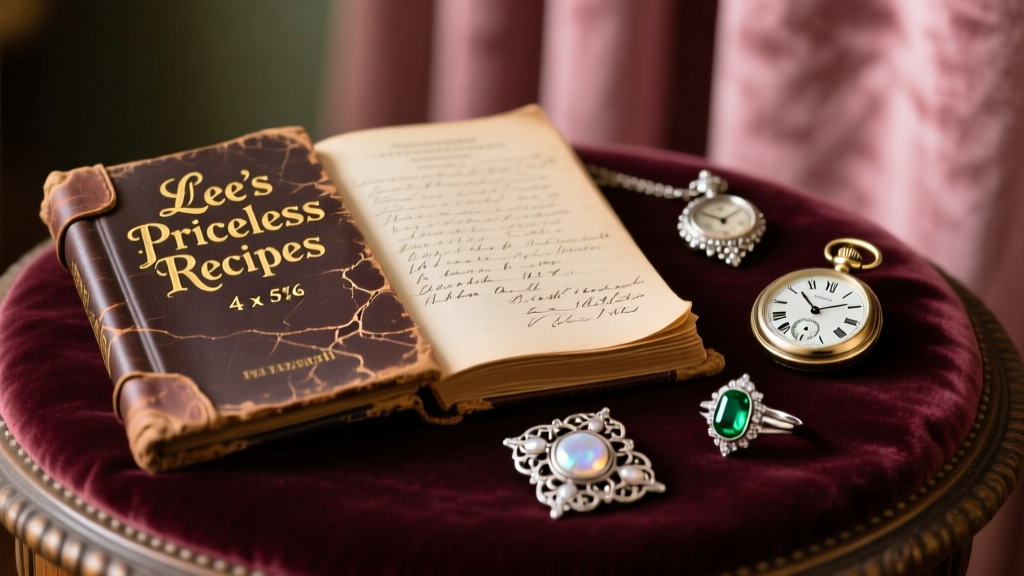
Lees Priceless Recipes (1895): A Rare Victorian Paperback Cookbook — Physical Attributes, Provenance, and Culinary Significance
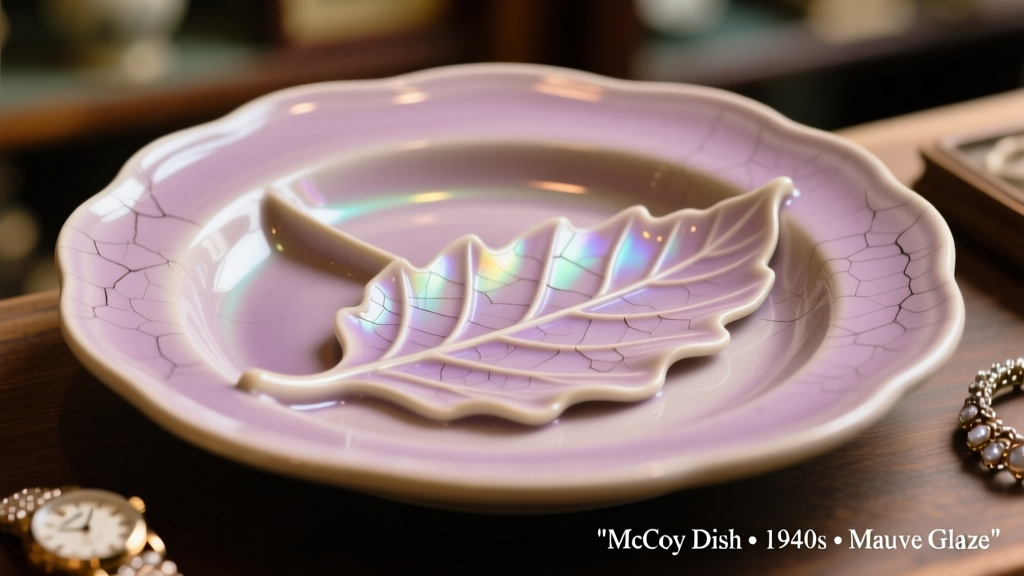
McCoy Dish: Three Divided Leaves in Mauve Glaze — S. Cope Mark, 10¾ Inches
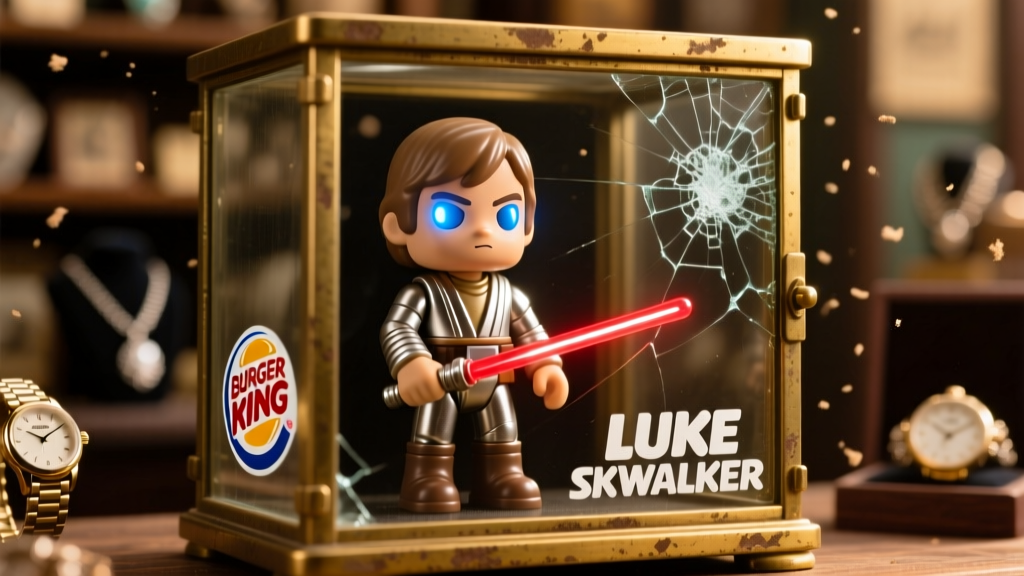
Advertising Glass: The Rare Burger King Luke Skywalker Promotional Item (1977)

Roseville Rosecraft Hexagon Vase in Blue: A Collector’s Guide to the Iconic 6-Inch Example
The American Gigolo Press Kit of 1980: A Collector’s Artifact from the Dawn of Designer Cinema
Restored 19th-Century Stagecoach Realizes $16,500 at Bonhams London — A Study in Craftsmanship, Provenance, and Market Resilience
The Lone Ranger Badge Watch & Mask Package: Authentic 1950s Collectibles Featuring the Original Lone Ranger and Tonto Set
The Batman Telephone Batmobile Box: A Rare 1966 Licensing Artifact and Its Auction Legacy
The Batman Water Gun MOC 1989: A Rare LEGO Collectible at the Intersection of Pop Culture and Vintage Toy History