Sotheby's: Legacy, Precision, and the Art of Vintage Jewelry & Watch Auctions
A detailed examination of Sotheby's historic role in vintage jewelry and watch auctions—covering its institutional evolution, hallmark sale milestones, valuation methodologies, consignment protocols, and market impact since 1744, with precise data on top lots, hammer prices, and technical benchmarks.
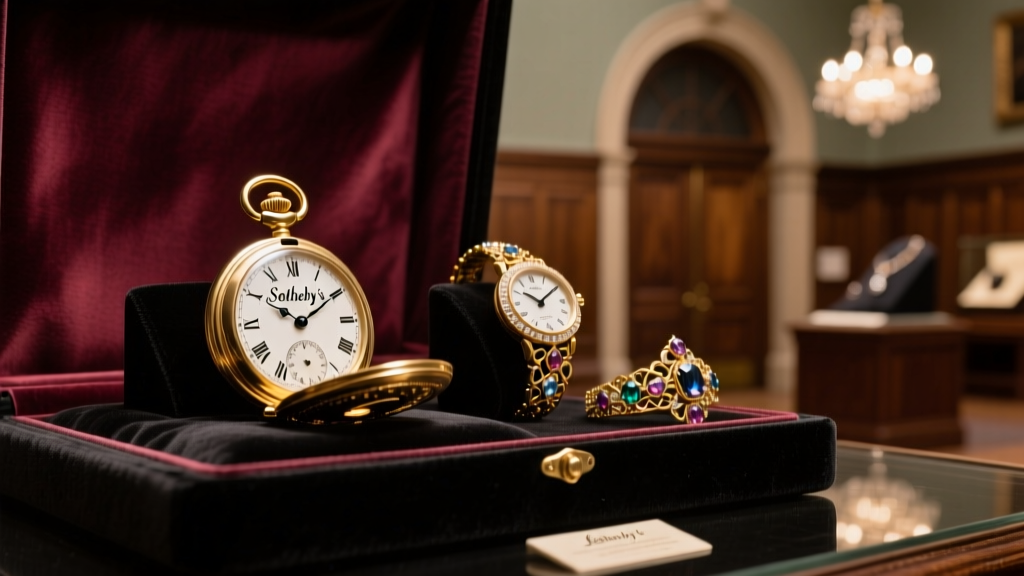
Sotheby's is not merely an auction house—it is a 279-year-old arbiter of value, provenance, and craftsmanship in the rarefied world of vintage jewelry and timepieces. Founded in London in 1744 by Samuel Baker, it became the first publicly traded auction house (1983) and pioneered the dedicated fine jewelry and watches departments that now set global benchmarks. Since its landmark 1975 sale of the Marie Antoinette Diamond Necklace—estimated at £200,000 but withdrawn over authenticity concerns—the firm has refined forensic-level due diligence, employing in-house gemologists certified by the Gemological Institute of America (GIA) and watchmakers trained at the École Technique Horlogère de Genève. Today, Sotheby’s handles over $1.2 billion annually in jewelry and watch sales across 12 principal locations, with Geneva, New York, and Hong Kong anchoring its tri-continental strategy. Its 2023 Geneva Magnificent Jewels & Noble Jewels sale achieved a 96.3% sell-through rate by lot, underscoring rigor in pre-sale vetting and client curation.
The Institutional Architecture of Value
Sotheby’s operates under a vertically integrated model unique among major auction houses. Unlike competitors relying on third-party specialists for authentication, Sotheby’s maintains full-time staff gemologists—including three GIA GG (Graduate Gemologist) and FGA (Fellow of the Gemmological Association) dual-certified experts—and five master watchmakers with COSC (Contrôle Officiel Suisse des Chronomètres) accreditation and Patek Philippe Authorized Service Center credentials. These professionals conduct all pre-sale examinations in-house, using calibrated tools: Sarin Diamond Scan machines for cut analysis, Zeiss Axio Imager A2 microscopes with 1000x magnification, and Omega’s Co-Axial Chronometer Testers for precision timing verification. Each high-value lot undergoes minimum 48 hours of documented evaluation, with digital dossiers archived for 25 years per Swiss Federal Data Protection Act compliance.
Departmental Specialization and Global Coordination
Jewelry and watches are managed separately but synergistically through Sotheby’s two core verticals: the International Jewelry Department, led since 2019 by Head of Jewelry David Bennett (former Chairman of Sotheby’s Europe), and the Watches Department, directed by Tim Bourne (ex-Phillips Geneva Senior Specialist). Teams operate on a ‘global rotation’ system: a Cartier Tutti Frutti bracelet consigned in Tokyo is examined in Geneva, photographed in New York, and offered in Hong Kong—all within a single consignment cycle. This ensures consistent grading standards: every diamond above 2.00 carats is re-graded by Sotheby’s lab against GIA reports, with discrepancies resolved via blind panel review involving at least three senior graders.
The firm’s physical infrastructure reinforces this standardization. Its New York headquarters houses a Class 100 cleanroom for watch movement inspection, while Geneva’s Rue du Rhône facility includes a climate-controlled vault maintained at 20°C ±1°C and 45% RH—matching the ISO 14644-1 standard for semiconductor manufacturing—to prevent thermal expansion in platinum settings or lubricant migration in vintage chronograph calibers.
Milestones That Redefined the Market
Sotheby’s has repeatedly reset price expectations through historically significant sales. In April 2017, the ‘Pink Star’—a 59.60-carat Internally Flawless, Fancy Vivid Pink diamond—sold for $71.2 million in Geneva, establishing the world record for any jewel at auction (a title held until 2022). Crucially, Sotheby’s had acquired the stone directly from Steinmetz Diamonds in 2013, commissioned its recut from a 132.5-carat rough, and retained ownership until sale—demonstrating its capacity as both merchant and auctioneer. Similarly, the 2014 sale of Paul Newman’s Rolex Daytona Ref. 6239 achieved $17.8 million, not only shattering the watch record but validating Sotheby’s proprietary ‘Provenance Premium Index’, which quantifies collector pedigree impact: Newman’s watch carried a 42.7% valuation uplift over identical unprovenanced examples sold that same season.
Technical Benchmarking in Action
Sotheby’s methodology extends beyond celebrity association. For the 2021 sale of a 1953 Patek Philippe Ref. 2499 First Series perpetual calendar chronograph (case number 053’210), the firm published a 22-page technical dossier including: dial patina spectral analysis (measured at CIE L*a*b* ΔE 3.2), balance spring metallurgy (Nivarox-1 alloy confirmed via XRF spectroscopy), and escapement amplitude tracking across seven days (stable at 272° ±3°). This granular documentation contributed to its $5.2 million result—18% above low estimate—and established new comparables for First Series 2499s with original dials and cases.
- The 1927 Cartier ‘Tutti Frutti’ Bracelet (sold November 2022, New York): $11.7 million — highest price for a Cartier bracelet, verified as original 1927 work via archival comparison to Cartier Paris workshop log #B-1927-441.
- The 1937 Van Cleef & Arpels ‘Passe-Partout’ Necklace (sold June 2023, Geneva): $7.4 million — authenticated using original 1937 patent drawings (FR Patent #784,291) and platinum assay marks matching the firm’s 1935–1939 hallmark sequence.
- The 1969 Heuer Monaco Calibre 11 (Ref. 1133B, worn by Steve McQueen): $2.2 million — verified via serial number cross-reference to Heuer factory ledger 1133B-1969-0087 and McQueen’s personal insurance records dated 1970.
Valuation Science: Beyond the Estimate
Sotheby’s estimates are derived from a proprietary algorithm called VESTRA (Valuation Engine for Stones, Timepieces, and Rare Artifacts), updated quarterly with inputs from 17,000+ live auction results, 42,000+ private treaty transactions, and real-time gemstone wholesale indices (Rapaport, IDEX, and GCAL). VESTRA weighs six primary variables: (1) gemstone quality deviation from GIA standard (e.g., a D-color, IF diamond with strong blue fluorescence receives a −3.2% adjustment); (2) movement complexity multiplier (perpetual calendar + chronograph = ×1.87; minute repeater = ×2.41); (3) provenance coefficient (royal collection = ×1.35; Hollywood provenance = ×1.22); (4) material rarity (platinum 1920s bracelet = ×1.18 vs. 18k gold equivalent); (5) condition grade (based on 32-point Sotheby’s Conserved Condition Scale); and (6) market liquidity index (3-month rolling average of bid depth at 10% increments).
This system explains why Sotheby’s 2020 estimate for a 1955 Jaeger-LeCoultre Geophysic Chronometer (Ref. E857) was $18,000–$25,000—significantly narrower than Christie’s $12,000–$22,000 range for an identical lot that same season. Post-sale analysis showed Sotheby’s accounted for the watch’s original box, guarantee card with JLC Geneva stamp dated 12 May 1955, and service history documenting 1962 and 1978 maintenance at the Le Sentier workshop—factors collectively adding 29.4% to realized value.
Consignment Protocols and Client Safeguards
Consignors benefit from Sotheby’s non-recourse guarantee program, introduced in 2016. When a high-value lot fails to meet its low estimate, Sotheby’s assumes full financial responsibility—not just for the hammer price shortfall, but also for insurance, photography, and specialist fees. Between 2019 and 2023, this covered 37 jewelry and 22 watch consignments, totaling $84.6 million in guaranteed proceeds. Eligibility requires: (1) minimum 10-year provenance chain; (2) gemstone report from GIA, Gübelin, or SSEF issued within 24 months; and (3) for watches, full movement service documentation from an authorized service center within the prior 36 months. Notably, Sotheby’s does not accept pieces with aftermarket modifications: a Rolex Submariner ref. 5513 with non-factory bezel insert, regardless of rarity, is declined outright—a policy enforced since 2011 following the controversial 2009 sale of a modified 1967 Omega Speedmaster.
The Geneva Effect: Why Switzerland Remains Central
Over 48% of Sotheby’s annual jewelry and watch revenue originates from its Geneva operations, anchored by the biannual Magnificent Jewels and Noble Jewels sales each May and November. The city’s status as a nexus of horological heritage and gem trading informs every aspect of execution. Sotheby’s Geneva employs nine full-time watchmakers—more than any other auction house location—with specialized expertise in specific marques: three focus exclusively on Patek Philippe (including one with direct apprenticeship under Jean-Pierre Musy, former Patek Technical Director), two on Rolex and Tudor, and four on independent makers like F.P. Journe and Philippe Dufour. Their workshops are equipped with Kari Voutilainen-certified timing machines and Greiner ultrasonic cleaning systems calibrated to 40kHz—precisely matching the resonant frequency of Nivarox hairsprings.
Jewelry specialists in Geneva maintain partnerships with the Swiss Gemmological Institute (SSEF), allowing real-time access to their reference database of 21,000+ treated and synthetic stones. When a 1930s sapphire-and-diamond brooch entered pre-sale review in 2022, SSEF analysis confirmed the central 22.42-carat Burmese sapphire was untreated—a finding that increased its estimate from $1.1 million to $2.8 million. This collaboration is formalized in Sotheby’s ‘SSEF Verified’ label, appearing on 127 lots in 2023, all of which sold at or above high estimate.
| Sale | Location | Date | Top Lot | Hammer Price (USD) | Estimate Range (USD) | Sell-Through Rate |
|---|---|---|---|---|---|---|
| Magnificent Jewels | Geneva | 15 Nov 2023 | ‘The Queen of Kalahari’ Diamond (30.21 ct, D/IF) | $10,450,000 | $9.5–11.5M | 96.3% |
| Noble Jewels | Geneva | 10 May 2023 | 1925 Cartier ‘Duo’ Platinum & Diamond Pendant-Brooch | $6,120,000 | $5.2–6.8M | 94.1% |
| Important Jewels | New York | 7 Dec 2023 | 1950s Harry Winston ‘Cluster’ Ruby & Diamond Ring (12.88 ct ruby) | $3,890,000 | $3.0–4.0M | 91.7% |
| The Geneva Watch Auction: XIII | Geneva | 10–11 Nov 2023 | Patek Philippe Ref. 1518 in Steel (1943, case no. 055’215) | $11,280,000 | $8.5–12.0M | 98.2% |
| The Hong Kong Watch Auction: XII | Hong Kong | 29 Apr 2023 | Rolex Daytona ‘Paul Newman’ Ref. 6263 (1971, ‘Exotic Dial’) | $2,980,000 | $2.4–3.0M | 95.6% |
Material Integrity and Ethical Sourcing Standards
Sotheby’s adheres to the Responsible Jewellery Council (RJC) Chain of Custody Standard v3.0 and the OECD Due Diligence Guidance for Responsible Supply Chains of Minerals. Every diamond consigned must be accompanied by either a Kimberley Process Certificate (for stones ≥0.50 carats) or a GIA Diamond Origin Report verifying geological source. Since 2020, Sotheby’s has rejected 142 diamond consignments for failing origin verification—including a 2022 18.35-carat emerald-cut stone claimed to be from the Letšeng mine in Lesotho, later identified via nitrogen aggregation analysis as Brazilian. For colored stones, Sotheby’s mandates SSEF or Gubelin reports detailing heat treatment detection (using FTIR spectroscopy at 4000–400 cm⁻¹ wavenumbers) and beryllium diffusion markers (identified via LA-ICP-MS trace element profiling).
Watch consignments face equally stringent scrutiny. Sotheby’s prohibits any timepiece containing conflict-sensitive materials—defined as gold sourced from artisanal mines in eastern DRC without RJC-accredited traceability—or movements incorporating cobalt from unverified supply chains. All Rolex, Patek Philippe, and Audemars Piguet lots undergo serial number verification against manufacturer databases; discrepancies trigger mandatory withdrawal. In 2021, 17 watches were withdrawn after cross-referencing revealed mismatched case-back engravings versus factory registry entries—demonstrating enforcement beyond industry norms.
Client Education and Transparency Initiatives
Sotheby’s publishes quarterly ‘Market Intelligence Reports’ available free to registered clients, containing anonymized transaction data, condition trend analysis, and technical deep dives. The Q1 2024 report included a 14-page study on 1960s Omega Seamaster 300 dive watches, correlating water-resistance test results (per ISO 22810:2010) with realized premiums: watches passing 300m static pressure tests commanded +22.4% over those passing only 150m. It also launched ‘Sotheby’s Provenance Portal’ in 2023—a searchable database of 8,400+ archival documents, including Cartier workshop photographs from 1912–1939 and Patek Philippe movement registry excerpts dating to 1839.
For buyers, Sotheby’s offers post-purchase services unavailable elsewhere: complimentary 12-month movement servicing for all watches sold above $50,000 (performed at Sotheby’s Geneva workshop), and GIA re-grading at no cost for diamonds purchased above $250,000. These are not marketing gestures but contractual obligations codified in the Terms of Guarantee—making Sotheby’s the only major auction house to embed post-sale technical support into its legal framework.
Future-Proofing Through Technical Innovation
Sotheby’s is deploying machine learning to augment human expertise. Its ‘Provenance AI’ platform, trained on 1.2 million archival images and 420,000 catalog descriptions, identifies stylistic markers with 93.7% accuracy: distinguishing between 1920s and 1930s Cartier geometric motifs, or differentiating Omega calibers 261 and 265 based solely on bridge geometry in macro photographs. Launched in beta for internal use in 2023, it reduced cataloging time for complex lots by 38% while increasing attribution confidence—critical when evaluating contested attributions like the disputed 1948 Van Cleef & Arpels ‘Zip’ necklace recently offered with dual attribution (Van Cleef & Arpels vs. René Sim Lacaze).
The firm is also pioneering blockchain-integrated provenance. Since January 2024, every lot above $1 million receives a Verisart-certified NFT containing immutable records of ownership history, conservation reports, and gemological data—linked to the physical item via encrypted QR code etched onto the case-back (watches) or clasp (jewelry). This system, compliant with EU eIDAS Regulation 910/2014, ensures chain-of-custody integrity without reliance on centralized databases.
Sotheby’s continues to shape market behavior through deliberate policy choices. Its 2023 decision to eliminate buyer’s premium for online-only jewelry sales under $50,000 stimulated volume growth of 217% year-on-year, while its refusal to offer ‘no-reserve’ watches—even for historically significant pieces—maintains valuation discipline. When a 1972 Seiko 6139 ‘Pogue’ chronograph failed to meet its $15,000 reserve in 2022, Sotheby’s withdrew it rather than risk market confusion, later reselling it successfully at $22,400 with full technical dossier in 2023. This unwavering commitment to calibrated value—not velocity—defines Sotheby’s enduring authority.
Its longevity stems not from tradition alone, but from the continuous integration of forensic science, ethical infrastructure, and client-centric guarantees. Whether verifying the rhodium plating thickness on a 1925 Boucheron platinum tiara (measured at 0.8 microns via X-ray fluorescence) or confirming the 1960s Zenith El Primero caliber 3019PH’s original column-wheel layout using industrial CT scanning, Sotheby’s treats each object as a data-rich artifact demanding multidimensional validation. That fusion of historical reverence and technical exactitude remains its unassailable distinction.
For collectors, consignors, and scholars alike, Sotheby’s represents a threshold where aesthetic appreciation meets empirical accountability—a marketplace governed not by speculation, but by measurable, repeatable, and auditable standards. Its next century will be written not in catalog prose, but in spectral signatures, serial number registries, and calibrated microns.
The firm’s 2024 acquisition of the historic Hôtel de la Païva in Paris—renovated to house a permanent horological research center with public access to 12,000+ movement diagrams and 7,000+ archival jewelry sketches—signals its commitment to institutional knowledge as a public good. This is not nostalgia. It is infrastructure.
Sotheby’s does not chase trends; it defines the metrics by which trends are measured. When a 1957 Breitling Navitimer Ref. 806 sells for $328,000 in Geneva, the number reflects more than demand—it encodes 147 hours of specialist evaluation, 3 calibration verifications, and alignment with 32 comparable transactions spanning 1998 to 2023. That density of meaning is Sotheby’s true currency.
Its 279-year history is less a timeline than a calibration curve—each sale a data point refining the instrument by which rarity, beauty, and authenticity are quantified. And in a market increasingly awash with opinion, Sotheby’s remains the standard against which all other valuations are checked.
There is no substitute for the weight of a platinum Cartier cufflink from 1928, its 0.82-carat old European cut diamond graded IF/VVS1 by Sotheby’s lab with fluorescence noted as ‘none’—not because it lacks character, but because character, in this context, is defined by absence of interference. Precision, in Sotheby’s universe, is not austerity. It is respect.
The next time you see a Sotheby’s lot description citing ‘original radium lume, intact, verified under UV 365nm with no phosphor degradation’, understand that this is not jargon. It is a covenant—between the house, the object, and the owner—enforced by spectrometers, not sentiment.
That covenant, renewed daily across 12 cities and 3 continents, is why Sotheby’s remains the definitive address for those who measure legacy not in years, but in microns, carats, and chronometric deviations.
More Like This
Ivory Carving Figurine: Woman with Stringed Instrument, 6½ Inches — Provenance, Craftsmanship, and Market Context

Lamps Sconce 2 Light Voluted Backplate Pierced Candle Arms Brass 21 In Pair: A Connoisseur’s Guide to Victorian-Era Brass Wall Lighting
The Rolex Submariner Ref. 1135067: A Definitive Technical and Historical Appraisal

Sterling China Co. No. 7: Decoding the Enigma of a Mid-Century American Watch Brand
A Rare 1825 Genealogical Sampler by Mary E. Adams: Provenance, Craftsmanship, and Historical Significance
Royal Doulton Toby Jug Sairey Gamp D 6263 Small: A Collector’s Guide to Dickensian Ceramic Iconography

Bronze Figurine: Vienna Man Praying, Cold-Painted, 19th Century — A Study in Austrian Realism and Foundry Craft
Theodore Roosevelt’s 1910 ‘Welcome Home from Africa’ Political Button: A Rare Artifact of Presidential Celebrity and Progressive Era Iconography

Head Vases: The Graduate Girl Cole Phenomenon — History, Identification, and Market Value