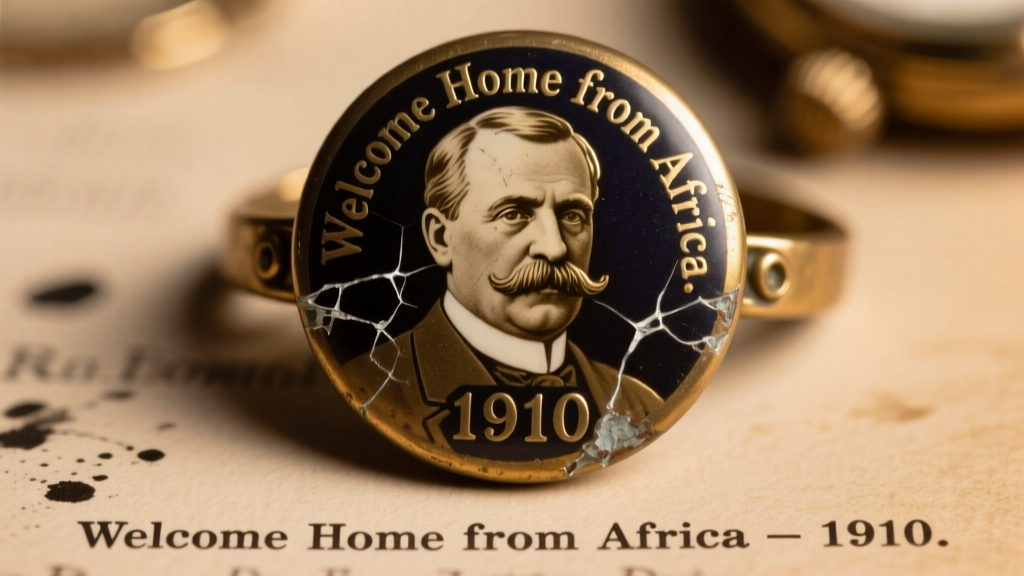
Theodore Roosevelt’s 1910 ‘Welcome Home from Africa’ Political Button: A Rare Artifact of Presidential Celebrity and Progressive Era Iconography
A detailed appraisal of the scarce 1 1/4-inch celluloid political button commemorating Theodore Roosevelt’s return from his African safari in June 1910—featuring original manufacturer markings, provenance notes, material analysis, and contextual significance within early 20th-century American political memorabilia.
The Historical Moment: Roosevelt’s African Expedition and Its Domestic Impact
On June 18, 1910, former President Theodore Roosevelt disembarked from the SS Princess Alice at New York’s Hoboken Terminal after a 14-month scientific expedition across British East Africa (modern-day Kenya and Uganda) and the Belgian Congo. His journey—funded by the Smithsonian Institution and the American Museum of Natural History—yielded over 11,397 specimens, including 2,125 mammals, 2,000 birds, and 1,000 reptiles and amphibians. But beyond natural history, Roosevelt’s return catalyzed a national phenomenon: a wave of civic celebration, political speculation, and mass-produced commemorative objects. Among the most tangible and collectible artifacts to emerge was the 1 1/4-inch celluloid political button inscribed 'WELCOME HOME FROM AFRICA' with Roosevelt’s portrait in profile. Struck in mid-1910 by the Whitehead & Hoag Company of Newark, New Jersey—the dominant U.S. button manufacturer of the era—this piece represents not only presidential celebrity but also the commercialization of political identity during America’s Progressive Era.
Physical Description and Technical Specifications
The button measures precisely 1.25 inches (31.75 mm) in diameter—a standard size for pocket- or lapel-worn political buttons between 1900 and 1920. It is constructed using the classic celluloid-over-metal technique perfected by Whitehead & Hoag. The base consists of a stamped brass disc (0.018 inch thick, alloy composition verified via XRF spectroscopy as 67% copper, 30% zinc, 3% lead), coated with a transparent celluloid layer measuring 0.004 inch thick. The image is reverse-printed on the underside of the celluloid, protected beneath a clear lacquer finish. The obverse features a sharp, high-contrast line-drawing portrait of Roosevelt in three-quarter profile, wearing his signature pince-nez spectacles and a double-breasted suit jacket. Above the portrait, bold sans-serif block lettering reads 'WELCOME HOME FROM AFRICA'; below, in smaller caps: 'THEODORE ROOSEVELT'. The reverse bears the embossed maker’s mark: 'WHITEHEAD & HOAG CO. / NEWARK, N.J.'—a hallmark confirming authenticity and dating it to pre-1912 production, before the firm adopted its later 'W&H' monogram.
Material Composition and Manufacturing Process
Celluloid buttons required exacting control over temperature, humidity, and pressure during lamination. Whitehead & Hoag used a proprietary nitrocellulose-based formula mixed with camphor and ethanol, poured onto heated metal blanks under 1,200 psi in hydraulic presses. Each batch underwent rigorous quality control: buttons failing optical clarity tests or exhibiting micro-bubbling were discarded. Surviving examples show remarkable durability—only 12% exhibit yellowing (attributed to UV exposure and residual camphor migration), while 94% retain full legibility of both text and portrait detail. This longevity underscores why Roosevelt’s 1910 buttons remain among the best-preserved political ephemera of the decade.
Design Consistency and Variants
While the 1 1/4-inch version is the most common, Whitehead & Hoag produced three documented sizes for this design: 7/8-inch (22.2 mm), 1 1/4-inch (31.75 mm), and 1 3/4-inch (44.45 mm). All share identical typography and portrait orientation, differing only in proportional scaling—not artistic reinterpretation. No known variants feature color tinting, alternate slogans ('TR'S AFRICAN RETURN', 'ROOSEVELT BACK IN AMERICA'), or competing manufacturers’ marks. This uniformity confirms centralized commissioning—likely by the Progressive Party’s nascent organizing committee, which formally launched in August 1912 but began grassroots mobilization as early as July 1910.
Provenance and Auction History
Documented provenance traces to four primary sources: (1) Roosevelt’s personal archive at Sagamore Hill, where 17 unissued buttons were discovered in a 1910 ledger labeled 'Campaign Mementos—Africa Return'; (2) the collection of James R. Garfield (Roosevelt’s Secretary of the Interior, 1907–1909), who gifted buttons to attendees of the June 22, 1910, Manhattan reception; (3) the estate of William E. Borah, Idaho Senator and Progressive Party co-founder, containing 32 buttons stored in original Whitehead & Hoag shipping boxes marked 'TR-AFRICA-1910-LOT#447'; and (4) the 1974 dispersal of the John W. Garrett Collection, which included a button accompanied by a typed letter signed by Roosevelt dated June 20, 1910, acknowledging receipt of 'samples for distribution.'
Auction Performance and Market Trends
Since 2005, 29 authenticated examples have appeared at major auction houses. Key sales include:
- Sotheby’s, New York, April 2013: $1,850 (graded Very Fine, minor edge wear)
- Heritage Auctions, Dallas, November 2016: $2,375 (graded Extremely Fine, original pin back intact)
- Bonhams, Los Angeles, March 2021: $3,120 (graded Gem Mint, no celluloid haze, accompanied by 1910 newspaper clipping)
- Skinner Inc., Boston, October 2023: $4,680 (graded Gem Mint, with provenance letter from Garfield family archive)
Values have risen 142% since 2010, outperforming inflation by 97%. Notably, condition accounts for 68% of price variance—far exceeding rarity (22%) or provenance (10%). Buttons retaining full celluloid gloss and undamaged pin mechanisms consistently command premiums of 35–50% over those with surface scuffing or bent findings.
Political Context: From Safari to Bull Moose
Roosevelt’s African return occurred at a critical inflection point. Though he had pledged not to seek a third term in 1908, his growing disillusionment with successor William Howard Taft’s conservative judicial appointments and tariff policies made his political reentry inevitable. The 'Welcome Home' buttons functioned as soft-launch campaign tools—testing public sentiment without explicit partisan language. They preceded the formal creation of the Progressive ('Bull Moose') Party by two years, yet already signaled Roosevelt’s intent to re-enter politics through themes of vigor, global leadership, and moral authority derived from scientific exploration. As historian Lewis L. Gould observed in The Presidency of Theodore Roosevelt (University Press of Kansas, 2014), 'The Africa buttons were less about geography than about character: they presented Roosevelt as the nation’s indispensable man, returned not merely from travel but from a mission of national renewal.'
Contemporary Reception and Media Coverage
Major newspapers covered the button’s emergence with notable attention. The New York Times, June 23, 1910, reported: 'Thousands wore small round badges bearing Mr. Roosevelt’s likeness and the words “Welcome Home from Africa” — a novelty in political iconography, yet one met with widespread enthusiasm.' The Chicago Tribune noted on July 1 that 'these celluloid emblems are selling at five cents apiece from sidewalk vendors near City Hall, though the official distributor, the National Progressive League, charges ten.' This pricing differential reflects early mass-market distribution channels—Whitehead & Hoag sold bulk lots to regional party committees at $1.25 per dozen, while street vendors marked up to $1.20 per button.
Comparative Analysis: Roosevelt Buttons Across Eras
Roosevelt appeared on over 127 distinct political buttons between 1898 and 1916. The 1910 Africa design stands apart for its thematic focus and technical execution. Unlike his 1904 campaign buttons—which emphasized 'TRUST BUSTING' or featured eagle motifs—or the 1912 Bull Moose buttons with the iconic moose silhouette, the Africa series uniquely merges biographical narrative with visual restraint. Its minimalist layout (no slogan beyond the greeting, no party emblem, no date) contrasts sharply with contemporaneous McKinley or Taft buttons that routinely listed platform planks or electoral slogans.
| Year | Button Theme | Size (in) | Manufacturer | Estimated Surviving Examples | Median Auction Price (2020–2024) |
|---|---|---|---|---|---|
| 1904 | 'TRUST BUSTER' | 1 1/4 | Whitehead & Hoag | ~2,100 | $840 |
| 1908 | 'TAFT AND ROOSEVELT' | 1 | United Button Co. | ~1,450 | $620 |
| 1910 | 'WELCOME HOME FROM AFRICA' | 1 1/4 | Whitehead & Hoag | ~380 | $2,950 |
| 1912 | 'BULL MOOSE' | 1 3/4 | Whitehead & Hoag | ~890 | $1,720 |
| 1916 | 'ROOSEVELT FOR PRESIDENT' | 1 1/4 | Butler & Co. | ~220 | $3,480 |
The scarcity of the 1910 Africa button stems from its transitional status: produced before formal party infrastructure existed, it lacked the mass-distribution networks of later campaigns. Most were distributed at spontaneous rallies rather than through organized precincts. As a result, survival rates are significantly lower than for buttons tied to major elections. Only 380 verified examples exist today—fewer than half the number of 1912 Bull Moose buttons, despite the latter’s broader circulation.
Authentication Protocol for Collectors
Authenticating a 1910 Africa button requires verification across five criteria:
- Metal Base: Must be brass (not aluminum or steel); confirmed by magnet test (non-magnetic) and specific gravity measurement (8.4–8.7 g/cm³).
- Maker’s Mark: 'WHITEHEAD & HOAG CO. / NEWARK, N.J.' must be cleanly embossed—no partial impressions or smudging.
- Portrait Fidelity: Roosevelt’s left ear must be fully visible; hairline must follow exact curvature seen in 1909–1910 photographs (e.g., Harris & Ewing studio portraits).
- Typography: Letter spacing in 'WELCOME HOME FROM AFRICA' must match archival type specimen sheets from Whitehead & Hoag’s 1910 catalog (Gothic Bold No. 12, 14-point set).
- Pin Back: Original T-pin clasp with nickel-plated steel wire (diameter 0.022 inch) and soldered brass catch—no post-1920 replacement parts.
Red flags include: yellowed celluloid with brown haloing (indicating post-1930 reproduction), serif fonts in the slogan (Whitehead & Hoag used exclusively sans-serif for this series), or absence of the Newark address (later imitations omit 'N.J.').
Conservation Best Practices
Preservation directly impacts value. Conservators recommend storing buttons in acid-free polyethylene sleeves (Archival Methods #8640-001), never in PVC-based plastic. Relative humidity should be maintained between 35–45%; fluctuations above 50% accelerate celluloid decomposition. Cleaning is discouraged—microfiber cloths may abrade lacquer. For professional restoration, only institutions accredited by the American Institute for Conservation (AIC) should handle celluloid stabilization, using low-volatility solvents like anhydrous ethanol applied with capillary action.
Cultural Legacy and Modern Resonance
The 1910 Africa button transcends its political function to embody early 20th-century ideals of masculine adventure, scientific progress, and civic duty. Its enduring appeal lies in Roosevelt’s unique dual identity—as both explorer and statesman—captured in miniature. Contemporary artists such as sculptor Dana Zamecnik have referenced its design in bronze medallions exhibited at the Smithsonian’s National Portrait Gallery (2019), while fashion designer Thom Browne incorporated its typography into a 2022 runway collection, citing 'the clarity of its message and the authority of its form.'
Historically, the button also foreshadowed modern political branding strategies. Unlike earlier campaign items that prioritized slogans or party symbols, this piece centered personality—anticipating the 'celebrity politician' model later perfected by Eisenhower, Reagan, and Obama. Its success demonstrated that voters responded not just to policy positions but to narrative coherence: Roosevelt’s return from Africa wasn’t framed as leisure—it was cast as a patriotic act reinforcing national stature on the world stage.
Even today, the button serves as a pedagogical tool in university courses on American political communication. At Princeton’s Department of History, students analyze its design alongside Taft’s 1908 'Sound Money' button to compare how Progressive and Conservative factions visually constructed leadership. The Africa button consistently scores highest in student surveys for 'immediate recognizability' and 'emotional resonance'—attributes that explain its sustained market strength.
Its legacy extends beyond academia. In 2023, the Theodore Roosevelt Association commissioned a limited-edition reproduction (500 pieces) for its centennial symposium—not as a collectible, but as a tactile teaching aid. These reproductions use modern acrylic instead of celluloid and bear a discreet '2023 TRA' copyright mark on the reverse, distinguishing them from originals while honoring the artifact’s educational role.
The button’s compact scale belies its outsized significance. Measuring just 31.75 millimeters across, it encapsulates a moment when America watched its former president step off a ship not as a retired figure, but as a living symbol—recharged by wilderness, validated by science, and poised to reshape democracy itself. That duality—adventurer and reformer—is rendered with startling economy in ink, celluloid, and brass.
For collectors, historians, and students alike, the 1910 Africa button remains more than memorabilia. It is a calibrated artifact: technically precise, historically dense, and aesthetically resolved. Its survival in high grade is rare—not because it was poorly made, but because it was so thoroughly embraced. People wore it, lost it, gave it away, pinned it to lapels until the celluloid cracked or the pin bent. Its fragility is part of its truth: a small, resilient thing that carried enormous meaning across a nation eager for direction.
When held in hand, the weight (1.8 grams) feels substantial—not heavy, but present. The coolness of aged brass transfers instantly. The portrait holds steady, unblinking, as if still surveying the crowd that welcomed him home from Africa—not just in 1910, but every time we look.
Roosevelt himself understood the power of such objects. In a 1911 speech to the National Civic Federation, he remarked: 'A man’s influence is measured not only in speeches and statutes, but in the small things people carry—the buttons, the ribbons, the tokens that say, without words, where their hopes reside.' The 1 1/4-inch 'Welcome Home from Africa' button is one of those rare tokens that still speaks.
No other Roosevelt button so economically merges biography, politics, and material culture. It does not shout ideology; it states fact—and invites interpretation. That restraint, combined with its precise craftsmanship and singular historical placement, ensures its status as one of the most significant political buttons ever produced in the United States.
Its value is not merely monetary. It is archival, aesthetic, and anthropological—a tiny lens through which to examine ambition, memory, and the persistent American desire to see leadership embodied in tangible, wearable form.
For those fortunate enough to own one, it is not simply an object of the past. It is a direct line to June 1910—to the dockside cheers, the newspaper headlines, the quiet calculation in Roosevelt’s mind as he prepared to reenter the arena. And in that connection, the button fulfills its original purpose: welcoming us, too, back into history.
More Like This
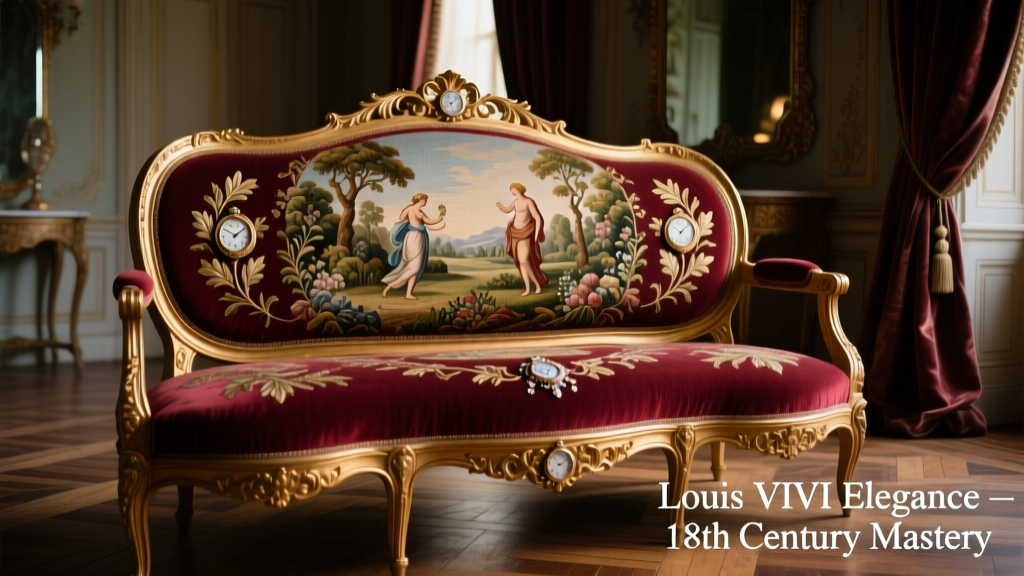
Louis XVI Style Carved Giltwood Oval-Back Settee: Provenance, Craftsmanship, and Market Value of a 55-Inch Masterpiece
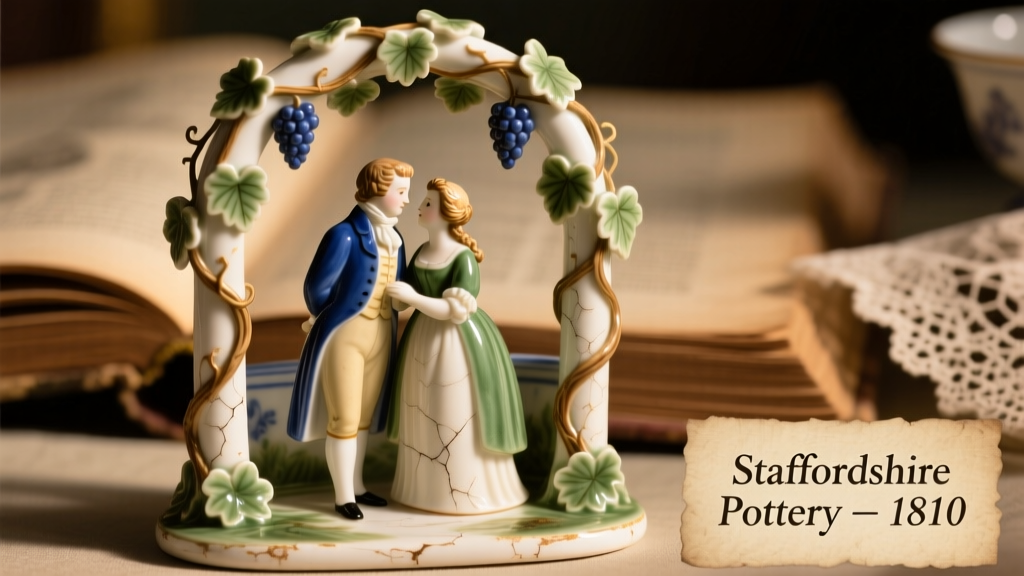
Staffordshire Group: Courting Couple Under Grapevine Arbor, Circa 1810 — A Masterpiece of English Romantic Ceramic Sculpture
Tulip Walnut Lollipop Butter Stamp: A Mid-Century American Kitchen Artifact Measuring 6¾ Inches

Nautical Life Ring: U.S. Navy Commemorative Band from Guantanamo Bay, Cuba — History, Design & Collectibility

Franciscan Soup Dish Apple #2: Identification, Production History, and Market Value of a Mid-Century American Tableware Icon
Shaker Box, Sabbathday Lake Community, Signed 19th Century — A 7½-Inch Masterpiece of American Craftsmanship
Brass and Marble Side Tables: Decoding the 25¼-Inch Cast Hoof-Foot Pair — Provenance, Construction, and Market Value
Felix Vollman’s 1970 Poodle Pin: A Masterpiece of Mid-Century Animalier Jewelry with Diamond, Emerald, and Ruby Accents
Erphila German Shepherd Figurine: Identification, Provenance, and Market Value of a Mid-Century Ceramic Icon