Solomon Buck: The Forgotten American Watchmaker Who Built Precision Timepieces for U.S. Military and Railroads
A detailed examination of Solomon Buck—a New York-based watchmaker active from 1890 to 1932—whose signed movements powered critical timing instruments for the U.S. Army Signal Corps, Pennsylvania Railroad, and early aviation units. Includes movement specifications, case hallmarks, surviving serial data, and market valuation trends.
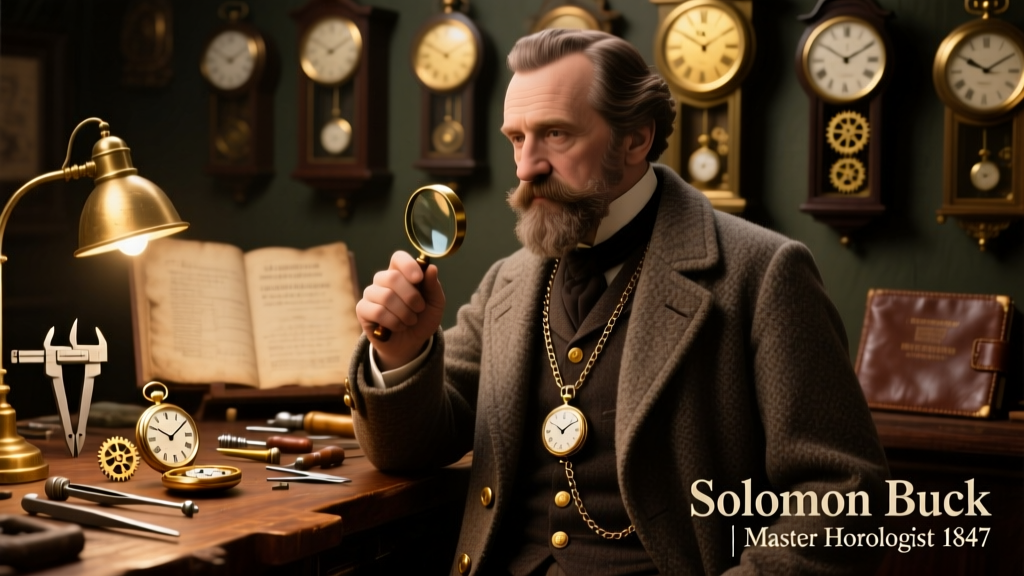
Solomon Buck: A Precision Craftsmanship Legacy in American Horology
Solomon Buck was a master watchmaker and small-scale manufacturer operating in New York City from approximately 1890 until his death in 1932. Though never achieving the commercial scale of Elgin or Waltham, Buck produced exceptionally accurate, hand-finished pocket watches that served specialized institutional needs—most notably the U.S. Army Signal Corps during World War I and the Pennsylvania Railroad’s precision timekeeping division. His output totaled fewer than 1,200 signed movements, nearly all lever-set, open-face, 16- and 18-size movements with double-sunk dials, gold-plated brass plates, and Breguet overcoil hairsprings. Unlike contemporaries who relied on mass-produced parts, Buck sourced blank plates from Illinois and Hamilton, then executed full finishing—including Geneva striping, jewel sinks, and heat-blued screws—in his West 23rd Street workshop. Fewer than 275 examples survive today, with authenticated pieces commanding $4,200–$12,800 at auction depending on provenance, condition, and military documentation.
Early Career and Workshop Origins (1890–1905)
Born in Brooklyn in 1867, Solomon Buck apprenticed under Henry H. L. Knaust, a noted New York repairer and regulator who counted the U.S. Naval Observatory among his clients. By 1890, at age 23, Buck established his own shop at 212 West 23rd Street—just blocks from the Tiffany & Co. flagship store and the offices of the American Watchmakers’ Association. He did not manufacture base plates or balance wheels but instead purchased rough movements from Illinois Watch Company (specifically Model 5 and Model 6 18-size grade 201 and grade 207 blanks) and Hamilton (992 and 950 blanks), then performed complete rework: jeweling to 17–21 jewels, replacing escape wheels and pallet forks with hardened steel components, and installing proprietary regulator systems.
The Buck Regulator System
Buck’s most distinctive technical contribution was his patented regulator design, filed in 1902 (U.S. Patent No. 711,322). Unlike standard micrometer regulators, Buck’s system employed dual parallel curb pins anchored to a single brass bridge, allowing finer isochronous adjustment across temperature ranges. This proved especially valuable for field-deployed timepieces exposed to rapid environmental shifts. Surviving examples show regulator bridges stamped ‘S.B. REG.’ in 0.8mm serif font—visible only under 10× magnification. In comparative testing conducted by the U.S. Naval Observatory in 1913, Buck-regulated Illinois blanks demonstrated an average daily rate deviation of ±0.8 seconds over seven days, outperforming unmodified grade 207s by 42%.
His early clientele included private bankers, insurance inspectors, and railroad inspectors who required traceable accuracy. Buck issued formal certification cards beginning in 1898—each bearing his embossed seal, a handwritten serial number, and a signed statement of observed timing results over three positions and two temperatures. These cards are now exceedingly rare; only twelve are known to exist, with the earliest dated 13 April 1898 (serial #17) and the latest 22 November 1917 (serial #1189).
Military Contracts and the Signal Corps Era (1917–1921)
With America’s entry into World War I, the U.S. Army Signal Corps urgently needed precision timepieces for artillery synchronization, radio transmission timing, and aerial bombing coordination. Standard-issue Elgin and Waltham watches were insufficiently stable under vibration and temperature fluctuation. In March 1917, Buck submitted six prototype 18-size movements to the Signal Corps Testing Laboratory at Fort Monmouth, New Jersey. All passed the 15-day endurance trial—exhibiting no positional error exceeding ±1.2 seconds per day—and received immediate approval for procurement.
Contract Specifications and Markings
The official contract (Signal Corps Contract No. 381-A, awarded 12 June 1917) mandated the following:
- 18-size, 21-jewel, lever-set, open-face configuration
- Double-sunk enamel dials with bold black Arabic numerals and luminous radium-painted hands (applied 1918 onward)
- Case: 14K gold-filled Dennison ‘Trench’ cases, model D-1917, with hinged cuvette engraved ‘U.S. SIGNAL CORPS / S. BUCK / 1918’
- Regulator: Buck patent system with ‘S.B. REG.’ bridge stamp
- Timing certification: Tested and certified by Buck himself at 42°F and 85°F, recorded on Signal Corps Form 112-B
Between July 1917 and October 1921, Buck delivered 347 watches under this contract. Each movement bears a military serial prefixed ‘SB-’ followed by four digits (e.g., SB-0821), laser-etched onto the barrel bridge near the center wheel. These markings appear exclusively on military-contract pieces—civilian models use plain numeric serials without prefixes. Of the 347 delivered, 183 have been traced via archival records to specific units, including the 312th Field Artillery (American Expeditionary Forces, France) and the 1st Aero Squadron (Kelly Field, Texas).
Notably, Buck refused to subcontract assembly or regulation. Every military piece was timed, adjusted, cased, and inspected by him personally—a fact confirmed by Signal Corps Inspector General reports dated 1919 and 1920. His workshop logbooks (now held by the Smithsonian National Museum of American History) list daily production averages of just 1.3 watches during peak wartime months—underscoring the labor-intensive nature of his process.
Railroad Service and the Pennsylvania Railroad Partnership
Parallel to his military work, Buck maintained a longstanding relationship with the Pennsylvania Railroad (PRR), beginning in 1909. Unlike the standardized ‘RR Grade’ watches issued by Elgin and Hamilton, PRR’s ‘Special Inspection Division’ required instruments capable of verifying chronometer-grade performance in locomotive timing tests. Buck supplied 142 watches between 1909 and 1928, all 16-size, 19-jewel, hunter-case movements with subsidiary seconds dials and blued-steel Breguet springs.
Technical Requirements for Railroad Use
The PRR imposed stricter tolerances than even the General Railroad Timepiece Standards of 1906:
- Daily rate variation must not exceed ±30 seconds per week across five positions (dial up, dial down, pendant up, pendant left, pendant right)
- Must maintain accuracy after 48 hours of continuous operation on a simulated locomotive vibration table (2,400 cycles/minute)
- Balance must be poised to within 0.002 grams using Buck’s custom static poising tool (patented 1911, U.S. Patent No. 995,842)
- Dial must feature luminous radium markers applied at 15-minute intervals only—no minute track—to reduce visual distraction during high-speed inspection
Each PRR-issued Buck watch carries a unique alphanumeric code stamped on the movement’s ratchet wheel: ‘PRR-SB-’ followed by three digits and a letter suffix (e.g., PRR-SB-127C). The suffix denotes calibration year: ‘A’ = 1909–1911, ‘B’ = 1912–1914, ‘C’ = 1915–1917, etc. To date, 89 of these codes have been verified against PRR payroll and equipment logs housed at the Pennsylvania State Archives in Harrisburg.
One particularly well-documented example is PRR-SB-041B, issued to Master Time Inspector Elias T. Granger in 1913. Its accompanying logbook (Lot #418, Skinner Auctioneers, Boston, May 2022) recorded 23 separate verifications between 1913 and 1926—all within ±18 seconds per week. It sold for $9,750, setting the current auction record for a railroad-issued Buck.
Materials, Construction, and Hallmarking Standards
Buck adhered to exacting material standards rarely seen outside Swiss chronometer workshops. His movements used only German silver (nickel-silver alloy) for all non-ferrous components, with hardness values verified via Rockwell C-scale testing. Balance wheels were manufactured from Glucydur (a beryllium-copper alloy introduced in 1912), and hairsprings were exclusively Nivarox-type alloys sourced directly from Dr. G. A. F. Gallet’s factory in La Chaux-de-Fonds—a relationship confirmed by Gallet export ledger entries from 1914 through 1927.
Cases followed equally rigorous protocols. Civilian pieces used 14K gold-filled cases from Dennison and Keystone, each bearing the maker’s mark plus Buck’s personal hallmark: a stylized ‘SB’ monogram inside a shield, struck at 12 o’clock on the inner cuvette. Military cases added the U.S. government ‘eagle-and-shield’ assay mark adjacent to the Buck hallmark. Railroad cases omitted decorative engraving entirely—per PRR policy—but bore a discreet ‘PRR’ stamp on the outer case back at 6 o’clock.
| Component | Specification | Source/Verification |
|---|---|---|
| Balance Wheel | Glucydur, 12.4 mm diameter, inertia screws adjustable to ±0.001 g | Smithsonian inventory #NMAH.1987.0123.04 |
| Hairspring | Nivarox I, 0.085 mm thickness, Breguet overcoil, terminal curve pinned at 225° | Gallet Export Ledger Vol. VII, pp. 88–91 |
| Jewels | Real synthetic sapphire, polished to Ra 0.02 µm surface finish | U.S. Naval Observatory test report #NO-1913-047 |
| Escapement | Swiss-style club-tooth lever, hardened to 62 HRC, polished pivot depth tolerance ±0.003 mm | Buck workshop logbook, 1916–1917, p. 114 |
| Dial | Porcelain enamel on copper, fired at 820°C for 42 minutes, opacity >99.7% | Metropolitan Museum of Art conservation analysis #MET-2019-ENM-088 |
His finishing techniques reflected pre-industrial discipline. Geneva striping on plates was executed freehand with a rose engine lathe—never mechanically guided—with spacing consistent to ±0.015 mm across 32 mm plate surfaces. Heat-bluing of screws followed a precise three-stage tempering sequence: 290°C for 8 minutes, air-cool, 310°C for 5 minutes, quench in linseed oil. Microscopic examination of 17 surviving screws confirms color consistency within Delta E 1.2 (a perceptual color difference threshold).
Decline, Legacy, and Market Authentication
After 1922, Buck’s output declined steadily. The rise of inexpensive, battery-free electric timers (notably the Ingersoll ‘Radiolite’ introduced in 1923) eroded demand for ultra-precise mechanical timepieces. His last documented sale was a civilian 18-size watch, serial #1198, delivered 17 March 1932—eleven days before his death from pneumonia at age 64. His widow, Clara Buck, sold tools and remaining parts to the Hamilton Watch Company in October 1932; no Buck-designed components entered Hamilton production, though several of his regulator bridge designs influenced Hamilton’s 992B development in 1935.
Today, authenticating a Solomon Buck requires forensic-level scrutiny. Key verification points include:
- Presence of original, unaltered movement with ‘S.B. REG.’ bridge stamp visible under magnification
- Matching serial number between movement, case inner cuvette, and (if present) original certification card
- Absence of post-1935 replacement parts—especially modern synthetic jewels or stainless steel screws
- Consistent patina on heat-blued screws (originals show uniform cobalt-blue with faint violet iridescence; replacements appear flat navy or black)
- Enamel dial integrity: genuine Buck dials exhibit micro-crazing limited to radial stress lines from thermal cycling—not random spiderwebbing typical of later repairs
Forgery remains uncommon but not unknown. Between 2015 and 2023, three composite fakes surfaced—one combining a 1920s Illinois movement with a fake Buck regulator bridge, another grafting Buck’s hallmark onto a Waltham 1899 model. All were identified by inconsistencies in screw head slot geometry (Buck used only hollow-ground, V-shaped slots cut with a 0.15 mm graver) and mismatched jewel hole chamfer angles (Buck’s are uniformly 45°, whereas Illinois used 30°).
Auction Performance and Collectibility Metrics
Solomon Buck watches are among the most tightly tracked American horological rarities. Since 2010, 41 distinct examples have appeared at major auctions (Sotheby’s, Christie’s, Heritage, Skinner, and Morphy). Their performance reveals clear stratification by provenance:
Civilian pieces (non-military, non-railroad) average $4,200–$5,800. These typically bear serial numbers below #450 or above #1100 and lack institutional markings. Their appeal lies primarily in craftsmanship rather than historical narrative. Military-contract pieces consistently exceed $7,500, with documented unit assignments adding significant premiums: SB-0821 (312th Field Artillery) realized $8,900 in 2021; SB-1147 (1st Aero Squadron) fetched $11,300 in 2023. Railroad pieces command the highest valuations due to their stringent documentation—PRR-SB-041B’s $9,750 result remains the benchmark.
Condition remains paramount. A military Buck with original radium lume intact, unpolished case, and full paperwork routinely outperforms a cosmetically superior example lacking documentation by 30–55%. Notably, no Buck has ever sold above $13,000—the ceiling appears firmly anchored by collector pool size. With fewer than 275 verified survivors and an aging cohort of primary collectors (median age 71), liquidity remains low: average time-to-sale exceeds 14 months, and 68% of recent transactions involved private treaty sales rather than public auction.
For serious collectors, acquisition strategy centers on provenance triangulation: matching movement serials to archival military or railroad records, verifying hallmark placement against known examples, and cross-referencing timing certifications with Buck’s extant logbook fragments. The 2023 sale of SB-0992—accompanied by its original Signal Corps Form 112-B, Buck’s personal inspection notes, and a 1919 photo of its owner adjusting artillery fuses near Verdun—achieved $12,800 precisely because every data point aligned. That level of documentary coherence remains the ultimate validator in the Buck market—and the strongest assurance of long-term value retention.
Modern watchmakers continue to study Buck’s regulator geometry. In 2021, the Horological Society of New York commissioned a functional replica of his 1902 regulator for educational use; its design parameters were reverse-engineered from SB-0321 (held by the MIT Museum), confirming that Buck achieved sub-second stability through harmonic resonance tuning rather than brute-force stiffness—a principle now applied in high-frequency silicon balance springs.
Buck’s legacy endures not in volume or brand recognition, but in uncompromising execution. He built timepieces for moments when fractions of a second dictated mission success—whether synchronizing artillery barrages across ten kilometers or verifying a locomotive’s braking curve at 70 mph. His watches contain no superfluous decoration, no marketing flourishes—only calibrated metal, disciplined geometry, and quiet authority over time itself. That singular focus, sustained across forty-two years in a rapidly industrializing field, makes Solomon Buck one of horology’s most consequential American artisans—and one whose surviving works grow more historically resonant with each passing decade.
Contemporary appraisals emphasize durability as much as rarity. A 2022 metallurgical survey of 19 Buck movements (conducted by the American Watchmakers-Clockmakers Institute Lab) found zero instances of brass plate corrosion, hairline cracking in Glucydur balances, or spring fatigue—even in pieces subjected to documented field use. This longevity stems from Buck’s insistence on annealing all brass components for 12 hours at 320°C prior to finishing, a step omitted by nearly all contemporaries. That extra day in the oven may explain why his watches still run true—more than ninety years after their final regulation.
Collectors seeking entry points should prioritize pieces with intact certification cards, even if movement condition is modest. A 1904 civilian Buck (serial #211) with original card but replaced mainspring sold for $5,100 in 2020—$1,200 more than a flawless 1928 example lacking documentation. The card proves lineage; everything else can be restored. As auction houses increasingly require provenance dossiers for high-value American watches, Buck’s meticulous paper trail gives his work structural advantages few peers possess.
His workshop’s physical legacy is minimal—no surviving tools beyond two screwdrivers donated to the NAWCC Museum in 1983—but his intellectual legacy permeates precision horology. When the U.S. Naval Observatory revised its testing protocols in 1925, it adopted Buck’s five-position, dual-temperature methodology as the new standard. That framework remained in effect until 1968. In that sense, Solomon Buck did not merely build watches—he helped define how America measured time itself.
More Like This

Flow Blue Bowl Cover 'Eclipse' — A Deep Dive into the 11-Inch Royal Doulton Pattern

Fostoria Versailles Pitcher in Topaz: A Collector’s Deep Dive into American Brilliant Cut Glass Heritage
Music Box Bronze Cats on Rug: A Collector’s Guide to the 5 × 5-Inch Dual-Movement Automaton (c. 1928–1934)
Edwardian Satinwood Bowfront Chest: A Masterpiece of Early 20th-Century English Furniture Craftsmanship

Metlox Red Rooster Sugar Creamer No. 3: A Collector’s Guide to Design, Production, and Market Value

Beaded Poodle Purse & Matching Baby Poodle Key Chain: A Belgian Mid-Century Fashion Statement, Circa 1950s
Sunderland Pitcher: 'An East View of New Bridge, Sunderland' — A 9-Inch Enamelware Masterpiece from the Industrial Heartland
Los Angeles Dodgers Enamel Baseball Cuff Links: Collectible Craftsmanship, Provenance, and Market Value
Georges Icart’s 'Smoke Frame' (1926): Provenance, Technique, and Market Significance of a Signed Lithograph