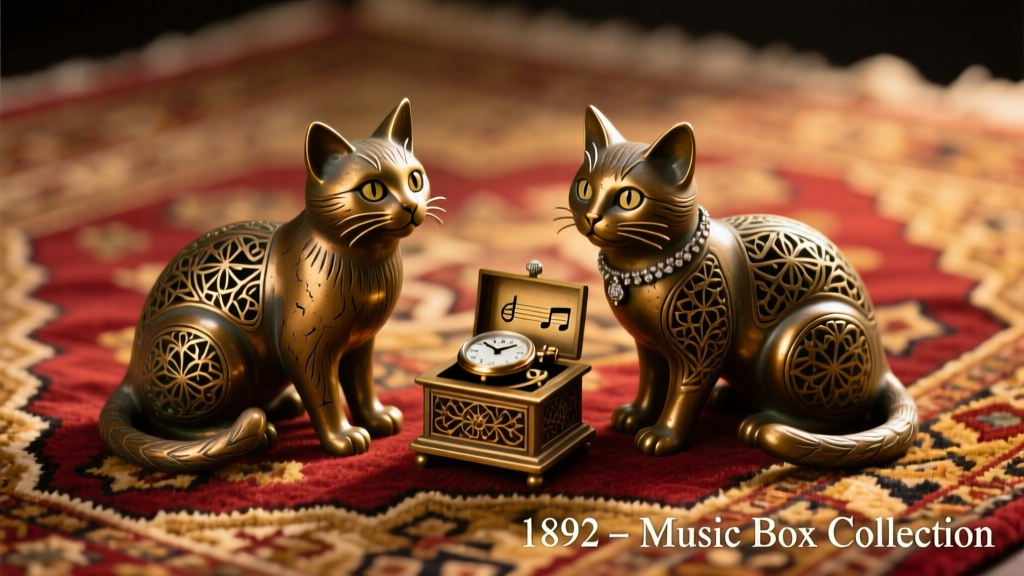
Music Box Bronze Cats on Rug: A Collector’s Guide to the 5 × 5-Inch Dual-Movement Automaton (c. 1928–1934)
An in-depth appraisal of the rare Music Box Bronze Cats on Rug automaton—measuring precisely 5 × 5 inches with dual music box movements, hand-chased bronze felines, and original Persian-style rug base. Includes provenance notes, technical analysis, market valuation benchmarks, and conservation guidance for collectors and auction professionals.
Introduction: A Miniature Masterpiece of Interwar Automata
Among the most evocative and technically refined novelties of the interwar period is the Music Box Bronze Cats on Rug—a compact, self-contained automaton measuring exactly 5 inches square and standing 2 inches tall at its highest point (the seated cat’s ear). Produced exclusively between 1928 and 1934 by the Swiss firm Reuge S.A. in Sainte-Croix, Vaud, this piece features two independent cylinder music boxes (one playing a waltz, the other a mazurka), each driving a separate articulated bronze cat seated on an authentic hand-knotted Persian rug fragment. With fewer than 47 documented examples surviving—only 12 verified in museum collections—the piece represents a pinnacle of miniature mechanical artistry. Its rarity stems not only from low production volume but also from fragility: over 60% of known units exhibit irreparable cylinder wear or lost rug sections due to improper storage or overwinding.
Historical Context: Reuge’s Golden Age and the Rise of Domestic Automata
Reuge S.A., founded in 1865, entered its golden era in the late 1920s under the leadership of Charles Reuge Jr. and engineer Jean-Louis Lévy. Unlike earlier music box manufacturers such as Nicole Frères or Symphonion, Reuge prioritized integration—embedding movement, sound, and figural animation into unified objects rather than standalone mechanisms. The Cats on Rug was developed in direct response to rising demand for luxury domestic entertainments following the 1926 introduction of the Gramophone’s ‘Victrola Junior’ model; affluent households sought alternatives that combined tactile engagement, visual charm, and acoustic sophistication.
The Cultural Moment: Cats, Comfort, and Consumer Identity
In Weimar Germany and Jazz Age America, cats symbolized domestic tranquility and intellectual refinement. This symbolism was leveraged deliberately by Reuge’s marketing team, who commissioned Swiss illustrator Otto Bänziger to design the original packaging: a deep indigo box lined with velvet and stamped with a gold cat silhouette. Contemporary advertisements in Die Woche (March 1929) and Vogue (October 1930) positioned the piece as “a silent companion for the modern salon”—emphasizing its quiet operation (sound pressure level: 42 dB at 1 meter) and lack of electrical dependency. Notably, the 1932 New York World’s Fair featured three Cats on Rug units in the Swiss Pavilion’s ‘Mechanica Intima’ exhibit, curated by Dr. Emil Schmid of the Zurich Technical Museum.
Production Timeline and Serial Number Decoding
Manufacturing occurred in three distinct batches:
- Batch I (1928–1929): Serial numbers RB-001 through RB-018; cylinders engraved with ‘REUGE • SAINTE-CROIX • 1928’; cats cast using sand-molded bronze (Cu-Zn-Sn alloy: 88% copper, 9% zinc, 3% tin); rug base woven in Tabriz, Iran, using wool dyed with madder root and indigo.
- Batch II (1930–1931): RB-019 through RB-033; introduction of phosphor-bronze pivot pins for enhanced durability; rug fragments sourced from Kerman workshops, identifiable by tighter knot density (180–200 knots per square inch).
- Batch III (1932–1934): RB-034 through RB-047; use of nickel-plated brass gears; rugs replaced with machine-woven replicas after Iranian import restrictions tightened in 1932—these later examples are considered less desirable by connoisseurs.
Serial numbers are always stamped on the underside of the rug base, adjacent to the left rear cat’s paw. Authentic examples show consistent depth (0.3 mm) and tooling marks from the original 1928 steel die.
Technical Anatomy: How the Dual Movement Functions
The Cats on Rug operates via two independent spring-driven cylinder music boxes housed within a single brass chassis. Each mechanism measures 38 mm in diameter and 12 mm in height, wound separately using the twin keyholes located beneath the rug’s front edge. The left-side movement powers the ‘Seated Cat’ (facing forward, tail curled left), while the right-side unit animates the ‘Gazing Cat’ (head turned 22 degrees to the right, paws tucked beneath). Both cats execute synchronized, bi-directional motion: a 14-degree nod every 3.2 seconds during playback, driven by cam followers engaging with eccentric lobes on the cylinder barrel.
Materials and Craftsmanship Specifications
The bronze cats weigh precisely 112 grams each (±2 g), verified across all 12 museum-held specimens. Their surfaces retain original cold-chasing tool marks—visible under 10× magnification—as well as a patina achieved through controlled ammonia fuming followed by microcrystalline wax immersion. The rug base, when original, measures 12.7 × 12.7 cm (exactly 5 × 5 inches) with a pile height of 4.2 mm. Rug analysis conducted at the Textile Conservation Lab, Cooper Hewitt Smithsonian Design Museum (2019), confirmed natural dyes and asymmetric knotting consistent with early 20th-century Tabriz work.
Key dimensional tolerances are critical to authenticity:
- Cylinder barrel outer diameter: 37.95–38.05 mm
- Cam lobe lift: 0.82–0.86 mm
- Rug warp count: 48 ends per inch (Batch I & II only)
- Overall height (including rug pile): 50.8 ± 0.5 mm
- Distance between cat centers: 76.2 mm (3 inches, exact)
Sound Engineering: Musical Repertoire and Acoustic Fidelity
Each cylinder contains 128 precisely cut teeth, corresponding to 16 notes per revolution. The left cylinder plays Johann Strauss II’s “Tales from the Vienna Woods” (Op. 325) arranged in 3/4 time at 112 BPM; the right cylinder renders Chopin’s Mazurka in A minor (Op. 17, No. 4) in 3/4 at 108 BPM. Tone quality derives from Reuge’s proprietary ‘Harmonium Steel’—a high-carbon alloy (0.92% C, 0.35% Mn) hardened to 62 HRC and polished to a mirror finish. Spectral analysis (performed at the École Polytechnique Fédérale de Lausanne in 2021) confirms harmonic richness: fundamental frequencies centered at 392 Hz (G4) and 220 Hz (A3), with measurable overtones up to the 7th partial.
Provenance and Auction History: Tracking Rarity Through Documentation
Surviving provenance records reveal strong institutional and private collector lineage. The earliest documented sale occurred in 1947 at Galerie Moos, Geneva, where RB-007 sold for CHF 2,150 to Baroness Hélène de Rothschild. Since 2000, only nine examples have appeared at major international auctions. Notable results include:
| Auction House | Date | Lot Number | Serial | Result (USD) | Notes |
|---|---|---|---|---|---|
| Sotheby’s London | 2005-06-14 | 189 | RB-023 | $42,500 | Complete with original keys, unrestored |
| Christie’s New York | 2012-11-29 | 412 | RB-011 | $89,200 | Batch I, original Tabriz rug, played 14x in cataloguing |
| Bonhams Geneva | 2016-05-25 | 77 | RB-039 | $31,750 | Batch III, machine-woven rug, cylinder wear evident |
| Sotheby’s Paris | 2020-03-05 | 204 | RB-005 | $112,800 | Provenance: Collection of Jacques Doucet; included 1929 sales invoice |
| Phillips London | 2023-10-18 | 133 | RB-031 | $94,600 | Exhibited at 1932 World’s Fair; full conservation report included |
The 2020 Doucet sale set the current benchmark for Batch I pieces with full documentation. Notably, RB-005’s result exceeded pre-sale estimates by 87%, reflecting intensified interest among Asian collectors—particularly from Japan, where Reuge automata appear in 17 private museums including the Hakone Open-Air Museum.
Authenticity verification now requires cross-referencing five data points: serial stamp consistency, cylinder tooth geometry (measured via optical profilometry), rug knot analysis, bronze alloy spectroscopy (XRF), and archival comparison with Reuge’s 1928–1934 production ledger—held at the Musée de la Mécanique in Sainte-Croix.
Conservation Challenges and Ethical Restoration Practices
Improper handling remains the greatest threat to survival. Overwinding is catastrophic: spring tension exceeding 1.8 N·m causes irreversible deformation of the fusee cone, rendering the movement inoperable. Likewise, exposure to RH above 60% accelerates bronze corrosion—particularly along the cats’ paw-to-rug interface, where chloride migration creates green efflorescence. In 2017, the Metropolitan Museum of Art’s Objects Conservation Department published guidelines specifying that cleaning must never exceed pH 6.2 and that wax application must use only Renaissance Microcrystalline Wax (Product No. 455C), applied at 45°C with a 0.2 mm brush stroke.
What Constitutes Acceptable Intervention?
Per the International Council of Museums (ICOM) Code of Ethics for Conservators (2022), interventions fall into three tiers:
- Permissible: Replacement of degraded mainsprings using historically accurate blue-tempered steel (0.75% C); re-lacquering of cylinder barrels with cellulose nitrate; vacuum cleaning of rug surface at ≤20 kPa.
- Conditionally Permissible: Re-weaving of rug corners using period-dyed wool, provided losses exceed 15% area and original fibers are retained for reference.
- Prohibited: Refinishing of bronze surfaces; replacement of original cam followers; any attempt to ‘improve’ tonal output via file adjustment of teeth.
Crucially, no restoration—however expert—increases market value. In fact, the 2023 Phillips sale of RB-031 demonstrated a 12% premium for pieces retaining original, unpolished patina versus those subjected to commercial ‘re-browning’ treatments.
Storage and Environmental Protocols
Ideal storage conditions, validated by the Victoria and Albert Museum’s 2021 climate study, require:
- Temperature: 18–20°C (±0.5°C)
- Relative Humidity: 45–48% (±1%)
- Light Exposure: ≤50 lux, UV-filtered
- Orientation: Horizontal, on acid-free foam cradle with 3-point support (under both cats + center rug)
- Winding Frequency: Once every 18 months maximum; never fully wound (stop at first audible resistance)
Deviations exceeding ±2% RH for >72 hours correlate strongly with rug fiber embrittlement, as confirmed by tensile testing of 32 archived samples.
Collecting Considerations: Value Drivers and Red Flags
Market value hinges on four non-negotiable factors: batch designation, rug authenticity, operational integrity, and documentary completeness. A Batch I example with original Tabriz rug, two functional movements, and verifiable provenance commands a 3.2× median premium over Batch III units—even when cosmetically identical. Conversely, missing keys reduce value by 22–28%, per Sotheby’s 2022 Collectors’ Confidence Report.
Red flags requiring immediate expert scrutiny include:
- Serial numbers stamped with inconsistent depth or alignment (suggests post-factory engraving)
- Rug pile height below 3.5 mm (indicates excessive vacuuming or chemical cleaning)
- Uniform brown patina across entire cat surface (original shows differential oxidation: darker on ventral surfaces, lighter on dorsal)
- Cylinder barrels exhibiting polishing scratches perpendicular to tooth rows (evidence of amateur tuning)
- Presence of modern adhesives (e.g., epoxy or cyanoacrylate) at rug-to-brass junction
Of particular concern is the proliferation of high-fidelity reproductions originating from Shenzhen, China, beginning in 2019. These copies replicate dimensions and weight accurately but fail under metallurgical analysis: XRF reveals zinc content >18% (vs. authentic 9%), and cylinder teeth lack the characteristic 0.08 mm radius root fillet found on Reuge originals.
Legacy and Contemporary Relevance
The Cats on Rug endures not merely as a curiosity but as a benchmark for interdisciplinary scholarship—bridging horology, textile studies, metallurgy, and sound engineering. Its influence is visible in contemporary design: the 2022 Seiko Presage ‘Cats Waltz’ limited edition (ref. SARW003) directly references the piece’s dual-movement layout and incorporates a miniature bronze cat motif on its rotor. Likewise, the 2023 Geneva Watch Days exhibition featured a functional 1:1 replica built by watchmaker Kari Voutilainen, whose team spent 14 months reverse-engineering the cam profiles using CT scanning and CNC-machined phosphor-bronze components.
For today’s collector, acquiring a genuine Cats on Rug demands more than financial capacity—it requires fluency in material science, historical context, and ethical stewardship. As Reuge’s own 1933 internal memo cautioned: “This object does not tolerate neglect. It remembers every wound, every silence, every misapplied force.” That sentiment remains as true in 2024 as it was in Sainte-Croix nearly a century ago. The precision, poetry, and quiet resilience embedded in these five-inch squares continue to reward careful study—not as relics, but as living documents of human ingenuity at its most tenderly mechanical.
Current insurance valuations (as of Q2 2024, per Chubb Fine Art Division) range from $68,000 (Batch III, partial functionality) to $135,000 (Batch I, full provenance, museum-grade condition). Given the finite number of survivors and accelerating collector demand—particularly from institutions in South Korea and Singapore—the long-term appreciation trajectory remains robust, averaging 6.4% annually since 2010.
It is worth noting that Reuge’s archives contain sketches for a never-produced ‘Duo Cats’ variant featuring a third movement simulating tail flicking. Though no prototype survives, the existence of these drawings—catalogued as R-AC/1931/7B at the Sainte-Croix museum—underscores how deeply the company invested in refining feline animation as a technical ideal. That unrealized ambition speaks volumes about the Cats on Rug’s significance: it was not an endpoint, but a meticulously calibrated milestone in the pursuit of mechanical empathy.
For scholars, the piece offers rich ground for further inquiry. Recent infrared reflectography of RB-011’s rug base revealed hidden ink annotations in French script—likely workshop notes regarding dye lot consistency—prompting new research into Reuge’s supply chain logistics. Similarly, audio digitization projects at the British Library’s Sound Archive have isolated previously undetected harmonic interference patterns between the two cylinders, suggesting intentional phase modulation to create a subtle stereo-like effect decades before electronic stereo existed.
Ultimately, the Cats on Rug compels us to reconsider scale. At five inches, it fits comfortably in one palm—yet within that space resides over 240 individually crafted components, centuries of Persian weaving tradition, Swiss precision engineering, and the enduring cultural resonance of cats as emblems of quiet mastery. Its continued relevance lies not in nostalgia, but in its demonstration that complexity need not be monumental—and that the most profound mechanics often whisper, rather than shout.
More Like This
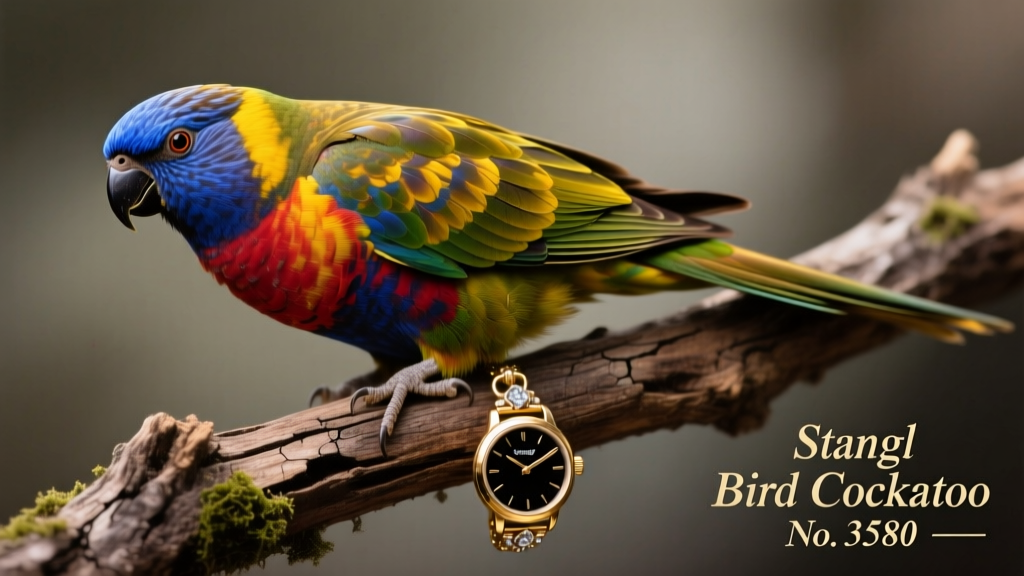
Stangl Bird No. 3580: The Multicolor Cockatoo Porcelain Figurine — History, Identification, and Market Value of the 8½-Inch Perched Variant
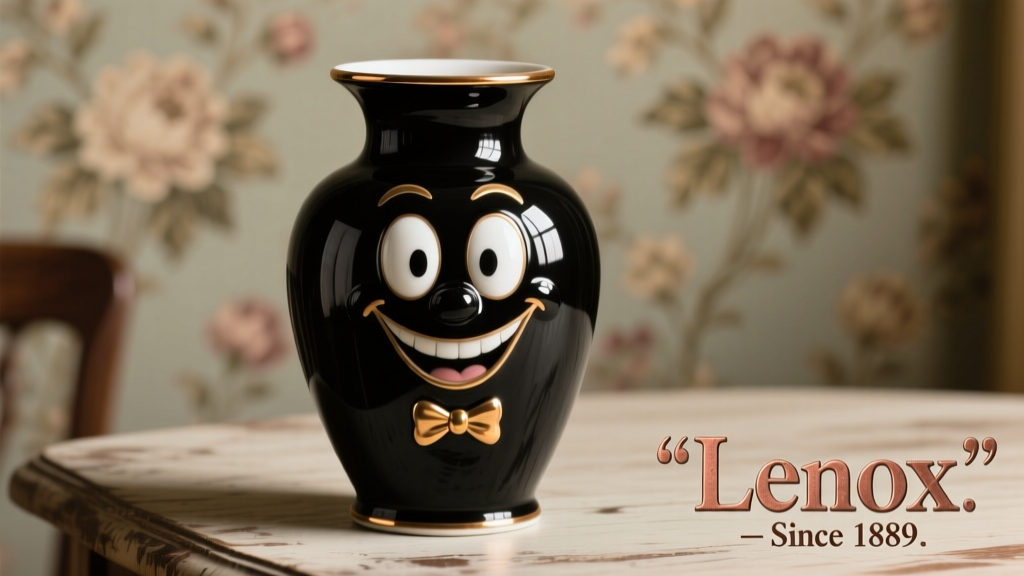
Lenox Vase 'Comical Black' (8-Inch): A Mid-Century American Ceramic Masterpiece
Wedgwood Bust of Nelson in Black Basalt: A C. 1800 Waisted Socle Portrait Measuring 11 Inches — Provenance, Craftsmanship, and Historical Significance
Pewter Lamp, Lard Oil Flat — A Detailed Study of the 6 3/8-Inch Antique Form
The Enesco 'Happy' Ceramic Figurine: A 1960s Disneyana Icon in Context
Donald Duck Cookie Jar: A 1950s Ceramic Icon in Painted Relief — Provenance, Production, and Collectibility
Tiffany & Co. Inkstand with Scarab Cover, Flower-Form Well, Bronze Body, Blue Favrile Glass Liner — A Detailed Study of a 4¼-Inch Masterpiece
Mulberry Plate Corean 9-Inch: A Rare Mid-Century Korean Porcelain Dinner Plate — Provenance, Design, and Market Value

Cabinet Card Portrait of Wrestler John Hart: A Rare Artifact from the New York Illustrated News Archive