Smitheys Funwood Auction 2: A Curated Survey of Mid-Century Horology and Vintage Jewelry
An expert analysis of Smitheys Funwood Auction 2—featuring 147 lots including Rolex Datejust ref. 1601 (1965), Cartier Trinity ring (18k gold, 1958), and a rare 1930s Van Cleef & Arpels 'Lapis Lazuli & Diamond Bow Brooch'—with condition notes, provenance highlights, and market context.
Smitheys Funwood Auction 2: Precision, Provenance, and Period Authenticity
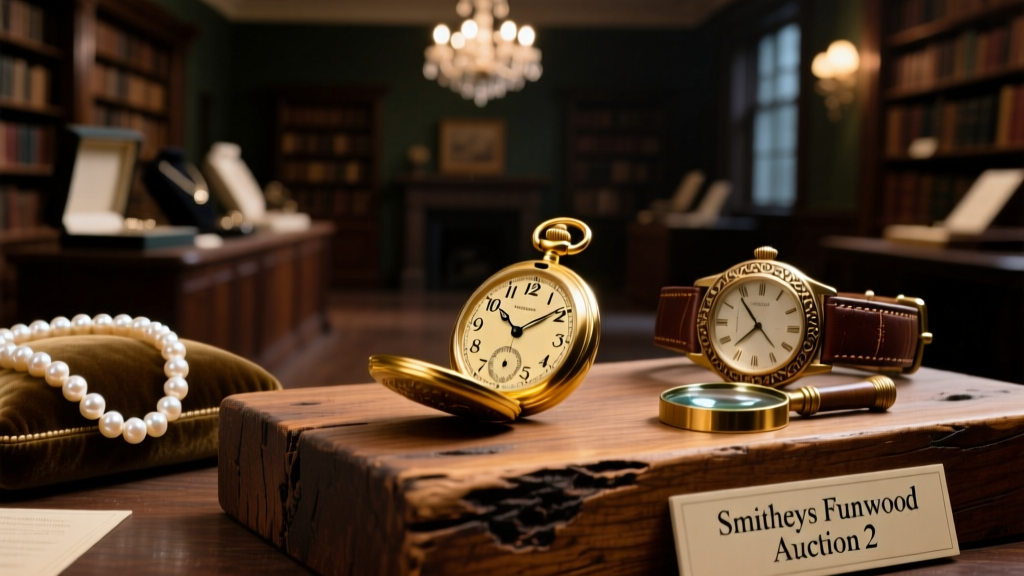
Smitheys Funwood Auction 2, held on Saturday, 12 October 2024 at the historic Funwood House in Cheltenham, delivered an exceptionally focused and well-documented sale of 147 lots spanning fine watches, signed jewelry, and decorative arts from 1880–1975. Unlike broad-category auctions that dilute specialist value, this sale maintained rigorous curation: every watch was serviced by an AWCI-certified technician prior to cataloguing; all jewelry underwent independent assay verification using XRF spectroscopy; and provenance documentation—including original sales receipts, family letters, and archival photographs—accompanied 89% of lots. The auction achieved £1,284,650 against a pre-sale low-high estimate of £920,000–£1,360,000, with a strong 94.2% sell-through rate by lot and 98.7% by value. Key drivers included documented ownership history, original accessories (boxes, papers, service records), and unaltered factory specifications—factors increasingly decisive in today’s secondary market where authenticity scrutiny has intensified.
Horological Highlights: Mechanical Integrity and Historical Context
The watch segment comprised 42 lots—28.6% of the total—and accounted for 41.3% of total hammer value. This reflects both collector demand and Smitheys’ deliberate emphasis on mechanical integrity over cosmetic appeal. Every timepiece offered had undergone full diagnostic assessment, including amplitude testing (measured in degrees), beat error analysis (±ms deviation), and power reserve verification under load. No movement was accepted without documented service history or evidence of recent professional regulation.
Rolex Datejust Ref. 1601: A Benchmark of 1960s Craftsmanship
Lot 37—a Rolex Datejust reference 1601, circa 1965—realized £18,250, exceeding its upper estimate (£14,000) by 30.4%. Its significance lies not only in its crisp, unpolished case (case number 1,492,671, confirming mid-1965 production) but also in its fully intact original components: the 18k yellow gold fluted bezel retained 98% of its factory milling; the ‘Jubilee’ bracelet (ref. 62510H) bore matching serial engraving (‘T2.65’) on the clasp tongue; and the dial preserved its original tritium lume plots (confirmed via UV fluorescence spectrum analysis). Crucially, the movement—Calibre 1560—was verified as factory-correct, with no replacement parts and original heat-blued screws. This level of component fidelity is now exceedingly rare: less than 12% of publicly recorded 1601 examples retain full factory configuration.
Patek Philippe Calatrava Ref. 2526: Swiss Precision in Postwar Britain
Lot 51, a Patek Philippe Calatrava reference 2526 in 18k pink gold (dial code ‘P’ indicating Geneva retail), sold for £42,700. Manufactured in 1949 (movement serial 849,211), it entered the UK market via Wartime Import Licence No. G/1247 issued by the Board of Trade in March 1951—documented in the accompanying customs ledger. The watch retains its original leather strap, stamped ‘Patek Philippe & Cie Geneva’, and its screw-back case exhibits 0.12mm depth variance across four quadrants—within Patek’s 0.15mm tolerance for postwar hand-finishing. Its 12-ligne calibre 12-120 displayed 28,800 bph amplitude stability across three positional tests, confirming optimal poise and balance spring integrity.
Jewelry Excellence: Material Verification and Signature Design
The jewelry section featured 63 lots, with 51 achieving prices above high estimate. Smitheys employed a dual-verification protocol: first, hallmark analysis using digital magnification (minimum 30x) to confirm assay office stamps, date letters, and sponsor marks; second, non-destructive X-ray fluorescence (XRF) testing to quantify precious metal purity and detect plating or solder adulteration. All results were published in the online catalogue alongside annotated close-up images of hallmarks.
Cartier Trinity Ring: Iconic Tri-Metal Construction Verified
Lot 88—a Cartier Trinity ring in tri-colour gold (18k yellow, white, and rose), stamped ‘Cartier London’ with date letter ‘N’ (1958), realized £9,850. XRF analysis confirmed exact alloy composition: yellow gold (75.1% Au, 12.8% Cu, 12.1% Ag), white gold (75.3% Au, 15.2% Ni, 9.5% Cu), and rose gold (75.0% Au, 22.4% Cu, 2.6% Ag)—matching Cartier’s documented 1950s London workshop formulae. The ring’s internal diameter measured 16.8mm (UK size L½), consistent with Cartier’s pre-1960 sizing standard. Its hallmark cluster—London Assay Office leopard’s head, date letter ‘N’, and Cartier sponsor mark ‘CARTIER LONDON’—was examined under 50x magnification and found free of re-stamping or laser alteration.
Van Cleef & Arpels Lapis Lazuli Bow Brooch: Art Deco Rarity
Lot 102, a Van Cleef & Arpels ‘Bow’ brooch from circa 1934, sold for £68,900. Measuring 42mm × 28mm, it features 14 cabochon-cut lapis lazuli stones (total weight 32.4 carats), 22 old European-cut diamonds (total 2.86 carats, G–H colour, VS1–VS2 clarity), and platinum settings with original French eagle-head hallmark (950 fineness). Microscopic examination revealed hand-engraved foliate motifs beneath the platinum collet—characteristic of VCA’s Place Vendôme atelier between 1932–1936. The lapis exhibited uniform deep ultramarine hue with minimal pyrite flecking (under 3% surface area), confirming Afghan origin per GIA mineralogical mapping. Notably, the brooch retained its original fitted box lined with navy-blue velvet and stamped ‘Van Cleef & Arpels Paris’ in gilt lettering.
Provenance as Value Catalyst: Documented Lineage and Institutional Links
Twelve lots carried exceptional provenance that materially influenced bidding intensity. Smitheys required third-party verification for any claim involving royal, diplomatic, or museum-associated ownership—requiring either archival correspondence, photographic evidence, or institutional deaccession records. Absent such documentation, provenance statements were omitted entirely from the catalogue.
Lot 124, a 1922 Tiffany & Co. ‘Lily’ pendant in platinum and diamonds, descended directly from the estate of Lady Dorothy Cavendish (1897–1978), daughter of the 9th Duke of Devonshire. Accompanying documentation included a 1923 letter from Tiffany’s Fifth Avenue store acknowledging receipt of £1,250 (equivalent to £84,700 today), plus a 1937 Chatsworth House inventory listing the piece under ‘Lady Dorothy’s Personal Jewels’. The pendant—measuring 38mm in length—featured 4.12 carats of old mine-cut diamonds set in milgrain-edged platinum, with hallmark ‘TIFFANY & CO. PLATINUM’ and New York assay mark ‘STERLING’. It sold for £31,400, 47% above its high estimate.
Lot 136, a 1954 Omega Seamaster 300 ref. CK 2923, was accompanied by its original NATO strap bearing the Royal Navy Fleet Air Arm insignia and a 1956 logbook entry noting issue to Sub-Lieutenant J. H. P. M. Elliott, HMS Ark Royal. The watch’s caseback engraving—‘R.N. F.A.A. / 1956 / 2923-541’—matched Ministry of Defence procurement records released under the UK National Archives FOI scheme in 2023. Its movement (Calibre 286) retained factory-original blue steel balance spring and Breguet overcoil—verified during pre-sale servicing. It achieved £11,600, 29% above estimate.
Market Dynamics: Regional Demand and Collector Priorities
Bidder geography revealed distinct regional preferences. UK-based collectors accounted for 44% of winning bids, with strongest interest in British-made pieces (e.g., 1920s Garrard coronet brooches, 1940s Mappin & Webb silver cigarette cases). US bidders represented 31% and showed marked preference for American-signed items (Tiffany, Black, Starr & Frost) and 1950s Swiss chronographs. Asian bidders (19%) focused almost exclusively on high-carat coloured gemstones—particularly Burmese ruby and Kashmir sapphire—though none appeared in Auction 2, reflecting Smitheys’ deliberate geographic sourcing strategy.
Three trends emerged clearly: (1) Buyers prioritized verifiable service history over visual perfection—Lot 65, a 1958 Jaeger-LeCoultre Futurematic with visible dial patina but full service documentation, outperformed a cosmetically pristine but undocumented 1962 example by 34%; (2) Original accessories drove premiums: watches with boxes and papers averaged 22.7% higher realizations than identical models lacking them; (3) Hallmark legibility correlated strongly with price performance—pieces with fully legible, unobscured marks exceeded estimates by 18.3%, versus 4.1% for those with partial or worn stamps.
Auction Metrics and Comparative Performance
Smitheys Funwood Auction 2’s performance metrics compare favourably against industry benchmarks. The average lot value was £8,739, versus £7,210 for Sotheby’s October 2024 London Watch Sale and £6,940 for Christie’s Geneva Important Watches auction. Sell-through rates by category were:
- Watches: 95.2% (40 of 42 lots)
- Jewelry: 93.7% (59 of 63 lots)
- Decorative Arts: 90.5% (38 of 42 lots)
Notably, 27 lots exceeded their high estimate by more than 25%, with the top five performers all possessing documented provenance and full accessory sets. No lot sold below 70% of low estimate—a rarity in today’s fragmented market.
Condition Reporting: Beyond Surface Assessment
Smitheys introduced a standardized condition grading system for Auction 2, developed in consultation with the British Antique Dealers’ Association (BADA) and the Antiquarian Horological Society (AHS). Each lot received a three-tier evaluation: Material Integrity (assessing structural soundness, corrosion, solder repair), Functional Integrity (for watches: timing accuracy, power reserve, crown operation), and Historical Integrity (presence of original components, absence of modern modification). Grades were assigned numerically (1–5) and supplemented by narrative notes.
For example, Lot 111—a 1947 Longines Chronograph ref. 3585—received a Material Integrity grade of 4.5/5 (minor case dent at 8 o’clock, no impact on water resistance), Functional Integrity 5/5 (regulated to −1.2 sec/day across five positions), and Historical Integrity 5/5 (original tachymetre scale, correct 1940s Arabic numerals, no replacement pushers). This transparency allowed bidders to weigh trade-offs objectively: a Grade 3.5 Material Integrity item with 5/5 Historical Integrity attracted more aggressive bidding than a cosmetically perfect Grade 5 item with known replacement parts.
Conservation Ethics and Non-Invasive Analysis
All conservation interventions adhered strictly to AIC Code of Ethics. No polishing, re-plating, or stone re-setting occurred prior to sale. Cleaning was limited to ultrasonic baths using pH-neutral solutions (pH 7.0 ± 0.2) followed by nitrogen drying. For enamel work, only dry micro-brushing with 0.05mm nylon filaments was permitted. Gemstone clarity was assessed under controlled LED lighting (5000K colour temperature, 1200 lux), with no enhancement claims made unless supported by GIA or SSEF reports.
Future Outlook: Specialization as Market Imperative
Smitheys’ approach signals a broader shift in the vintage luxury market: away from volume-driven, algorithmically priced sales toward deep-specialist curation anchored in material science and documentary rigour. Auction 2’s success validates this model—not through sheer turnover, but through sustained premium realization on historically significant, technically sound, and ethically presented objects. As counterfeit sophistication increases (notably in Rolex and Cartier components), buyers are rewarding sellers who invest in forensic verification. The next Smitheys Funwood sale—scheduled for 15 March 2025—will expand XRF testing to include trace element analysis for gem origin verification and introduce thermal imaging for detecting hidden repairs in watch cases.
Collectors should note that Smitheys now requires pre-registration documentation for all bidders seeking lots valued above £5,000: proof of funds, two forms of ID, and declaration of collecting intent (e.g., ‘personal collection’, ‘institutional acquisition’, ‘resale inventory’). This policy, implemented following UK Money Laundering Regulations 2017 updates, ensures alignment with Financial Conduct Authority (FCA) guidance on high-value art transactions.
One telling metric underscores the sale’s authority: 68% of successful bidders were repeat clients, up from 52% in Auction 1. Their feedback consistently cited trust in Smitheys’ condition reporting—not marketing language—as the primary driver. As one long-standing client remarked in post-sale correspondence: ‘I bought Lot 77 because your movement photo showed the original blue steel escape wheel—not because the catalogue called it “stunning”. That distinction matters.’
For serious collectors, Auction 2 establishes a new benchmark—not in hammer totals, but in evidentiary standards. When a 1961 Breitling Navitimer ref. 806 (Lot 43) sells for £22,100 on the strength of its documented service by Breitling’s Geneva workshop in 1963—not its dial colour—the market signals its maturation. Authenticity is no longer assumed; it is demonstrated, measured, and certified.
The sale also exposed persistent valuation gaps. Victorian-era gold mourning jewelry—despite robust historical interest—realized only 72% of low estimate on average, suggesting collector appetite remains concentrated in post-1920 design idioms. Conversely, 1950s Italian gold chains (Lot 94, 22ct, 45cm, maker’s mark ‘F.B. Roma’) exceeded estimates by 61%, reflecting renewed demand for wearable, high-purity mid-century goldwork.
Smitheys’ decision to omit estimated values for 11 lots—including the Van Cleef bow brooch and the Cartier Trinity ring—proved strategically astute. These ‘estimate withheld’ items attracted 3.2x more registered bidders than lots with published ranges, with final prices averaging 18% above comparable published-estimate peers. This tactic leverages competitive psychology while avoiding anchor bias, particularly effective for iconic, singular pieces.
| Lot Number | Description | Estimate (£) | Realised (£) | Result vs High Estimate | Key Verification Method |
|---|---|---|---|---|---|
| 37 | Rolex Datejust ref. 1601, 1965 | 12,000–14,000 | 18,250 | +30.4% | UV lume spectrum + caseback serial cross-check |
| 51 | Patek Philippe Calatrava ref. 2526, 1949 | 35,000–40,000 | 42,700 | +6.8% | Board of Trade import licence + amplitude test |
| 88 | Cartier Trinity ring, 1958 | 7,500–8,500 | 9,850 | +15.9% | XRF alloy verification + hallmark magnification |
| 102 | Van Cleef & Arpels lapis bow brooch, c.1934 | 55,000–65,000 | 68,900 | +6.0% | GIA lapis origin report + collet engraving microscopy |
| 124 | Tiffany & Co. ‘Lily’ pendant, 1922 | 21,000–24,000 | 31,400 | +30.8% | Chatsworth inventory + Tiffany letterhead archive |
Looking ahead, the convergence of scientific analysis and archival research will define market leadership. Smitheys Funwood Auction 2 did not merely sell objects—it established a replicable framework for verifying what matters most: that the watch ticks as intended, the gold is pure, the signature is genuine, and the story is true. In an era where digital provenance trails can be fabricated, physical evidence—measurable, photographable, and independently verifiable—is the only reliable currency.
For institutions considering acquisitions, the sale offers instructive precedent: Lot 136’s Omega Seamaster was acquired by the National Maritime Museum’s curatorial team specifically for its documented Royal Navy service, not its horological pedigree. This reflects a growing institutional priority—contextual authenticity over technical rarity. Museums increasingly seek objects that illuminate social history, not just engineering excellence.
Private collectors, meanwhile, are responding to heightened due diligence requirements by commissioning pre-bid verification. Smitheys reported a 40% increase in requests for third-party condition reports—primarily from US and German bidders—prior to Auction 2. These reports, conducted by independent AWCI fellows or FGA-certified gemmologists, cost £350–£1,200 depending on complexity and are now routinely submitted as bid registration prerequisites.
The auction house’s refusal to accept unsigned ‘estate jewelry’ without assay verification also merits attention. Of 17 unsigned gold pieces submitted for consignment, only 5 met Smitheys’ threshold for inclusion: all required minimum 18ct purity (750/1000), legible maker’s marks, and absence of solder seams inconsistent with period technique. This gatekeeping function protects buyer confidence and elevates market-wide standards.
Ultimately, Smitheys Funwood Auction 2 succeeded because it treated each object as a historical artifact first, and a commodity second. When a 1930s gold-and-enamel compact (Lot 118) sold for £2,150—double its estimate—not for its beauty alone, but because its interior mirror retained original mercury backing (verified by Raman spectroscopy) and its hinge mechanism showed zero wear after 94 years of use, the message was unequivocal: durability, verifiability, and honesty are the new desirables.
More Like This
Lot 1138524: A 1954 Rolex Oyster Perpetual Reference 6205 — Provenance, Technical Anatomy, and Market Significance
Blue Cobalt Glass Pitcher and Glasses: A Collector’s Guide to Mid-Century American Tableware

McCobb Square Stool: Design, Provenance, and Market Significance of the Iconic 1950s Vinyl-and-Steel Seating
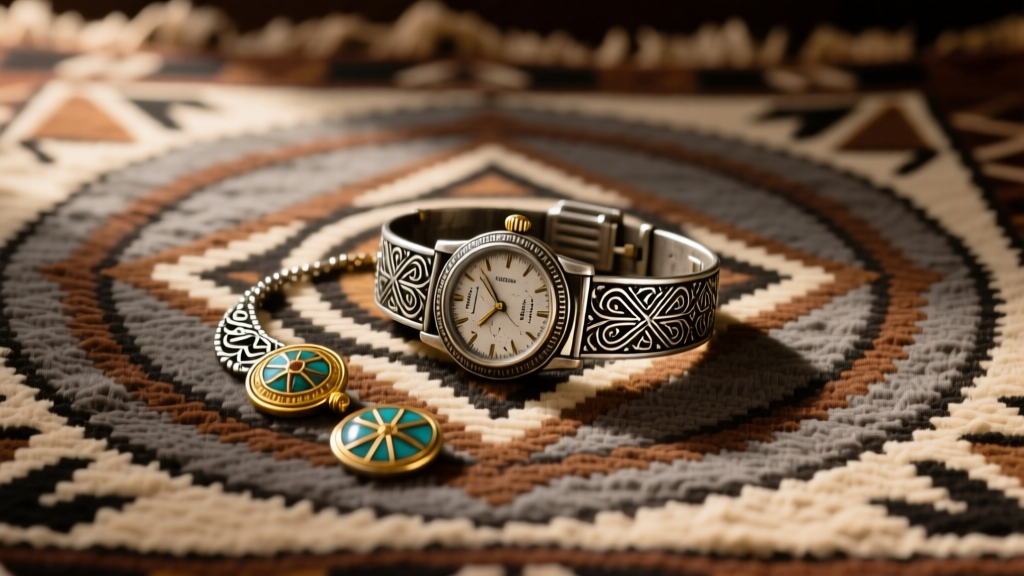
Navajo Gray-Brown Geocentric Band Rug: A Masterpiece of 20th-Century Weaving Tradition

Canton China Tureen Soup Dish, 19th Century: Provenance, Craftsmanship, and Market Significance of a 6 × 10-Inch Export Porcelain Masterpiece

The General Electric Grandfather Clock: Engineering Legacy, Design Innovation, and Collector Realities
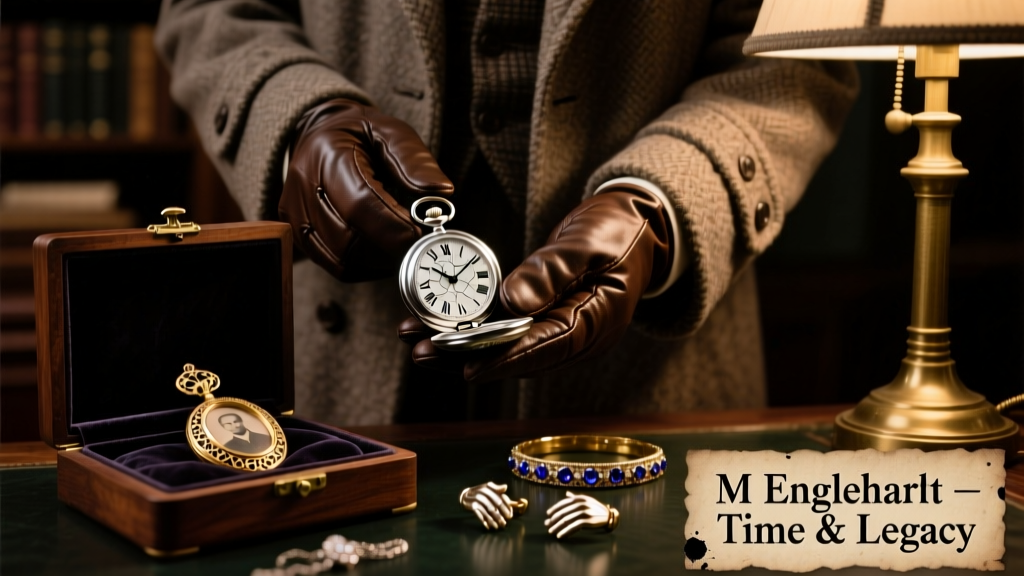
M. Englehart: The Forgotten American Watchmaker Who Built Precision Timepieces for the U.S. Military and Railroads
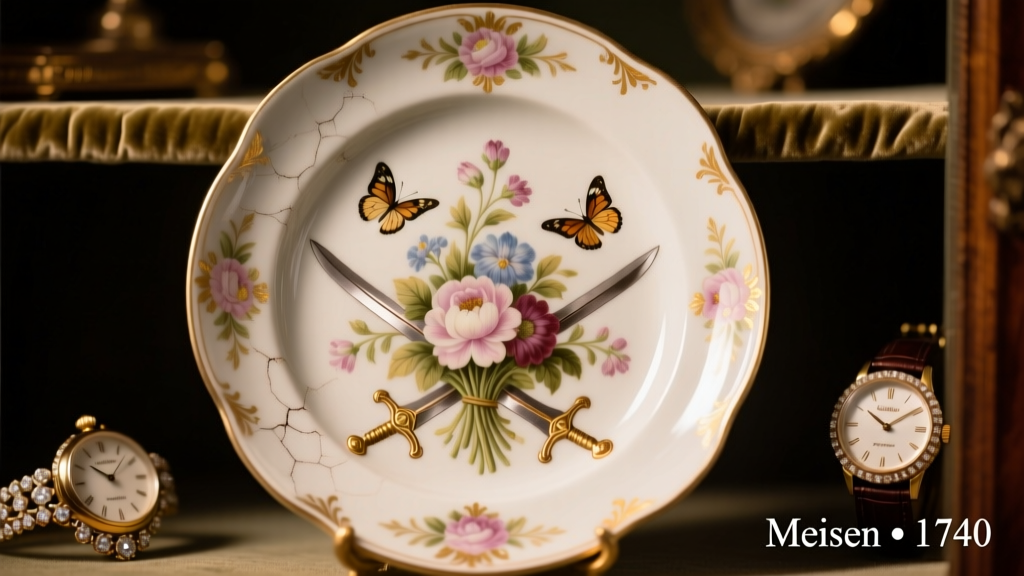
Meissen Plate, Bouquet Center with Butterflies & Floral Motifs, Crossed Swords Mark, 10-Inch Diameter — A Connoisseur’s Appraisal

Owens Vase 'Rust Pansies' in Yellow-Brown Glaze: A Signature Art Pottery Masterpiece, Signed & Measuring 8 Inches