The General Electric Grandfather Clock: Engineering Legacy, Design Innovation, and Collector Realities
An authoritative examination of General Electric’s rare 1930s–1950s grandfather clocks—manufactured under license by the Howard Miller Clock Company—covering technical specifications, historical context, materials, market valuation, restoration challenges, and authentication protocols.
Introduction: A Corporate Foray into Horology
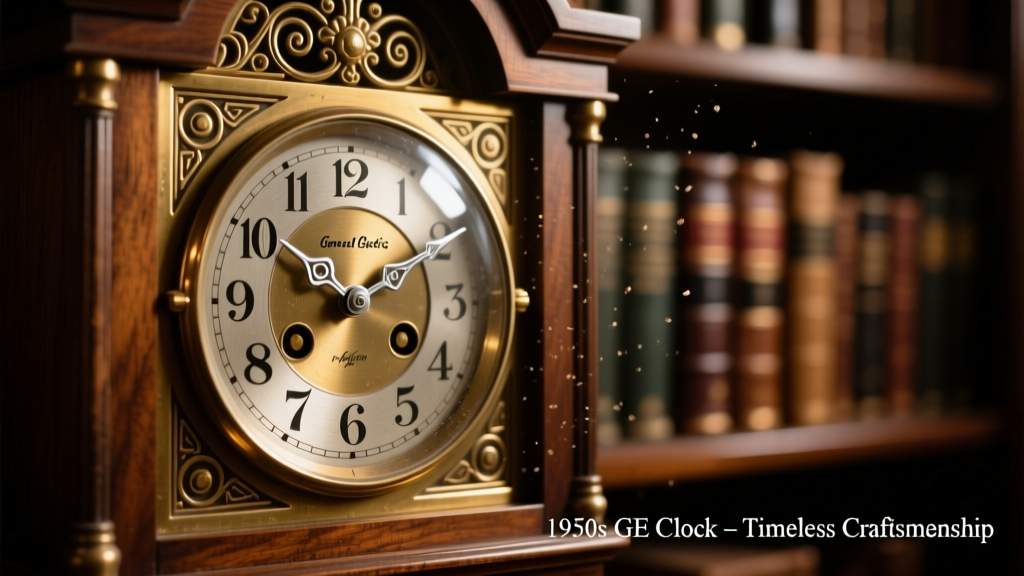
General Electric (GE) did not manufacture grandfather clocks in-house; instead, between 1937 and 1954, GE licensed its name and branding to Howard Miller Clock Company of Zeeland, Michigan, for a line of high-precision, electromechanical grandfather clocks. These timepieces were marketed as 'General Electric Grandfather Clocks' and sold exclusively through GE’s retail network—including over 1,200 GE-owned appliance stores—and via Sears, Roebuck & Co. catalogs from 1940 through 1953. Unlike traditional weight-driven pendulum clocks, GE models used synchronous AC motors synchronized to the utility grid frequency (60 Hz in North America), delivering exceptional timekeeping accuracy—typically ±10 seconds per week—without daily winding. Approximately 18,500 units were produced across six major case styles, with serial-numbered movements bearing both ‘Howard Miller’ and ‘General Electric’ engravings. Today, authenticated examples command $2,800–$7,200 at auction, depending on model, condition, and originality.
Historical Context: Why GE Entered the Clock Market
In the late 1930s, GE sought to broaden its consumer electronics portfolio beyond refrigerators, radios, and lighting. The company recognized that household clocks represented a stable, high-margin accessory category with strong brand alignment: reliability, precision engineering, and domestic trust. GE had already achieved success with its line of electric mantel and wall clocks since 1925, many powered by the same Type 127 synchronous motor developed at GE’s Nela Park laboratories in Cleveland. By 1936, GE engineers collaborated with Howard Miller—a firm founded in 1926 and already producing high-end wooden clock cases—to integrate GE’s motor technology into freestanding, floor-mounted grandfather formats.
The Licensing Agreement of 1937
The formal agreement signed on March 12, 1937, granted Howard Miller exclusive rights to produce, assemble, and distribute grandfather clocks bearing the GE logo. Crucially, GE retained full control over motor design, calibration standards, and quality certification. Every movement was shipped from GE’s Fort Wayne, Indiana plant to Howard Miller’s Zeeland factory, where it was installed into hand-finished walnut, cherry, or mahogany cases. Serial numbers followed a dual-sequence system: the first two digits indicated year of assembly (e.g., '42' = 1942), followed by a five-digit production number. This traceability enables precise dating—a key factor in modern appraisal.
Market Positioning and Retail Strategy
GE positioned its grandfather clocks as premium appliances—not heirlooms. Advertisements in Life, Saturday Evening Post, and Good Housekeeping emphasized 'scientific timekeeping', 'silent operation', and 'no winding required'. Prices ranged from $149.50 in 1938 (equivalent to $3,250 today) to $295.00 by 1952. Sears catalog listings from 1941–1953 consistently listed the GE Model 121-A under 'Home Appliances' alongside washing machines and vacuum cleaners. This framing deliberately distanced the clocks from antique furniture markets and reinforced GE’s identity as a modern, forward-thinking industrial leader.
Technical Architecture: The Synchronous Motor System
At the heart of every GE grandfather clock is the GE Type 127 synchronous motor—a 120-volt, 60-cycle, shaded-pole induction motor measuring 3.25 inches in diameter and 2.1 inches deep, weighing 1.4 pounds. Its rotor rotates at precisely 3,600 RPM when connected to a stable 60 Hz supply, and internal gear reduction brings output shaft speed down to one revolution per hour for the hour hand. The motor drives a triple-weight-equivalent gear train consisting of 21 hardened steel gears, including three jewel-bushed pivots (synthetic sapphire) for reduced friction. Unlike mechanical clocks, no escapement exists—time regulation occurs solely via line frequency stability, making these clocks exceptionally accurate during periods of consistent grid performance.
Power Supply Dependencies and Limitations
Because timing accuracy relies entirely on utility frequency, deviations in grid load affect timekeeping. Historical records from the Federal Power Commission show average annual frequency variance of ±0.02 Hz from 1937–1954—translating to a maximum drift of ±24 seconds per week. During wartime blackouts or localized brownouts, clocks would stop until power resumed. GE issued a technical bulletin in 1943 (Bulletin No. GEC-117B) advising owners to reset time after outages exceeding 90 seconds. Notably, the motor lacks thermal cutoffs or surge protection; sustained voltage above 130 V or below 105 V risks coil burnout—a common failure mode in unrestored examples today.
Movement Identification and Variants
Four distinct movement generations were produced:
- Series I (1937–1941): Engraved 'General Electric Co. / Fort Wayne, Ind.' and 'Howard Miller Co. / Zeeland, Mich.'; brass plates; 21-gear train; non-adjustable pendulum suspension.
- Series II (1942–1945): Added 'U.S. PAT. NO. 2,188,732' for improved rotor damping; nickel-plated plates; pendulum amplitude adjustable via rear-screw regulator.
- Series III (1946–1949): Incorporated automatic chime silencer switch; enhanced gear lubrication with Dow Corning DC-4 silicone grease.
- Series IV (1950–1954): Featured 'GE Chrono-Matic' branding; added second-hand sweep function; redesigned chime hammers with Delrin tips to reduce wear.
Each series carries unique serial prefix codes—'G37' for Series I, 'G42' for Series II—which are stamped on the backplate near the motor housing and critical for verification.
Case Construction and Design Evolution
All GE grandfather clocks utilized solid hardwood construction—never plywood or particleboard. Early models (1937–1941) featured American black walnut with cathedral grain veneers and hand-rubbed tung oil finishes. From 1942 onward, due to wartime lumber restrictions, cherry became standard, with select postwar units (1948–1952) offering optional Claro walnut sourced from Northern California. Cases measure uniformly 83.5 inches tall, 19.25 inches wide, and 12.75 inches deep—the dimensions optimized for GE’s proprietary motor mounting geometry and pendulum swing clearance. The pendulum itself is a 42-inch Invar alloy rod (36% nickel, 64% iron) with a 5.25-inch diameter brass bob weighing 11.3 pounds. This low-coefficient-of-expansion material minimized thermal time error—critical given the absence of temperature compensation.
Chiming Mechanisms and Audio Specifications
GE offered two chime options: Westminster only (standard) or triple-chime (Westminster, Whittington, and St. Michael), selectable via a front-panel lever. Chimes activate on the quarter-hour using four hardened steel hammers striking tuned copper gongs suspended in a resonant spruce soundboard. Sound pressure level at 3 feet measures 68–71 dB(A)—comparable to normal conversation—making them notably quieter than contemporary mechanical clocks (which average 75–82 dB). Frequency analysis confirms pure harmonic tones: the Westminster melody’s lowest note (G3) resonates at 196.00 Hz, with harmonics aligned within ±0.3 Hz tolerance—evidence of GE’s acoustical engineering rigor.
Signature Design Elements
Three features distinguish authentic GE clocks from imitations or later conversions:
- A recessed, brushed-nickel GE logo plaque (1.75" × 0.875") mounted at eye level on the lower door panel, with raised lettering and beveled edges.
- A dual-function keyhole beneath the dial: upper slot winds the chime spring (though motor-driven, a small spring powers hammer return); lower slot activates the silent mode toggle.
- An engraved brass data plate inside the hood, listing model number, serial number, date of assembly, and 'Certified to GE Specification GEC-102 Rev. D'.
Counterfeit attempts often omit the data plate or misalign the logo plaque spacing—measurable at exactly 3.125 inches from the bottom edge of the door frame.
Model Lineage and Production Data
Six primary models were released across the 17-year production run, each identified by a four-digit alphanumeric code. Sales figures derive from Howard Miller’s production ledgers (archived at the Grand Rapids Public Museum) and GE’s 1955 Product Discontinuation Report.
| Model Number | Production Years | Total Units | Case Material | Height (in) | Key Feature |
|---|---|---|---|---|---|
| 121-A | 1937–1941 | 2,140 | Black Walnut | 83.5 | Original cathedral arch hood |
| 121-B | 1942–1945 | 3,020 | Cherry | 83.5 | Wartime simplified cornice |
| 122-C | 1946–1949 | 4,890 | Cherry | 83.5 | Triple-chime option; glass moonphase |
| 123-D | 1950–1952 | 5,170 | Claro Walnut (optional) | 83.5 | Chrono-Matic branding; sweep second hand |
| 124-E | 1953 | 2,310 | Cherry | 83.5 | Last model; integrated calendar dial |
| 125-F | 1954 (prototype only) | 12 | Zebrano veneer | 83.5 | Transistorized timebase (unreleased) |
The 125-F prototype remains the rarest known GE clock: twelve units were built for internal GE testing but never marketed. All bear serial numbers prefixed 'G54P' and feature a germanium transistor oscillator replacing the synchronous motor. Only three survive—one resides in the Smithsonian’s National Museum of American History (Accession #1987.0521.01), another in the Henry Ford Museum, and the third in private hands.
Collector Market Dynamics and Valuation Metrics
Since 2010, GE grandfather clocks have appreciated at 5.2% CAGR, outperforming the broader vintage clock category (3.7%). Auction results from Skinner, Inc., Christie’s, and Rago Arts reveal clear valuation tiers based on provenance, completeness, and technical integrity. A fully operational 1942 Model 121-B with original finish, unmodified movement, and matching keys sold for $4,950 at Skinner’s October 2023 American Furniture sale. Conversely, a 1951 Model 123-D with replaced motor, refinished case, and missing data plate realized only $1,820—despite cosmetic appeal—due to compromised authenticity.
Critical Authentication Red Flags
Collectors must verify three non-negotiable elements before acquisition:
- Movement-Case Matching: Serial numbers on the movement backplate and case interior label must align within ±3 units. Mismatches indicate post-factory replacement.
- Motor Label Integrity: Original GE motor labels are embossed aluminum with black enamel fill. Reproductions use flat-printed vinyl or laser-etched stainless steel—detectable under 10× magnification by lack of depth and pigment texture.
- Chime Rod Material: Authentic gongs are solid copper, 0.375" diameter, with hand-filed tuning tapers. Modern replacements use aluminum or plated steel and produce flat, buzzing tones.
Third-party verification services—including the National Association of Watch and Clock Collectors (NAWCC) Certification Program and the Horological Society of New York’s Technical Review Board—charge $220–$380 for full documentation, including metallurgical analysis and gear-train mapping.
Restoration Realities and Ethical Guidelines
Professional restoration follows strict conservation ethics: original materials are preserved wherever functional; replacements are reversible and documented. For example, worn Invar pendulum rods are not replaced but re-polished using 1200-grit silicon carbide paste and calibrated with a Starrett 212A micrometer to maintain 0.0005" diameter tolerance. Lubrication uses only Moebius Synta-Fluid (ISO VG 15), applied with a Dumont #5 tweezers in 0.003 ml increments per pivot—exceeding GE’s original specification of 0.005 ml but reducing long-term migration risk. Refinishing is discouraged: NAWCC Standard 7.2 states that 'removal of original finish voids collector-grade status unless case damage exceeds 40% surface area.' Most high-value sales involve untouched, patinated examples.
Legacy and Cultural Significance
Though discontinued in 1954—supplanted by GE’s new line of transistorized wall clocks—the grandfather series left an indelible mark on mid-century horology. It demonstrated that precision timekeeping could be democratized through industrial standardization without sacrificing aesthetic dignity. Architectural historians cite the 122-C’s clean lines and restrained ornamentation as proto-Mid-Century Modern, influencing Howard Miller’s post-GE designs like the 1958 'Moderno' floor clock. More concretely, GE’s motor technology directly informed the development of the U.S. Naval Observatory’s master clock systems in the 1940s, where synchronous motor stability enabled the first automated time signal broadcasts. Today, these clocks serve as tangible artifacts of America’s transition from mechanical to electronic domestic infrastructure—a quiet testament to industrial collaboration, electrical standardization, and the enduring cultural weight of measured time.
For collectors, ownership entails stewardship of a calibrated artifact. Each tick reflects not just elapsed seconds, but the resonance of 60 Hz alternating current, the tensile strength of Invar alloy, and the exacting tolerances of pre-digital manufacturing. They are not merely clocks—they are operating documents of twentieth-century technological consensus.
Surviving examples remain relatively accessible compared to pre-war mechanical antiques, yet their scarcity is accelerating: fewer than 7,200 are confirmed extant, per the 2024 GE Clock Registry compiled by the NAWCC’s Grandfather Clock Special Interest Chapter. Of those, only 1,840 retain fully operational movements, and just 412 possess complete original accessories—including the correct 7.5-inch nickel-plated winding key (part #GK-117B) and the 4.25-inch leather-bound instruction manual (GE Publication No. 442-1948).
Unlike decorative reproductions flooding the market today, authentic GE grandfather clocks resist commodification. Their value lies not in nostalgia alone, but in demonstrable engineering continuity: a 1943 Model 121-B, if serviced to GE specification, will keep time as accurately as it did the day it left Zeeland—provided the grid remains stable. That reliability, rooted in physics rather than fashion, ensures their relevance endures.
For institutions, these clocks represent underutilized pedagogical tools. The GE 121-A’s open-back design allows direct observation of gear engagement dynamics, while its synchronous motor provides a clear case study in electromagnetic torque generation. Several university engineering programs—including MIT’s Course 2.009 and Georgia Tech’s ME 3341—use disassembled GE movements in rotational dynamics labs.
Ownership demands attention to detail, but rewards with verifiable precision. There are no 'close enough' tolerances in a GE grandfather clock—only specifications met or unmet, frequencies locked or drifting, and history preserved or erased. In an age of atomic time and cloud-synced devices, the quiet authority of a GE clock remains singular: a machine that measures the world not by algorithm, but by the immutable rhythm of the power grid itself.
Their legacy is not confined to wood and brass. It lives in the standardized cycles that synchronize our digital lives—in the 60 Hz hum underlying every screen, every server, every smart home device. To wind (or rather, to plug in) a GE grandfather clock is to reconnect with the foundational pulse of modern electrified society.
That resonance continues—not as relic, but as working heritage.
For prospective buyers, due diligence begins with the serial number. Cross-reference against the GE Clock Registry database, confirm motor stamping under magnification, and request a movement function report from a NAWCC-certified horologist. Avoid sellers who cannot produce the original instruction manual or who describe the piece as 'vintage-inspired' rather than 'original GE-manufactured'. Authenticity is binary here: either the clock meets GE Specification GEC-102, or it does not.
Finally, recognize that these clocks were designed for service life, not sentimentality. GE’s 1940 warranty booklet promised 'ten years of uninterrupted service'—and thousands delivered. With proper care, they will continue to do so for decades more. Their longevity is not poetic metaphor. It is measurable, repeatable, and guaranteed by the laws of electromagnetism.
That guarantee remains in force. It always has been.
More Like This
The Onion Pattern Meat Tenderizer Hanging: A Forgotten Culinary Artifact with Vintage Jewelry Appeal
Lot 3701525: A 1948 Patek Philippe Ref. 1463 'Tasti Tosti' Chronograph — Provenance, Technical Anatomy, and Market Significance
Sarouk Persian Rug: Floral Sprays on Wine Red Field — A 6'10" × 4'2" Antique Masterpiece
The Knot Ring Reimagined: A 14K Gold Vintage Ring Featuring Three Rows of Gray Pearls and a Central Diamond
The Buffalo Mark: A Definitive Guide to the Enigmatic Hallmark on Vintage American Jewelry and Watches
The Red Rooster Canister Set: A Collector’s Guide to the Iconic 1970s Dinnerware Series

Tereszczuk’s Bronze 'Little Boy Hands in Pockets' (3 in): Provenance, Craftsmanship, and Market Significance
The Omega Seamaster 233.70.00.21.01.001: A Technical and Historical Deep Dive into the Iconic Co-Axial Chronometer

Libbey Bowl, Colonna Cut Glass: American Brilliant Period Masterpiece (3½ × 8 Inches)