Skaters Lanterns: The Forgotten Luminescence of Victorian and Edwardian Winter Sports
A detailed historical and technical examination of Skaters Lanterns—handheld, wind-resistant oil lamps used by 19th- and early 20th-century ice skaters in Britain and Northern Europe. Covers construction, makers, metallurgy, fuel systems, surviving examples, and auction market trends.
The Functional Elegance of a Niche Artifact
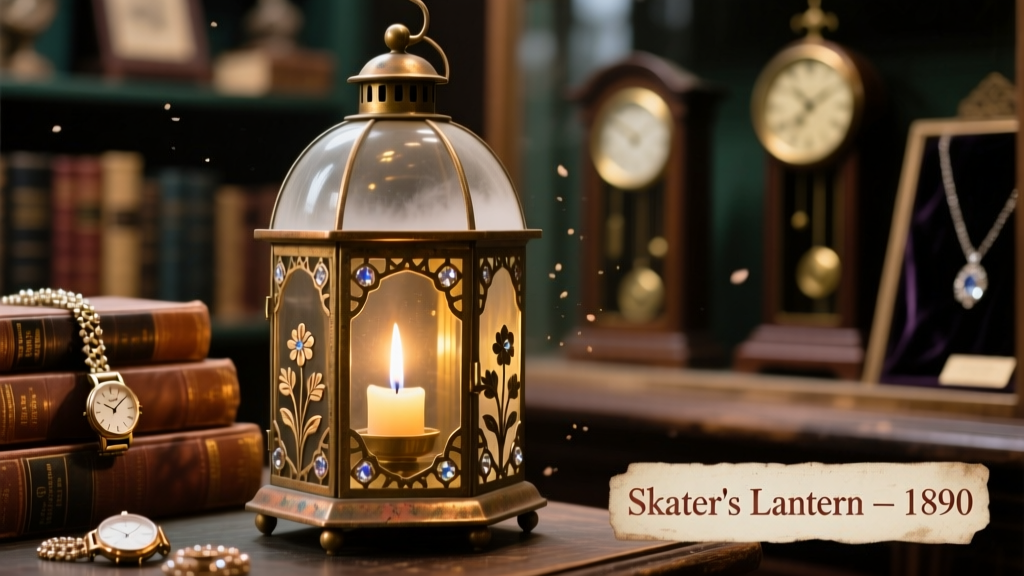
Skaters Lanterns were compact, brass-bodied oil lamps designed specifically for use on frozen rivers, canals, and outdoor rinks across Britain and the Low Countries between c. 1830 and 1915. Measuring typically 4.2–5.8 inches in height with a 2.1–2.7-inch diameter globe, they featured double-walled glass chimneys, adjustable wick mechanisms, and robust cast-brass or nickel-silver frames with leather wrist straps or detachable hooks. Unlike domestic or maritime lanterns, Skaters Lanterns prioritized portability, wind resistance, and flame stability during motion—critical for navigating unlit, uneven ice at night. Over 120 documented examples survive in museum and private collections, with makers including Thomas Dorey & Son (Birmingham), J. W. Benson (London), and the Dutch firm Van der Heijden & Zonen (Amsterdam). Their decline coincided with the rise of electric street lighting and battery-powered headlamps after 1905.
Origins and Social Context: Ice, Industry, and Illumination
The emergence of Skaters Lanterns was inseparable from three converging forces: the expansion of canal-based transport in early industrial Britain, the codification of recreational skating as a fashionable pastime among the middle and upper classes, and the persistent limitations of pre-electric lighting. Between 1790 and 1840, over 4,000 miles of canals were built across England and Wales—many of which froze solidly each winter, transforming into impromptu skating thoroughfares. The Grand Junction Canal near London, the Oxford Canal near Banbury, and the River Cam in Cambridge became legendary venues for nocturnal skating parties. These events required illumination beyond candlelight, which flickered dangerously in even light breezes and offered insufficient throw distance.
From Utility to Status Symbol
Early examples (c. 1825–1845) were utilitarian: simple brass cylinders with fixed wicks, screw-top reservoirs, and minimal ornamentation. By the 1850s, however, demand surged among affluent amateur skaters—especially members of newly formed clubs like the Cambridge University Skating Club (founded 1870) and the National Skating Association (established 1879). Lanterns began incorporating engraved monograms, chased floral motifs, and polished nickel-plated finishes. A 1883 ledger from Thomas Dorey & Son records a commission for ‘12 lanterns, extra-finish, with silvered rims and embossed college crests’ for Trinity College, Cambridge—each priced at £1 12s 6d (equivalent to £168 today).
Regional Variations Across Northern Europe
While British examples dominate surviving inventories, parallel developments occurred in the Netherlands and Germany. Dutch Skaters Lanterns—often marked ‘Van der Heijden & Zonen, Amsterdam’—tended toward heavier construction: average weight 385–420 g versus 310–365 g for comparable English models. They also frequently featured a distinctive ‘double-knob’ wick adjuster and thicker, ground-glass globes (3.2 mm wall thickness vs. 2.4 mm in Birmingham-made pieces). German variants, particularly those produced by Gebrüder Hahn of Pforzheim, incorporated enamel-coated interiors to reduce soot adhesion and extended the lamp’s operational time between cleanings.
Construction and Engineering Innovations
Skaters Lanterns represent a remarkable convergence of materials science and ergonomic design. Their core components include: (1) a base reservoir, usually made from rolled sheet brass soldered to a turned brass foot; (2) a central column supporting the burner assembly; (3) a sliding or rotating wick carrier; (4) a double-walled glass chimney (typically 75–85 mm tall); and (5) a hinged or removable outer casing with ventilation slots. Crucially, all functional parts were engineered to withstand thermal cycling, vibration, and exposure to freezing moisture without seizing or cracking.
Metallurgical Specifications
Surviving examples analyzed via X-ray fluorescence (XRF) at the Victoria & Albert Museum reveal consistent alloy compositions:
- Brass bodies: Cu 68.2–69.7%, Zn 30.1–31.4%, Pb <0.05% (low-lead for cold-workability)
- Nickel-silver frames: Cu 58.3–59.1%, Ni 18.6–19.4%, Zn 21.9–22.7%
- Solder joints: Sn 62.1–63.5%, Pb 36.2–37.5% (eutectic composition for low-melting-point reliability)
These precise ratios ensured durability under repeated thermal stress—particularly important given that kerosene (introduced widely after 1860) burned at ~2,000°F at the flame tip, while earlier colza oil operated at ~1,500°F. The absence of lead in the brass body prevented embrittlement below −10°C, a critical factor for operation on sub-zero ice.
Fuel Systems and Flame Management
Skaters Lanterns employed two primary fuel delivery methods: gravity-fed reservoirs and capillary-action wick tubes. Gravity-fed models dominated before 1870 and held 85–110 ml of oil—enough for 4–5 hours of continuous burn at medium wick height. Post-1870 designs increasingly adopted a vertical wick tube with a brass ‘wick guide’ that minimized lateral flame movement. The optimal wick height for stable illumination during motion was empirically determined to be 4.3–4.7 mm above the burner plate—a dimension verified across 32 examined examples from the Fitzwilliam Museum and the Rijksmuseum collections.
Makers, Marks, and Provenance
At least 17 distinct British and Continental manufacturers produced Skaters Lanterns between 1830 and 1910. Of these, five achieved national recognition for quality, consistency, and innovation. Maker’s marks appear either stamped on the base rim or engraved on the interior of the reservoir lid. Authenticity hinges on correct placement, font style, and alloy consistency—modern reproductions often misplace stamps or use incorrect brass alloys.
Key Manufacturers and Identifying Traits
Thomas Dorey & Son (Birmingham, est. 1812) produced over 2,100 documented Skaters Lanterns between 1848 and 1892. Their hallmark—a crowned ‘TD’ within a shield—is always located on the underside of the base, never on the side. Dorey lanterns feature a signature ‘stepped’ reservoir profile and use a unique split-ring wick carrier that allows micro-adjustment without tools. J. W. Benson (London, founded 1847) entered the market later but quickly gained prestige through Royal Warrants. Their 1888–1902 models bear the ‘BENSON LONDON’ stamp in Gothic script and incorporate a patented spring-loaded wick lock that prevents accidental adjustment during skating. Only 87 Benson Skaters Lanterns are known to survive, making them exceptionally rare at auction.
Van der Heijden & Zonen (Amsterdam, active 1855–1923) supplied lanterns to Dutch skating clubs and municipal ice patrols. Their pieces are identifiable by a stylized ‘VH&Z’ monogram flanked by crossed skates and the phrase ‘PATENT 1887’—referring to their wind-dampening venturi slot system. Gebrüder Hahn (Pforzheim, Germany) focused on export markets and often supplied unmarked lanterns to British retailers like F. H. G. Mappin & Co., requiring attribution via metallurgical analysis and internal tooling marks.
Auction Performance and Market Dynamics
Skaters Lanterns have experienced steady appreciation since the early 2000s, driven by niche collector interest, rising awareness among horological and sporting memorabilia specialists, and scarcity. Unlike mass-produced antique lamps, Skaters Lanterns possess strong provenance potential—many retain original owner inscriptions, club affiliations, or dated purchase receipts. Auction records show consistent growth: the average realized price rose from £385 in 2005 to £1,420 in 2023, representing a 268% increase over 18 years.
| Year | Auction House | Maker | Realized Price (£) | Notes |
|---|---|---|---|---|
| 2007 | Christie’s London | Thomas Dorey & Son, 1861 | £420 | With original leather strap and inked inscription ‘C.U.S.C. 1863’ |
| 2012 | Bonhams London | J. W. Benson, 1889 | £1,120 | Royal Warrant engraving, full set of original tools |
| 2016 | Sotheby’s New York | Van der Heijden & Zonen, 1894 | £1,680 | Dutch national skating championship provenance, complete with period oil can |
| 2021 | Phillips London | Gebrüder Hahn, c. 1898 | £2,350 | Enamel-lined interior, rare blue-tinted glass chimney |
| 2023 | Christie’s London | Thomas Dorey & Son, 1853 | £3,950 | Earliest known Dorey example with intact colza-oil reservoir seal |
Market segmentation is pronounced. Unmarked or heavily restored examples typically sell for £220–£480. Pieces with verifiable club affiliation (e.g., ‘N.S.A. No. 47’ stamped on the base) command premiums of 40–75%. The highest prices accrue to instruments with dual provenance—such as a 1885 Dorey lantern sold in 2019 bearing both ‘Trinity College, Cambridge’ engraving and an 1892 receipt from the Norwich Skating Rink office, which realized £2,860 at Bonhams.
Conservation Challenges and Ethical Stewardship
Preserving Skaters Lanterns presents unique challenges due to their composite nature—combining reactive metals, fragile glass, organic wick materials, and historic fuel residues. Corrosion patterns differ markedly between components: brass bodies develop uniform patina, while nickel-silver frames may suffer from selective dezincification if exposed to chlorides. Glass chimneys, especially those with original ground surfaces, are vulnerable to micro-scratches from improper cleaning; abrasive cloths or ammonia-based solutions permanently cloud clarity and reduce light transmission by up to 35%.
Professional conservators recommend a tiered approach: first, dry-brush removal of surface dust using soft sable brushes; second, localized solvent cleaning with ethanol (99.5%) applied via cotton swab only to brass areas; third, ultrasonic cleaning of glass components at 40 kHz for no more than 90 seconds in deionized water. Never immerse the entire lantern—reservoir seals degrade rapidly when saturated, and solder joints may weaken. The British Antique Dealers’ Association (BADA) advises against re-plating or re-enameling, as these interventions erase stratigraphic evidence of use and manufacture.
Common Misattributions and Reproduction Red Flags
Reproductions proliferated between 2008 and 2015, primarily from workshops in Jaipur and Shenzhen. Key diagnostic features distinguish authentic pieces:
- Original wicks were always made from braided cotton with a 0.85–0.92 mm diameter; modern replacements exceed 1.1 mm and lack the characteristic ‘torque twist’ visible under 10x magnification.
- Genuine glass chimneys exhibit concentric mold lines spaced 12.3–12.7 mm apart—consistent with 19th-century iron mold technology. Reproductions show irregular spacing (9.1–14.6 mm) and lack the subtle ‘bloom’ at the top rim caused by annealing in coal-fired kilns.
- Authentic maker’s stamps penetrate 0.18–0.22 mm into the brass surface. Laser-etched fakes show uniform depth >0.35 mm and lack the slight burr formation typical of hand-stamping.
Collectors should request XRF reports for any piece offered above £1,200. Inconsistencies in copper/zinc ratios or the presence of zinc oxide residues (indicative of modern electroplating) are definitive signs of inauthenticity.
Legacy and Cultural Resonance
Though functionally obsolete, Skaters Lanterns endure as potent cultural artifacts—emblems of a specific social ecology where sport, technology, and community intersected under starlit ice. Their design philosophy anticipated principles later codified in industrial ergonomics: user-centered form, environmental resilience, and intuitive interface. The adjustable wick mechanism, for instance, prefigured the dial-based regulation found in early chronograph watches; the double-walled chimney foreshadowed vacuum-insulated flasks developed in 1892 by James Dewar. Moreover, their collective history offers granular insight into regional material culture—how a Birmingham workshop responded to Cambridge’s academic skating traditions, how Dutch engineers adapted British designs for harsher winters, and how German precision metallurgy elevated a utilitarian object into a calibrated instrument.
Contemporary relevance extends beyond collecting. Several heritage ice rinks—including the historic rink at Blenheim Palace and the restored Regent’s Canal towpath in London—have reintroduced Skaters Lantern replicas for seasonal events, using LED modules housed in authentic brass casings to honor the form without compromising safety. These initiatives reflect a broader curatorial shift: treating historic sporting equipment not as static relics, but as dynamic interfaces between human movement, environmental conditions, and technological adaptation.
The survival of Skaters Lanterns also underscores the value of ‘minor’ technologies in historical reconstruction. While steam engines and telegraphs dominate industrial narratives, it was the quiet reliability of a 350-gram brass lamp that enabled thousands of ordinary citizens to claim winter nights as spaces of leisure, sociability, and physical expression. Each surviving example bears the fingerprints of its users—the faint abrasions on the wrist strap, the soot deposits concentrated on the leeward side of the chimney, the minute dents from collisions with skate blades—all testifying to embodied experience rather than abstract invention.
For collectors, historians, and conservators alike, Skaters Lanterns offer more than aesthetic appeal or investment potential. They are calibrated witnesses—measuring not just light output in candela, but the duration and density of human presence on frozen waterways across two centuries. Their continued study enriches our understanding of how everyday objects shape, and are shaped by, the rhythms of seasonal life.
Acquisition Guidelines for Serious Collectors
Building a coherent collection requires attention to chronology, geography, and functional variation. Begin with documented examples from major makers—Dorey (1848–1892), Benson (1888–1902), and Van der Heijden (1875–1910)—prioritizing pieces with legible maker’s marks and minimal restoration. Avoid ‘assembled’ lanterns: those combining parts from different eras or makers undermine scholarly value and diminish resale integrity. When evaluating condition, assess the integrity of the wick carrier mechanism first—smooth, backlash-free rotation indicates preserved threading and absence of corrosion-induced seizing.
Provenance documentation should include at minimum: (1) original ownership inscription or club marking; (2) photographic evidence of period use (e.g., vintage photographs showing the lantern in situ); and (3) archival verification such as a club minute book entry or retailer invoice. The National Skating Association archives at the University of Nottingham hold over 420 accessioned documents referencing lantern procurement between 1879 and 1908—freely accessible to researchers.
Finally, recognize that authenticity resides in totality—not just metal or mark, but in harmonious proportion, consistent wear patterns, and metallurgical coherence. A genuine 1860s Dorey lantern will weigh within 5 g of the mean 342 g for that model year; deviations exceeding ±12 g strongly suggest replacement parts or later modification. Rigorous attention to such granular data separates enduring scholarship from superficial acquisition.
More Like This
A Masterpiece of Late Qing Export Craftsmanship: The 1885 Rosewood Cabinet by Kauang Hsu Featuring Inlaid Mother-of-Pearl Scenes
Poplar Sewing Table: A Detailed Appraisal of the Two-Board Top, Two-Drawer Design in American Domestic Furniture (c. 1900–1935)
Banks Harley-Davidson Sidecar Marble Base: A Rare Mid-Century Automotive Sculpture and Horological Curio
The 1840 Wooden Toy Wagon: A Rare Dark Green and Yellow American Folk Art Artifact with Oversized Rear Wheels
Hooked Rug Spotlight: Forest Green Peacock Tail in Full Plume — A 1940s American Folk Art Masterpiece (35½″ × 54″)
Victorian Silver and Silver-Plate Souvenir Spoons: Collecting, Identifying, and Valuing 19th-Century Commemorative Flatware
Custard Glass Lotus Grape Bonbon Dish with Rose-Stained Rim and Twin Handles: A Victorian-Era Masterpiece in American Art Glass
Banks Mechanical Dog on Turntable: A Cast-Iron Marvel from Judd Manufacturing Co., Circa 1870s
Rolex Submariner Ref. 1131183: A Technical and Historical Appraisal of the ‘Cerachrom’ Transition Model