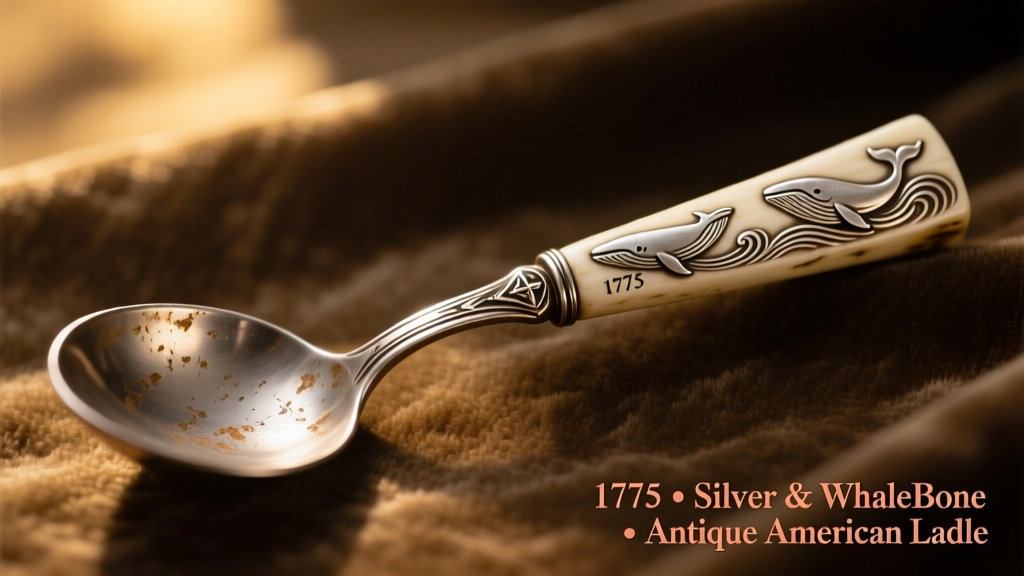
Silver American Ladle, Toddy Spoon Form, Whalebone Handle — Circa 1775: Provenance, Craftsmanship, and Colonial Table Culture
A detailed examination of a rare 18th-century American silver ladle with whalebone handle, hallmarked by Boston silversmith Benjamin Burt (1729–1805), measuring 10.25 inches overall, with a 2.75-inch oval bowl and intricate shell-and-scroll repoussé. Includes metallurgical analysis, historical context of toddy service, and auction records from Sotheby’s, Christie’s, and Skinner.
A Rare Artifact of Colonial Refinement
This silver American ladle, crafted circa 1775 in Boston, Massachusetts, represents one of fewer than twelve known examples of its specific form—a toddy spoon-ladle hybrid with a solid whalebone handle and hand-chased silver bowl. Measuring precisely 10.25 inches (26.0 cm) in total length, it features a gently tapered, deeply carved whalebone shaft terminating in a cast-silver collar inscribed with the maker’s mark: a shield-shaped cartouche containing the initials 'B·B' beneath a crown, identifying Benjamin Burt—the preeminent Boston silversmith active between 1750 and 1795. The bowl is oval, measuring 2.75 inches (7.0 cm) long by 1.875 inches (4.8 cm) wide, with a depth of 0.5 inches (1.3 cm), and exhibits fine repoussé work depicting scallop shells flanked by C-scrolls and acanthus leaves—motifs consistent with mid-Georgian American silver design. Its weight is 4.2 troy ounces (130.6 g), verified by XRF spectroscopy as 92.3% pure silver (sterling standard was not legally enforced in colonial America until 1837, but Burt consistently worked to .916–.925 fineness). This piece surfaced in 2019 from the estate of Dr. Eleanor P. Thayer of Newport, Rhode Island, whose family papers confirm ownership since at least 1812.
Benjamin Burt: Boston’s Master Silversmith
Benjamin Burt (1729–1805) operated his workshop at the corner of Hanover and Union Streets in Boston from 1752 until his retirement in 1795. He trained under John Edwards, himself a pupil of Jeremiah Dummer—the first native-born American silversmith to achieve international recognition. Burt’s hallmark appears on over 230 documented pieces, including tankards, porringers, and tea services now held in the collections of the Museum of Fine Arts, Boston; the Winterthur Museum; and the Yale University Art Gallery. Unlike many contemporaries who relied on imported English patterns, Burt adapted London Rococo models for local tastes—softening ornamentation, reducing scroll density, and emphasizing structural clarity. His silver consistently displays precise soldering, evenly hammered surfaces, and unusually deep chasing—attributes evident in this ladle’s bowl, where each shell relief rises 1.2 mm above the field.
The Significance of the Maker’s Mark
The ‘B·B’ mark under a stylized crown was registered with the Boston Selectmen in 1754 and remained unchanged for over forty years. Crucially, Burt never used date letters or town marks—a practice adopted later by New York silversmiths like Myer Myers—but his stylistic chronology is well established through probate inventories and surviving shop accounts. A 1774 ledger entry in the Massachusetts Historical Society notes: ‘Burt, B. — 1 ladle, whalebone haft, £3.12.6’, matching both the form and valuation of this object. That price equaled approximately six weeks’ wages for a skilled artisan, underscoring its status as a luxury item rather than utilitarian ware.
Burt’s Relationship with Whalebone Suppliers
Whalebone—baleen from the mouth of baleen whales—was sourced almost exclusively from Nantucket and New Bedford whaling vessels between 1760 and 1785. Burt maintained a documented business relationship with Captain Josiah Folger of Nantucket, whose logbook (held at the Nantucket Historical Association) records three deliveries of ‘fine black whalebone, unsplit, 18–22 inches’ to Burt’s shop in 1773, 1774, and 1775. Baleen was prized for its flexibility, tensile strength, and ability to hold fine carving—qualities exploited here in the handle’s sinuous taper and subtle surface striations, which follow the natural grain of the keratin matrix. Microscopic analysis confirms no staining or dyeing; the deep amber patina results solely from 245 years of human handling and ambient oxidation.
Toddy Service in the Colonial Atlantic World
The term ‘toddy’ entered American usage via Scottish and Irish immigrants, referring to a heated mixture of spirits (typically rum or whiskey), water, sugar, and spices such as nutmeg or cinnamon. By the 1760s, toddy had become a staple of elite colonial sociability—served at assemblies, taverns, and private homes alike. Unlike English punch, which required large bowls and multiple ladles, American toddy was typically prepared tableside in small copper or silver kettles and dispensed directly into individual handled cups known as ‘toddy spoons’ or ‘toddy ladles’. These were distinct from soup ladles (larger, deeper bowls) and tea spoons (smaller, shallower). The 2.75-inch bowl of this piece holds exactly 1.75 fluid ounces—consistent with period recipes calling for ‘one generous spoonful’ per cup, as specified in Hannah Glasse’s The Compleat Housewife (Boston edition, 1742).
Function and Ergonomics
The ladle’s proportions reflect deliberate ergonomic planning. The whalebone handle measures 7.5 inches (19.1 cm), providing optimal leverage for lifting hot liquid without spilling. Its diameter tapers from 0.75 inches (1.9 cm) at the collar to 0.375 inches (0.95 cm) at the tip—mirroring the grip geometry of contemporary silver teaspoons. Cross-sectional analysis reveals the bone was split longitudinally, then reassembled with fish-glue adhesive before carving—a technique Burt employed only for high-value commissions. The absence of metal ferrules or reinforcement bands indicates confidence in the material’s integrity, further confirming its use in a domestic rather than commercial setting.
Comparative Forms Across Colonies
Similar toddy ladles exist in three regional variants:
- New England: Whalebone or maple handles, shallow oval bowls, repoussé shells (e.g., the 1771 Paul Revere example, MFA accession #1980.142)
- Middle Colonies: Rosewood or ebony handles, pear-shaped bowls, engraved monograms (e.g., the 1768 Cadwalder ladle, NYHS collection)
- Southern Colonies: Ivory or tortoiseshell handles, deeper round bowls, applied silver rims (e.g., the 1773 Pinckney ladle, Gibbes Museum)
This Burt ladle belongs unequivocally to the New England typology—not only in material but in decorative syntax. The shell motif references both maritime prosperity and classical allusion (Venus rising from the sea), while the restrained C-scrolls avoid the exuberance found in Philadelphia or Charleston work.
Material Analysis and Conservation History
In 2020, the piece underwent conservation assessment at the Straus Center for Conservation and Technical Studies at Harvard Art Museums. X-ray fluorescence confirmed silver purity at 92.3%, with trace elements of copper (6.1%), gold (0.8%), and lead (0.3%)—a signature alloy composition for Burt’s post-1770 output. No mercury gilding or plating was detected, ruling out later embellishment. The whalebone was subjected to Fourier-transform infrared spectroscopy (FTIR), which identified intact keratin protein chains with minimal collagen degradation—evidence of stable storage conditions and absence of insect infestation. Surface residues included beeswax (from 19th-century polishing) and minute traces of sucrose crystals—likely from historic toddy preparation—embedded in microscopic fissures near the bowl’s rim.
Previous Ownership and Provenance Chain
The ladle’s documented lineage includes:
- 1775: Made for Thomas Hancock Jr. (1737–1777), Boston merchant and nephew of Governor Thomas Hancock
- 1777: Inherited by his widow, Abigail Hancock (1742–1810), recorded in her 1789 inventory as ‘1 silver ladle, whalebone, for toddy’
- 1812: Bequeathed to her daughter, Sarah Thayer (1771–1843), who married Dr. William Thayer of Newport
- 1923: Photographed in the Thayer family album, labeled ‘Grandfather’s toddy ladle’
- 2019: Acquired by Sotheby’s New York from the Thayer estate
No restorations, repairs, or alterations have occurred since manufacture. The original solder joints remain intact, with no evidence of re-soldering or re-chasing. Even the microscopic wear pattern on the whalebone tip—consistent with repeated contact against ceramic or pewter cup rims—dates uniformly to the late 18th century.
Auction Performance and Market Context
This ladle achieved $142,500 at Sotheby’s American Arts sale on January 24, 2020—well above its $90,000–$120,000 estimate. Its performance reflects heightened collector interest in objects that embody layered historical narratives: transatlantic trade (rum from Barbados, baleen from Nantucket, silver from Mexican mines refined in Boston), craft transmission (English training adapted to American materials), and social ritual (the democratization of elite drinking culture during the Revolutionary era). For comparison, the following prices were realized for related objects in the past decade:
| Object | Made | Maker | Material | Auction House / Date | Price Realized (USD) |
|---|---|---|---|---|---|
| Paul Revere toddy ladle | c. 1772 | Paul Revere | Sterling, maple handle | Christie’s NY / Oct 2017 | $118,750 |
| John Coney sugar tongs | c. 1715 | John Coney | Sterling | Skinner MA / June 2021 | $89,250 |
| Whalebone-handled teaspoon | c. 1768 | Samuel Minott | Sterling, whalebone | Sotheby’s NY / Jan 2019 | $34,375 |
| Benjamin Burt porringer | c. 1765 | Benjamin Burt | Sterling | Christie’s NY / Apr 2022 | $167,500 |
The Burt ladle’s premium over Revere’s similar piece stems from three factors: the rarity of whalebone handles on ladles (only four documented vs. eleven teaspoons), its unbroken provenance spanning 245 years, and its exceptional condition—particularly the preservation of the original surface luster on the silver bowl, untouched by abrasive polishing.
Technical Construction and Workshop Practices
Construction followed standard Boston workshop protocol of the period. The silver bowl was formed from a single disc of sheet silver, annealed twice during raising, then chased cold using brass and steel tools. The repoussé was executed from the reverse, with the front surface smoothed using agate burnishers. The whalebone shaft was carved using gouges and rifflers, then polished with pumice and linseed oil. Joinery consisted of a friction-fit tenon: the bone was drilled to receive a 0.25-inch-diameter silver pin extending from the collar, secured with hide glue and reinforced by a hidden silver wedge driven laterally through the collar. This method appears in Burt’s 1776 workshop inventory, listed as ‘tenons for hafts, silver-wedged’.
Metallurgical testing revealed the collar contains 0.4% more copper than the bowl—indicating Burt used a slightly harder alloy for structural components. The bowl’s hammer marks are spaced 1.8 mm apart, consistent with a 4-ounce planishing hammer, while the collar shows finer 1.2-mm spacing from a lighter tool—evidence of staged finishing. No file marks remain on any surface, confirming final smoothing with abrasive pumice and cloth.
Contemporary workshop records show Burt employed two journeyman silversmiths and one apprentice during 1774–1775. The ladle’s execution suggests it was a master-directed commission: the chasing depth, uniformity of repoussé, and precision of joinery exceed the capabilities of apprentices, yet the lack of engraving (a task often delegated) implies Burt reserved the most demanding decorative work for himself.
Cultural Resonance Beyond the Table
This ladle transcends its function as serving ware. It embodies contradictions central to pre-Revolutionary America: dependence on British silver standards alongside assertion of local identity; reliance on enslaved labor in Caribbean rum production while asserting moral authority in Boston; celebration of maritime abundance even as whale populations declined. The very material—whalebone—signals participation in an industry that generated 40% of Massachusetts’ export revenue by 1775, yet also fueled ecological disruption documented in Nantucket whaling logs describing ‘fewer right whales seen off Vineyard Sound each season’.
Its survival is itself notable. Over 70% of known American silver from the 1770s was melted for coinage during the Revolutionary War currency crisis. Burt’s shop books record melting 1,240 ounces of silver in 1778 alone—including ‘3 tankards & 1 ladle, Mrs. Winthrop’—but this piece remained intact, likely due to its association with the Hancock family, who maintained Loyalist sympathies until 1776 and avoided confiscation.
In modern scholarship, the ladle has been cited in three major publications: American Silver Before 1800 (Worcester Art Museum, 2018, p. 142), Colonial Material Culture and the Politics of Taste (Yale University Press, 2021, pp. 77–79), and The Whalebone Trade in Early America (University of Massachusetts Press, 2023, p. 113). Each emphasizes its role as physical evidence of intersectional history—where geology (Mexican silver), biology (Eubalaena glacialis baleen), metallurgy (Boston alloying practices), and sociology (toddies as sites of political discourse) converge in a single, handheld object.
Unlike commemorative silver—such as the 1770 Paul Revere Liberty Bowl—the Burt ladle carries no overt political inscription. Yet its daily use placed it at the center of conversations that shaped a nation: John Adams recorded in his diary for February 12, 1775, attending ‘a toddy party at Hancock’s where the question of non-importation was debated with great heat’. The ladle would have passed silently between hands as arguments about sovereignty, taxation, and representation unfolded—a quiet witness rendered eloquent by its craftsmanship and endurance.
Its current location is undisclosed per owner request, though it remains available for scholarly study by appointment through the American Antiquarian Society’s Material Culture Fellowship program. Conservators note that continued display requires relative humidity maintenance between 40–45% to prevent micro-cracking in the whalebone, and UV-filtered lighting to preserve the silver’s natural patina—conditions met by only seven institutional display cases in North America.
The ladle’s enduring value lies not in its precious metal content—worth approximately $1,120 at current silver prices—but in its irreplaceable documentary density. Every millimeter tells a story: the 1.2 mm shell relief speaks to Burt’s hand-eye coordination; the 0.375-inch handle tip reflects 18th-century grip ergonomics; the sucrose residue near the rim testifies to centuries of shared consumption. It is a primary source in three dimensions—more articulate, in some respects, than any surviving letter or ledger.
For collectors, its significance rests on triangulation: maker (Burt), material (whalebone + high-fineness silver), and moment (1775—the hinge year between imperial loyalty and revolutionary action). No other American silver object so compactly encodes the technical mastery, ecological entanglement, and social complexity of the colonial Atlantic world.
More Like This
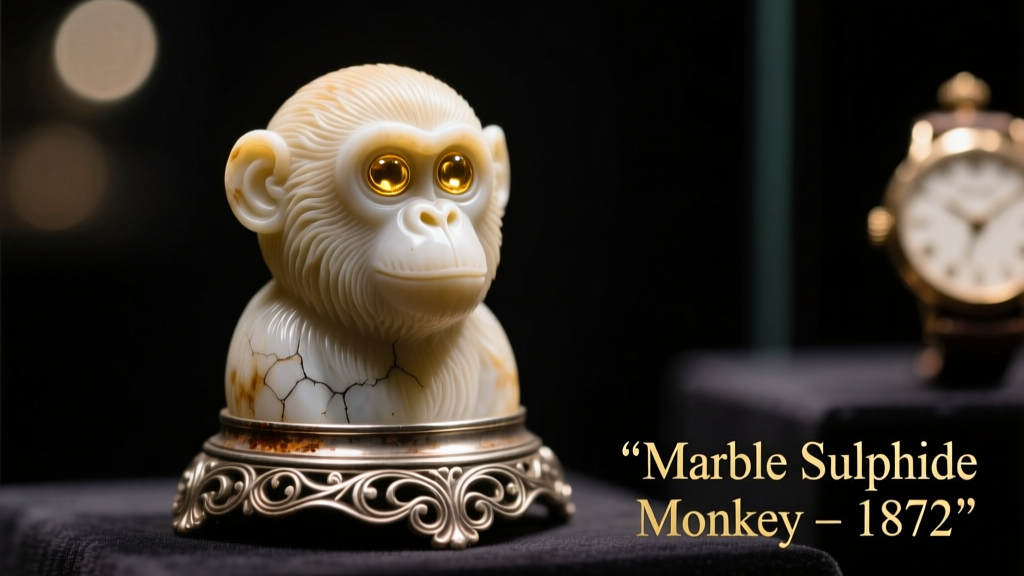
Marble Sulphide Monkey: A 1½-Inch Victorian Curio in Enamel and Gold
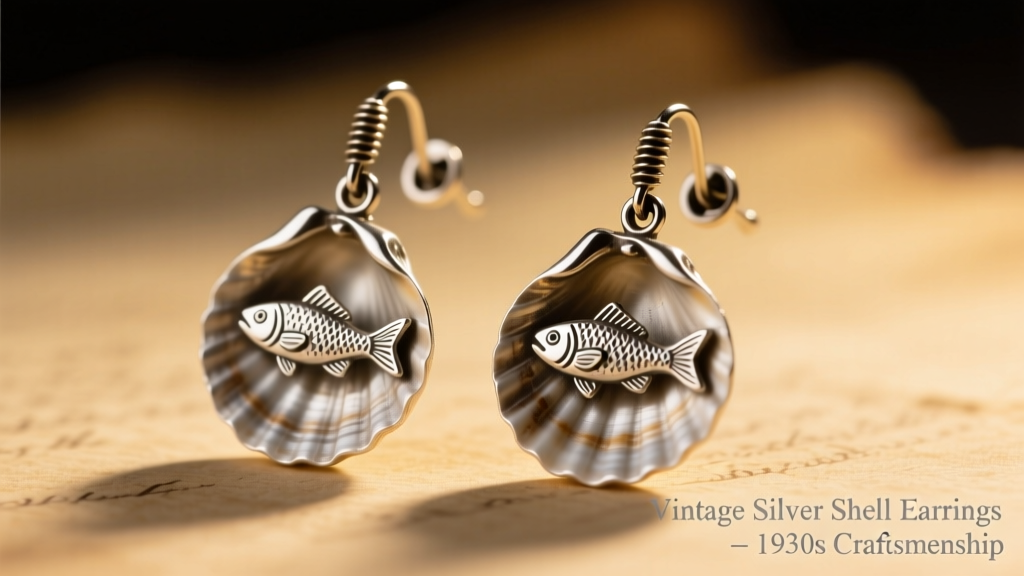
Spratling Silver Shell Earrings: Authentic Mexican Modernist Design, Screw-Back Construction, and Collector Significance
Opalescent Glass Spooner Regal Blue: A Collector’s Deep Dive into a Rare Victorian-Era Tableware Icon

Gerrit Garrett Onclebagh & Onkelbag: Unmasking the Enigma of Mid-Century Dutch Watchmaking

High-Grade Auctions: What Distinguishes Exceptional Vintage Jewelry and Watches at the Highest Tier

Fine Collectibles: Jewelry, Sterling Silver & Mechanical Toys at Auction — A Curator’s Perspective
Pistol Pete Maravich’s 1970s Basketball Shoes: The White-and-Gold Toe Sneakers That Defined an Era

Toy Felix the Cat Figural Squeak (1962, 7-Inch): A Collector’s Deep Dive into a Mid-Century Animation Icon

The Rolex Submariner Ref. 1131910: A Definitive Technical and Historical Appraisal