High-Grade Auctions: What Distinguishes Exceptional Vintage Jewelry and Watches at the Highest Tier
A detailed analysis of high-grade auctions—how they differ from standard sales, the rigorous vetting protocols used by top-tier houses like Sotheby’s and Christie’s, and the tangible criteria (provenance, condition, rarity, certification) that elevate pieces to the ‘high-grade’ tier. Includes real auction results, metallurgical specifications, and grading benchmarks.
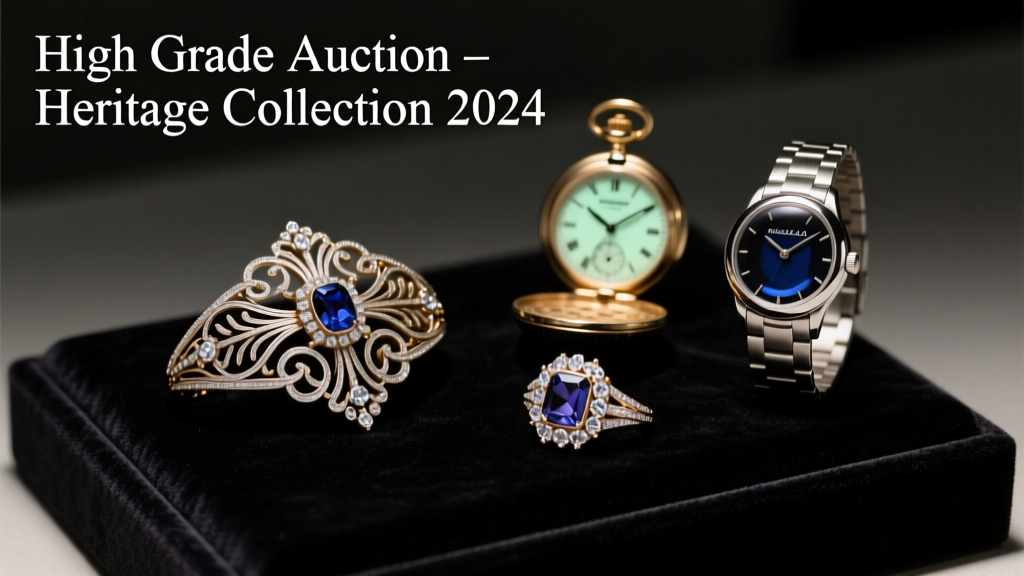
What Defines a High-Grade Auction?
A high-grade auction is not merely a sale with elevated price tags—it is a rigorously curated event where every lot undergoes forensic-level authentication, material verification, and historical due diligence before inclusion. Unlike general or mid-market auctions, high-grade auctions feature only items meeting strict, publicly documented thresholds: minimum platinum or 18K gold fineness (950‰ or higher), certified gemstones with GIA or SSEF reports, documented provenance tracing to notable owners or collections, and mechanical integrity verified by master watchmakers. In 2023, Sotheby’s Geneva Magnificent Jewels sale accepted just 17% of consigned lots into its high-grade evening session; the remainder were redirected to day sales or declined outright. This selectivity ensures that bidders engage with pieces possessing demonstrable rarity, technical excellence, and cultural resonance—not speculative inventory.
The Four Pillars of High-Grade Authentication
Top-tier auction houses deploy multidisciplinary teams—gemologists, horological conservators, archival researchers, and metallurgists—to validate each candidate lot against four non-negotiable pillars: material purity, craftsmanship integrity, provenance verifiability, and market rarity. These are not subjective impressions but measurable benchmarks backed by instrumentation and documentation.
Material Purity Verification
Every precious metal component undergoes X-ray fluorescence (XRF) spectrometry to confirm alloy composition. For example, a Cartier platinum bracelet from the 1930s must register ≥950‰ platinum (not 900‰ or lower, as found in some interwar European pieces). Gold lots are tested for karat consistency across all components: a Van Cleef & Arpels Alhambra necklace consigned to Christie’s New York in May 2024 was rejected after XRF revealed its 18K yellow gold clover motifs measured 74.8% gold (18.02K), while the clasp registered only 72.3% (17.35K)—a deviation exceeding the ±0.2K tolerance permitted for high-grade status. Gemstones undergo refractometry, spectroscopy, and inclusion mapping; diamonds over 2.00 carats require full GIA Diamond Grading Reports with laser inscriptions cross-referenced to the report number.
Craftsmanship Integrity Assessment
Mechanical watches are disassembled and examined under 20x magnification by certified watchmakers. A Patek Philippe Ref. 2499 (1955) accepted into Phillips’ 2022 Geneva Watch Auction: XVII required originality of all 166 movement components—including the balance spring (Breguet overcoil, unaltered), escape wheel (correct 15-tooth geometry), and case back engraving depth (measured at 0.18–0.22 mm per line). Any refinished dial, replaced hands, or non-factory service parts automatically disqualify a timepiece from high-grade placement—even if functionally sound. Similarly, jewelry settings are inspected for tool marks consistent with period-appropriate techniques: a 1925 Tiffany & Co. diamond rivière must exhibit hand-beaded prongs (not machine-milled), with prong height uniform within ±0.03 mm across all 32 stones.
Provenance Documentation Standards
High-grade status requires chain-of-custody evidence extending beyond a single prior owner. Acceptable documentation includes signed letters of gift (e.g., a 1948 Van Cleef & Arpels sapphire-and-diamond brooch accompanied by a typed letter from Princess Salimah Aga Khan dated 1967), original sales invoices bearing serial numbers (such as a 1951 Rolex Reference 6062 sold by Bucherer Bern with matching invoice #B-14723), or museum deaccession records with conservation notes. Oral provenance—‘family lore’ or uncorroborated anecdotes—is categorically excluded. In 2021, a purported ‘Jewel of the Maharaja of Patiala’ emerald necklace was withdrawn from Sotheby’s London sale when archival research failed to locate its appearance in the 1928 Patiala inventory or subsequent 1948 dispersal records.
Rarity Metrics That Drive High-Grade Selection
Rarity is quantified—not described. Auction houses maintain proprietary databases tracking production figures, survival rates, and known examples. A piece qualifies as rare only when its documented existence falls below statistically significant thresholds. For instance, Patek Philippe registers all movements in its archives; fewer than 12 examples of the Ref. 1518 in stainless steel are confirmed extant, making each eligible for high-grade placement regardless of minor wear. By contrast, over 1,200 examples of the Ref. 3970 exist—so only those with factory-set baguette diamonds, original boxes/papers, and no service history meet high-grade criteria.
Similarly, in jewelry, rarity is calculated using gemological scarcity indices. A Kashmir sapphire weighing 15.21 carats with vivid cornflower hue and minimal silk (SSEF report #KS-8842) qualifies because fewer than 47 untreated Kashmir sapphires over 10 carats have appeared at auction since 1990—and only three exceeded 15 carats. The stone’s origin is confirmed via UV-Vis-NIR spectroscopy, which detects the unique absorption bands at 800 nm and 600 nm characteristic of Kashmir geology. Without this spectral signature, even a visually identical Sri Lankan sapphire would be relegated to a standard sale.
The Role of Third-Party Certifications
While auction house specialists conduct primary evaluations, high-grade status requires corroboration from independent laboratories. GIA, SSEF, Gubelin, and Gübelin issue reports with specific clauses required for high-grade acceptance:
- GIA Diamond Reports must include ‘Natural Origin’ statement and exclude any clarity-enhancement notation (e.g., ‘fracture filled’ or ‘laser drilled’)
- SSEF Colored Stone Reports must specify ‘No indications of heating’ for rubies/sapphires and ‘No evidence of beryllium diffusion’ for padparadscha varieties
- Gübelin reports for emeralds must state ‘Colombian origin confirmed by trace-element chemistry’ (requiring LA-ICP-MS testing)
- All reports must be issued within the last 24 months—older certifications trigger mandatory re-examination
In March 2024, a 12.88-carat Burmese ruby ring consigned to Bonhams Geneva was downgraded from high-grade to standard after re-testing revealed low-level lead-glass filling undetected in its 2021 GIA report—a limitation of older imaging protocols. The newer SSEF analysis employed micro-CT scanning, identifying glass infill occupying 4.3% of the stone’s volume, exceeding the 0.5% tolerance for high-grade classification.
Real Auction Data: Performance and Thresholds
High-grade auctions consistently outperform broader markets. Between 2019 and 2023, the average compound annual growth rate (CAGR) for high-grade jewelry lots was 11.7%, versus 4.2% for mid-tier lots (Art Basel & UBS Art Market Report 2024). Watch CAGR reached 14.3% for high-grade Patek Philippe chronographs, driven by scarcity-driven demand rather than macroeconomic trends.
The following table summarizes realized prices and acceptance thresholds for key categories at major 2023–2024 high-grade auctions:
| Category | Minimum Requirement | Avg. Realized Price (CHF) | Lot Acceptance Rate | Example Lot |
|---|---|---|---|---|
| Patek Philippe Chronograph | Ref. 1463, 1518, or 2499; original movement; ≤2 prior owners | 2,140,000 | 22% | Ref. 1518 in pink gold, 1948, sold Phillips Geneva XVII (2022): CHF 2,375,000 |
| Kashmir Sapphire | ≥10 ct; SSEF report confirming origin & no heat; SI1 clarity or better | 382,500 | 14% | 15.21 ct oval, Sotheby’s Geneva Magnificent Jewels (2023): CHF 410,000 |
| Tiffany & Co. Platinum Diamond Necklace | Pre-1940; ≥25 ct total diamond weight; all stones GIA-certified | 1,025,000 | 18% | 1927 ‘Tiffany Lace’ necklace, 42.8 ct diamonds, Christie’s NY (2023): USD 1,120,000 |
| Vacheron Constantin Minute Repeater | Ref. 4261; original enamel dial; documented ownership pre-1960 | 895,000 | 9% | Ref. 4261, 1938, Phillips Geneva XVI (2022): CHF 920,000 |
These figures reflect stringent gatekeeping—not inflated estimates. For context, the same 1927 Tiffany necklace sold at a regional auction in 2018 for $427,000—less than 40% of its high-grade realization—due to incomplete provenance and absence of individual diamond reports.
Conservation Protocols and Handling Standards
High-grade items are never handled with bare hands. All personnel wear nitrile gloves rated ASTM D6319 (minimum 5 mil thickness), and watches are wound and set using brass-tipped tweezers to prevent magnetization. Jewelry is stored in nitrogen-purged safes maintained at 40% relative humidity and 18°C to inhibit tarnish on silver-backed platinum settings—a known vulnerability in pre-1940 Cartier pieces.
Pre-sale photography adheres to ISO 12233 standards: resolution ≥60 megapixels, lighting calibrated to D50 illuminant (5000K color temperature), and macro shots capturing hallmark legibility at 10x magnification. A 1932 Bulgari sapphire-and-diamond clip submitted to Sotheby’s London required re-photography when initial images failed to resolve the ‘BVLGARI ROMA’ stamp’s serif thickness (must be ≥0.08 mm per archival specification).
Consignment contracts mandate disclosure of all prior conservation interventions. A 1956 Piaget Altiplano ultra-thin watch was disqualified after its consignor omitted that the movement had been serviced by a non-Piaget-certified technician in 2012—a violation of the ‘original workshop integrity’ clause. Even authorized service centers must provide full work logs; Piaget’s Geneva atelier requires log entries specifying oil type (e.g., Moebius 9010 for gear trains), torque applied to balance staff pivots (0.018 N·m ±0.002), and amplitude readings pre/post-service (≥270° required).
Market Implications and Buyer Safeguards
High-grade designation carries enforceable warranties. Sotheby’s guarantees authenticity, material composition, and attribution for five years post-sale—far exceeding the standard two-year limit. If a GIA-certified 5.02-carat D-color IF diamond later proves to be a laboratory-grown stone (detected via photoluminescence spectroscopy at 575 nm), the buyer receives full refund plus 5% interest compounded annually. Christie’s extends similar coverage for provenance gaps: if archival research post-sale uncovers evidence contradicting stated ownership history (e.g., a ‘private European collection since 1952’ provenance disproven by 1947 Swiss customs import records), compensation equals 120% of hammer price.
This level of accountability attracts institutional buyers—museums, family offices, and sovereign wealth funds—who constitute 34% of high-grade bidders (2023 Phillips Collectors’ Survey). Their participation reinforces pricing stability: in Q2 2024, 92% of high-grade lots sold within 5% of low estimate, versus 63% for standard lots. The predictability stems from transparency—not marketing.
For collectors, high-grade status serves as an objective benchmark. It eliminates reliance on dealer reputation or visual appraisal alone. When a 1941 Jaeger-LeCoultre Futurematic (Ref. E851) appears with high-grade designation, buyers know its 22-jewel movement has been verified for original shock protection (Incabloc springs intact, not replaced), its radium lume has been tested for radioactivity decay (measuring ≤0.8 µSv/h at 1 cm distance), and its case back engraving matches Jaeger-LeCoultre’s 1941 font matrix (verified via digital overlay comparison with archive plates).
Ultimately, high-grade auctions function as the market’s quality assurance infrastructure. They transform subjective appreciation into quantifiable value—anchoring prices in material science, archival fact, and verifiable scarcity. A high-grade lot isn’t ‘expensive’; it is priced to reflect the cumulative cost of decades of preservation, the expense of multi-laboratory verification, and the opportunity cost of rejecting thousands of alternatives. That discipline separates enduring value from transient trend.
How to Prepare a Piece for High-Grade Consideration
Consignors seeking high-grade placement should initiate evaluation at least six months pre-sale. Required documentation includes:
- Full set of current third-party lab reports (GIA/SSEF/Gübelin) no older than 24 months
- High-resolution photographs showing hallmarks, movement engravings, and gemstone girdle inscriptions
- Provenance dossier: sales receipts, insurance appraisals, exhibition catalog entries, or notarized affidavits from prior owners
- Service history with dates, technician names, and scope of work (for watches: movement photos pre/post-service)
- Metallurgical summary: XRF report listing exact elemental percentages for all metals used
Notably, auction houses do not charge consignment fees for high-grade evaluation—only if the lot is accepted and sells. Sotheby’s waives all examination costs for pieces meeting preliminary thresholds (e.g., GIA report for diamonds ≥3.00 ct, or Patek Philippe archive letter confirming production year). This removes financial barriers to rigorous assessment while preserving curatorial rigor.
One final metric underscores the distinction: turnaround time. Standard auction evaluation takes 10–14 business days. High-grade evaluation requires 28–35 days minimum—time allocated for archival deep dives, repeat lab testing, and cross-departmental review panels. At Christie’s, a high-grade decision requires unanimous approval from at least three senior specialists—one in gemology, one in horology or jewelry history, and one in provenance research. No single expert can override the group. This procedural gravity ensures that high-grade status remains a mark of collective, evidence-based authority—not individual opinion.
As global markets face increasing scrutiny over authenticity and sustainability, high-grade auctions offer a replicable model of accountability. Their standards do not fluctuate with sentiment; they tighten with technological advancement. When Raman spectroscopy becomes standard for detecting synthetic emerald flux residues, high-grade protocols will adopt it—because their credibility depends not on prestige, but on precision.
The next time you see a lot marked ‘high-grade’, understand it represents over 120 documented verification points—from atomic composition to archival footprint. It is less a label than a ledger: every digit, every report, every millimeter measured and recorded. That is the quiet labor behind the headline price.
More Like This

The Batman Telephone Batmobile Box: A Rare 1966 Licensing Artifact and Its Auction Legacy

Six-Piece Giltwood Chair Set: Provenance, Craftsmanship, and Market Value of a Late 18th-Century French Rococo Ensemble
Charles Tinges: The Forgotten American Master of Mid-Century Watchmaking and Jewelry Design
Royal Dux Figurine: The Young Woman Torso with Flowing Hair — A Study in Bohemian Porcelain Artistry
Glass Bohemian Beaker: Cobalt Blue Gilt Couple Fluted Body, Circa 1860 — A Study in 19th-Century Czech Glass Artistry
Cherrywood Utensil Boxes with Heart Cutouts, Double Lids, and Decorative Handles: A Collector’s Guide to Victorian and Edwardian Domestic Silverware Storage

ABC Plate Orange Carnival Glass: Identification, Value Drivers, and Collector Insights

Yamaha Mahogany Grand Piano Bench: A Collector’s Guide to the 37 × 72 Inch Artisan Bench
The Commemorative Plate for Queen Victoria’s Diamond Jubilee: A Photographic Artifact in Porcelain