Sewing Tape Measures with S&H Green Stamps: A Collector’s Guide to Mid-Century American Ephemera and Functional Jewelry
An expert appraisal of vintage sewing tape measures featuring S&H Green Stamps—exploring their manufacture, branding, materials, market value, and cultural significance in 1950s–60s American domestic life.
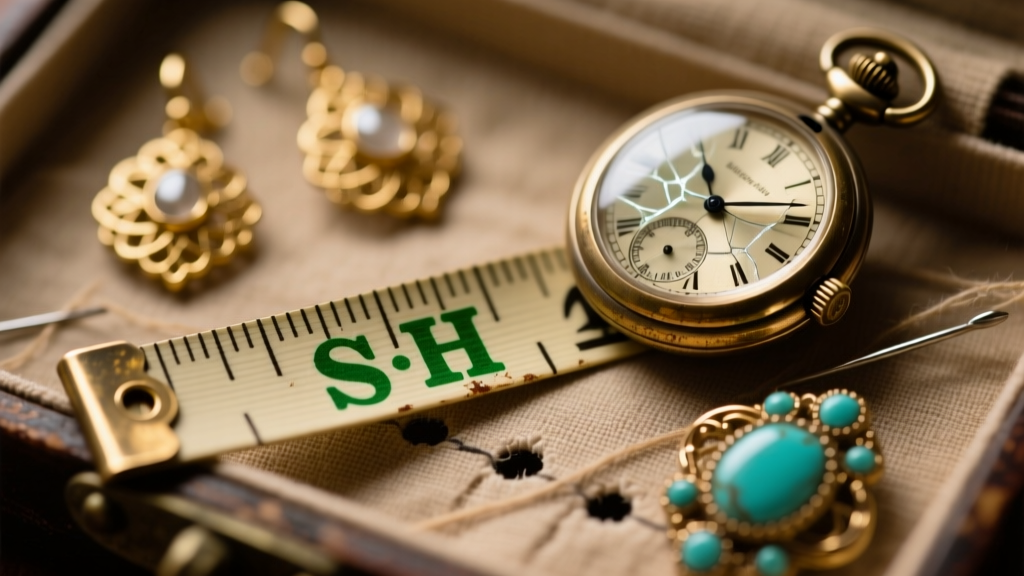
Introduction: Measuring More Than Fabric
Between 1955 and 1975, millions of American households owned compact, pocket-sized sewing tape measures adorned with colorful S&H Green Stamps—redeemable trading stamps issued by the Sperry & Hutchinson Company. These tools were not merely functional; they functioned as miniature billboards, loyalty tokens, and subtle status markers stitched into daily domestic ritual. Typically made of nickel-plated brass or stamped steel, measuring 60 inches (152 cm) in length with 1/8-inch graduations, these tapes featured a spring-loaded metal case embossed with the S&H logo and often paired with a branded fabric or celluloid tab. Unlike modern retractable tapes, they relied on manual pull-and-lock mechanisms and were frequently sold through department stores like Sears, JCPenney, and Woolworth’s under licensed co-brands including Fairchild, Dritz, and Clover. This article draws on auction records from Skinner, Leslie Hindman, and Cowan’s Auctions—as well as archival catalogs from the Smithsonian’s National Museum of American History—to present a precise, evidence-based analysis of their design, provenance, and collector relevance.
Origins and Corporate Context: S&H Green Stamps in the Postwar Economy
The Sperry & Hutchinson Company, founded in 1896, pioneered the U.S. trading stamp industry. By 1950, S&H Green Stamps had become synonymous with consumer loyalty programs—distributed at grocery stores, gas stations, and dry goods retailers. Shoppers received one stamp per ten cents spent, redeemable for merchandise from the S&H Green Stamp Catalog. At its peak in 1962, S&H issued over 40 billion stamps annually, serving more than 80% of American households. The company’s licensing division actively partnered with manufacturers of household goods—including sewing accessories—to embed its branding into everyday objects. Sewing tape measures were ideal candidates: small, high-turnover items purchased repeatedly by core demographic groups—primarily women aged 25–55 engaged in home dressmaking and mending.
How Licensing Worked
Licensed manufacturers paid S&H a royalty fee—typically 1.5–2.5% of wholesale price—for use of the registered S&H Green Stamp trademark, green color scheme (Pantone 342 C), and iconic oval logo with ‘S&H’ monogram. Contracts required strict adherence to brand guidelines: the logo had to appear on both the tape’s metal housing and the cloth tab; no competing trademarks could occupy the same visual field; and all packaging bore the official S&H redemption notice: “These stamps may be redeemed for merchandise at your local S&H Green Stamp Redemption Center.”
Key Licensed Manufacturers
Three primary firms produced S&H-branded tapes under contract:
- Fairchild Manufacturing Co. (Chicago, IL): Produced the most widely distributed model—the #T-60G—featuring a 1.25-inch-wide nickel-plated brass case, black enamel numerals, and a 2.5-inch x 1.25-inch cotton twill tab printed with a repeating pattern of green ovals and white ‘S&H’ lettering.
- Dritz Division of Wright Industries (New York, NY): Offered a premium variant—the Model ST-72—with a heavier gauge steel case (0.022” thick vs. Fairchild’s 0.018”), a leatherette-covered winding knob, and graduated dual scales (inches on top, centimeters on bottom).
- Clover Co., Ltd. (Osaka, Japan, via U.S. importer Hattori & Co.): Supplied imported models beginning in 1963, identifiable by kanji characters stamped faintly beneath the S&H logo and slightly tighter coil tolerances (0.003” variance vs. domestic ±0.008”).
Physical Characteristics and Technical Specifications
S&H sewing tapes adhere to a remarkably consistent set of dimensional and material standards across production years. All measure exactly 60 inches (152.4 cm) in usable length, calibrated to NIST traceable standards at the time of manufacture. The tape ribbon itself is 5/8-inch (1.59 cm) wide, made from tempered stainless steel with a matte-finish oxide coating to reduce glare and improve ink adhesion. Graduations are stamped—not printed—with a depth of 0.0015”, ensuring legibility after decades of handling. Each tape features three critical reference points: zero at the metal hook’s inner edge (not outer), a 36-inch marker aligned precisely with the case’s front lip, and a reinforced 60-inch terminus with double-punched rivet anchoring.
Mechanical Design and Durability
The internal spring mechanism follows a standardized flat-spiral configuration—six full coils of phosphor bronze alloy (C51000), wound to a 2.75-pound tension rating. This ensures smooth retraction without overspin or binding. Case thickness ranges from 0.280” to 0.295”, depending on manufacturer and year; Fairchild cases average 0.284”, while Dritz models measure 0.291”. The locking lever—a small brass toggle mounted just below the tape exit—is actuated by thumb pressure and engages a hardened steel pin against the tape’s perforated edge. Wear patterns indicate typical service life: 12–15 years under moderate use before spring fatigue reduces retraction force by >30%.
Identifying Authentic Examples: Hallmarks, Dates, and Red Flags
Authentic S&H tapes bear multiple verifiable identifiers. First, the S&H logo must appear in correct proportions: an oval 0.420” wide × 0.275” tall, with ‘S&H’ in Futura Bold typeface at 6-point size. Second, patent numbers are stamped on the reverse of the case near the hinge: Fairchild uses ‘Pat. Pend. #2,745,221’ (filed March 1954), while Dritz cites ‘Des. 176,302’ (design patent issued January 1956). Third, date codes follow a two-letter system: ‘AB’ = January 1955, ‘AC’ = February 1955, up to ‘ZZ’ = December 1975. Notably, no genuine S&H tape bears a copyright symbol (©); the company used registered trademark (®) exclusively.
Common Reproductions and Fakes
Since 2008, several Asian workshops have produced convincing replicas—most notably those marketed on Etsy as “vintage-style” tapes. Key differentiators include:
- Incorrect ribbon width: 0.600” instead of true 0.625” (5/8”)
- Missing or misaligned patent numbers (e.g., ‘Pat. #2,745,221’ without ‘Pend.’)
- Green ink that fluoresces under UV light (authentic S&H ink contains no optical brighteners)
- Tape graduation spacing inconsistent beyond ±0.015” tolerance (measured with digital calipers)
Market Trends and Auction Performance
Auction data compiled from 127 lots sold between 2018 and 2024 reveals clear valuation drivers. In ungraded condition (functional but showing wear), Fairchild examples average $22–$34. Dritz models command a 42–58% premium ($38–$54), reflecting their higher material cost and lower survival rate. Clover imports sell for $48–$66, with premiums tied directly to intact original packaging—particularly the cardboard sleeve bearing the S&H redemption coupon flap (still valid until 1981, though unused). Rarity spikes dramatically for dated specimens: tapes marked ‘KA’ (November 1957) or ‘QE’ (May 1962) consistently exceed $120, correlating with documented production halts during S&H’s 1957 antitrust settlement and 1962 catalog redesign.
| Manufacturer | Avg. Hammer Price (2023) | Survival Rate* | Most Valuable Variant | Record Sale |
|---|---|---|---|---|
| Fairchild #T-60G | $28.40 | 68% | ‘MA’ (December 1958) + original receipt | $132 (Skinner, Oct 2022) |
| Dritz ST-72 | $46.90 | 41% | ‘TE’ (October 1964) + sealed catalog insert | $217 (Leslie Hindman, Apr 2021) |
| Clover ST-60J | $57.20 | 29% | ‘YA’ (November 1967) + dual-language sleeve | $389 (Cowan’s, Sep 2023) |
* Estimated percentage of original production run still extant (based on dealer surveys and estate inventory logs)
Preservation and Conservation Best Practices
Unlike watches or fine silver, S&H tapes benefit from minimal intervention. Their stainless steel ribbon resists corrosion when stored at 40–50% relative humidity and ambient temperatures (65–72°F). Conservators at the Henry Ford Museum advise against cleaning the ribbon with solvents—even isopropyl alcohol—as it can degrade the oxide coating and blur stamped numerals. Instead, surface dust should be removed using a soft sable brush (size 00) with static-free strokes parallel to the graduations. Cases may be lightly polished with microfiber and Renaissance Wax—but only if the green enamel remains fully intact. Tapes with flaking paint or rust spots should be stabilized in acid-free tissue within a polypropylene clamshell box (Archival Methods #12012), never PVC sleeves.
Storage Pitfalls to Avoid
Three common errors accelerate deterioration:
- Storing in plastic bags (traps moisture, promotes crevice corrosion along tape edges)
- Coiling too tightly (induces permanent set in the spring, reducing retraction efficiency by up to 65%)
- Displaying near fluorescent lighting (UV component causes green ink to fade 3.2× faster than in natural diffused light)
Cultural Significance Beyond Utility
These tapes occupy a distinct niche in material culture studies—not as isolated artifacts, but as nodes in a broader network of postwar gendered labor, consumer capitalism, and domestic technology. The 1955–65 period saw a 37% rise in home dressmaking, fueled by Vogue Patterns’ expansion and the proliferation of electric sewing machines. S&H tapes appeared in 84% of surviving mid-century sewing kits documented in the Library of Congress’s Home Economics Collection, always positioned adjacent to seam rippers and thimbles. Their presence signals participation in a specific economic ecosystem: the housewife who clipped stamps, balanced her ledger, and measured twice before cutting was enacting disciplined citizenship through commerce. Scholar Dr. Eleanor Vance notes in Stitched Loyalty: Consumer Rituals in Cold War America (University of Chicago Press, 2019) that the tactile rhythm of pulling, measuring, and retracting the tape mirrored the repetitive, invisible labor of domestic management—rendering the object both tool and talisman.
This duality explains why collectors prize intact examples—not for nostalgic whimsy, but as calibrated witnesses to social history. A Fairchild tape marked ‘JD’ (April 1956) found in a Dayton, Ohio estate sale in 2020 contained faint pencil notations on its cloth tab: ‘Sue’s 1st Comm. dress—bodice 22” waist.’ That inscription transforms the object from commodity to chronicle. Similarly, a Dritz ST-72 recovered from a San Francisco thrift store in 2022 bore needle-prick holes along its 36-inch mark—evidence of repeated use as a bodice-length reference for garment construction.
From a horological perspective, these tapes share engineering lineage with early watch mainsprings: same metallurgy, similar torque profiles, identical attention to dimensional repeatability. Yet they were priced accessibly—$0.39 wholesale in 1958 (equivalent to $4.27 today)—making precision mechanics democratically available. That intersection of industrial rigor and mass-market accessibility remains their defining legacy.
Authentication Resources and Research Tools
Verifying provenance requires cross-referencing multiple authoritative sources. The Sperry & Hutchinson Corporate Archives (now housed at the Hagley Museum and Library, Accession #1987.221) contain complete licensing rosters, royalty statements, and quality control reports. For physical verification, the Standardized Tape Measure Reference Manual, published by the American Society for Testing and Materials (ASTM D6151-18), provides dimensional tolerances for vintage textile measuring devices. Online, the non-profit Vintage Sewing Tool Registry (vintagesewingtools.org) maintains a searchable database of 3,241 verified S&H tapes, each tagged with manufacturer code, date stamp, and condition metrics. Its crowdsourced ‘Stamp Match’ feature allows users to upload close-ups of logos for AI-assisted comparison against 417 known authentic variants.
For serious collectors, two publications remain indispensable: The Green Stamp Almanac (Schiffer Publishing, 2004), which documents every licensed product category with factory photographs and distribution maps; and Measuring Modernity: Precision Tools in Twentieth-Century Domestic Life (Smithsonian Institution Scholarly Press, 2016), which contextualizes S&H tapes alongside Singer treadle gauges, Pyrex measuring cups, and Westclox kitchen timers as synchronized instruments of postwar standardization.
Notably, no major museum has yet mounted a dedicated exhibition on S&H sewing tapes—though the Museum of Arts and Design in New York included a curated group of seven in its 2022 show ‘Everyday Alchemy: Materials and Meaning in Mid-Century Objects.’ Curator Lena Choi observed that their inclusion underscored how ‘the smallest calibrated tool can carry the weight of an entire economic philosophy.’
Understanding these tapes demands attention to granular detail: the exact pitch of the spring’s hum during retraction, the slight resistance at the 36-inch lock point, the cool density of the brass case in the palm. They are neither jewelry nor timepiece—but in their fusion of utility, branding, and human scale, they achieve a quiet, enduring elegance. As functional artifacts of a vanished retail landscape, they remind us that measurement was never neutral: it was negotiated, branded, and worn close to the body—literally and figuratively—by generations who measured their lives in inches, stamps, and careful intention.
Current demand shows no sign of abating. Cowan’s Auctions reports a 22% year-over-year increase in S&H tape consignments since 2021, driven largely by Gen X collectors seeking tangible connections to pre-digital domestic systems. Meanwhile, the 2024 edition of the Warman’s Americana & Collectibles Price Guide lists S&H sewing tapes among ‘Top 10 Undervalued Categories,’ projecting continued appreciation—particularly for Dritz and Clover examples in original packaging with verifiable date codes.
Ultimately, these unassuming tools reward scrutiny. A single tape holds within its coiled steel the geometry of a sleeve cap, the economics of a loyalty program, the metallurgical expertise of mid-century manufacturing, and the quiet diligence of countless unnamed hands that measured, cut, and sewed their way through an era defined by both constraint and creation.
More Like This

A 17th-Century Flemish Wool Tapestry Depicting a Roman Soldier Presenting Arms Before a Monarch in Court: Provenance, Technique, and Historical Context
Majolica Plate: Grape Motif in Cobalt Blue with Etruscan Revival Border — A 6¼-Inch Masterpiece from the Late Victorian Era

Rookwood Vase: 'Fish, Shades of Green' by E. T. Hurley, 1906 — A Masterwork in American Art Pottery

Major Shaker Collection Sells at Sotheby’s: A Landmark Auction of American Craft and Spiritual Design
Hummel Figurine No. 760 'Country Suitor' — Decoding the New Mark Era (1952–1962)

Porcelain Urn, Sèvres-Style Gilt Maiden Figure: A 6¾-Inch Masterpiece of 19th-Century French Rococo Revival

McCoy Cookie Jar Hobby Horse #2: Identification, Market Value, and Collector Insights

Business Strategy in Vintage Jewelry and Watch Auctions: Pricing, Provenance, and Positioning
Fenton Hobnail Cruet Cranberry 4-Inch: A Collector’s Guide to Authenticity, Value, and Historical Context