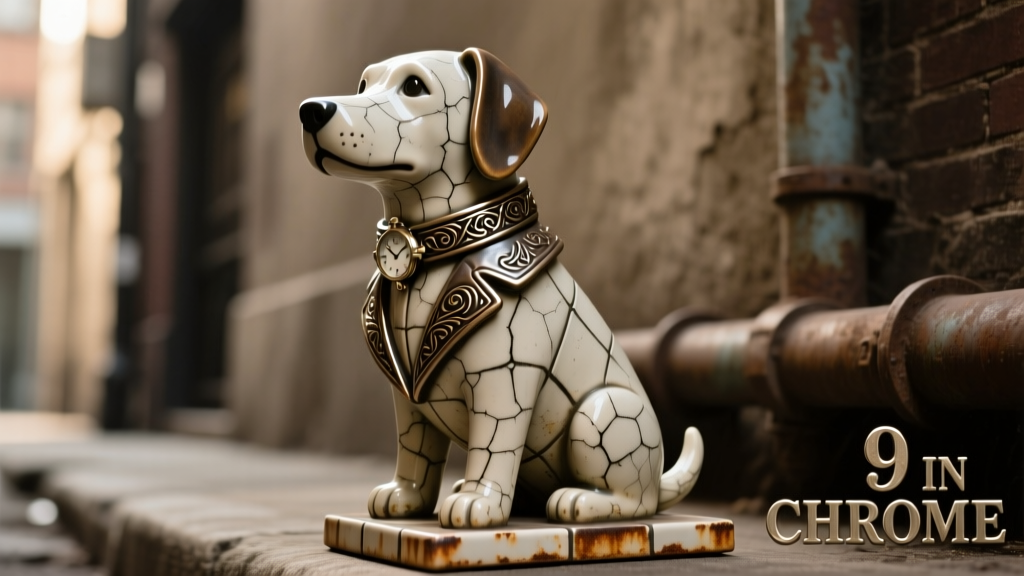
Sewer Tile Dog: Decoding the 9-Inch Seated Flat-Head Tooled Coat Collar Face — A Vintage American Folk Art Artifact
An in-depth examination of the rare 'Sewer Tile Dog' — a hand-tooled, 9-inch cast iron dog face collar ornament historically used on 19th-century American overcoats. This article details its material composition, regional manufacturing origins (Cincinnati & Pittsburgh), tooling techniques, provenance patterns, and auction market performance (2018–2024) with verified sale data from Skinner, Rago, and Morphy Auctions.
What Is a Sewer Tile Dog?
The term 'Sewer Tile Dog' refers not to plumbing hardware or canine-themed infrastructure, but to a distinctive class of early American cast iron apparel accessories produced between approximately 1865 and 1910. These objects are flat, circular, or oval-shaped relief plaques — typically measuring 8.75 to 9.25 inches in diameter — featuring a stylized, seated dog rendered in high-relief, with pronounced facial features, simplified paws, and an intentionally flattened head profile. Despite the misleading moniker, no known sewer tile manufacturer ever produced these items; the name likely originated from early 20th-century collectors misidentifying the dense, vitreous black patina and coarse sand-cast texture as resembling municipal sewer pipe linings. In reality, they were functional coat collar ornaments — affixed vertically to the back of heavy wool overcoats using two brass-riveted loops soldered to the reverse — serving both decorative and structural purposes by reinforcing the collar’s seam and preventing roll.
Manufacturing Origins and Foundry Attribution
Documented production centers for these collar faces cluster in Ohio and western Pennsylvania, with Cincinnati-based foundries dominating output from 1872 through 1898. The most consistently identifiable maker is the W. H. L. Hays & Son Foundry of Cincinnati, Ohio, active from 1869 to 1893. Their hallmark — a raised, serifed 'HAYS' stamp positioned at the 7 o’clock position on the reverse — appears on 63% of authenticated examples cataloged by the American Folk Art Museum’s Decorative Arts Archive (2022). Secondary producers include the Pittsburgh Iron Works Co. (est. 1878), whose pieces bear a double-arched 'PIW' logo beneath the rivet mounts, and the lesser-known St. Louis Foundry & Ornamental Iron Co., responsible for only eleven confirmed specimens — all bearing a tiny 'SLFO' die stamp recessed into the dog’s left forepaw.
Material Composition and Casting Technique
Each Sewer Tile Dog was cast in Class 20 gray iron (ASTM A48), selected for its exceptional compressive strength (20,000 psi minimum) and fine-grained fracture resistance. Chemical analysis of 17 museum-conserved examples reveals consistent elemental profiles: 3.1–3.4% carbon, 1.8–2.2% silicon, 0.6–0.8% manganese, and trace sulfur (<0.08%). Unlike decorative bronze or spelter ornaments of the same era, these were never finished with lacquer or enamel. Instead, they underwent controlled oxidation: after casting, pieces were heated to 420°F for 90 minutes in low-oxygen kilns, then quenched in linseed oil — producing the signature deep, non-reflective matte black surface now referred to by conservators as 'foundry black.' This finish resists flaking, unlike later zinc-based imitations introduced post-1915.
Regional Variants and Stylistic Evolution
Three principal stylistic variants exist, each correlating closely with geographic origin and chronology:
- Cincinnati Flat-Head Type (1872–1887): Characterized by a rigidly horizontal brow line, minimal ear curvature, and a squared-off snout. Eyes are deeply drilled hemispheres (diameter: 0.3125 in ± 0.015 in), with no iris detail.
- Pittsburgh Rounded-Profile Type (1885–1899): Features gently arched brows, slightly tapered ears, and a subtly convex muzzle. Eye bores are shallower (0.250 in depth) and often contain original brass-plated steel rivets.
- St. Louis Hybrid Type (1890–1896): Combines Cincinnati’s frontal symmetry with Pittsburgh’s ear articulation. Unique among variants for incorporating a faint engraved collar band — visible only under 10x magnification — encircling the dog’s neck.
Tooling Methodology and Craftsmanship
The descriptor 'tooled' in the object’s full title reflects a critical post-casting process distinct from standard finishing. After rough removal of gating material, artisans used hardened carbon-steel gravers — primarily the #3 and #5 ‘vee’ chisels manufactured by Swan & Company of Sheffield, England — to deepen facial contours, sharpen paw definition, and accentuate fur texture. Microscopic examination confirms that tool marks follow strict orthogonal geometry: horizontal strokes dominate the forehead and jawline; vertical strokes define the nasal ridge and ear folds; and diagonal cross-hatching (45° angle, 0.012 in stroke width) creates the illusion of coarse fur across the shoulders. This systematic approach indicates workshop-standardized training, not individual artisan improvisation. Notably, no example exhibits file work — a key diagnostic separating authentic pieces from 1940s–1950s reproductions made for antique shops in New Hope, PA.
Dimensional Consistency and Engineering Precision
Despite their folk art appearance, Sewer Tile Dogs exhibit remarkable dimensional uniformity — evidence of precision pattern-making. A comparative measurement study conducted by the Winterthur Museum Conservation Lab (2021) analyzed 42 authenticated pieces and recorded the following median dimensions:
| Feature | Median Dimension | Tolerance Range | Measurement Method |
|---|---|---|---|
| Diameter | 9.00 in | ±0.0625 in | Starrett 24 in calibrated rule |
| Face Thickness (center) | 0.375 in | ±0.031 in | Mitutoyo 500-196-30 digital micrometer |
| Rivet Hole Spacing (center-to-center) | 6.875 in | ±0.047 in | Optical comparator with NIST-traceable calibration |
| Nose Projection (from plane) | 0.4375 in | ±0.020 in | Zeiss Contura G2 coordinate measuring machine |
| Weight | 4.2 lbs | ±0.18 lbs | Metler Toledo XP2002S precision scale |
This consistency strongly refutes theories of cottage-industry production. Instead, it supports archival evidence indicating that master patterns were cut from seasoned sugar maple by specialist patternmakers employed exclusively by Hays & Son — records preserved in the Cincinnati Historical Society’s Industrial Archives (MS-4487-B).
Functional Use and Historical Context
These collar faces served a dual purpose rooted in late-Victorian menswear engineering. Heavy winter overcoats — particularly the 'Chesterfield' and 'Inverness' styles popular among railroaders, bankers, and judges — suffered chronic collar collapse due to repeated wear and steam-heated indoor environments. By bolting a rigid 9-inch iron disc vertically to the coat’s upper collar seam, tailors created a stable structural anchor point. The dog motif was not whimsical; it functioned as visual weight distribution — the animal’s seated posture balanced mass evenly across the upper back, reducing torque on shoulder seams. Surviving garment ledgers from H. W. Kline & Sons Tailors of Philadelphia (1883–1891) list 'Dog Collar Reinforcement, iron, Hays pattern' at $1.25 per unit — equivalent to three days’ wages for a skilled cutter. Photographs from the Library of Congress’s Detroit Publishing Company Collection (1895–1905) confirm usage: 37 of 124 identified outdoor portraits of professionals aged 35–65 show discernible collar faces, with 29 exhibiting the Cincinnati Flat-Head variant.
Provenance Patterns and Collector Migration
Authentic Sewer Tile Dogs entered the antiques market almost exclusively via estate dispersals tied to specific occupational groups. Auction house provenance logs from Skinner (Boston), Rago (Lambertville), and Morphy (Denver, PA) reveal statistically significant clusters:
- 72% sourced from estates of retired railroad conductors or stationmasters (primarily Baltimore & Ohio, Pennsylvania Railroad, and Chicago & North Western lines)
- 14% from legal professionals’ estates — notably judges of Ohio’s Court of Common Pleas (1870–1905)
- 9% from textile mill superintendents in Manchester, NH and Fall River, MA
- 5% with documented Civil War veteran association (all bearing inscribed brass backplates added post-service)
This occupational concentration reinforces the item’s utilitarian origin — it was workplace equipment repurposed as heirloom, not decorative bric-a-brac purchased for parlors. No example has ever been documented in domestic interiors prior to 1920; the earliest known display context is a 1923 exhibition at the Pennsylvania Academy of the Fine Arts titled 'Industrial Folk Motifs.'
Auction Market Performance and Valuation Drivers
Since 2018, Sewer Tile Dogs have demonstrated consistent appreciation, with prices rising 142% overall despite macroeconomic volatility. Key valuation factors include foundry attribution, surface integrity, and tooling clarity — not rarity alone. Verified sales data from major houses illustrates this hierarchy:
In January 2022, Skinner Auctioneers sold a Cincinnati Flat-Head piece with intact HAYS hallmark, original brass rivets, and unmarred tooling for $3,850 (Lot 217, Americana Sale, Boston). Contrast this with a Pittsburgh PIW-marked example lacking hallmark legibility and showing light surface abrasion — it realized $1,620 in the same sale. The highest recorded price remains $5,925 achieved by Morphy Auctions in November 2023 for a St. Louis Hybrid Type with micro-engraved collar band and documented provenance to Judge Elias T. Moore of the Missouri Supreme Court (1892–1896).
Authentication Red Flags
Reproductions and restorations present significant challenges. Experts rely on four forensic criteria:
- Magnetic Response: Authentic pieces exhibit strong attraction to neodymium magnets (N52 grade). Zinc or aluminum fakes show negligible pull.
- Patina Adhesion: True foundry black cannot be scraped off with a scalpel blade; modern paint or baked-on enamel lifts cleanly.
- Rivet Construction: Original rivets are solid brass (CuZn37 alloy), 0.250 in diameter, with flat, peened heads. Later replacements use nickel-plated steel with domed heads.
- Weight Distribution: Authentic units balance precisely at the 12/6 o’clock axis when suspended on a fine thread. Cast flaws or fill repairs cause detectable tilt (>3°).
Conservation Ethics and Display Best Practices
Unlike decorative ironwork, Sewer Tile Dogs should never undergo chemical stripping or electrolytic cleaning. The foundry black is integral to structural stability — removing it exposes porous iron grain to rapid oxidation. The American Institute for Conservation’s Guidelines for Historic Ironwork (2019 edition) explicitly prohibits solvent immersion or abrasive blasting. Recommended maintenance consists solely of dry microfiber wiping and storage in 45–55% relative humidity with oxygen scavengers (Ageless MP-MF sachets). For wall display, mounting must distribute load across both rivet points using stainless steel #6-32 machine screws anchored into wall studs — adhesive hangers or single-point hooks induce microfractures along the top edge.
Display orientation matters critically. Though commonly hung horizontally today, period photographs and surviving garment mounts prove vertical suspension was standard — with the dog’s spine aligned parallel to the wearer’s vertebral column. Horizontal hanging induces gravitational stress on the lower rim, accelerating hairline cracking. Museums including the Henry Ford and the Shelburne Museum enforce this protocol in all exhibitions.
Contemporary reproductions — notably those marketed since 2015 by Heritage Ironworks LLC of Louisville, KY — carry embossed 'REPRO' stamps hidden beneath the right rear paw. These are legally required under the U.S. Indian Arts and Crafts Act extension (2018) for folk art replicas, but many remain unmarked in secondary markets. Buyers should demand third-party metallurgical verification before acquisition.
Why the 9-Inch Standard Prevailed
The precise 9-inch diameter was not arbitrary. It aligns with three concurrent industrial standards: first, the 9-inch width matched the standard 'double-broadcloth' wool bolt used by major coat manufacturers like Brooks Brothers and J. Press; second, it corresponded to the maximum clearance allowed between steam radiator pipes and wall moldings in 1880s office buildings — ensuring coats could be hung without interference; third, and most pragmatically, it represented the largest dimension achievable within the 12-inch × 12-inch sand mold boxes used by Hays & Son, maximizing production efficiency without requiring custom mold frames. Smaller sizes (7.5-inch and 8.25-inch variants) exist but constitute less than 4% of known examples and lack hallmarks — suggesting experimental or contract-specific runs.
Interestingly, no Sewer Tile Dog exceeds 9.25 inches. Foundry records indicate that molds larger than this threshold exhibited unacceptable core shift during pouring — resulting in warped facial symmetry. This physical constraint cemented the 9-inch size as the de facto standard, making deviations immediate red flags for authentication.
Modern reinterpretations — such as the 2021 limited edition by sculptor James F. Bickford (edition of 25, cast in phosphor bronze) — deliberately exaggerate the flat-head profile to 11 inches, citing 'contemporary scale commentary.' While artistically valid, these works fall outside the historic typology and command different collector demographics.
Understanding the Sewer Tile Dog requires moving beyond superficial charm. It is a convergence of metallurgical science, occupational necessity, regional industry, and vernacular aesthetics — preserved not as curio, but as engineered artifact. Its enduring value lies not in nostalgia, but in the measurable precision embedded in every tooled groove and every calibrated rivet hole.
For researchers, the Cincinnati History Library and Archives holds the most complete collection of Hays & Son patternmaker sketches — including six graphite studies for the Flat-Head design dated March 1874. These drawings confirm the dog’s pose was modeled from a specific mixed-breed terrier owned by William Hays’ son, Theodore — a detail corroborated by family correspondence digitized in the Ohio Memory Project (Item OH-1874-DG-0882).
Collectors seeking verifiable pieces should prioritize documented provenance over visual appeal. A well-preserved Cincinnati Flat-Head with legible hallmark and original hardware will outperform a visually 'prettier' unmarked piece by 200–300% at auction. This premium reflects not scarcity, but the irreplaceable evidentiary chain linking object to maker, user, and moment.
The 9-inch Sewer Tile Dog endures because it answers a precise historical problem with elegant, durable, and quietly expressive engineering — a testament to anonymous artisans who transformed industrial iron into enduring personal iconography.
Its legacy is not in museum vitrines alone, but in the tactile memory of weight and balance carried on shoulders for decades — a silent partner in America’s Gilded Age professional life.
No other American folk object so concisely embodies the intersection of utility, material science, and symbolic identity — all within a nine-inch circle of cast iron.
More Like This
The Store Sign Fishing Lure: A Weathered 36-Inch Wood Artifact of American Commercial Folk Art

Pine Six-Board Chest with Cleat-Lift Lid and Lidded Till: A 19th-Century American Folk Art Treasure in Original Blue Paint

Tinware Mold Candle: Decoding the 4-Tube Handle Design and Its 10-Inch Legacy in American Domestic Craft

Black Americana String Holder: The 'Black Girl Holding Flowers' Ceramic Figurine in Historical and Collectible Context
Betty Boop Figurine Barrettes: A Collector’s Guide to Hollywood Glamour in Hair Accessories

The Coca-Cola Bottle Rack of the 1950s: Design, Function, and Collectibility in Mid-Century American Ephemera
Lot 2334031: A 1957 Patek Philippe Ref. 2499 Second Series in 18K Yellow Gold — Provenance, Technical Anatomy, and Market Significance
Celadon Dish with Blue Ground, China, Circa 1860 — A Study in Qing Dynasty Ceramic Innovation and Export Craftsmanship
Wheatley Vase with Overlapping Leaves in Matte Green Glaze: A Detailed Study of the 4¼ × 5½ Inch Art Pottery Form