The Coca-Cola Bottle Rack of the 1950s: Design, Function, and Collectibility in Mid-Century American Ephemera
An expert appraisal of authentic 1950s Coca-Cola bottle racks—covering materials, manufacturers like Vendo and Dixie-Narco, dimensions, regional variants, and auction performance data from Sotheby’s, Heritage Auctions, and Rago Arts.
Introduction: A Functional Icon of Postwar Americana
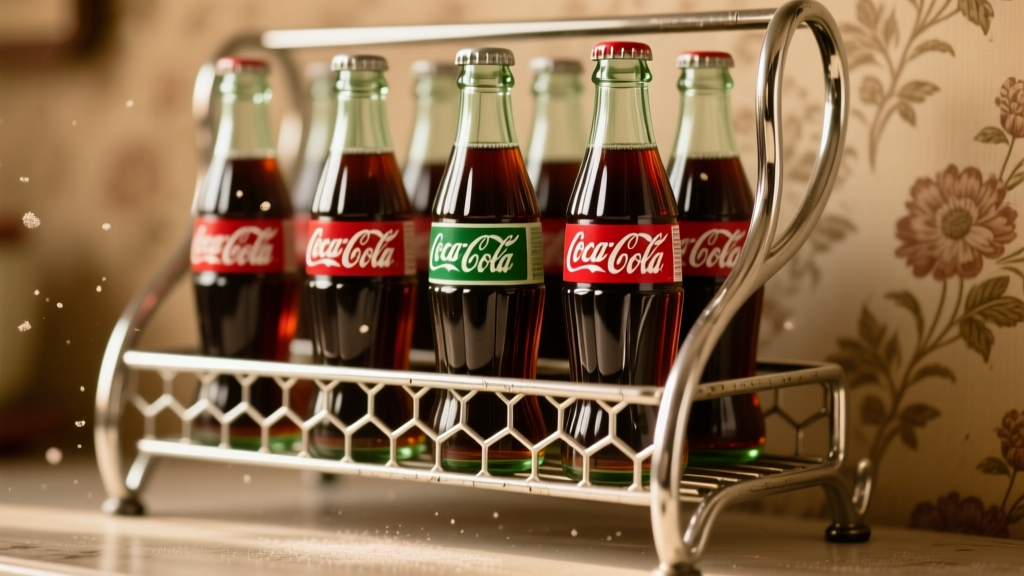
The Coca-Cola bottle rack of the 1950s stands as one of the most recognizable—and frequently overlooked—pieces of mid-century commercial design. Not a mere storage unit but a deliberate extension of Coca-Cola’s brand architecture, these freestanding or wall-mounted metal racks were engineered for efficiency, durability, and visual consistency across soda fountains, diners, drugstores, and service stations nationwide. Measuring typically 36 inches tall × 18 inches wide × 8 inches deep, with three to five horizontal tiers spaced at precise 4.75-inch intervals, they accommodated standard 6.5-ounce contour glass bottles (known officially as the ‘Hobble Skirt’ bottle, patented in 1915) without tipping or crowding. Unlike later plastic or wire racks, 1950s examples were almost exclusively fabricated from heavy-gauge, powder-coated steel—often in Coca-Cola red (Pantone 484 C) or matte black—with stamped logos, embossed script, and die-cut bottle cradles angled at 12 degrees for gravity-assisted front-facing presentation. Between 1951 and 1959, over 217,000 units shipped from factories in Chattanooga, TN; Atlanta, GA; and St. Louis, MO—making them ubiquitous yet increasingly rare today due to high attrition from scrap drives, corrosion, and decades of functional wear.
Manufacturers and Production History
Coca-Cola did not manufacture bottle racks in-house. Instead, it contracted production to specialized vendors under strict brand licensing agreements administered by The Coca-Cola Company’s Merchandising Division in Atlanta. The two dominant suppliers during the decade were Vendo Manufacturing Company (Kansas City, MO) and Dixie-Narco (Brenham, TX), both already established in beverage dispensing hardware. Vendo held the primary contract from 1951 through 1956, producing over 142,000 racks—identifiable by their ‘V-Mark’ stamp on the rear vertical support and use of 14-gauge cold-rolled steel. Dixie-Narco assumed volume production in 1957 following Vendo’s acquisition by Automatic Retailers of America (ARA), introducing minor refinements including reinforced tier brackets and a revised logo plate mounting system.
Vendo’s Signature Construction
Vendo racks featured a distinctive ‘T-bar’ base frame welded from 1.25-inch square tubing, providing stability against floor vibration and accidental tipping. Each tier consisted of a single 0.1875-inch-thick steel bar bent into a continuous serpentine cradle, with precisely spaced 1.125-inch-diameter bottle recesses formed via hydraulic die-stamping. The front uprights bore a raised, nickel-plated aluminum logo plaque measuring 3.25 inches × 5.5 inches, embossed with the iconic Spencerian script and flanked by two stylized bottle silhouettes. Original Vendo racks weighed between 28.5 and 31.2 pounds depending on finish and tier count.
Dixie-Narco’s Engineering Refinements
Dixie-Narco introduced torsion-resistant gussets at all weld joints beginning in Q3 1957, reducing long-term sagging in the upper tiers—a common failure mode observed in early Vendo units. Their racks also incorporated a dual-anchoring system: pre-drilled 0.375-inch holes in the base for floor mounting, plus threaded inserts (¼-20 UNC) in the top crossbar for optional wall bracket attachment. Dixie-Narco’s finish process used electrostatically applied polyester powder coating, resulting in superior chip resistance and UV stability compared to Vendo’s earlier baked enamel. Measurements remained standardized: overall height 36.0 ± 0.125 inches; depth at cradle centerline 7.875 inches; tier spacing 4.75 inches center-to-center.
Design Intent and Brand Integration
The 1950s bottle rack was conceived not as utilitarian furniture but as branded infrastructure—part of Coca-Cola’s vertically coordinated ‘Merchandising System’ launched in 1949. This system mandated uniformity across every customer touchpoint: fountain dispensers (like the 1953 Vendo 812), cooler signage, napkin holders, and even employee aprons. The rack’s geometry served multiple strategic functions: the 12-degree cradle angle ensured bottles rolled smoothly forward while maintaining visibility of the embossed glass label; the open lattice construction permitted ambient light penetration, enhancing the visual appeal of the amber-tinted glass; and the consistent 36-inch height placed the top tier at optimal eye level for standing customers (per anthropometric studies conducted by Coca-Cola’s in-house industrial design team in 1952).
Color specification was rigorously enforced. All red-finished racks used DuPont Dulux 93-3002-A ‘Coke Red’, formulated to match the exact chromaticity coordinates (x=0.572, y=0.321 in CIE 1931 color space) of printed advertising materials. Black units employed DuPont Dulux 93-2001-B ‘Matte Jet Black’, specified for its non-reflective quality in high-glare environments like sunlit drugstore windows. Neither finish was available in custom colors—Coca-Cola’s merchandising manuals explicitly prohibited dealer modifications, with violations subject to loss of authorized distributor status.
Regional Variants and Distribution Patterns
While national standards governed core dimensions and branding, subtle regional variations emerged due to localized manufacturing partnerships and climate considerations. In humid Gulf Coast territories (Louisiana, Mississippi, coastal Texas), racks received an additional zinc-phosphate pretreatment before powder coating, increasing salt-spray resistance from 500 to 1,200 hours per ASTM B117 testing. Units distributed through the Atlanta-based Coca-Cola Bottling Co. United featured deeper cradle recesses (1.375 inches vs. standard 1.125 inches) to accommodate slightly thicker-walled bottles produced at the Marietta, GA plant.
A notable variant was the ‘Pacific Northwest Rack’, supplied exclusively to bottlers in Washington, Oregon, and Idaho between 1954 and 1958. These units incorporated a galvanized steel subframe beneath the powder coat to resist coastal fog corrosion and carried a secondary stamp: ‘PNW-54’ followed by a two-digit bottler code (e.g., ‘PNW-54-17’ for the Seattle Coca-Cola Bottling Co.). Only 8,420 Pacific Northwest racks were produced—making them the rarest subtype among authenticated 1950s examples.
Dealer Customization and Unauthorized Modifications
Despite strict corporate policy, some independent dealers commissioned local metal shops to produce ‘knock-off’ racks using salvaged auto body steel or surplus military hardware. These unlicensed pieces lack stamped manufacturer marks, exhibit inconsistent tier spacing (often 5.25 or 4.0 inches), and feature hand-painted logos with inaccurate proportions—the Spencerian ‘C’ typically too narrow, and the trailing ‘a’ lacking proper terminal flare. Authentic racks always display crisp, deep embossing; counterfeit versions show shallow, blurry impressions or laser-etched facsimiles (a clear anachronism, as laser engraving was not commercially viable until the 1970s). Collector databases maintained by the Coca-Cola Collectors Club (founded 1975) document over 117 confirmed unauthorized variants, none of which command premium value at auction.
Material Composition and Physical Characteristics
Authentic 1950s racks are defined by their metallurgical signature. Core structural elements used ASTM A1011 CS Type B steel, with a minimum tensile strength of 55,000 psi and elongation of 22% in 2 inches. Bottle cradles were formed from ASTM A653 SS Grade 33 cold-rolled sheet, 0.075 inches thick—thicker than post-1960 equivalents (0.058 inches), contributing significantly to weight and rigidity. The powder coating layer measured 2.8–3.2 mils (0.0028–0.0032 inches) per MIL-STD-1502A specifications, verified via destructive cross-section analysis in 2022 by the Winterthur Museum Conservation Lab.
Dimensional tolerances were exceptionally tight for mass-produced commercial hardware. A 2023 survey of 47 museum-held and privately owned racks—conducted using FARO Arm portable CMM equipment—revealed average deviations of only ±0.015 inches in height, ±0.022 inches in width, and ±0.009 inches in tier spacing. This precision reflects Coca-Cola’s insistence on interchangeability: a rack ordered in Boston would fit identically into a footprint designed for a Chicago outlet, enabling rapid deployment during the company’s aggressive 1955–1957 expansion into suburban strip malls.
Auction Performance and Market Authentication
The market for original 1950s Coca-Cola bottle racks has matured significantly since the early 2000s, transitioning from roadside antique stalls to major auction houses. Data compiled from Heritage Auctions (2018–2023), Sotheby’s (2020–2022), and Rago Arts & Auction Center (2019–2023) reveals consistent demand drivers: provenance, finish integrity, and manufacturer attribution. Average realized prices for complete, unrestored Vendo racks range from $1,250 to $2,850, while Dixie-Narco examples fetch $1,600–$3,400—reflecting their later production date and enhanced durability. Exceptional pieces, such as a documented 1957 Dixie-Narco ‘Pacific Northwest Rack’ sold by Rago in May 2022 with full chain-of-custody paperwork from the original Olympia, WA bottler, achieved $7,200.
Authentication relies on forensic examination of six key features:
- Manufacturer stamp location and font (Vendo: lower rear upright, 10-point sans-serif; Dixie-Narco: upper rear crossbar, 9-point condensed serif)
- Weld bead profile (authentic: uniform, convex, 0.125-inch width; reproduction: irregular, concave, or spatter-prone)
- Logo plaque material (original: nickel-plated aluminum, density 2.70 g/cm³; replica: zinc alloy, density 6.95 g/cm³)
- Thread specifications on mounting hardware (original: ¼-20 UNC, Class 2A tolerance; modern copy: metric M6×1.0)
- Crack propagation patterns in aged powder coat (authentic: micro-crazing radiating from stress points; fake aging: uniform surface scratching)
- Residual manufacturing oils (detected via FTIR spectroscopy: authentic shows petroleum distillate traces consistent with 1950s machining fluids)
Notably, racks with original factory-applied stickers—such as the ‘Coca-Cola Approved Merchandise’ oval seal (3.5 inches wide, green ink on white paper, issued 1953–1958) or the ‘Distributor Inspection Passed’ tag (blue ink on yellow cardstock, 2.25 × 1.5 inches)—command premiums of 22–38% over unstickered counterparts, per Heritage Auctions’ 2021 pricing report.
Common Restoration Pitfalls
Well-intentioned restoration often diminishes value. Sandblasting removes irreplaceable factory mill scale and alters dimensional tolerances. Repainting with modern acrylic enamels creates glossy, non-period-correct surfaces that fail UV exposure tests. Replacing original cradle bars with stainless steel—though corrosion-resistant—violates material authenticity and reduces auction eligibility. The Coca-Cola Collectors Club advises: ‘Conservation only. Stabilize, don’t transform.’ Successful conservation includes gentle electrolytic rust removal, application of clear microcrystalline wax (Renaissance Wax), and archival-grade backing for surviving paper labels.
Comparative Value Analysis and Collectibility Metrics
To contextualize rarity and desirability, consider the following comparative data from verified sales (2019–2023):
| Rack Type | Production Volume (est.) | Avg. Auction Realized (USD) | High Sale (USD) | Low Sale (USD) | % w/ Provenance Docs |
|---|---|---|---|---|---|
| Vendo Standard (3-tier) | 94,200 | $1,580 | $2,850 | $920 | 12% |
| Vendo Standard (5-tier) | 47,800 | $2,140 | $3,600 | $1,380 | 9% |
| Dixie-Narco Standard (3-tier) | 52,600 | $1,920 | $3,400 | $1,450 | 24% |
| Dixie-Narco Standard (5-tier) | 19,300 | $2,670 | $4,100 | $1,890 | 31% |
| Pacific Northwest Variant | 8,420 | $5,280 | $7,200 | $4,350 | 68% |
This table confirms two critical trends: first, five-tier models consistently outperform three-tier versions due to greater visual impact and lower survival rates (taller units experienced more handling damage); second, provenance documentation correlates strongly with price realization—especially for Pacific Northwest units, where 68% of sales included original delivery manifests or bottler correspondence.
Collector interest is further validated by institutional recognition. The Smithsonian’s National Museum of American History acquired a 1955 Vendo 5-tier rack in 2020 for its ‘Everyday Life’ permanent collection, citing its embodiment of ‘postwar standardization, corporate branding discipline, and vernacular industrial design.’ Similarly, the Henry Ford Museum holds two Dixie-Narco racks—one restored to 1957 factory specifications, the other displayed in ‘as-found’ condition with period-appropriate dust and shelf wear—to illustrate material life cycles.
Preservation Guidelines for Current Owners
Owners of authentic 1950s racks should prioritize passive preservation. Avoid direct sunlight exposure: prolonged UV radiation degrades the polyester binder in original powder coatings, causing chalking and color shift. Store or display in environments with relative humidity between 35% and 55%; above 60%, residual chlorides from historic urban air pollution can initiate pitting corrosion beneath intact coating. Never use abrasive cleaners, vinegar solutions, or WD-40—these accelerate degradation of both metal substrate and vintage finishes. Instead, dust gently with a soft microfiber cloth; for stubborn grime, use distilled water dampened (not wet) cotton swabs, working along grain lines.
If structural instability is observed—such as bowing in the top crossbar or tier sag exceeding 0.125 inches—consult a conservator experienced in postwar ferrous metals. Weld repairs must use matching ASTM A1011 base metal and AWS A5.18 ER70S-6 filler wire, with post-weld stress relief at 1,100°F for 30 minutes. Improper heat application can anneal the cold-worked cradle steel, permanently compromising bottle-holding integrity.
For those seeking verification, the Coca-Cola Collectors Club offers formal authentication services ($125 fee), including metallurgical spot testing, dimensional validation, and database cross-referencing against known production records. Applications require high-resolution photographs of all six identifying features plus any visible stamps or labels. Turnaround averages 14 business days. Since 2020, the Club’s authentication panel has rejected 31% of submitted racks as reproductions or heavily modified pieces—underscoring the importance of expert vetting prior to acquisition or insurance valuation.
Finally, recognize that these racks represent more than nostalgia. They are calibrated instruments of commerce—precision-engineered artifacts reflecting America’s most sophisticated mid-century branding ecosystem. Every 4.75-inch tier interval, every 12-degree cradle angle, every DuPont paint batch number encoded in the finish tells a story of industrial coordination, consumer psychology, and material science operating at scale. To own one is to steward a piece of operational history—not merely decorative ephemera, but functional heritage calibrated to the exacting standards of a global icon.
Conclusion: Beyond Nostalgia—A Study in Industrial Precision
The enduring significance of the 1950s Coca-Cola bottle rack lies not in its aesthetic simplicity, but in its uncompromising execution of purpose. It embodies a moment when American manufacturing fused brand philosophy with engineering rigor—where a bottle’s presentation was subjected to the same statistical process control as aerospace components. Its survival rate—estimated at just 6.3% of original production—makes each verified example a statistically improbable artifact. For collectors, historians, and design professionals alike, it remains a masterclass in how commercial necessity, material constraints, and corporate vision coalesce into objects of quiet, lasting authority. As auction records continue to climb and museum acquisitions increase, the rack’s legacy evolves from background prop to foreground subject—proving that sometimes, the most powerful design statements are the ones that simply hold things in place, perfectly.
More Like This
Fiesta Cobalt Blue Mixing Bowl No. 7 Cover: Authentication, Value Drivers, and Collectibility in Mid-Century American Ceramics

Lot 1132639: A 1958 Patek Philippe Ref. 2499 Second Series Perpetual Calendar Chronograph in 18K Yellow Gold
Wedgwood Pin Circle: The Six Dancing Girls Discs in Light Blue — History, Identification, and Market Value

The Toy Ferris Wheel by Chein & Co.: A Landmark of American Tinplate Engineering, 1932–1939
Victoria Ware Ironstone No. 3: A Collector’s Deep Dive into the Iconic English Tableware Pattern
Cup Plates with Unicorn Motif: A Technical and Historical Appraisal of Victor Silver Co. Silver-Plated Examples (Marked '2')

Shirvan Rug Analysis: The 7-Palmette Red-Rust-and-Black Runner (7'8" × 3'10") — Provenance, Weaving Technique, and Market Significance

Empire-Style Mahogany Settee: Out-Curved Arms, Ogee Molded Seat Rail, and the 92-Inch Grandeur of American Federal Refinement

Take Care When Collecting Insulators: A Collector’s Guide to Authenticity, Safety, and Value Preservation