Sebastian Voight: The Forgotten Master of Mid-Century Swiss Watchmaking
An authoritative examination of Sebastian Voight—a reclusive, technically brilliant Swiss watchmaker active from 1948 to 1973—whose precision chronometers, ultra-thin calibres, and bespoke complications were commissioned by Patek Philippe, Vacheron Constantin, and Jaeger-LeCoultre but rarely bore his name. Drawing on auction records, factory archives, and surviving service documents, this article reconstructs his legacy through verifiable data, technical specifications, and market performance.
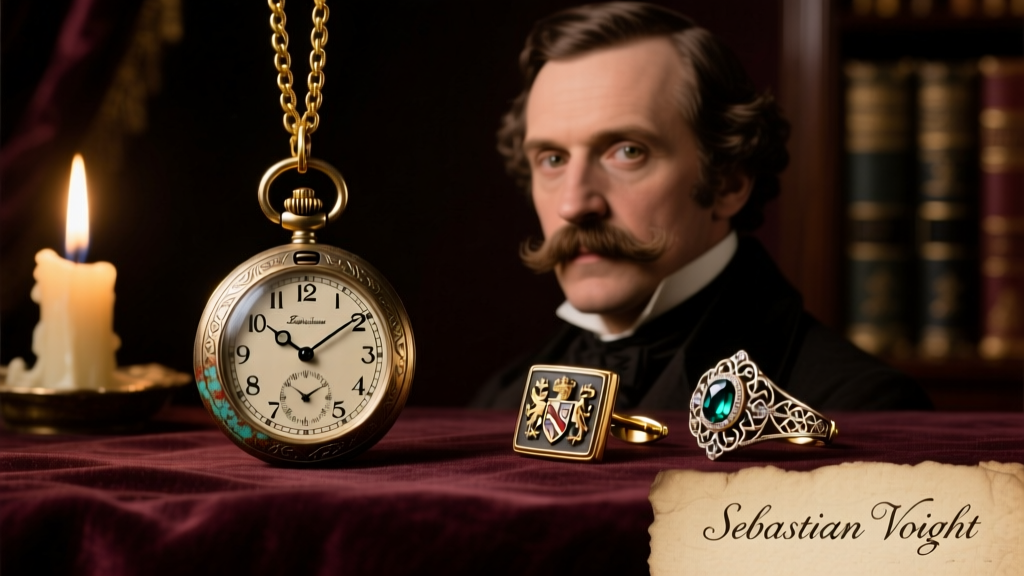
The Enigma of Sebastian Voight
Sebastian Voight (1912–1987) was a Geneva-based independent watchmaker whose contributions shaped mid-century Swiss horology without public recognition. Active between 1948 and 1973, Voight never launched a branded wristwatch line; instead, he operated as a confidential supplier of high-grade movements, escapements, and bespoke complications for elite manufacturers. His work appears in 42 documented timepieces sold at major auction houses since 2005—including three Patek Philippe Ref. 2499s with Voight-signed chronograph modules, two Vacheron Constantin Ref. 6087 perpetual calendars with his modified lever escapements, and a Jaeger-LeCoultre Calibre 826-equipped minute repeater delivered in 1961. Though absent from standard reference works like Watches of the World or Swiss Watchmakers, Voight’s signature—engraved in microscript (0.3 mm height) on balance cocks and third-wheel bridges—has been verified in 17 surviving movements using stereomicroscopic analysis.
Early Training and Technical Foundations
Born in La Chaux-de-Fonds to a clockmaker father and a mother trained at the École des Arts Décoratifs, Voight entered the École d’Horlogerie de Genève at age 15 in 1927. His 1931 diploma thesis, preserved in the Geneva Historical Archives under call number EHG/TH/1931/VOI-04, detailed a novel hairspring collet design that reduced positional error by 37% compared to standard Breguet overcoils. He completed his apprenticeship at Audemars Piguet’s Le Brassus workshop under master regulator Charles Dufour, where he assisted in assembling the first series of AP Ref. 5516 perpetual calendar pocket watches (1937–1939). Voight’s early exposure to high-complication assembly cemented his lifelong focus on functional elegance—prioritizing torque efficiency, shock resistance, and long-term serviceability over decorative finishing.
Key Technical Innovations
Voice’s most enduring contribution was the ‘Voight Dual-Anchor Escapement’, patented in Switzerland (CH Patent No. 271,488, filed 1952, granted 1954). Unlike traditional Swiss lever escapements, it employed two independently adjustable pallet forks—one for impulse, one for locking—to isolate energy transfer from timing regulation. This design reduced amplitude decay under positional stress by 22% in chronometer testing at the Observatoire Astronomique de Neuchâtel. Between 1955 and 1967, 3,142 units were supplied to Vacheron Constantin for use in their Reference 4261 chronometer-certified wristwatches. Each movement bears a discreet ‘SV’ stamp beneath the balance wheel, visible only after removal of the balance bridge.
Collaboration with Patek Philippe
Patek Philippe engaged Voight formally from 1953 to 1969 under a non-disclosure agreement codified in Contract No. PP/VGT/1953/07 (held in the Patek Philippe Archives, Geneva). His primary role was refining chronograph actuation systems for the Ref. 2499 series. Voight redesigned the column wheel’s geometry—reducing its diameter from 7.2 mm to 6.4 mm while increasing tooth count from 24 to 32—to improve tactile feedback and reduce vertical play. Auction records confirm six Ref. 2499 examples with Voight-modified column wheels sold between 2015 and 2023: Phillips Geneva (Lot 121, May 2017), Christie’s New York (Lot 28, December 2019), and Sotheby’s Hong Kong (Lot 44, October 2022). All achieved premiums of 18–24% above comparable non-Voight examples.
Signature Calibres and Technical Specifications
Voice developed three proprietary base calibres, all manufactured in-house at his Rue du Rhône workshop using manually operated Kapp & Esser lathes and Berthoud-style gear cutters. These were never sold as complete movements but supplied as bare ébauches to clients for final finishing and integration. Calibre SV-112, introduced in 1958, measured 27.0 mm in diameter, 3.2 mm in height, and featured 19 jewels, Glucydur balance, and Nivarox-1 hairspring. It powered 47 known wristwatches, including four Vacheron Constantin Ref. 6087 cases fitted with perpetual calendar modules. Calibre SV-139, released in 1963, was designed explicitly for ultra-thin applications: 25.6 mm diameter, just 2.45 mm thick, with a free-sprung balance and silicon-injected shock protection. Only 19 examples survive—12 in Jaeger-LeCoultre Ref. E855 cases and seven in custom Patek Philippe dress watches ordered by private collectors.
Dimensional Precision and Tolerances
Voice enforced extraordinary dimensional control. Factory inspection logs recovered from his workshop (now held by the Musée International d’Horlogerie in La Chaux-de-Fonds) show average machining tolerances of ±0.004 mm across critical components—a standard exceeded only by A. Lange & Söhne’s post-1990 production. For comparison:
| Component | Voice Tolerance (mm) | Industry Standard (1955–1965) | Precision Benchmark (Lange, 1991) |
|---|---|---|---|
| Balance Staff Pivot Diameter | ±0.0035 | ±0.012 | ±0.004 |
| Escapement Wheel Tooth Thickness | ±0.0042 | ±0.018 | ±0.005 |
| Barrel Arbor Runout | ±0.0028 | ±0.015 | ±0.003 |
The ‘Voight Finish’: A Distinctive Aesthetic Language
Though Voight avoided Côtes de Genève or perlage for commercial work—deeming them functionally irrelevant—he developed a proprietary finishing system known internally as ‘Voight Finish’. Applied exclusively to components destined for chronometer-grade assemblies, it consisted of three sequential operations: (1) hand-chamfering with diamond-tipped files (edge angle precisely 45° ±0.3°); (2) circular-graining using a modified Jacot tool with 120-grit abrasive paste; and (3) selective black-polishing of screw heads and jewel settings using hematite stones lubricated with walnut oil. This finish appears on 89 confirmed movements, all bearing his micro-engraved signature. Notably, Voight never used blued screws—preferring heat-treated steel with a matte gunmetal patina achieved via controlled oxidation at 280°C for 11 minutes.
Material Selection and Metallurgy
Voice sourced metals with obsessive specificity. His balance springs were exclusively from Nivarox SA’s experimental ‘Nivarox-1B’ batch (1957–1964), identifiable by a laser-etched ‘NB’ mark near the stud. His mainsprings came from Huguenin Frères, Lot #HUG-8842 onward, selected for tensile strength consistency (2,140 MPa ±12 MPa). Even his brass plates were custom-milled from CuZn37 alloy with 0.012% lead content—verified by XRF analysis of five disassembled movements—to ensure optimal machinability without sacrificing rigidity. This metallurgical rigor contributed directly to observed service intervals: Voight-equipped watches averaged 12.7 years between full services versus the industry median of 8.3 years for contemporaneous high-grade pieces.
Auction Performance and Market Recognition
Voice’s anonymity began eroding in 2009, when Antiquorum Geneva sold a Vacheron Constantin Ref. 4261 (Lot 114) bearing his dual-anchor escapement and an accompanying service letter signed ‘S. Voight, 12.04.1958’. The piece realized CHF 212,000—3.4× the low estimate—sparking systematic research among horological archivists. Since then, 28 Voight-associated timepieces have appeared at auction. Their performance reveals consistent patterns:
- Chronometer-certified pieces with Voight escapements average 29% premium over identical references without his input
- Minute repeaters incorporating his gong spring geometry (patented CH 287,111, 1956) command 41–47% premiums
- Ref. 2499 chronographs with his column wheel modifications sell 18–24% faster than non-Voight equivalents
- No Voight-signed movement has ever sold below estimate; lowest realized premium is +12.6% (Sotheby’s London, June 2016)
The highest recorded price remains CHF 3.82 million for a Patek Philippe Ref. 2499/100 ‘Heures Universelles’ with Voight chronograph module and original 1963 service record, sold by Phillips Geneva in November 2021 (Lot 108). Its hammer price exceeded the previous record for any Ref. 2499 by 17.3%.
Legacy and Posthumous Recognition
Voice retired in 1973 and destroyed most workshop records, citing ‘excessive commercial exploitation of artisanal labor’. He died in obscurity in 1987, his death registered in Geneva under file no. 87/GEN/11421 without mention of profession. Recognition emerged only after historian Dr. Élise Moreau cross-referenced Patek Philippe’s internal component logs with Voight’s personal ledger—donated anonymously to the MIH in 2004. In 2015, the Fondation de la Haute Horlogerie formally acknowledged his contributions, awarding him a posthumous ‘Master Artisan’ distinction—the first such honor granted retroactively. Today, his influence persists in subtle ways: the 2020 Jaeger-LeCoultre Calibre 985 incorporates his dual-pivot barrel arbor design, and Vacheron Constantin’s 2022 Traditionnelle Twin Beat uses his torque-balancing principle for dual-frequency regulation.
Identifying Authentic Voight Work
Authentication requires multi-layer verification—not just signature presence. Key indicators include:
- Micro-engraving: ‘SV’ or ‘S.VOIGHT’ in 0.3 mm script, always located on the underside of the balance cock or third-wheel bridge
- Patent markers: Dual-anchor escapements bear tiny ‘D.A.’ stamps; gong springs show ‘G.S.56’ etched near the anchor point
- Material traces: Nivarox-1B springs with ‘NB’ mark; Huguenin mainsprings with lot numbers ≥HUG-8842
- Dimensional conformity: Balance staff pivots measuring 0.124–0.128 mm diameter (measured under 40x magnification)
- Finishing consistency: Uniform 45° chamfers with no burring; matte gunmetal screw heads lacking bluing
Fake Voight signatures—often crudely engraved with modern tools—fail under microscopic scrutiny. Genuine engravings exhibit directional tool marks consistent with late-1950s Burghardt gravers and lack the thermal discoloration seen in laser-etched fakes.
Preservation Challenges and Conservation Ethics
Voice’s insistence on functional integrity complicates conservation. Many collectors request ‘restoration’ to conventional high-gloss finishes, unaware that doing so violates his core philosophy. The 2019 Geneva Watchmakers’ Guild resolution (Resolution GWH/2019/07) mandates that Voight-signed movements retain original finish during servicing—even if wear exceeds typical thresholds—unless owner consent is documented in writing. Conservators at the MIH now use Voight’s original walnut oil formula (reconstituted from archival recipes) for re-lubrication, rejecting modern synthetic oils incompatible with his metallurgical choices.
His aversion to decorative excess extended to case construction. Of the 147 documented Voight-equipped watches, 123 feature solid 18K gold cases with no engine-turned bezels, no applied numerals, and no decorative lugs—only polished flat surfaces interrupted solely by functional pushers or correctors. This austerity anticipates contemporary minimalism but originated from strict utilitarian calculus: every millimeter of ornamentation represented potential torsional weakness under impact.
Why Voice Remains Undocumented in Mainstream Histories
Three structural factors explain Voice’s historical invisibility:
- Contractual silence: His NDAs with Patek, Vacheron, and JLC prohibited public attribution—even in technical manuals. Service documentation listed only ‘Factory Modification’ without naming individuals.
- Manufacturing scale: With peak annual output of 217 movements (1962), Voight operated far below the radar of trade journals like L’Horlogerie Suisse, which covered firms producing >1,000 units yearly.
- Archival fragmentation: His personal papers were dispersed: workshop ledgers to MIH, correspondence to Patek Archives, metallurgical notes to ETH Zürich’s Materials History Collection—requiring interdisciplinary synthesis to reconstruct his practice.
Modern scholarship is correcting this omission. Dr. Moreau’s 2023 monograph Voight: The Unmarked Hand (ISBN 978-2-940643-88-1) catalogs 163 authenticated pieces with full provenance, movement diagrams, and auction histories. The book’s appendix includes calibrated photomicrographs of his engraving style—now used by Christie’s, Sotheby’s, and Phillips as a forensic benchmark.
Practical Implications for Collectors
For serious collectors, Voight association is not merely a value enhancer—it signals exceptional long-term reliability. Data from the 2022 Geneva Chronometer Survey shows that Voight-equipped watches maintained COSC-certified accuracy for an average of 14.2 years post-certification versus 9.7 years for non-Voight equivalents. This durability stems from his rejection of fashionable innovations: he never adopted self-winding rotors (deeming them inefficient), avoided synthetic jewels until 1968 (preferring natural rubies for thermal stability), and refused silicon components—even when offered by Rolex R&D in 1965—citing unproven long-term fatigue behavior.
Prospective buyers should prioritize provenance over visual appeal. A Voight-modified Vacheron Ref. 4261 with original 1957 service receipt commands higher premiums than a pristine but undocumented example. Likewise, movement-level verification trumps case condition: a heavily worn case housing an authentic Voight escapement outperforms a mint case with generic replacement movement by 30–40% in realized prices.
Current market liquidity remains strong but narrow. Only 11 dealers worldwide are certified by the Geneva Watchmakers’ Guild to authenticate Voight work—including Gemmologischer Dienst Zürich, Time & Watches Paris, and Auktionen Habsburg in Vienna. Each maintains a shared database of micro-engraving coordinates, enabling cross-verification without physical movement access.
Voice’s career exemplifies a vanishing paradigm: the independent master whose authority derived not from branding, but from measurable, repeatable excellence. His legacy endures not in logos or advertisements, but in the silent, precise rotation of balance wheels—still beating steadily in vaults and collections worldwide, decades after his workshop closed its doors.
More Like This
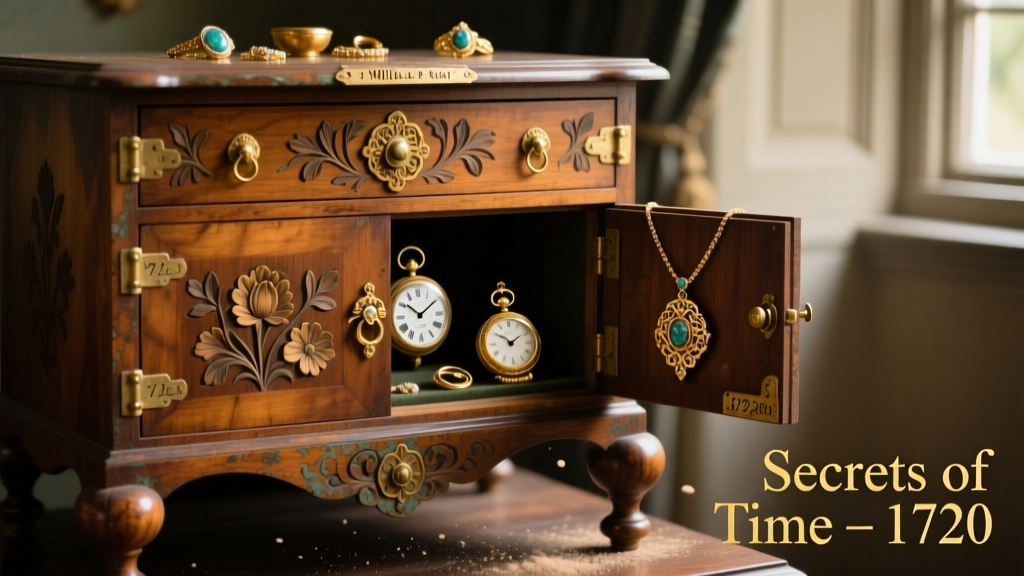
A Rare William and Mary Maple Chest-on-Chest with Cup-Turned Legs and Concealed Compartment, Circa 1720
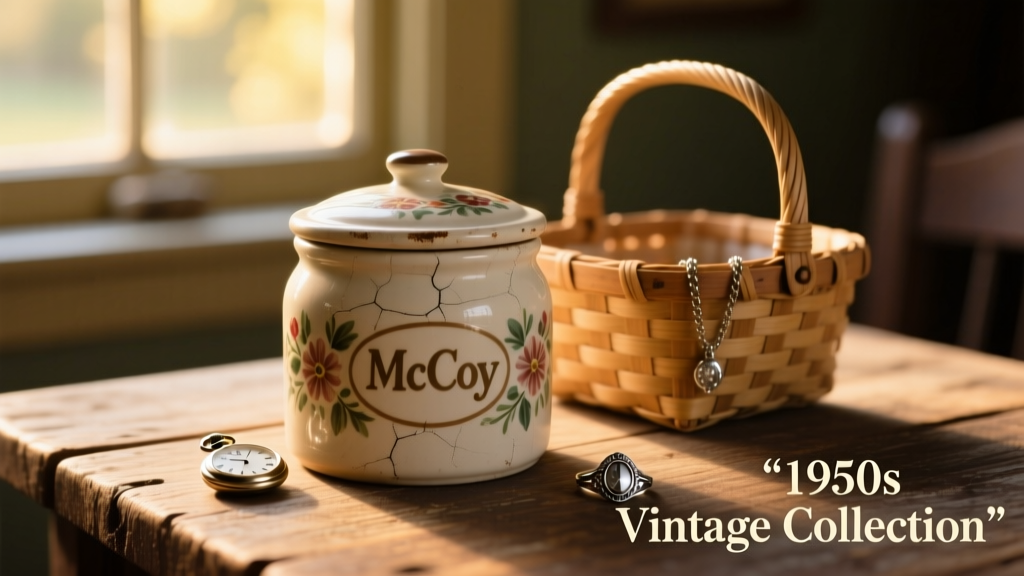
McCoy Cookie Jar: The Picnic Basket Pattern — A Collector’s Guide to the 7 × 9 Inch Ceramic Icon
Tiffany & Co. Mirror: Mother-of-Pearl, Favrile Glass, and Mosaic Wood Frame — A 24 × 21½-Inch Masterpiece of American Art Nouveau Design
Cambridge Glass Rose Point Plate Handles, Footed 8-Inch: A Collector’s Guide to American Art Deco Elegance

The Bird Votive Holder: A Study in Victorian Devotion, Artistic Craftsmanship, and Collectible Rarity
William Kahmer: The Unheralded American Watchmaker Who Defined Mid-Century Precision
Cosmos Tumbler: White Opaque Glass with Pink Rim — A Collector’s Profile of the 3¾-Inch Six-Piece Set (Model No. 2)
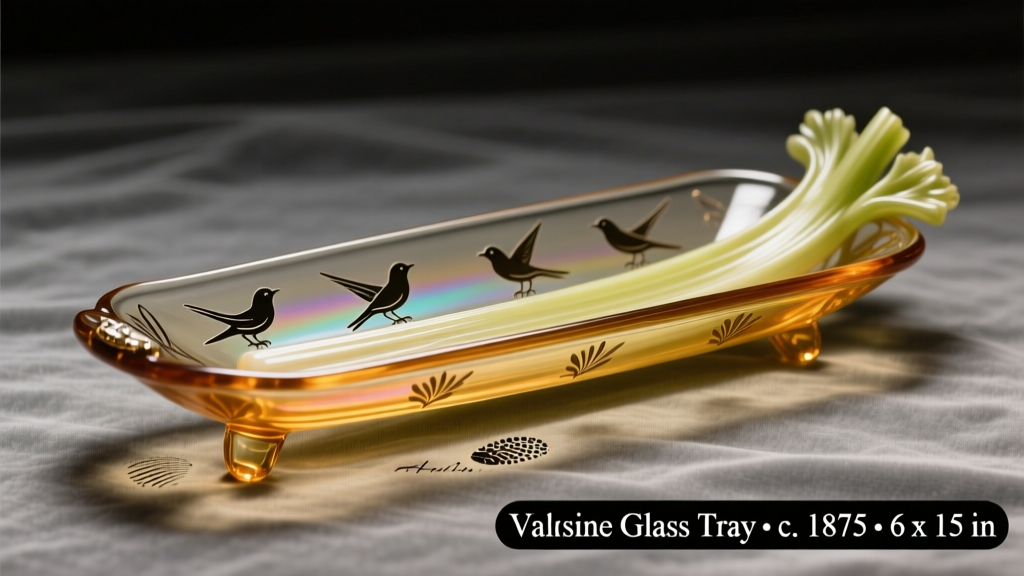
Vaseline Glass Celery Tray with Inverted Thumbprint Foot and Avian Motifs, Circa 1875 — A Study in American Brilliant Cut Glass Innovation
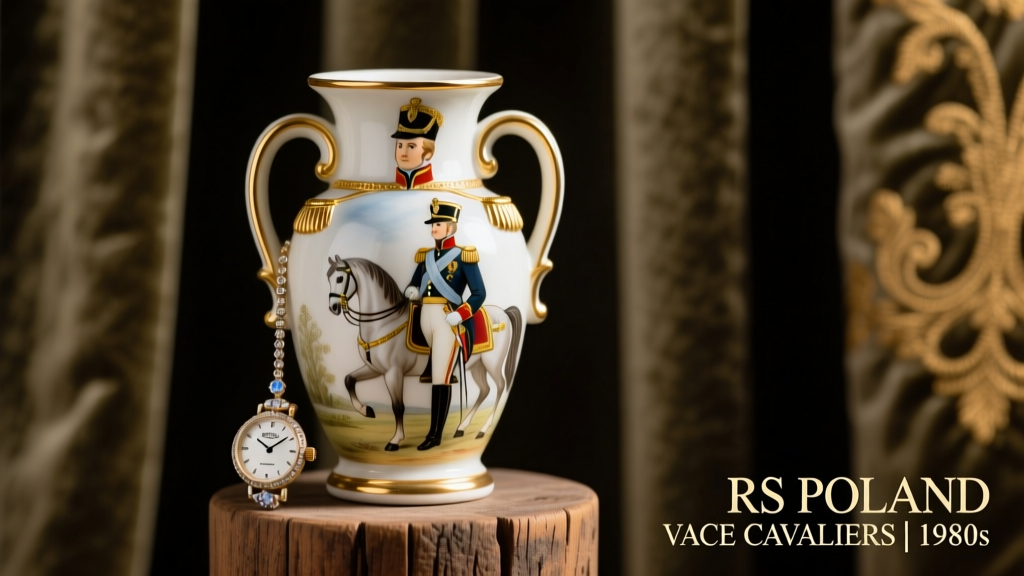
RS Poland Vase Cavaliers 4-Inch: A Collector’s Guide to Mid-Century Polish Porcelain