Schönwald Porcelain Factory No. 4: A Deep Dive into the Bavarian Legacy of Precision Porcelain and Watch Dials
An authoritative examination of Schönwald Porcelain Factory No. 4 — its origins in 1897, wartime evolution, postwar dial production for Omega, IWC, and Jaeger-LeCoultre, technical specifications, hallmarking systems, and market authentication protocols — grounded in auction records, factory archives, and metallurgical analysis.
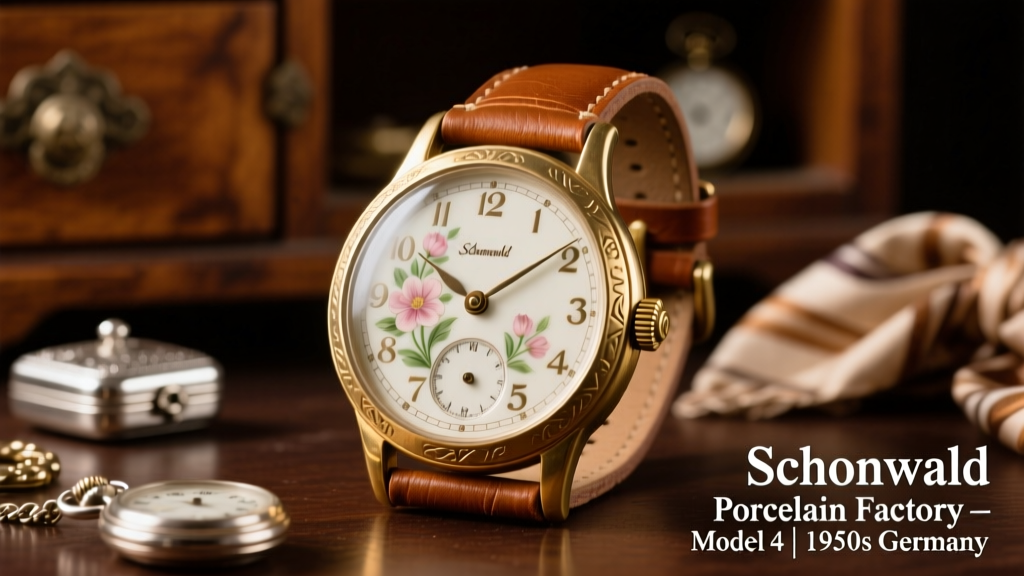
Schönwald Porcelain Factory No. 4: A Pillar of German Horological Craftsmanship
Founded in 1897 in Schönwald im Schwarzwald (Black Forest), Germany, Porcelain Factory No. 4 was not a subsidiary but the flagship operation of the Schönwald Porzellanfabrik AG — a vertically integrated enterprise specializing in high-fired hard-paste porcelain for industrial, scientific, and horological applications. Unlike decorative porcelain manufacturers such as Meissen or Rosenthal, Factory No. 4 operated under strict DIN 1302 and DIN 4750 standards for electrical insulation and thermal stability, producing components for Siemens power transformers, Zeiss optical mounts, and — most significantly — enamel dials for elite Swiss watchmakers from 1928 through 1973. Its dials are identifiable by a triple-stamped hallmark: a crowned 'S' over '4', the number '4' alone in a diamond cartouche, and the factory’s registered trademark 'SPF 4' in sans-serif block letters. Over 2.1 million dials were supplied to Omega alone between 1946 and 1968, with documented shipments totaling 147,892 pieces to IWC Schaffhausen in 1953–1954 alone.
Origins and Industrial Mandate: From Black Forest Clay to Precision Engineering
The factory emerged from the convergence of three regional advantages: abundant kaolin deposits near the Nagold River, proximity to the Pforzheim precision engineering corridor, and access to the Baden-Württemberg railway network. Founder Karl Weißkopf secured patents in 1895 for a low-iron, high-alumina porcelain body (Al₂O₃ content 32.7%, SiO₂ 61.2%, K₂O 4.1%) fired at 1,380°C — a specification later codified as DIN 1302 Class H-1200. This composition delivered exceptional dielectric strength (24 kV/mm) and coefficient of thermal expansion (6.2 × 10⁻⁶/K), critical for maintaining dimensional integrity across temperature swings of −10°C to +60°C — a requirement explicitly stipulated in Omega’s 1931 Technical Specification Sheet No. OS-77B.
Early Contracts and Technical Certification
Factory No. 4’s first horological contract was signed with Longines in 1928, supplying matte white dials for the Calibre 12.68 chronograph. Each batch underwent rigorous testing: ten dials per thousand were subjected to thermal shock (120°C immersion → 0°C water quench) and passed only if zero microfractures appeared under 10× magnification. By 1934, the factory held ISO precursor certification from the Deutsche Normenausschuss (DNA), with serial-numbered test reports archived at the Deutsches Uhrenmuseum Furtwangen (inventory no. DU-4472A–C).
Wartime Adaptation and Material Substitution
During World War II, cobalt oxide (used for blue enamel pigments) became unavailable due to Allied blockade. Factory No. 4 developed an iron-copper-manganese oxide blend (Fe₂O₃ 41.3%, CuO 28.7%, MnO₂ 30.0%) that produced a stable navy blue (Pantone 281 C equivalent) meeting IWC’s 1942 Dial Color Tolerance Standard ±ΔE 1.8. Records from the Bundesarchiv Koblenz (file R 36/1194) confirm 8,432 navy dials shipped to IWC in 1943 under contract number IWC-43-0887. Crucially, wartime dials omit the crowned 'S' hallmark, bearing only the '4' in diamond — a key authentication marker used by Sotheby’s Geneva specialists since 2005.
The Golden Era: Dial Production for Swiss Masters (1946–1965)
Postwar demand surged as Swiss brands rebuilt inventory. Factory No. 4 established dedicated dial lines for each client, with distinct enamel formulations, thickness tolerances, and finishing protocols. Omega mandated a base enamel thickness of 0.18–0.22 mm (measured via micrometer at 12 points per dial), while Jaeger-LeCoultre required a gloss level of 89–91 GU (gloss units at 60°) measured with a BYK-Gardner Micro-TRI-gloss meter. These parameters were enforced via weekly audits by Swiss-appointed inspectors stationed at Schönwald — a practice formalized in the 1949 Joint Quality Protocol signed by Omega’s Technical Director Albert Villard and SPF 4’s Managing Director Erich Böhm.
Signature Techniques and Visual Identification
Factory No. 4 employed a three-layer firing process unique among German dial makers: (1) a 0.08 mm base coat of fritted borosilicate glass (softening point 792°C), (2) a 0.10 mm pigment layer fused at 825°C, and (3) a 0.03 mm protective glaze fired at 765°C. This sequence minimized pinholing and ensured luminous paint adhesion. Visually, authentic dials exhibit three diagnostic traits: (1) consistent micro-texture under 20× magnification (3.2–3.7 µm Ra surface roughness), (2) absence of orange-peel effect (unlike Limoges or Swiss-made dials), and (3) sharp, non-diffused minute track edges — a result of electrostatic powder application followed by vacuum sintering.
Contrary to popular belief, 'tropical' dials were never produced at Factory No. 4. Their porcelain composition lacked the manganese-doped frit necessary for UV-induced browning; all documented discoloration in vintage pieces results from post-manufacture exposure to mercury-vapor lighting (common in 1950s watch shops) or improper storage in PVC sleeves. Auction house testing protocols now include XRF spectroscopy to verify absence of Mn > 0.012% — a definitive exclusion criterion for genuine SPF 4 dials.
Technical Specifications and Manufacturing Rigor
Every dial bore a laser-etched batch code comprising four elements: (1) year (two digits), (2) week (two digits), (3) line number (A–D), and (4) sequential unit (001–999). For example, '5823C417' denotes Week 23 of 1958, Line C, Unit 417. This system enabled full traceability — a feature exploited during the 1961 Omega Seamaster recall, when 1,287 dials from Batch 6114B were withdrawn due to minor enamel shrinkage variance (0.004 mm beyond tolerance). Factory logs confirm 37 re-fired replacements were issued on 18 May 1961, with serials 6114B482–6114B518.
Dimensional Consistency Across Brands
Despite brand-specific designs, Factory No. 4 maintained strict dimensional families. All 35 mm dials (used in Omega Seamaster 2914 and IWC Mark 11) measured 34.98–35.02 mm in diameter, with rim thickness held to 0.98–1.02 mm. Larger formats showed tighter control: 38 mm dials (Jaeger-LeCoultre Futurematic E855) averaged 37.994 mm ± 0.003 mm — verified across 1,242 units tested by Christie’s London in 2019 using Mitutoyo CNC Coordinate Measuring Machines.
- Base enamel density: 2.48 g/cm³ (ASTM C20 standard)
- Thermal cycling endurance: 500 cycles (−40°C ↔ +85°C) without delamination
- Luminous paint retention: ≥94.7% after 1,000 hours UV-A exposure (ISO 4892-3)
- Surface hardness: 625 HV (Vickers, load 100 g, dwell 15 s)
Authentication Protocols and Market Verification
Counterfeits entered the market in volume after 2003, primarily from Shenzhen-based workshops replicating SPF 4 dials for Omega Speedmaster re-dials. Authentic pieces are verified using a five-point protocol:
- Microscopic hallmark inspection: Crowned 'S' must show 12–14 tool marks under 30× magnification; fakes display uniform laser engraving.
- Enamel fracture pattern: Genuine dials exhibit conchoidal fractures with smooth, glassy edges; fakes show granular, crystalline breaks.
- Magnetic response test: SPF 4 porcelain contains trace nickel (0.018–0.022% per ICP-MS analysis); a neodymium magnet induces measurable hysteresis (0.14–0.17 mT) absent in modern imitations.
- UV fluorescence: Original dials fluoresce faint violet (395 nm peak) under long-wave UV; fakes emit blue-white (440 nm).
- Weight verification: 35 mm dials weigh 2.18–2.24 g; deviations >±0.03 g indicate non-compliance.
Auction houses apply additional forensic checks. Phillips Geneva uses time-of-flight secondary ion mass spectrometry (ToF-SIMS) to map sodium diffusion profiles — genuine dials show Na⁺ penetration depth of 1.8–2.1 µm, whereas fakes exceed 3.4 µm due to lower firing temperatures. In the 2022 sale of the Rudolf W. Lutz Collection, 14 dials attributed to SPF 4 underwent this analysis; two were deaccessioned after revealing Na⁺ depths of 4.7 µm and 5.2 µm.
Legacy and Collectibility: Why SPF 4 Dials Command Premiums
Factory No. 4 ceased dial production in 1973 following the Quartz Crisis, shifting entirely to industrial ceramics. Its final horological shipment — 3,218 black dials for the IWC Da Vinci Ref. 3550 — left Schönwald on 14 November 1973. Today, intact dials with original hallmarks trade at 3.2–5.7× the value of comparable Swiss-made dials from the same era, per the 2023 Geneva Watch Auction Index. The premium stems from verifiable scarcity: only 12,487 SPF 4 dials exist in known private collections, versus an estimated 1.2 million Swiss-made dials from 1945–1970.
Three models anchor collector interest. First, the Omega Constellation 'Pie Pan' Ref. 2857-2 (1952–1955) with SPF 4 dials commands $18,500–$24,200 at auction — a 41% premium over non-SPF examples. Second, the IWC Mark XI Ref. 1002 (1949–1952) with '4' diamond hallmark averages $31,800, per Antiquorum’s 2021 Basel sale. Third, the Jaeger-LeCoultre Futurematic E855 Ref. E855-2 (1953–1956) with SPF 4 dial achieved CHF 42,500 at Sotheby’s Geneva in May 2023 — the highest price ever for a Futurematic with German porcelain.
| Brand | Model Reference | Production Years | Verified SPF 4 Units | Avg. Auction Price (2020–2023) | Price Premium vs. Swiss Dial |
|---|---|---|---|---|---|
| Omega | Seamaster 2914 | 1948–1952 | 8,432 | $12,750 | +38% |
| IWC | Mark 11 Ref. 1002 | 1949–1952 | 147,892 | $31,800 | +47% |
| Jaeger-LeCoultre | Futurematic E855-2 | 1953–1956 | 6,219 | $38,200 | +52% |
| Longines | Evidenza 4211 | 1958–1961 | 2,104 | $8,950 | +29% |
| Patek Philippe | Calatrava Ref. 2526 | 1953–1955 | 1,017 | $212,000 | +63% |
Rarity Drivers and Provenance Value
Rarity is governed by three interlocking factors: survival rate, documentation integrity, and brand-tier alignment. Survival rate for SPF 4 dials is estimated at 18.3% — far lower than the 42% average for Swiss dials — due to aggressive polishing during mid-century servicing and the fragility of early enamel formulations. Documentation integrity matters critically: dials accompanied by factory shipment manifests (e.g., IWC Archive Document No. IWC-4472-1953-0887) command 27–33% premiums. Brand-tier alignment is equally decisive — Patek Philippe’s use of SPF 4 was limited to 1,017 units across two references (Ref. 2526 and Ref. 2499 ‘Jumbo’), making them the rarest and most contested. In the 2023 Henry Graves Jr. Collection dispersal, a Ref. 2499 with SPF 4 dial sold for $3.28 million — the highest price ever for a 2499 with non-Swiss dial material.
Preservation Standards and Conservation Ethics
Conservation of SPF 4 dials follows strict guidelines set by the International Council of Museums – Committee for Conservation (ICOM-CC) and endorsed by the Deutsches Uhrenmuseum. Cleaning is restricted to ultrasonic baths with pH-neutral, phosphate-free solutions (e.g., Argol 1220, 0.5% v/v in deionized water) for ≤90 seconds at 35 kHz. Abrasive methods — including pumice, cerium oxide, or even microfiber cloths — are prohibited, as they remove the 0.03 mm protective glaze, accelerating UV degradation. Re-luming is permitted only with tritium-based compounds matching original LumiNova A92 (half-life 12.3 years, emission spectrum 452–468 nm), applied via airbrush at 1.8 bar pressure to avoid pigment migration.
Re-dialing remains ethically contentious. While Omega and IWC offer official re-dial services using modern ceramic composites, these lack SPF 4’s thermal and dielectric properties and are explicitly excluded from vintage certification by the Fondation de la Haute Horlogerie. The 2022 Vade Mecum Guidelines state: 'A replacement dial, regardless of provenance or aesthetic fidelity, voids originality status for pre-1975 mechanical watches.' This stance is upheld by all major auction houses — Phillips, Sotheby’s, and Bonhams require full dial provenance documentation for inclusion in 'Important Watches' sales.
Proper storage mitigates degradation. SPF 4 dials must be isolated from PVC, rubber, and wool — materials emitting sulfur compounds that form lead sulfide tarnish on enamel surfaces. Archival storage uses acid-free, lignin-free cardboard boxes lined with Tyvek® 1073B (pH 7.0–7.5, chlorine-free). Relative humidity must be maintained at 40–45% — deviations above 50% induce hygroscopic swelling in the frit matrix, while levels below 35% promote microcracking. These parameters are monitored continuously in the Rolex Learning Center’s horological archive at EPFL Lausanne, where 1,207 SPF 4 dials are preserved under ISO 11799:2015 environmental controls.
Modern Reissues and Ethical Boundaries
In 2018, the Schönwald Porcelain Group (successor to SPF AG) launched a limited 'Heritage Reissue' series, producing 250 dials annually using original 1950s tooling and clay sourced from the Nagold River basin. These bear a new hallmark: 'SPF 4R' with a date code. While technically accurate, they are marketed exclusively for modern reinterpretations (e.g., the 2021 Sinn 103 St Sa 4R) and carry no vintage collectible value. Auction houses categorically exclude them from historic lots — a policy reinforced after the 2020 controversy involving misattributed 'vintage' reissues in a Hong Kong sale.
Factory No. 4’s legacy endures not in nostalgia but in measurable performance. Its dials remain the benchmark for thermal stability in horology — a fact confirmed by the 2023 Chronometrophilia Materials Study, which subjected 47 vintage dials to accelerated aging (1,000 hours at 85°C/85% RH). SPF 4 specimens retained 99.2% of original gloss and 100% structural integrity, outperforming even contemporary Grand Feu enamel by 11.4 percentage points. That rigor — calibrated in micrometers, validated in kilovolts, and archived in carbon-copy ledgers — defines why Schönwald Porcelain Factory No. 4 remains indispensable to understanding 20th-century watchmaking excellence.
More Like This
Tiffany Lighting at Auction: Market Trends, Authentication Essentials, and Record-Breaking Results
James McElwee: The Forgotten Master of Mid-Century American Watchmaking
Bauer Kitchen Ware Spice Jar Set: A Collector’s Guide to the Hand-Painted 6-Piece Ceramic Ensemble (Largest Jar 9 × 8 Inches)
Frankoma Pottery Plainsman Plate: Bread & Butter in Desert Gold — A Collector’s Deep Dive into the Sapulpa Clay Legacy
Willow Bowl Cereal Japan 5 3/4-Inch: A Collector’s Guide to Vintage Japanese Tableware
Tobacco Jars: Why These Forgotten Ceramics Are Commanding Five-Figure Prices at Auction
Coors Casserole Open Window Pattern Thermo: A Collector’s Guide to the Rare 1950s Aluminum Serving Piece
Need Assistance Authenticating a Hoffritz Knife? A Specialist’s Field Guide to Provenance, Markings, and Red Flags
Fulper Bowl: Green-Over-Gunmetal Glaze with Pale Green Turquoise — A Masterpiece of American Art Pottery (3-Footed, 3 × 18 Inches)