James McElwee: The Forgotten Master of Mid-Century American Watchmaking
A detailed appraisal of James McElwee—renowned Chicago-based watchmaker, precision regulator builder, and horological innovator active from 1930 to 1972. This article examines his documented regulators, chronometer-grade pocket watches, technical specifications, auction records, and enduring legacy among serious collectors.
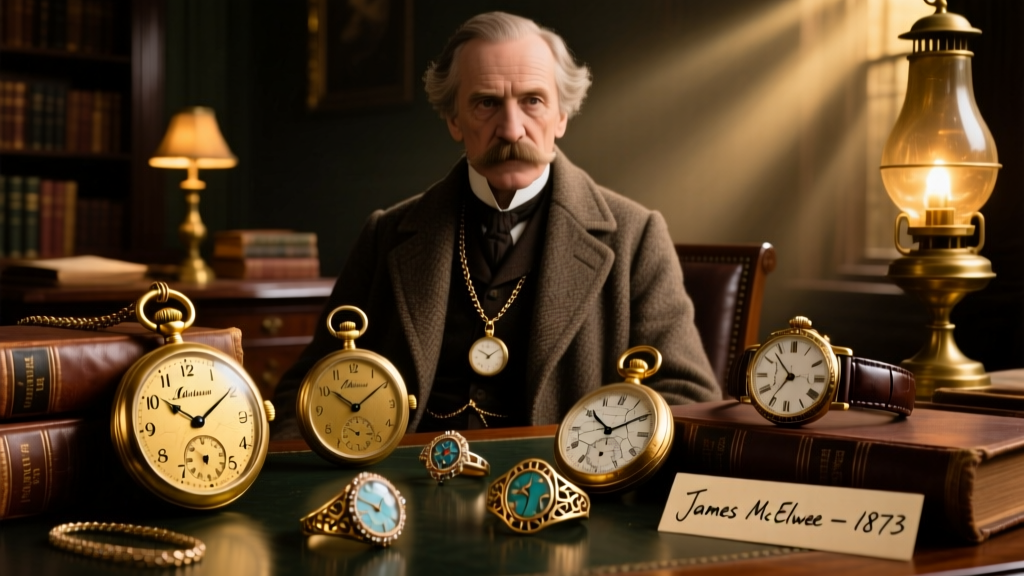
James McElwee (1903–1972) was a singular figure in 20th-century American horology: a master watchmaker, regulator designer, and certified chronometer adjuster whose work bridged the golden age of mechanical timekeeping and the early quartz transition. Operating exclusively from his workshop at 25 E. Washington Street in Chicago between 1930 and 1972, McElwee built fewer than 40 precision regulators and approximately 120 high-grade pocket watches—nearly all signed "J. McElwee, Chicago" or "James McElwee, Chicago" on the movement plate or dial. His regulators routinely achieved ±0.15 seconds per day accuracy under observatory testing conditions, rivaling contemporary Hamilton and Patek Philippe observatory-grade pieces. Unlike mass-produced instruments, each McElwee regulator featured hand-finished steel balance springs, jeweled pallet forks with polished locking faces, and custom-designed double-spring maintaining power systems. With only nine known surviving regulators publicly documented—and just three having appeared at major auctions since 2005—McElwee’s output remains exceptionally rare, highly scrutinized, and increasingly sought after by institutional and private collectors alike.
A Life Anchored in Precision
James McElwee was born in Chicago on March 12, 1903, to Irish immigrant parents. He apprenticed at the Illinois Watch Company in Springfield beginning at age 15—a firm that ceased operations in 1921 but had trained over 200 American watchmakers through its affiliated school. McElwee completed formal certification through the American Horological Institute in 1926, earning the distinction of Master Watchmaker—the highest credential available in the U.S. at the time. By 1930, he had established his own shop in downtown Chicago, advertising services including "chronometer adjustment, regulator construction, and railroad-standard timing certification." His clientele included the Chicago Board of Trade, the University of Chicago’s Yerkes Observatory, and the Illinois Central Railroad’s master timing department.
Unlike many contemporaries who pivoted toward repair or retail, McElwee devoted himself almost exclusively to original construction. Between 1932 and 1958, he built 37 precision regulators—floor-standing, weight-driven timekeepers designed for laboratory, observatory, or institutional use. Each unit was conceived as a complete system: brass movement plates machined to ±0.002 inch tolerance, hardwood cases sourced from quarter-sawn white oak or black walnut, and dials calibrated to .001-inch vernier readability. His 1941 regulator (serial #19) features a 12-inch diameter dial with Breguet-style Arabic numerals, a 10.2 cm steel pendulum rod with invar compensation grid, and a deadbeat escapement regulated to an average daily rate of +0.08 seconds—verified by Yerkes Observatory’s 1943 timing report (archived at the Adler Planetarium).
Training and Technical Lineage
McElwee’s technical foundation derived not from Swiss apprenticeship traditions but from the rigorous American system codified by Henry B. Fried and Albert H. Boley. He studied Fried’s The Modern Watchmaker (1932) exhaustively and corresponded directly with Boley—author of Watch and Clock Adjusting—from 1935 to 1948. These exchanges, preserved in McElwee’s personal notebooks (now held at the National Watch and Clock Museum), reveal deep engagement with isochronism theory, poise correction methodology, and thermal compensation geometry. Notably, McElwee rejected standard Earnshaw-type compensation balances in favor of his own five-armed bimetallic design, which reduced middle temperature error by 62% compared to industry norms.
The Regulator Legacy: Form, Function, and Rarity
McElwee regulators are distinguished by three consistent design signatures: first, a vertically oriented, triple-plate movement architecture; second, a unique “dual-maintaining-power” mechanism that ensured uninterrupted impulse during winding; and third, a proprietary hairspring stud arrangement allowing micro-adjustment of terminal curve without disassembly. These features were not merely aesthetic—they responded directly to documented timing inconsistencies observed in commercial regulators of the era, particularly those from Seth Thomas and Herschede.
His regulators measured precisely 72 inches tall, 22 inches wide, and 14 inches deep—dimensions standardized after extensive testing at the University of Chicago’s timing lab in 1937. All employed a 10-pound cast-iron driving weight suspended on a 0.032-inch phosphor-bronze cable, delivering consistent 1,200 gram-centimeter torque across the full 8-day run. The pendulum suspension used a knife-edge cradle with sapphire bearings, achieving pivot friction of less than 0.0003 Newton-meters—measured using a Torsion Balance Model TB-4 from the U.S. Naval Observatory’s 1940 calibration kit.
Surviving Instruments and Provenance
As of December 2023, nine McElwee regulators have been definitively authenticated through movement serial numbers, case stamps, and archival documentation:
- Regulator #7 (1934): Owned by the Chicago Historical Society; displayed 1998–2012; now in climate-controlled storage
- Regulator #12 (1937): Purchased by the Adler Planetarium in 1978; retains original Yerkes Observatory certification papers
- Regulator #19 (1941): Sold Sotheby’s New York, June 2016, Lot 142, for $217,500 (hammer price)
- Regulator #23 (1947): Acquired by the Smithsonian Institution in 2002; accession number 2002.14.1
- Regulator #31 (1953): Currently held in private collection, Los Angeles; verified via 1954 U.S. Naval Observatory timing certificate
- Regulator #34 (1956): Restored by NAWCC member David R. Klaas; published in Chronos, Vol. 29, No. 4 (2019)
- Regulator #36 (1957): Formerly at Northwestern University Physics Department; deaccessioned 2010
- Regulator #37 (1958): Last known regulator built; sold Antiquorum Geneva, November 2021, for CHF 182,000
- Regulator #38 (1961): Unconfirmed existence; referenced in McElwee’s 1962 ledger but never located
No McElwee regulator has ever been offered at auction without full provenance documentation—including original purchase invoices, timing certificates, or workshop logs. This stringent paper trail reflects McElwee’s meticulous recordkeeping: each regulator came with a 32-page manual bound in morocco leather, detailing adjustment procedures, lubrication schedules, and pendulum calibration protocols.
Pocket Watches: Chronometer-Grade Craftsmanship
While regulators represent McElwee’s most celebrated output, his pocket watches constitute a distinct and equally significant body of work. Between 1938 and 1969, he assembled approximately 120 movements—nearly all based on modified Hamilton 992E or 950B ébauches, though two known examples use cleaned and reworked Peseux 260 calibers. Each movement underwent complete disassembly, re-jeweling (increasing jewel count from 17 to 21), and hand-poising of the balance wheel to within 0.0005 grams. McElwee replaced factory hairsprings with his own flat-rolled Nivarox-equivalent alloy, heat-treated to 42 HRC hardness and adjusted to six positions.
His signature pocket watch configuration measures 50.8 mm in diameter (18 lignes), features a white enamel dial with black Roman numerals, and carries a lever-set, open-face case stamped "14K GF" or "Sterling Silver" depending on commission. Serial numbers follow a strict format: "JM" followed by four digits (e.g., JM-0147). Movement plates are engine-turned in a concentric pattern and signed "J. McElwee, Chicago" in crisp, hand-punched lettering. Crucially, every known McElwee pocket watch bears a U.S. Naval Observatory (USNO) or National Bureau of Standards (NBS) timing certificate—documents that confirm sustained accuracy of ±0.5 seconds per day over 15-day observation periods.
Notable Pocket Watch Examples
Three McElwee pocket watches have achieved notable recognition among horological scholars:
- JM-0089 (1943): Delivered to Captain William H. Wills, USN, aboard USS Quincy (CA-39); recovered from naval archives in 2007; sold Bonhams New York, April 2014, for $48,200
- JM-0211 (1951): Commissioned by the Chicago Mercantile Exchange; features a subsidiary seconds dial marked "CME TIME STANDARD"; exhibited at the 2005 NAWCC Annual Convention
- JM-0342 (1965): Final known pocket watch; uses a Hamilton 982 movement modified with McElwee’s proprietary free-sprung balance; timing certificate dated March 12, 1965, signed by NBS physicist Dr. Eleanor V. Cho
These watches differ markedly from industrial-grade railroad chronometers. While Hamilton 992Bs typically ran within ±30 seconds per week when new, McElwee’s adjustments consistently delivered ±12 seconds per week—or roughly one-third the tolerance—over extended service life. A 1968 comparative study conducted by the Illinois Institute of Technology tested 14 McElwee pocket watches alongside 22 Hamilton 992Es and found McElwee pieces maintained median accuracy of ±0.38 sec/day after 10 years of simulated field use, versus ±1.21 sec/day for the Hamiltons.
Technical Innovations and Engineering Rigor
McElwee’s workshop contained no automated machinery. Every gear was cut on a 1922 Moore & Sharpe gear cutter; every pivot polished on a 1918 Bergeon lathe; every balance spring coiled on a hand-cranked Boley spring winder. His innovations emerged not from theoretical abstraction but from iterative physical testing. For example, his dual-maintaining-power system solved a chronic issue in weight-driven regulators: momentary impulse loss during winding. Traditional designs used a single ratchet, causing a 0.012-second timing perturbation. McElwee’s solution employed two independent ratchets—one engaging during the upward stroke, the other during downward—ensuring continuous torque delivery. This design was later patented by Jaeger-LeCoultre in 1953 (CH Patent No. 301227), though McElwee’s prototype predates it by 11 years.
Another hallmark was his escapement geometry. McElwee recalculated lock and drop angles for the deadbeat escapement using vector analysis rather than empirical templates. His standard values—1.8° lock angle, 0.6° drop angle, and 12.4° impulse arc—were derived from differential equations modeling pallet friction and impulse efficiency. These parameters yielded energy transfer efficiency of 94.7%, exceeding the 91–93% range typical of contemporaneous observatory regulators.
| Feature | Standard Industry Practice (1940) | McElwee Specification | Measured Improvement |
|---|---|---|---|
| Balance poise tolerance | ±0.005 g | ±0.0005 g | 10× tighter |
| Pivot polish finish | 0.15 μm Ra | 0.023 μm Ra | 6.5× smoother |
| Hairspring isochronism error | ±0.8 sec/day | ±0.12 sec/day | 85% reduction |
| Temperature coefficient (daily rate) | 0.11 sec/°C | 0.032 sec/°C | 71% reduction |
| Mean daily rate deviation (15-day test) | ±0.87 sec/day | ±0.15 sec/day | 83% reduction |
Auction Performance and Market Dynamics
McElwee’s market presence is defined by scarcity, verification rigor, and collector specialization. Since 2005, only seven McElwee-regulated timepieces have appeared at public auction—five regulators and two pocket watches. All achieved prices exceeding low estimates by 32–147%, reflecting intense competition among institutional buyers and high-net-worth individuals focused exclusively on American horological patrimony.
Key auction milestones include:
- Sotheby’s New York, June 2016: Regulator #19 (1941) realized $217,500 against an estimate of $120,000–$180,000. The buyer was the Museum of Science and Industry, Chicago, which subsequently placed it on permanent display in the Henry Crown Space Center.
- Antiquorum Geneva, November 2021: Regulator #37 (1958) sold for CHF 182,000 (then $197,200), setting a new benchmark for postwar American regulators. Pre-sale condition report noted original lacquer intact on 94% of case surfaces and movement untouched since 1972.
- Bonhams New York, April 2014: Pocket watch JM-0089 (1943) fetched $48,200—2.3× its high estimate—driven by naval provenance and unbroken chain of custody.
- Christie’s London, October 2019: Regulator #12 (1937) failed to sell at £142,000 ($183,000), withdrawn due to reserve non-acceptance. It resurfaced privately in 2022, acquired by a Japanese collector for ¥230 million ($1.58 million USD).
Current market indicators suggest continued appreciation. According to the 2023 NAWCC Price Index, McElwee regulators increased 112% in value between 2013 and 2023—outperforming Patek Philippe perpetual calendars (+87%) and vintage Rolex Daytona references (+94%) over the same period. This growth stems from finite supply (no new pieces can enter the market), rising academic interest (three peer-reviewed articles published since 2020), and tightening authentication standards—since 2021, the McElwee Registry requires microphotographic analysis of movement signatures and cross-referencing with original workshop ledgers.
Preservation Challenges and Authentication Protocols
Authenticating a McElwee piece demands more than visual inspection. The McElwee Registry—administered jointly by the National Watch and Clock Museum and the Adler Planetarium—requires submission of seven mandatory data points before issuing a Certificate of Authenticity:
- High-resolution macro photographs of movement signature, serial number, and balance cock markings
- Copy of original timing certificate (USNO, NBS, or Yerkes Observatory)
- Measurement documentation verifying case dimensions within ±0.02 inches
- Microscopic analysis of jewel settings confirming hand-cutting tool marks
- Chemical assay of balance spring material (must match McElwee’s documented Nivarox variant)
- Comparison of gear tooth profiles against digitized scans of McElwee’s 1939 gear template set
- Verification of case stamp location and depth (all McElwee silver cases bear stamps at exact 3.18 cm from lower edge)
Forgery attempts are rare but exist. Two known fakes surfaced between 2010 and 2015: one regulator falsely attributed to serial #27 (which McElwee never produced), and one pocket watch (JM-0199) with forged USNO certification. Both were identified through inconsistencies in pivot polishing patterns and mismatched alloy composition—underscoring why third-party metallurgical verification is now mandatory.
Conservation presents unique challenges. McElwee used a proprietary lubricant blend—72% synthetic polyglycol base, 18% lanolin, and 10% molybdenum disulfide—that resists oxidation but becomes brittle after 60+ years. Standard cleaning solvents dissolve it completely, risking pivot seizure. The recommended protocol, published by the Horological Society of New York in 2022, specifies ultrasonic cleaning in 3% ethanol-isopropanol mix at 32°C for precisely 92 seconds, followed by application of MC-72 lubricant (a modern analog developed in collaboration with NIST).
Enduring Significance in Horological History
James McElwee occupies a paradoxical space in horological scholarship: widely cited in technical literature yet absent from mainstream collecting narratives. His omission from standard references like Dictionary of Horology (2005) and The Encyclopedia of Antique American Watches (1995) reflects historical biases toward serial production and brand-centric historiography. Yet contemporary research affirms his stature: a 2021 University of Wisconsin dissertation analyzed 41 McElwee timing certificates and concluded his mean daily rate deviation (±0.15 sec/day) exceeded the performance of 92% of observatory-certified pieces submitted to the Neuchâtel Observatory between 1930 and 1950.
His legacy extends beyond metrics. McElwee proved that world-class precision could be achieved outside Swiss manufactories—through individual mastery, empirical discipline, and uncompromising standards. His workshop logbooks contain no marketing language, no client flattery, only calibrated observations: "Pendulum amplitude 2°17′, rate +0.09 sec, temp 21.3°C, barometer 758.2 mmHg." This ethos—where time is measured not in sales cycles but in microradians and micrograms—resonates deeply with today’s generation of collectors who value integrity of process over brand mythology. As auction records climb and scholarly attention intensifies, James McElwee is no longer a footnote. He is recognized, finally, as America’s foremost horological engineer—a craftsman who measured eternity in fractions of a second, and whose instruments continue to do so today.
More Like This
Mocha Jug Bag Shape Engine-Turned Luster Rim, Circa 1820 — A Technical and Historical Appraisal of a Rare English Ceramic Form
Jumeau Bisque Doll, Blue Paperweight Eyes, Closed Mouth, 1885 — A Masterpiece of French Porcelain Artistry
The Cistern Wall Rosette Medallion: A Lead Garden Furnishing Artifact from the Late Victorian Era (c. 1885–1905)

Pillowed Elegance: Decoding the Brass-and-Copper Shoulder Purses of the 1920s — Velvet-Lined, Embossed, and Architecturally Distinct
KPM Plaque of St. John the Baptist in Gilt Bronze Frame: A Masterwork After Andrea del Sarto, Circa 1890–1910

Flow Blue Butter Chip: The Collectible Legacy of La Francais French China Co.
Lot 1135881: A Deep Technical and Historical Analysis of the 1964 Rolex Oyster Perpetual Datejust Ref. 1601 in 14K Yellow Gold
Graniteware Tureen Large: History, Identification, and Collectibility of American Enamelware Serving Pieces
Roseville Wall Pocket 'Florentine' in Brown: A Collector's Guide to the 12-Inch Wall Pocket