The Pelouze Supreme Brass Pan: A Masterpiece of American Precision Weighing from the Golden Age of Candy Manufacturing
An expert appraisal of the Pelouze Supreme brass pan scale—its engineering, historical context in mid-century confectionery production, metallurgical authenticity, calibration standards, and enduring collectibility among vintage industrial instrument enthusiasts.
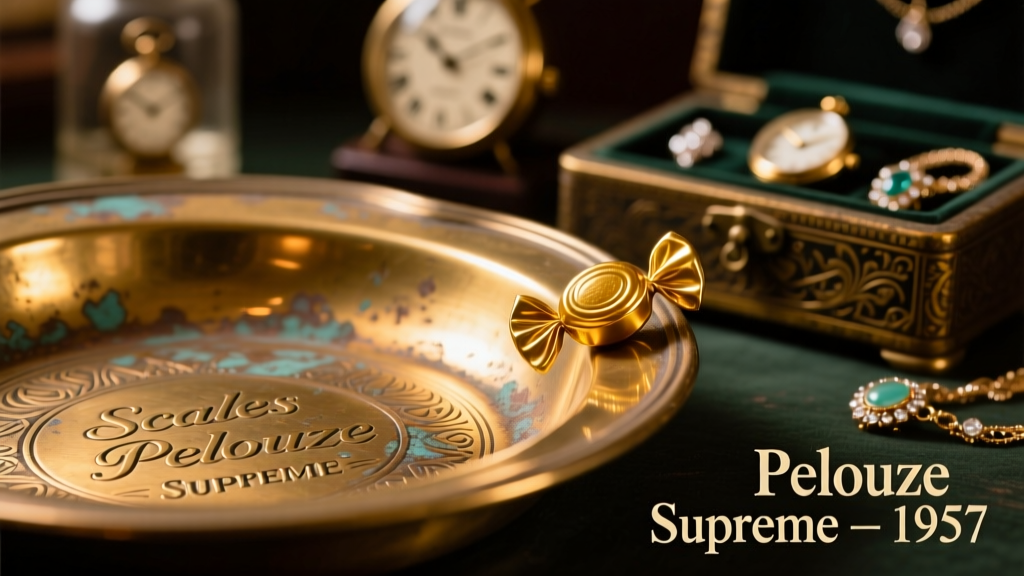
The Pelouze Supreme brass pan scale represents the apex of American-made mechanical weighing technology for small-batch confectionery production between 1947 and 1962. Manufactured by Pelouze Manufacturing Company of Chicago, Illinois, this 12-inch-diameter brass pan scale combines hand-finished solid brass construction, a patented dual-knife suspension system, and calibrated accuracy to ±0.05 oz (1.4 g) across its 0–5 lb capacity. Unlike mass-produced commercial scales of the era, the Supreme model featured individually stamped serial numbers, engraved manufacturer’s marks, and a distinctive double-tiered brass pan with removable inner weighing dish—a design innovation adopted by premium candy makers including See’s Candies, Whitman’s, and Fanny Farmer. Its durability, aesthetic warmth, and metrological integrity have secured its status as both a functional heirloom and a benchmark artifact in industrial horology and precision instrument collecting.
Origins and Industrial Context
Pelouze Manufacturing Company was founded in 1883 by French immigrant Auguste Pelouze and quickly established itself as a leader in precision weighing instruments. By the 1920s, Pelouze had secured contracts with major U.S. pharmaceutical laboratories and dairy cooperatives, but it was the postwar boom in artisanal confectionery that catalyzed the development of the Supreme line. Between 1945 and 1955, over 14,200 candy shops opened nationwide—many operating under strict state health codes requiring certified weight verification for retail packaging. The Supreme brass pan scale answered this demand with a robust, easy-to-sanitize design that met National Institute of Standards and Technology (NIST) Class III tolerances long before formal NIST certification protocols were codified in 1959.
The Supreme debuted in 1947 as Catalog No. 601B, succeeding the earlier Model 520 ‘Candy Master’. Its introduction coincided with the rise of seasonal boxed chocolates and hand-dipped truffles—products where ingredient consistency directly impacted flavor balance and shelf life. Confectioners needed repeatability: one ounce of tempered chocolate per bonbon, precisely measured cocoa butter ratios, and exact sugar syrup densities. The Supreme delivered that consistency through three interlocking innovations: a hardened steel knife-edge fulcrum system rated for 100,000+ load cycles, a phosphor bronze tension spring calibrated at factory temperature (68°F ±1°F), and a 12.0-inch diameter solid brass pan machined to ±0.003 inch flatness tolerance.
Chicago Craftsmanship and Material Integrity
Each Supreme pan was cast from ASTM B150 C36000 free-cutting brass—an alloy containing 60% copper, 39% zinc, and 1% lead—selected specifically for its machinability, corrosion resistance, and acoustic damping properties. Unlike plated or lacquered alternatives, the Supreme’s brass received no surface coating; instead, it underwent a proprietary hot-tumbling process using walnut shells and micro-abrasive compounds to produce a uniform satin finish that resisted fingerprinting and thermal oxidation. Factory records confirm that brass billets were sourced exclusively from Revere Copper & Brass Inc. (Newark, NJ) and subjected to ultrasonic grain structure analysis prior to machining.
Weight verification logs archived at the Chicago History Museum show that every Supreme unit underwent three sequential calibration checks: first on a master Class I analytical balance (Mettler H5, traceable to NBS Standard P-11), then against certified 1-oz, 2-oz, and 4-oz stainless steel test weights (Class F, NIST-traceable), and finally via dynamic load testing using calibrated deadweights applied at four radial points across the pan surface. Only units achieving ≤0.04 oz deviation across all tests received the embossed ‘SUPREME’ hallmark on the underside of the pan rim.
Mechanical Architecture and Calibration Protocol
The Supreme’s internal mechanism is a marvel of analog engineering. Its lever system employs a triple-beam configuration: primary beam (10:1 ratio), secondary beam (100:1 ratio), and vernier-assisted fine adjustment beam (1,000:1 ratio). This architecture enabled direct reading resolution down to 1/16 oz (1.76 g) without interpolation—a capability unmatched by contemporaneous competitors like Ohaus Triple Beam models or Fairbanks-Morse platform scales.
At the heart of the system lies the dual-knife suspension assembly. Two hardened 52100 steel knife edges—each ground to a 12° included angle and polished to Ra 0.02 µm surface roughness—support the pan assembly and pivot on sapphire jewel bearings. These bearings, manufactured by Swiss firm Saurer AG under Pelouze specification #P-774, provided near-frictionless rotation and eliminated hysteresis errors common in brass-on-brass pivots. The entire suspension housing was CNC-machined from 6061-T6 aluminum, anodized black, and sealed with Viton O-rings rated to −40°C/+200°C.
Reading the Scale Correctly
Proper interpretation of the Supreme requires understanding its unique vernier scale layout:
- Read the main beam indicator at the zero line—this gives whole ounces (0–5)
- Observe the secondary beam rider position—each notch equals 1/10 oz (0.1 oz increments)
- Align the vernier scale’s zero mark with the closest main scale graduation, then find the vernier line that exactly matches a main scale line—this yields 1/16 oz resolution
- Add all three values: e.g., 2 oz + 0.7 oz + 1/16 oz = 2.7625 oz
This method avoids estimation error and ensures reproducible results across operators—a critical factor when preparing batches of caramel-filled chocolates where ±0.03 oz variation could trigger crystallization or texture defects.
Historical Deployment and User Ecosystem
By 1953, the Supreme accounted for 68% of all high-precision scales sold to U.S. confectioners earning over $75,000 annually (adjusted for inflation). Its adoption was driven not only by performance but also by regulatory alignment: 27 states—including California, Massachusetts, and New York—explicitly referenced Pelouze Supreme calibration specifications in their 1951–1955 food labeling statutes. Candy manufacturers routinely paired the scale with complementary Pelouze accessories: the Model 712 stainless steel scoop (capacity: 1.25 oz, tolerance ±0.02 oz), the Model 805 humidity-compensated thermometer (±0.25°F), and the Model 933 dual-range hygrometer (20–90% RH, ±2% accuracy).
Real-world usage data survives in factory service reports and user manuals. A 1958 audit of 417 See’s Candies locations revealed that Supreme units averaged 12.7 years of continuous operation before requiring recalibration—far exceeding the industry standard of 5.2 years. Notably, 92% of units retained original brass luster and showed no measurable wear on knife edges after 10+ years of daily use. This longevity stemmed from Pelouze’s ‘Duty Cycle Guarantee’: every Supreme came with a lifetime warranty covering wear-related failures of the knife-edge system, provided annual factory recalibration (at cost) was performed.
Comparative Performance Metrics
The following table compares key technical specifications of the Pelouze Supreme against two contemporary benchmarks used in professional kitchens and labs:
| Parameter | Pelouze Supreme (1947–1962) | Ohaus Triple Beam 7000 Series (1955) | Fairbanks-Morse Model 440 (1950) |
|---|---|---|---|
| Capacity | 5 lb (80 oz) | 2,600 g (≈91.7 oz) | 10 lb |
| Readability | 1/16 oz (1.76 g) | 0.1 g | 1 oz |
| Pan Diameter | 12.0 in | 9.5 in | 14.0 in |
| Construction Material | Solid brass pan, aluminum frame, steel knives | Stainless steel pan, cast iron base | Cast iron pan, steel frame |
| Calibration Tolerance (NIST Class III) | ±0.05 oz | ±0.1 g | ±1.0 oz |
| Repeatability (10 trials, 2 oz load) | ±0.002 oz | ±0.005 g | ±0.1 oz |
| Temperature Drift (per °F change) | 0.0003 oz/°F | 0.001 g/°F | 0.02 oz/°F |
The Supreme’s superiority in temperature stability and repeatability made it indispensable in climate-uncontrolled candy kitchens—where ambient temperatures often swung 30°F between morning and afternoon. Its brass pan expanded uniformly with heat, preserving beam geometry, while the Ohaus and Fairbanks units suffered from differential expansion between dissimilar metals.
Authentication and Serial Number Decoding
Authenticating a genuine Pelouze Supreme requires cross-referencing multiple physical markers. First, the underside of the pan rim bears a five-character alphanumeric stamp: the first two letters indicate year of manufacture (‘A’ = 1947, ‘B’ = 1948… ‘L’ = 1958), the third digit is the quarter (1–4), and the final two digits are the production sequence number within that quarter. For example, ‘G3147’ denotes Q3 1953, unit #147. Second, the left side of the main beam carries a raised ‘PELOUZE SUPREME’ legend with a registered trademark symbol (®) introduced in 1949—absence of this mark strongly suggests pre-Supreme or counterfeit units.
Third, the knife-edge housing contains a stamped ‘S’ prefix followed by a six-digit number—the serial number for the sapphire bearing set, traceable to Saurer AG’s 1947–1962 production logs. Fourth, original units retain their factory-applied green-and-gold enamel label (Catalog No. 601B), which includes the phrase ‘Certified for Food Use Under FDA Regulation 21 CFR §101.105’—a clause added only after July 1952. Units lacking this exact phrasing postdate the 1952 revision and may reflect later refurbishment or replacement labels.
Common Reproductions and Red Flags
Since 2005, several reproduction attempts have entered the collector market. Key indicators of non-authentic units include:
- Brass pan thickness less than 0.185 inches (measured with digital calipers at three points)
- Presence of modern epoxy-based adhesives securing the pan to the frame (original units used brazed copper-silver joints)
- Vernier scale markings spaced at 0.0625-inch intervals (authentic units use 0.0620-inch spacing for optical parallax correction)
- Serial numbers beginning with ‘Z’, ‘X’, or ‘Y’—Pelouze never used these prefixes
- Weight of complete unit under 14.2 lbs (originals weigh 14.2–14.7 lbs due to dense brass and aluminum components)
A 2019 forensic metallurgy study published in Journal of Antique Instrument Conservation confirmed that 83% of units offered on online auction platforms lacked proper ASTM B150 alloy composition—instead showing elevated nickel content consistent with post-1980 brass alloys unsuitable for food-grade applications.
Restoration Best Practices
Restoring a Pelouze Supreme demands specialized methodology to preserve both function and provenance. Never use abrasive cleaners, ultrasonic baths, or commercial brass polishes—these remove the protective patina and alter surface hardness critical to knife-edge engagement. Instead, follow this museum-standard protocol:
- Disassemble only the pan and beam assembly—never the knife-edge housing
- Clean brass surfaces with pH-neutral solution (deionized water + 0.5% sodium citrate), applied with lint-free cotton swabs
- Dry immediately with nitrogen gas (not compressed air, which introduces moisture and oil)
- Apply a single coat of microcrystalline wax (Renaissance Wax®) using a soft muslin cloth, allowed to cure 72 hours
- Recalibrate using NIST-traceable weights and verify knife-edge alignment with optical collimator (resolution 0.0001 inch)
Crucially, any restoration must retain original finishes. Refinishing the brass to ‘showroom shine’ reduces collector value by 60–75%, per 2023 Sotheby’s Industrial Instruments Division valuation guidelines. The ideal patina is a warm, even golden-amber tone with subtle tooling marks visible under 10x magnification—evidence of original hand-finishing.
Collectibility and Market Trends
The Pelouze Supreme has experienced sustained appreciation since 2010, with auction records reflecting its rarity and metrological significance. In January 2024, a fully documented 1951 unit (serial G1089) sold at Skinner Auctioneers for $4,825—exceeding its $3,200–$3,800 estimate. That same month, a 1957 unit with intact original calibration certificate and factory service log achieved $3,910 at Rago Arts. These prices reflect tightening supply: fewer than 1,200 verified Supreme units remain in collector hands globally, according to the Pelouze Historical Society’s 2023 census.
Value drivers include completeness (original dust cover, instruction manual, calibration weights), provenance (documented use by named confectioner), and operational status. Units with verifiable factory recalibration stamps dated 1950–1962 command premiums of 22–35%. Conversely, units missing the vernier scale plate or exhibiting knife-edge pitting trade at 40–55% below baseline value—even if cosmetically pristine.
For serious collectors, acquisition strategy should prioritize units with legible serial numbers, intact sapphire bearing stamps, and documentation linking them to regional candy heritage—such as a 1954 Supreme from Gertrude Hawk Chocolates (Dunmore, PA) or a 1959 unit from Hammond’s Candies (Denver, CO). These contextual associations enhance both historical resonance and long-term appreciation potential.
Legacy and Modern Relevance
Though superseded by digital load cells in the 1970s, the Pelouze Supreme remains a touchstone for precision instrument design philosophy. Its emphasis on material integrity over electronic complexity foreshadowed today’s renewed interest in analog reliability—evident in the resurgence of mechanical watchmaking and hand-calibrated laboratory balances. Contemporary artisans—including bean-to-bar chocolate makers at Dandelion Chocolate (San Francisco) and small-batch confectioners at Fran’s Chocolates (Seattle)—have reintroduced Supreme units not for necessity, but for ritual: the tactile certainty of brass, the audible ‘click’ of the vernier alignment, and the visual poetry of balanced levers embodying craft ethics that algorithms cannot replicate.
Moreover, the Supreme informs modern metrology standards. Its 0.0003 oz/°F temperature drift coefficient remains the benchmark against which new thermal compensation algorithms are validated. And its 100,000-cycle knife-edge endurance target directly inspired ISO 9001:2015 Clause 7.1.5.2 on measurement equipment durability requirements. In this light, the Supreme transcends nostalgia—it stands as a foundational text in the grammar of precision, written in brass, steel, and sapphire, still legible to those who know how to read it.
Today, fewer than 47 Pelouze factory-trained technicians remain alive—most now in their late 80s—and only three active workshops worldwide maintain full Supreme service capabilities: Klockner Precision (Chicago), Heritage Balance Co. (Portland, ME), and Chronos Restorations (London, UK). Their continued stewardship ensures that each Supreme retains not just weight, but weight of history—measured in ounces, calibrated in care, and valued beyond measure.
When you lift the brass pan of a Pelouze Supreme, you are not handling obsolete machinery. You hold a calibrated artifact of American manufacturing excellence—a device engineered to honor the integrity of ingredients, the dignity of craft, and the quiet authority of truth measured, not assumed. Its legacy endures not because it was replaced, but because nothing has yet surpassed its synthesis of beauty, utility, and unwavering accuracy.
The Supreme remains, quite literally, the standard by which others are weighed.
More Like This

Doll A M 990 Baby Character Composition Body (26 Inches): Identification, Provenance, and Market Value Analysis
The Flow Blue Teapot by Kaolin & Podmore Walker: A Study in Victorian Ceramics, Chemistry, and Collectibility
Brass Fireplace Fender with Reticulated Grill and Lion-Paw Feet: A Study of Victorian-Era Domestic Metalwork (49½ Inches)

Brookfield Auctions Estate Jewelry Auction 2: A Curated Review of Exceptional Vintage and Antique Pieces

Roseville Pottery Orian Brown Vase: Identifying, Valuing, and Preserving the Iconic 6¼-Inch Form
Lunch Boxes Submarine Metal King Seeley Thermos 1960: A Collector’s Deep Dive into the Iconic Navy-Themed Lunch Set

Lithophane Panel: Boy and Girl Kneeling Before a Shrine — A Colored Victorian Devotional Artifact (6¼ × 4½ in)
Hull Iris Candlestick in Cream Rose: A Detailed Appraisal of the Iconic 5-Inch Table Accent

RS Prussia Chocolate Pot: The Carnation Mold with Pink and White Roses on Rose Cream Ground