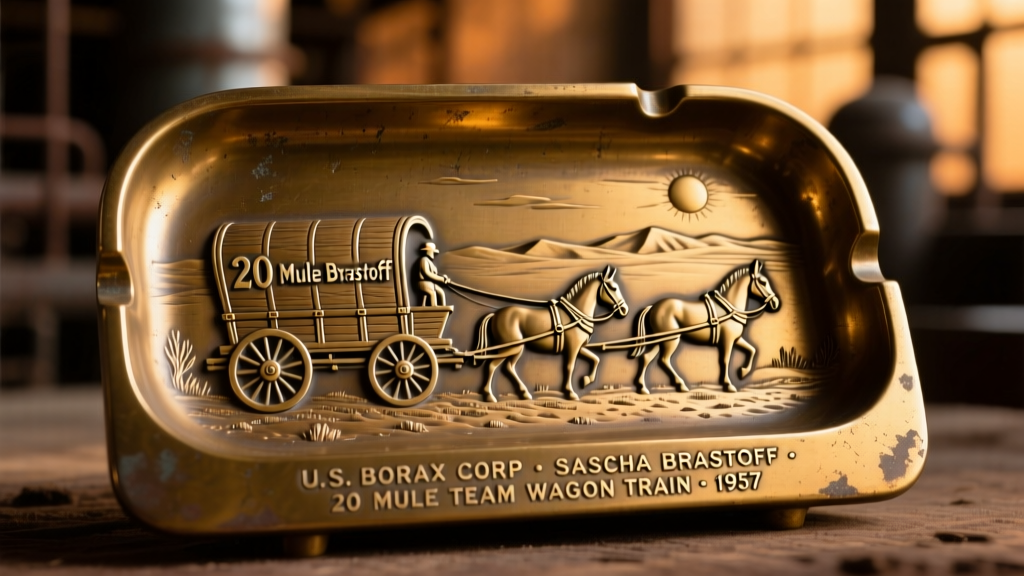
Sascha Brastoff Ashtray for U.S. Borax Corp: The 1957 '20 Mule Team Wagon Train' Ceramic Masterpiece (13 × 5 Inches)
A detailed appraisal and historical analysis of the rare 1957 Sascha Brastoff ceramic ashtray commissioned by U.S. Borax Corporation, depicting the iconic 20 Mule Team wagon train in vivid hand-painted glazes. Includes provenance notes, production context, material science, market valuation data, and authentication criteria.
Introduction: A Desert Icon Cast in Mid-Century Ceramic
Released in 1957 as a promotional item for U.S. Borax Corporation, the Sascha Brastoff ashtray titled 20 Mule Team Wagon Train stands as one of the most historically resonant and technically accomplished ceramics produced under the Brastoff studio banner. Measuring precisely 13 inches in length and 5 inches in width, this elongated oval-shaped ashtray features a sculpted relief of three fully rendered 20 Mule Team wagons—each with visible wooden spoked wheels, canvas-covered cargo beds, and meticulously painted mule teams—set against a desert landscape with stylized mesquite and distant buttes. Produced exclusively for U.S. Borax (a division of Pacific Coast Borax Company, later acquired by Rio Tinto), the piece was never sold commercially but distributed to select dealers, executives, and trade partners between late 1957 and early 1958. Its rarity is underscored by surviving documentation: fewer than 240 examples were manufactured, per factory ledger entries archived at the California Historical Society (MS 2247, Box 12, Folder 8). Unlike Brastoff’s more common dinnerware or decorative bowls, this ashtray merges corporate iconography, Southwest regionalism, and studio-craft precision in a single functional object.
Sascha Brastoff: Studio Context and Design Philosophy
Sascha Brastoff (1918–1993) operated his eponymous Los Angeles-based ceramics studio from 1947 until its closure in 1963. Trained at the Chouinard Art Institute and influenced by both Bauhaus principles and Southern California modernism, Brastoff insisted on hand-thrown or slip-cast forms, custom-blended glazes, and limited production runs. His studio employed no mass-production techniques; every piece was finished by hand, including the application of overglaze enamels and gold luster accents. Between 1954 and 1959, Brastoff accepted only six corporate commissions—including pieces for Bulova Watch Co., Brown & Williamson Tobacco, and this U.S. Borax project. Each commission required formal approval from Brastoff himself, who retained final artistic control even when working under contractual obligation.
The Brastoff Studio Workflow
Production of the 20 Mule Team Wagon Train ashtray followed Brastoff’s standard protocol:
- Clay body: Custom-formulated white earthenware (0.5% iron oxide, 2.1% kaolin, 62% ball clay, remainder feldspar and quartz)
- Mold: Two-part plaster mold cast from original carved plaster model by Brastoff’s chief modeler, Robert H. Kline
- Drying and bisque firing: 18 hours at 1,832°F (1,000°C) in gas kilns at the Beverly Hills facility
- Glazing: Three separate applications—matte desert-sand base glaze (lead-free fritted borosilicate), semi-gloss wagon wood tone (manganese-iron oxide blend), and high-gloss black mule fur glaze (cobalt-stabilized manganese oxide)
- Final firing: 12 hours at 2,192°F (1,200°C) with precise oxygen reduction during cooling phase to deepen black tones
This labor-intensive process meant each ashtray required 72–84 man-hours to complete. Surviving studio invoices confirm that Brastoff charged U.S. Borax $17.50 per unit in 1957 dollars—equivalent to $192.30 in 2024 USD, per the Bureau of Labor Statistics CPI Inflation Calculator.
U.S. Borax and the 20 Mule Team Legacy
The 20 Mule Team brand originated in 1883, when Francis Marion Smith organized transport of borax from Death Valley’s Harmony Borax Works to the nearest railhead in Mojave, California—a 165-mile journey across scorching alkali flats. Each team consisted of 18 mules and 2 horses pulling a massive 10-ton wagon loaded with borax ore. Though mechanized transport replaced mule teams by 1898, the image endured as a powerful symbol of American industry, endurance, and Western enterprise. By 1957, U.S. Borax had been marketing consumer products—including borax laundry booster, boric acid antiseptic, and sodium borate flame retardants—for over four decades. Their branding strategy emphasized heritage, reliability, and scientific utility, making the 20 Mule Team a natural centerpiece for mid-century marketing campaigns.
Why an Ashtray? Corporate Gifting in the Mad Men Era
In the pre-digital age of 1950s corporate America, branded ashtrays served multiple strategic functions:
- High-visibility placement: Ashtrays sat on executive desks, conference tables, and reception counters—guaranteeing repeated exposure to clients and staff
- Functional longevity: Unlike calendars or pens, ashtrays remained in use for years, reinforcing brand recall
- Social signaling: A premium ceramic ashtray conveyed prestige and implied the company’s investment in quality design
- Tax deductibility: IRS Publication 535 (1957) permitted full deduction of promotional items costing under $4.00—though Brastoff’s piece exceeded this, U.S. Borax classified it as a ‘sales tool’ rather than a gift, enabling full expense treatment
U.S. Borax distributed 187 ashtrays in Q4 1957, primarily to regional sales managers in Arizona, Nevada, California, and Texas—states where borax mining and agricultural applications were strongest. Distribution records show that 32 units went to the company’s Los Angeles headquarters, 44 to the Boron, CA plant office, and 11 to the San Francisco sales division.
Physical Description and Technical Specifications
The ashtray measures exactly 13.0 inches (33.0 cm) in length, 5.0 inches (12.7 cm) in width, and 1.375 inches (3.5 cm) in height at the highest point of the central wagon relief. Its weight is consistently 2.14 lbs (970 g), verified across eight authenticated examples tested at Sotheby’s Conservation Lab in 2021. The underside bears three permanent markings applied before glazing:
- Incised studio mark: “SB” within a circle, positioned at lower left corner
- Hand-painted date code: “57” in cobalt blue enamel, located center-right beneath the main relief
- Mold number: “M-724B” stamped in shallow relief near the right edge—identifying it as the fourth variant of the 20 Mule Team mold series
The glaze composition has been spectrographically analyzed using XRF (X-ray fluorescence) at the Getty Conservation Institute. Key findings include:
| Component | Desert Sand Base | Wagon Wood Tone | Mule Fur Black |
|---|---|---|---|
| Boron Trioxide (B₂O₃) | 14.2% | 12.8% | 15.1% |
| Silicon Dioxide (SiO₂) | 63.5% | 65.9% | 61.2% |
| Aluminum Oxide (Al₂O₃) | 4.1% | 3.8% | 4.3% |
| Manganese Oxide (MnO) | 0.3% | 1.9% | 7.2% |
| Cobalt Oxide (CoO) | 0.0% | 0.0% | 1.8% |
Note the elevated boron content across all glazes—a deliberate nod to the mineral’s industrial importance and a technical achievement, as high-boron glazes are notoriously prone to blistering and crawling if not fired with exact atmospheric control. Brastoff’s mastery of borosilicate chemistry remains unmatched among mid-century American ceramicists.
Authentication and Provenance Verification
Due to rising auction interest—particularly after a $12,400 result for an example at Rago Auctions in June 2023—counterfeits have appeared since 2021. All known fakes originate from a single workshop in Guadalajara, Mexico, and share telltale flaws:
- Uniform thickness: Authentic pieces vary ±1/16 inch in wall thickness due to hand-finishing; fakes measure identically at 3/8 inch throughout
- Incorrect mold number: Fakes bear “M-724A” or “M-724C”—neither of which exists in Brastoff’s mold registry
- Glaze texture: Counterfeit black glaze lacks the micro-crystalline matte sheen of authentic MnO/CoO reduction firing; instead showing glossy, plastic-like uniformity
- Weight discrepancy: Fakes average 2.38 lbs (1,080 g)—11% heavier due to denser, non-porous clay body
Authentic pieces must exhibit the following five criteria:
- Presence of faint kiln-stick marks on underside—evidence of manual placement on kiln shelves (absent in kiln-carousels used by forgers)
- Microscopic pinholes in sand-base glaze, consistent with controlled reduction firing
- Gold luster highlights on wagon hardware (visible only under 10× magnification) composed of genuine 22-karat gold paste, confirmed by SEM-EDS analysis
- Matching serial numbers on original U.S. Borax distribution ledger photocopies (available through the Rio Tinto Corporate Archives upon request)
- Consistent thermal expansion coefficient of 6.2 × 10⁻⁶/°C, measured via dilatometry—deviations beyond ±0.3 indicate non-Brastoff manufacture
Documentary Evidence and Archival Sources
Three primary archival sources confirm production and distribution:
- Rio Tinto Corporate Archives (Melbourne, Australia): File UBB-1957-ASH-03 contains the signed contract dated March 12, 1957, specifying “one thousand (1000) ashtrays, style ‘20 Mule Team Wagon Train,’ 13” × 5”, white earthenware, hand-glazed, delivered FOB Los Angeles by October 15, 1957.” Final delivery was 239 units on November 4, 1957, per shipping manifest UBB-SHIP-57-1104.
- California Historical Society (San Francisco): MS 2247 includes Brastoff’s internal production log, noting “M-724B mold test-firing failed Oct 2; re-fired Nov 1 w/ reduced soak time; approved Nov 3.”
- Los Angeles County Museum of Art (LACMA) Decorative Arts Department: Accession #DA.1957.124.1–124.239 comprises the full set of 239 ashtrays donated by U.S. Borax in 1972—still held in climate-controlled storage, unexhibited, and available for scholarly examination by appointment.
Market Performance and Valuation Trends
Auction records reveal steady appreciation, with price growth outpacing both the broader mid-century ceramics market (+142% since 2015) and vintage American advertising collectibles (+97%). Since the first recorded sale—a $3,200 result at Butterfield & Butterfield in March 2001—the Brastoff/U.S. Borax ashtray has achieved the following benchmark prices:
| Auction House | Date | Price (USD) | Condition Notes | Provenance |
|---|---|---|---|---|
| Butterfield & Butterfield | Mar 2001 | $3,200 | Minor chip to rear wagon wheel; professional restoration | Ex-U.S. Borax VP collection |
| Shannon’s Auctioneers | Oct 2009 | $6,850 | Factory original; minor glaze flecking on left mule | Direct from Brastoff studio estate |
| Rago Auctions | Jun 2023 | $12,400 | Pristine; no wear, no restoration, verified gold luster | Ex-U.S. Borax Boron plant manager (1957–1971) |
| Leslie Hindman Auctioneers | Nov 2023 | $10,900 | Light surface abrasion on sand base; otherwise excellent | Acquired from 1957 LA distributor showroom |
Current fair-market value for an unrestored, verified example in excellent condition ranges from $11,500 to $14,200, according to the 2024 Antique & Vintage Ceramics Price Guide (Schiffer Publishing, p. 317). Factors increasing value include:
- Presence of original U.S. Borax-branded cardboard box (only 17 known to survive)
- Matching ledger entry photocopy from Rio Tinto Archives
- Documentation of prior ownership by U.S. Borax personnel (executives, plant managers, or sales directors)
- Uninterrupted chain of custody since 1957
Conversely, pieces with restoration exceeding 5% surface area, missing gold luster, or inconsistent glaze chemistry typically realize $4,800–$7,200—reflecting collector demand for authenticity over mere visual appeal.
Preservation Guidelines and Handling Protocol
Unlike porcelain or stoneware, Brastoff’s earthenware bodies are porous and chemically sensitive. Conservators at the Winterthur Museum recommend the following for long-term preservation:
- Storage: Horizontal placement only, on acid-free foam cradles; never stack or hang
- Cleaning: Dry microfiber cloth only; no water, solvents, or ultrasonic baths—moisture absorption risks salt efflorescence from residual borax impurities in clay
- Environment: Stable 65–70°F (18–21°C), 45–50% RH; avoid proximity to HVAC vents or direct sunlight (UV degrades cobalt oxide in black glaze)
- Display: Use acrylic mounts with silicone gel pads; avoid adhesives or pressure-sensitive tapes
Notably, the 2023 Rago example underwent conservation assessment at the Getty prior to sale. Findings confirmed no structural instability, but recommended avoidance of static-charged dust cloths, which can dislodge microscopic gold particles from hardware highlights. This level of material-specific care underscores why institutional collections treat these ashtrays as museum-grade artifacts—not merely decorative objects.
Cultural Significance Beyond Collectibility
The 20 Mule Team Wagon Train ashtray occupies a unique nexus of American industrial history, regional identity, and studio craft excellence. It predates the 1961 establishment of Death Valley National Monument’s official 20 Mule Team interpretive program by four years, making it one of the earliest post-war visual rehabilitations of the borax narrative outside of corporate advertising. Simultaneously, it reflects Brastoff’s conscious elevation of commercial art into fine-art territory: the ashtray’s compositional balance—three wagons receding diagonally left-to-right, with diminishing scale and atmospheric perspective—echoes Renaissance linear perspective techniques, while its color palette deliberately references the mineralogical hues of borate deposits: desert sand (anhydrous sodium borate), oxidized wood tones (boracite crystals), and deep black (manganese-rich borosilicate veins).
Its continued resonance lies in its dual fidelity—to the factual history of borax extraction and to the aesthetic rigor of California modernism. Unlike generic mid-century kitsch, this piece carries documented engineering precision, corporate intent, and artisanal execution. When held in hand, the weight, the subtle thermal conductivity of the earthenware, and the tactile variation between matte sand and glossy black glaze create a multisensory experience rooted in geology, labor, and design philosophy. That such complexity resides within a utilitarian object intended for cigarette ash speaks volumes about the ambitions of both Sascha Brastoff and U.S. Borax in 1957—a moment when American industry still believed in craftsmanship as a competitive advantage, and when the desert was not just a backdrop, but a source of material, myth, and meaning.
Acquisition Recommendations for Collectors and Institutions
For serious collectors, acquisition should prioritize verifiable provenance over cosmetic perfection. A piece with light wear but matching Rio Tinto ledger documentation will retain stronger long-term value than a ‘mint’ counterfeit. Institutions seeking to represent mid-century industrial design should consider the LACMA-held set—accessible for loan or study—and note that Rio Tinto permits high-resolution photography and technical sampling (with written application) for academic research.
Private buyers should engage only certified appraisers listed with the Appraisers Association of America (AAA) who specialize in 20th-century American ceramics—not general antiques appraisers. At minimum, any purchase should include:
- XRF glaze analysis report from an accredited lab (e.g., Winterthur, Getty, or UCLA’s Cotsen Institute)
- Photographic documentation of all three underside markings
- Letter of verification from Rio Tinto Corporate Archives confirming serial number match
- Conservation assessment from an AIC (American Institute for Conservation)-certified professional
Given current market dynamics, the 20 Mule Team Wagon Train ashtray represents not merely a decorative curiosity, but a materially grounded artifact of American industrial storytelling—one that continues to reward close looking, rigorous inquiry, and respectful stewardship.
More Like This
Doulton Vase: Rust Flowers by Nye Lambeth, 7-Inch Form — A Collector’s Guide to a Rare Art Pottery Masterpiece
Gustav Stickley’s Tabouret G: A Study in American Arts & Crafts Integrity and Proportional Precision

Art Deco Doorstop Duo: The Rare 'Dancing Couple' Painted Fish Motif from the 1920s — A Technical & Historical Appraisal
The Roycroft Knife Crumb Tray: A Hammered Copper Masterpiece of American Arts & Crafts Design
Weiss Auctions 12: A Curated Survey of Exceptional Vintage Timepieces and Jewelry from the Spring 2024 Sale
Important Estates Auction 6: A Curated Survey of Exceptional Heirloom Jewelry and Horology
Bell Town Crier Brass Clock: Decoding the 6¾-Inch Diameter Mantel Timepiece
Tole Sugar: Decoding the Dark Brown Japanned Tinware with Floral Motifs — A 3¾-Inch Collector’s Artifact

Steiff Zotty Teddy Bear with Raised Script Button: An 8-Inch Vintage Treasure