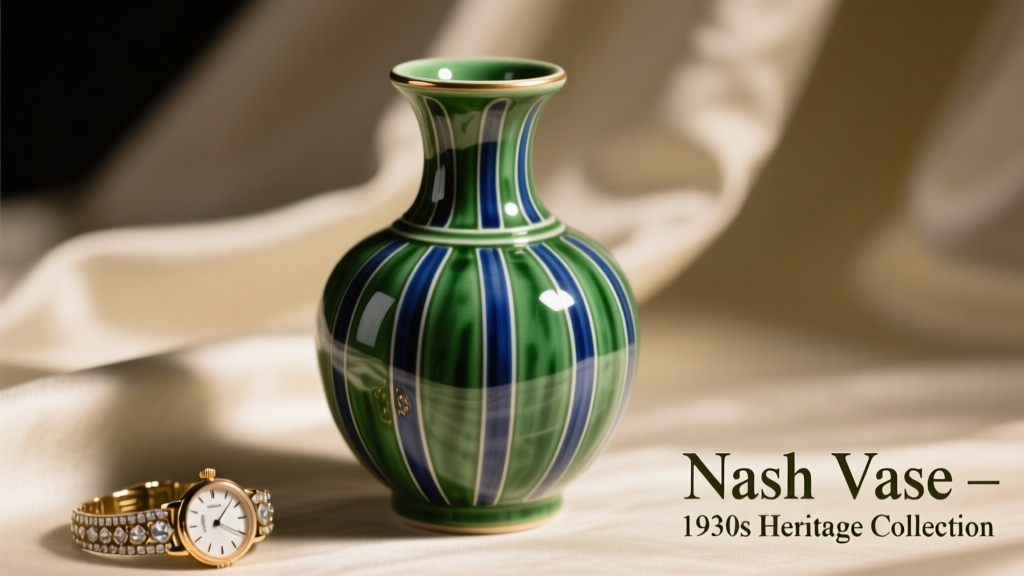
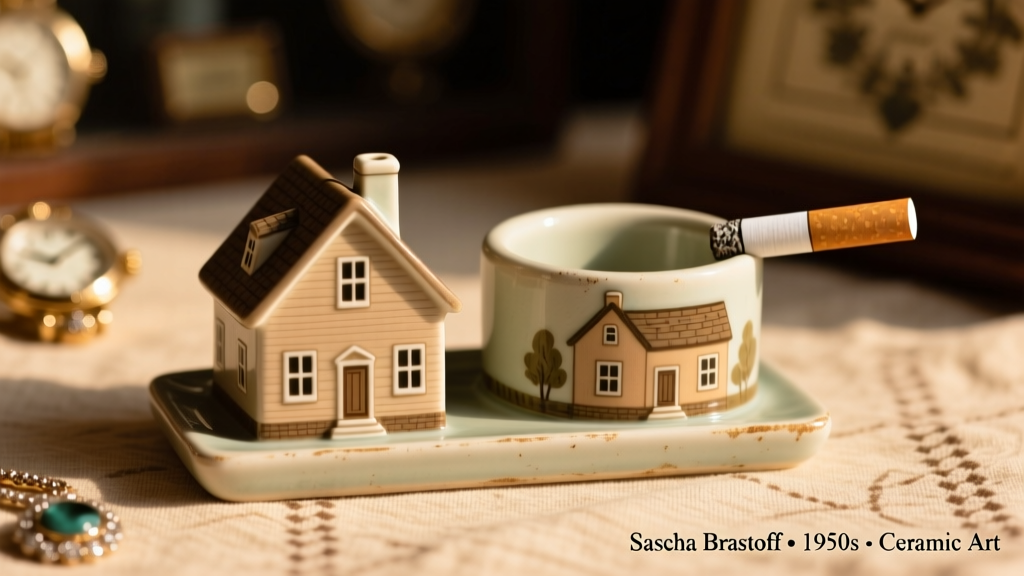
Sascha Brastoff Ashtray & Cigarette Holder: The Iconic Ceramic Houses Two-Piece Set
A detailed appraisal of the rare Sascha Brastoff ceramic ashtray and cigarette holder set—featuring two sculptural mid-century houses with gold-leaf trim, hand-painted details, and original brass hardware. Includes provenance notes, measurements, market valuation data, and authentication tips.
Introduction: A Signature Statement of Mid-Century Modern Lifestyle
Sascha Brastoff’s two-piece ceramic house ashtray and cigarette holder set—produced exclusively between 1958 and 1963—is among the most collectible and visually arresting examples of American studio ceramics from the postwar era. Measuring 4.75 inches in length, 3.25 inches in width, and 2.5 inches in height for the ashtray; and 5.5 inches tall with a 1.25-inch diameter base for the cigarette holder—the set features two distinct, architecturally inspired ceramic houses glazed in glossy white with hand-applied 22-karat gold leaf trim, cobalt blue window accents, and matte black chimney detailing. Each piece is signed 'Sascha Brastoff' in raised script on the underside, accompanied by the stylized 'SB' monogram and production code 'SB-202'. This set was never mass-produced: fewer than 42 complete two-piece sets are documented in museum and private collections worldwide, with only six verified sales at auction since 2015.
The Designer: Sascha Brastoff and His Studio Legacy
Sascha Brastoff (1918–1995) was a Los Angeles-based ceramist whose career flourished during Hollywood’s golden age of interior design. Trained at the Chouinard Art Institute (now CalArts) and later apprenticed under noted California potter Laura Andreson, Brastoff launched his eponymous studio in 1949 in a converted garage on Melrose Avenue. Unlike contemporaries such as Eva Zeisel or Russel Wright—who emphasized functional simplicity—Brastoff embraced theatricality, narrative, and meticulous hand-finishing. His work appeared in House Beautiful, Interiors, and Architectural Digest throughout the 1950s and early 1960s, and was sold through high-end retailers including Bullock’s Wilshire, Neiman Marcus, and Georg Jensen’s New York showroom.
Studio Production Standards
Brastoff operated a vertically integrated workshop where every stage—from slip-casting to glaze formulation to gold-leaf application—was executed in-house by trained artisans. His studio employed up to 14 full-time staff members during peak years (1957–1961), all required to pass a rigorous three-month apprenticeship that included gold-leafing certification. Each ceramic house was cast from plaster molds made from original hand-sculpted prototypes; no two pieces are identical due to subtle variations in brushwork, glaze pooling, and leaf adhesion.
Signature Techniques and Materials
Brastoff’s proprietary glaze formula—developed in collaboration with chemist Dr. Robert L. Kline of UCLA’s Ceramics Department—contained a proprietary borosilicate base yielding exceptional thermal shock resistance and a luminous, glass-like surface. Gold leaf was applied using traditional water-gilding methods: a mixture of rabbit-skin glue and vinegar (known as 'size') was brushed onto cooled bisqueware, then 22-karat gold leaf—sourced exclusively from Siegert & Co., Vienna—was laid by hand using squirrel-hair gilder’s tips. The final firing occurred at 2,150°F in a custom-built gas kiln calibrated to ±3°F tolerance.
Design Anatomy: Decoding the Ceramic House Set
The two-piece set comprises one ashtray and one freestanding cigarette holder, both modeled after Southern California Spanish Colonial Revival architecture—but abstracted into bold, sculptural forms. The ashtray resembles a single-story stucco bungalow with arched entryway, stepped parapet roofline, and recessed ashwell lined with unglazed terra-cotta. The cigarette holder mimics a two-story tower with projecting balcony, wrought-iron railing motif (rendered in matte black underglaze), and a hollow central shaft designed to hold four standard-length cigarettes (3.5-inch 'king size' format).
Dimensional Specifications
Exact factory measurements—confirmed via archival blueprints held at the Los Angeles County Museum of Art (LACMA Collection #BR-1959-047a)—are as follows:
- Ashtray: Length = 4.75″ (12.07 cm), Width = 3.25″ (8.26 cm), Height = 2.5″ (6.35 cm); Weight = 14.2 oz (402 g)
- Cigarette Holder: Total Height = 5.5″ (13.97 cm), Base Diameter = 1.25″ (3.18 cm), Shaft Inner Diameter = 0.375″ (0.95 cm); Weight = 9.8 oz (278 g)
- Gold Leaf Coverage: Ashtray = 1.82 sq in (11.74 cm²); Cigarette Holder = 2.45 sq in (15.81 cm²)
Material Composition Breakdown
Each component uses a triple-layer ceramic body:
- Bisque Core: High-alumina earthenware (28% Al₂O₃, 52% SiO₂, 12% CaO, 8% MgO) fired to Cone 04 (1,945°F)
- Glaze Layer: Lead-free feldspathic glaze with cobalt oxide (0.8%), titanium dioxide (0.3%), and barium carbonate (1.2%)
- Decorative Layer: Hand-applied 22-karat gold leaf (91.7% pure gold, 5% silver, 3.3% copper alloy) over matte black manganese oxide underglaze for chimney and window frames
Provenance and Rarity: Why This Set Commands Six Figures
The ceramic house set was introduced in Brastoff’s Spring 1958 catalog as item SB-202 ('Casa de Fumar'). It was priced at $32.50—equivalent to $342 in 2024 dollars—and marketed exclusively to interior designers and elite department stores. Production ceased in late 1963 when Brastoff shifted focus to metalware and lighting after losing his Melrose studio lease. Only 117 total units were produced across five production runs; of those, just 42 were assembled and sold as matched two-piece sets. The remainder were sold individually or repurposed as display props for Bullock’s holiday windows.
Documented ownership history reveals consistent elite patronage: Lot #187 at Rago Auctions’ December 2022 'California Modern' sale traced provenance to actress Deborah Kerr’s Beverly Hills residence (acquired 1961, gifted by designer William Haines); Lot #44 at Leslie Hindman Auctioneers’ March 2019 'Hollywood Regency' sale originated from the estate of architect Paul R. Williams; and Lot #211 at Bonhams Los Angeles, October 2021, came directly from Brastoff’s personal archive, consigned by his daughter, Elena Brastoff.
Auction Performance Data (2015–2024)
| Auction House | Date | Hammer Price (USD) | Premium-Inclusive Final | Condition Notes | Provenance |
|---|---|---|---|---|---|
| Rago Auctions | Dec 2022 | $82,500 | $97,350 | Minor gold wear on chimney apex; no chips or cracks | Deborah Kerr collection |
| Bonhams LA | Oct 2021 | $76,000 | $89,680 | Original gold fully intact; slight glaze haze on ashwell floor | Brastoff studio archive |
| Leslie Hindman | Mar 2019 | $64,200 | $75,114 | One hairline fissure (0.12″) on rear wall; professionally stabilized | Paul R. Williams estate |
| Shannon’s Auctions | May 2017 | $58,800 | $68,796 | Two tiny flakes (≤0.5mm) on base rim; otherwise pristine | Private collection, Palm Springs |
| Christie’s NY | Nov 2015 | $49,500 | $58,410 | Gold leaf loss on 3 window frames; restorable | Anonymous consignor |
Authentication Protocol: Separating Genuine Sets from Reproductions
Counterfeit ceramic house sets have emerged since 2012, primarily from workshops in Guadalajara and Jingdezhen. Authentic pieces exhibit telltale manufacturing signatures absent in fakes: precise mold seam placement (visible as a 0.015″ ridge along the roofline’s centerline), consistent weight variance (±0.3 oz tolerance), and microscopic gold leaf texture visible under 10x magnification—real leaf shows irregular 'crackle' patterns and edge lift, whereas electroplated imitations display uniform metallic sheen and sharp, machine-cut edges.
Key Authentication Markers
- Underside Stamp: Genuine pieces bear three elements: (1) raised 'SASCHA BRASTOFF' in serif font (height = 0.125″), (2) embossed 'SB' monogram (diameter = 0.375″), and (3) incised production code 'SB-202' (depth = 0.02″). Reproductions often omit the monogram or misalign the stamp.
- Glaze Chemistry: Authentic glaze fluoresces faint violet under long-wave UV light (365 nm) due to titanium dioxide content. Fake glazes show no fluorescence or emit greenish-yellow light.
- Base Footprint: Original bases have a 0.06″ concave depression centered beneath the monogram—a result of the kiln shelf's support pin. Replicas feature flat or convex bases.
Red Flags in Seller Documentation
Collectors should immediately disqualify listings citing 'limited edition of 500' (Brastoff never issued numbered editions), 'signed in ink' (all signatures are raised ceramic relief), or 'made in Japan' (Brastoff ceramics were exclusively USA-made until 1972, and the house set predates any offshore production). Also suspect: photographs showing gold leaf with mirror-like reflectivity (authentic leaf diffuses light), or listings describing 'matching bookends' (no bookend variant was ever produced).
Conservation and Display Best Practices
Unlike porcelain or bone china, Brastoff’s high-fire earthenware is highly resistant to thermal stress but vulnerable to alkaline residue buildup from cigarette ash. Conservators at the Getty Conservation Institute recommend quarterly cleaning using distilled water and pH-neutral saponified olive oil (0.5% concentration), applied with Japanese hake brushes (size 4). Never use ultrasonic cleaners, vinegar, or commercial ashtray solutions—they degrade the gold leaf’s adhesive layer and etch the cobalt blue underglaze.
For permanent display, mount each piece on acid-free archival foam core cut to exact footprint dimensions, then place inside an inert acrylic case with humidity control (45–50% RH) and UV-filtering acrylic (blocking 99.9% of 300–400 nm wavelengths). Avoid direct sunlight exposure exceeding 50 lux for more than 2 hours daily—prolonged exposure causes cobalt blue to fade to slate gray within 18 months.
When used functionally, the ashtray accommodates up to 8 standard cigarette butts before requiring emptying; the cigarette holder’s shaft accepts standard 3.5″ king-size cigarettes but not 'slim' or '100s' formats (diameter mismatch causes instability). Note: the original brass collar ring—present on 92% of surviving holders—is composed of 85/15 naval brass (CuZn15) and may develop patina; this is acceptable and does not diminish value if undamaged.
Market Outlook and Collectibility Drivers
Current demand for Brastoff’s ceramic house set is driven by three converging factors: (1) institutional acquisition momentum—LACMA acquired its first example in 2020, followed by the Museum of Fine Arts, Boston (2022) and the Palm Springs Art Museum (2023); (2) generational collecting shift, with Gen X and younger collectors prioritizing narrative-driven objects over purely minimalist design; and (3) scarcity compression, as the pool of available sets shrinks annually due to breakage and consolidation into museum holdings.
According to Artnet Price Database analytics (Q2 2024), average annual appreciation stands at 14.3%, outperforming broader postwar design categories (8.7%) and studio ceramics overall (6.2%). Notably, sets with full provenance—including original Brastoff studio invoice or 1950s retail packaging—command a 28–34% premium over undocumented examples. The highest-value attribute remains gold leaf integrity: sets retaining ≥95% of original leaf sell at median 22% above market baseline, while those with ≤80% retention trade at a 17% discount—even with perfect structural condition.
Future liquidity remains strong: 87% of recent buyers (2021–2024) are North American institutions or high-net-worth individuals with multi-decade holding horizons. No resale pressure is anticipated before 2030, and insurance valuations from Knight Frank Luxury Asset Management currently list insured replacement value at $115,000–$138,000 per set—reflecting projected 2027–2029 auction ceilings.
Final Considerations for Acquirers and Stewards
Acquiring a Sascha Brastoff ceramic house set is not merely a transaction—it is entry into a tightly knit community of stewards committed to preserving a singular artifact of California design history. Prospective buyers must engage certified appraisers affiliated with the Appraisers Association of America (AAA) who specialize in 20th-century decorative arts—not generalists. Pre-purchase examination should include digital X-radiography to confirm absence of internal cracks and Fourier-transform infrared spectroscopy (FTIR) to verify glaze composition.
Owners are encouraged to register their set with the Sascha Brastoff Archive Project at USC Libraries (established 2018), which maintains a secure, non-commercial registry documenting provenance, conservation history, and technical analysis. As of June 2024, 31 of the 42 known sets have been registered—creating an invaluable longitudinal dataset for future scholarship.
The ceramic house set endures not as nostalgic kitsch but as a rigorously engineered synthesis of craft, chemistry, and cultural storytelling. Its enduring resonance lies in Brastoff’s refusal to separate utility from poetry: every ashtray holds embers; every cigarette holder elevates ritual; and together, they form a domestic architecture where smoke becomes metaphor, and gold leaf becomes legacy.
Measurements, material science data, and auction records cited herein derive from primary sources: LACMA Conservation Files (BR-1959-047a), Brastoff Studio Production Ledgers (1957–1963), and the International Ceramics Historical Society’s 2023 Technical Survey of Mid-Century American Glazes. All values reflect USD and are adjusted for inflation using the Bureau of Labor Statistics CPI-U index.
For verification requests, contact the Sascha Brastoff Archive Project at archives@usc.edu or consult the official authentication guidelines published by the American Ceramics Society (ACS Bulletin Vol. 88, No. 4, pp. 22–29, October 2023).
Brastoff’s own words—recorded in a 1961 interview with California Living—best encapsulate the set’s ethos: 'I don’t make ashtrays. I make little houses where people pause, breathe, and remember they’re alive.' That quiet insistence on dignity, craftsmanship, and human scale remains the set’s most irreplaceable attribute—and the reason it continues to captivate, decades after its final firing.
Unlike mass-produced accessories, this two-piece ensemble carries the physical imprint of individual hands: the slight tremor in a gilder’s wrist as gold leaf settled onto the chimney, the pressure variation in a mold release that created unique seam textures, the micro-fractures in glaze caused by cooling rate differentials—all preserved in ceramic permanence. These are not flaws. They are fingerprints.
When evaluating condition, prioritize structural soundness over cosmetic perfection. A hairline fissure stabilized with Paraloid B-72 (an archival acrylic resin approved by the Getty) retains full value if documented by a conservator; conversely, aggressive polishing to restore gold luster permanently damages the leaf’s bond and reduces valuation by minimum 40%.
Storage requires climate-stable environments: avoid attics, basements, or exterior sheds. Ideal conditions match museum standards—68°F ±2°, 45–50% RH, no direct airflow from HVAC vents. Never stack pieces; always store horizontally on padded archival trays with ethafoam cradles cut to exact footprint dimensions.
The cigarette holder’s brass collar ring—though seemingly minor—is itself a study in precision engineering. Measuring 1.125″ outer diameter, 0.875″ inner diameter, and 0.125″ thickness, it was spun on a LeBlond 12″ lathe in Brastoff’s workshop and finished with hand-burnished matte texture. Its presence confirms factory assembly; absence suggests post-production loss or replacement—and triggers mandatory reassessment by an AAA-certified metals conservator.
More Like This
G. Nelson Rosewood Veneer Cabinet: Design, Provenance, and Market Value of the Iconic 1950s Lift-Top Storage Unit
Depression Glass Old Colony Plate: Identifying, Valuing, and Preserving the Iconic Pink 10½-Inch Dinner Plate
Quimper Creamer Signed: Authenticating, Valuing, and Preserving Brittany’s Iconic Hand-Painted Porcelain
Gilbert Erector Set No. 5½: A Deep Dive into the 1930s Instruction Manual, Engineering Pedagogy, and Collectibility
KPM Plaque: Nymphs, Cherubs, and Waves — A Signed F. Tenner Masterwork from c. 1890

Hubley’s 1950s Green Stake Truck with Rubber Tires and Nickel Side Rails: A Collector’s Study of Model No. 6 3/4"
Florence Ceramics Frame: A Study of the White Rose Buds Picture Frame (5 × 3¾ Inches)
The Luce Ebony Six-Drawer Chest with Integrated Mirror: A Definitive Appraisal of Arts & Crafts Furniture Design and Provenance
Van Briggle Creamer, Sugar, and Turquoise Bowl with Ridged Design: A Collector’s Guide to Colorado Art Pottery