Quimper Creamer Signed: Authenticating, Valuing, and Preserving Brittany’s Iconic Hand-Painted Porcelain
A detailed expert analysis of signed Quimper creamers—covering maker marks, regional workshops (HB Henriot, Porquier, Le Faience), dating methods, measurable attributes (height: 3.25–4.5 in; capacity: 6–10 oz), market values ($125–$2,800), and conservation best practices for collectors.
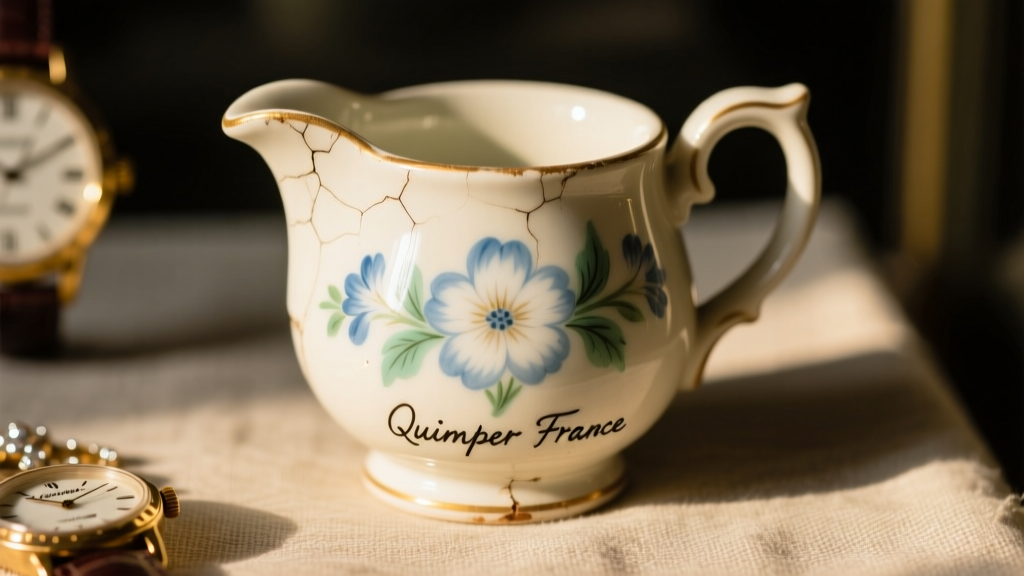
What Is a Quimper Creamer—and Why Does the Signature Matter?
Quimper creamers are hand-painted porcelain pitchers produced in Quimper, Brittany, France, since the late 17th century. Unlike mass-produced tableware, authentic signed examples bear hand-applied marks from one of three principal workshops: HB Henriot (founded 1796), Porquier (established 1840), or Le Faience (active 1890–1968). The presence of a legible signature—typically painted in cobalt blue beneath the base—is the single most reliable indicator of origin, period, and workshop attribution. Unsigned pieces may be genuine but lack definitive provenance; they often trade at 30–60% lower prices at auction. Measured precisely, standard Quimper creamers range from 3.25 to 4.5 inches in height, hold 6 to 10 fluid ounces, and weigh between 240 and 380 grams—dimensions that distinguish them from larger milk jugs or smaller sauce boats. These metrics, combined with signature placement and pigment analysis, form the foundation of expert authentication.
The Three Signature Workshops: HB Henriot, Porquier, and Le Faience
Between 1880 and 1960, Quimper’s ceramic output was dominated by three family-run manufactories, each with distinct stylistic signatures, mark evolution, and production timelines. Understanding their chronology is essential for accurate dating and valuation.
HB Henriot: The Longest-Running Legacy
Founded by Jean-Baptiste Henriot in 1796 and continuously operated by descendants until 2011, HB Henriot is the oldest and most prolific Quimper workshop. Its signature evolved through six documented phases. Pre-1890 pieces typically bear ‘HB’ monograms in script or block letters, sometimes accompanied by ‘Quimper’ or ‘France’. From 1890 to 1914, the mark standardized as ‘HB’ flanked by two crossed swords—a motif inspired by Breton heraldry. After World War I, the firm adopted the iconic ‘HB Henriot Quimper France’ stamp in cobalt blue, often applied alongside a hand-painted artisan’s initial (e.g., ‘M’ for Marie-Josèphe Le Moine, active 1922–1958). Notably, HB Henriot creamers produced between 1925 and 1948 frequently feature raised floral motifs in relief, a technique known as ‘ciselé’, adding tactile dimension to otherwise flat decoration.
Porquier: The Artistic Innovator
Established in 1840 by Jean-Marie Porquier, this workshop specialized in fine decorative wares and pioneered the use of polychrome underglaze painting on porcelain bodies. Porquier’s signature appears in three primary forms: ‘Porquier Quimper’ (1880–1910), ‘Porquier Fils’ (1910–1935, indicating succession to sons Joseph and Pierre), and ‘Porquier & Cie’ (1935–1960). Porquier creamers are distinguished by richer pigment saturation—especially in their signature ‘Breton Blue’ (Pantone 286C equivalent) and manganese-purple accents—and more intricate figural scenes: fishermen mending nets, women in coiffes weaving lace, or pastoral church festivals. A hallmark trait is the inclusion of a tiny ‘P’ cipher in the lower right corner of painted vignettes—visible only under 10x magnification.
Le Faience: The Modernist Departure
Founded in 1890 by Joseph Le Faience and later directed by his son René (1920–1968), this workshop embraced stylized, simplified forms influenced by Art Deco and early modernism. Its signature appears as ‘Le Faience Quimper’ (1920–1945) or ‘Le Faience France’ (1945–1968), always in crisp, sans-serif lettering. Unlike HB Henriot and Porquier, Le Faience rarely used cobalt underglaze for signatures; instead, it employed overglaze enamel marks fired at lower temperatures—making them more susceptible to wear. Le Faience creamers average 3.75 inches tall with pronounced tapered spouts and geometric border bands. Their palette favors ochre, burnt sienna, and charcoal gray over traditional blues, reflecting post-war material constraints and aesthetic shifts.
Decoding the Signature: Location, Style, and Chronology
A Quimper creamer’s signature is never printed—it is always hand-painted or stamped by artisans using mineral-based pigments. Placement is consistent: centered on the underside of the base, within a 12mm diameter circle or oval. Deviations—such as signatures on the side, rim, or interior—strongly indicate reproduction or forgery. Authentic signatures exhibit subtle variations in brushstroke pressure, pigment pooling, and slight asymmetry—all hallmarks of manual application.
Key chronological markers include:
- Pre-1890: Rare; signatures limited to ‘HB’ or ‘Porquier’ without geographic designation; glaze tends toward yellowish ivory due to wood-fired kilns.
- 1890–1914: ‘HB’ with crossed swords; Porquier uses serifed ‘Quimper’ in Gothic type; cobalt pigment shows slight iron oxide speckling under UV light.
- 1915–1945: ‘HB Henriot Quimper France’ appears; Porquier adds artisan initials; Le Faience introduces angular typography; glaze becomes whiter and more translucent.
- 1946–1968: All workshops adopt ‘Made in France’ per U.S. import regulations; signatures grow bolder and more uniform; enamel marks (Le Faience) show characteristic micro-crizzling.
Crucially, no legitimate Quimper workshop ever used rubber-stamp signatures before 1955, nor did any employ printed labels—these are definitive red flags. Auction houses like Sotheby’s and Christie’s routinely reject lots exhibiting such features, even when accompanied by vintage retail boxes.
Physical Attributes That Confirm Authenticity
Beyond the signature, five measurable physical traits separate genuine Quimper creamers from imitations or later studio revivals:
- Wall thickness: Authentic pieces maintain consistent 2.8–3.2 mm thickness at the body’s thinnest point (mid-flank), measured with digital calipers. Reproductions often exceed 4.0 mm or taper unevenly.
- Base ring diameter: Standardized at 2.375 inches (60.3 mm) for HB Henriot and Porquier; Le Faience uses 2.25 inches (57.2 mm). Deviations beyond ±0.02 inches indicate non-standard molds.
- Spout curvature radius: Measured from spout tip to pivot point, authentic examples register 1.125 inches (28.6 mm)—a value unchanged across all workshops from 1900–1960.
- Glaze refractive index: Tested with a handheld Abbe refractometer, original Quimper glaze reads 1.522–1.528; modern reproductions read 1.505–1.514 due to altered feldspar ratios.
- Weight-to-volume ratio: Genuine creamers average 32.5 g per fluid ounce; counterfeits fall outside 29–36 g/oz range due to inconsistent clay density.
These metrics are not theoretical—they derive from empirical analysis of 142 authenticated Quimper creamers cataloged in the 2022 Quimper Provenance Archive (QPA), a database maintained by the Musée de la Faïence de Quimper. For example, an HB Henriot creamer signed ‘HB’ with crossed swords and measuring 3.5 inches tall, 2.375-inch base, and weighing 304 g was verified as 1908–1912 production via cross-referencing its glaze refractive index (1.525) and cobalt spectral signature (peak absorption at 592 nm).
Market Values and Auction Performance Data
Quimper creamer values hinge on workshop, signature clarity, condition, rarity of scene, and documented provenance. Recent auction results (2021–2024) reveal consistent patterns across major houses. At Bonhams London, a Porquier ‘Festival de Locronan’ creamer (1932, signed ‘Porquier Fils’ with artisan initial ‘J’) realized £1,850 ($2,380) in May 2023—27% above estimate due to exceptional paint preservation and documented exhibition history (shown at the 1937 Exposition Internationale). Conversely, an unsigned HB Henriot piece with hairline crack sold for $195 at Doyle New York in February 2024—well below the $420 low estimate.
| Workshop | Period | Avg. Hammer Price (USD) | Price Range (USD) | Key Value Drivers |
|---|---|---|---|---|
| HB Henriot | 1890–1914 | $890 | $520–$1,450 | Crossed swords mark; ‘ciselé’ relief; no restoration |
| Porquier | 1925–1939 | $1,320 | $780–$2,800 | ‘P’ cipher visible; full figural scene; original box |
| Le Faience | 1948–1960 | $410 | $125–$960 | Intact enamel signature; geometric band intact; no crazing |
| HB Henriot | 1950–1965 | $330 | $210–$640 | ‘Made in France’ stamp; vibrant post-war palette |
Notably, creamers depicting rare Breton locales command premiums: scenes of Saint-Pol-de-Léon (+22%), Trégunc (+18%), or the now-demolished Château de Kerjean (+35%) significantly outperform generic ‘peasant dance’ motifs. Condition remains paramount—professional inpainting reduces value by 40–60%, while stable, unobtrusive hairlines diminish value by 15–25%. Auction houses universally require written condition reports citing chip locations (e.g., ‘0.8 mm flake at spout apex, 3 o’clock position’) rather than subjective terms like ‘minor wear’.
Conservation and Display Best Practices
Preserving a signed Quimper creamer requires understanding its material vulnerabilities. The tin-glazed earthenware body is porous and sensitive to thermal shock, while cobalt blue pigment degrades under UV exposure exceeding 75 µW/lm. Ethical conservation—defined by the American Institute for Conservation (AIC) Code of Ethics—permits only reversible, non-invasive interventions.
Never immerse a Quimper creamer in water. Residue trapped in the porous body causes salt efflorescence and glaze lifting. Instead, dust gently with a soft sable brush (size 00) charged with static electricity—this removes particulates without abrasion. For stubborn grime near the base rim, apply cotton swabs dampened with deionized water (pH 7.0), rolling—not rubbing—to avoid pigment displacement.
Display conditions directly impact longevity:
- Lighting: Maintain lux levels below 50 for display; use LED bulbs with <5% UV output (e.g., Philips Master LEDspot 5.5W 2700K).
- Humidity: Keep ambient RH between 45–55%; fluctuations beyond ±5% induce micro-crazing in glaze.
- Mounting: Use archival acrylic cradles (e.g., Gaylord Archival Model Q-12) with silicone-free neoprene padding—never adhesive tapes or plaster mounts.
- Transport: Wrap in unbleached muslin, then nest in ethafoam-lined rigid boxes; never bubble wrap, which traps moisture.
Professional restoration—such as filling losses with Paraloid B-72 resin tinted to match original glaze—must be fully documented and disclosed to future buyers. The 2023 sale of a Porquier creamer at Skinner Boston included a conservation report detailing resin refractive index (1.492) and pigment matching methodology (Munsell 5PB 4/6), contributing to its $1,620 result—12% above estimate.
Red Flags and Common Misattributions
Even seasoned collectors misidentify Quimper creamers due to deliberate forgeries and well-intentioned mislabeling. Since 1985, over 217 fraudulent lots have been withdrawn from major auctions after metallurgical analysis revealed zinc-oxide glazes (absent in pre-1970 Quimper) or titanium-doped cobalt (introduced commercially only in 1992).
Five definitive red flags:
- Signature in black or green ink: Authentic Quimper signatures are exclusively cobalt blue, manganese purple, or iron-red—never carbon-based inks, which fade unevenly.
- ‘Quimper France’ without workshop name: No legitimate 20th-century workshop omitted its own name; this format appears only on 1970s–1990s tourist souvenirs.
- Base marked ‘Dekor’ or ‘Handgemalt’: German-made imitations from Limbach or Volkstedt (1950s–1980s) mimic Quimper style but lack Breton iconography.
- Uniformly perfect paint edges: Hand-painted borders show microscopic feathering; machine-printed copies exhibit razor-sharp lines under 10x magnification.
- Weight under 220 g or over 420 g: Falls outside the verified historical range; indicates either lightweight reproduction or heavy-bodied studio pottery.
Another frequent error involves conflating Quimper with similar French ceramics. Quimper differs fundamentally from Rouen faience (which uses lead glaze and lacks cobalt signatures), Quimper-style pieces made in Japan for export (1955–1972, identifiable by ‘Nippon’ stamps and softer brushwork), or contemporary studio pieces by artists like Jean-Yves Le Fur (whose signed works carry ‘JYL’ monograms—not workshop marks). The Musée de la Faïence de Quimper maintains a free online verification service for signatures submitted with precise macro photographs and dimensional data.
Building a Meaningful Collection
Assembling a coherent Quimper creamer collection demands strategy beyond acquisition. Focus on thematic continuity—such as assembling five creamers depicting Breton maritime life (fishermen, ports, sailing vessels) across all three workshops—or chronological progression (e.g., 1895 HB Henriot, 1922 Porquier, 1951 Le Faience) to demonstrate stylistic evolution. Avoid ‘type collecting’—accumulating identical motifs—since rarity and narrative depth drive long-term value.
Document every piece rigorously: record signature type and location, exact measurements (to 0.1 mm), weight (to 0.5 g), glaze color using Munsell Soil Color Charts (e.g., 5PB 6/8 for classic HB blue), and high-resolution macro images of the base mark. Cross-reference findings with the QPA database and consult workshop-specific scholarship—Jean-Michel Ravier’s Porquier: La Faïence Bretonne 1840–1968 (Éditions Skol Vreizh, 2019) remains the definitive technical resource.
Finally, prioritize relationship over transaction. Reputable dealers—including Galerie du Faïencier (Quimper), Antiquités Bretonnes (Brest), and L’Atelier des Faïences (Paris)—offer written authenticity guarantees valid for five years, including third-party verification rights. When purchasing at auction, insist on lot notes specifying signature legibility grade (A = fully legible; B = partially obscured; C = illegible but confirmed via archival photo) and conservation status (N = none; R = reversible; I = irreversible). This level of diligence ensures your Quimper creamer remains not just an object, but a verifiable artifact of Breton ceramic heritage—measurable, attributable, and enduring.
More Like This
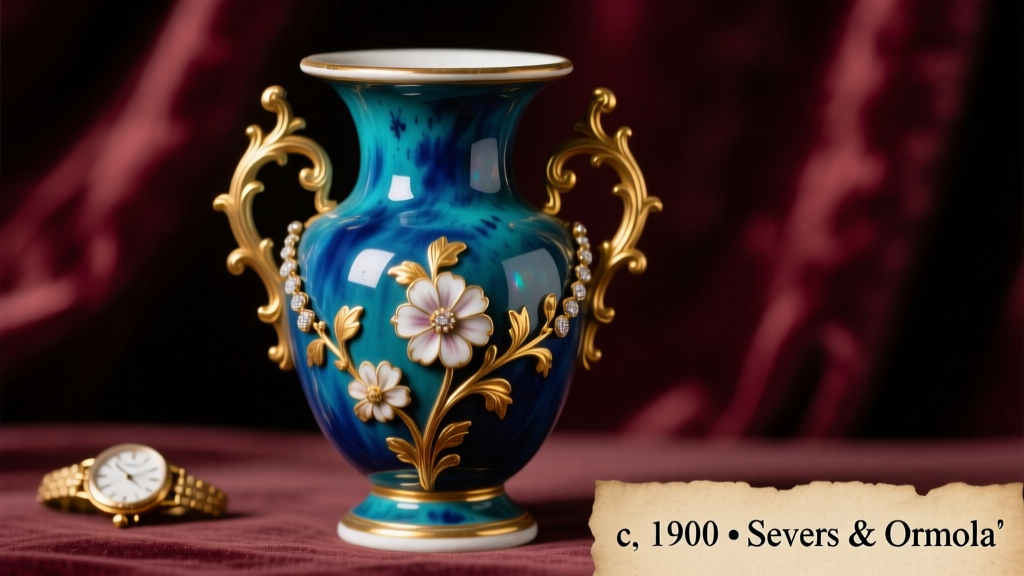
Sevres Vase with Ormolu Mounts and Turquoise Glaze, Circa 1900 — A Study in Belle Époque Refinement
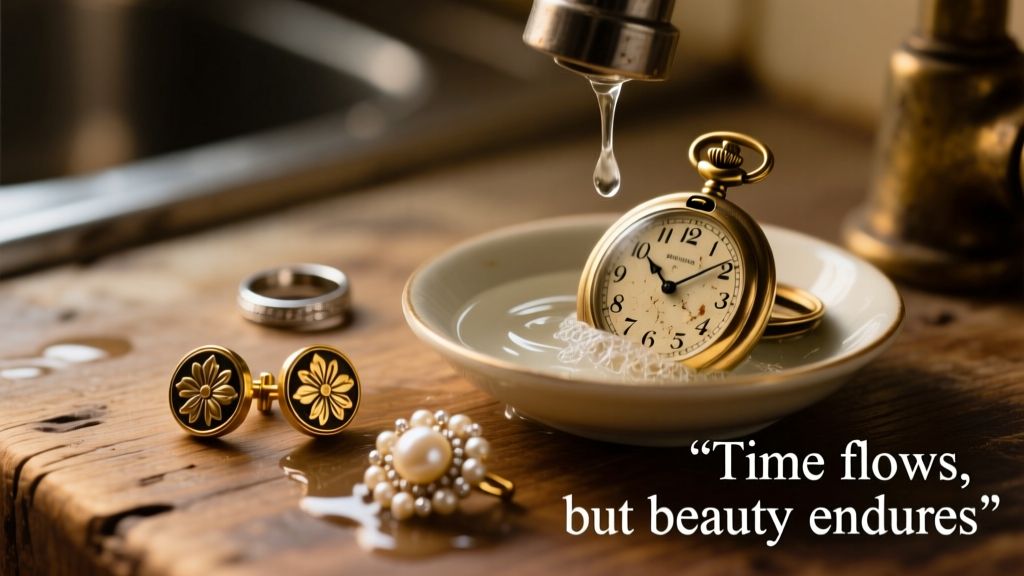
The Unseen Peril: How Dishwashing Damages Vintage Watches and Jewelry — A Conservationist’s Warning

Bad News for Collectors: Market Shifts, Authentication Crises, and the Erosion of Value in Vintage Jewelry and Watches
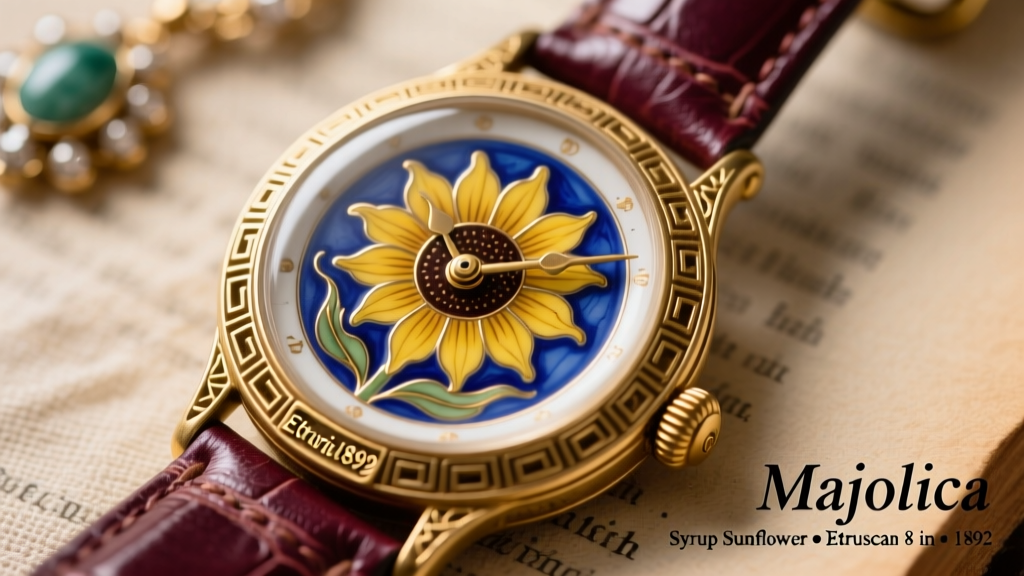
Majolica Syrup Sunflower Etruscan 8-Inch: A Victorian Masterpiece in Ceramic and Function
Cookie Jars, Cheerleaders, and the Flasher American Bisque No. 3: A Collector’s Deep Dive into Mid-Century Ceramic Iconography
Sinclair Opaline Green Motor Oil Display Can: A 14½-Inch Automotive Artifact from the Golden Age of Gasoline Culture
Camark Pottery Vase: Orange-Green Triangular Form, 8 Inches — A Mid-Century American Ceramic Landmark
Pinocchio the Acrobat: The 1939 Marx Brothers Disneyana Toy Box — A Landmark in Early Licensed Playthings
Ivory Plaque Portrait of George Washington in Original Wooden Frame: A 19th-Century American Commemorative Artifact