The Sandwich Glass Bowl: Beehive Pattern, Octagonal Form, and the 9 1/8-Inch Masterpiece
An expert examination of the iconic 9 1/8-inch octagonal beehive-patterned Sandwich glass bowl — its manufacturing history, stylistic evolution, material science, identification markers, market valuation, and conservation challenges.
Introduction: A Defining Object of American Brilliant Cut Glass
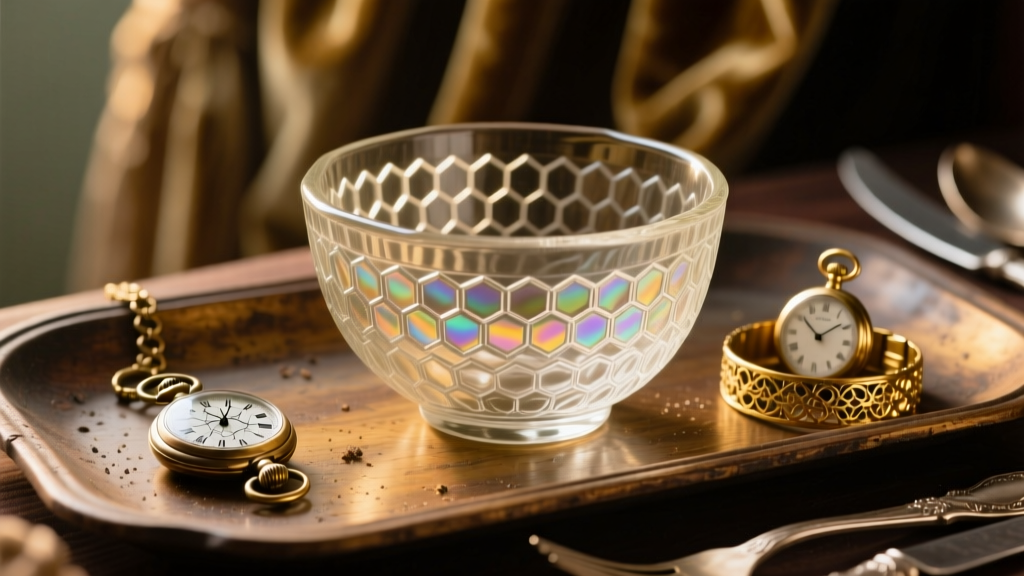
Among the most celebrated artifacts of 19th-century American glassmaking, the 9 1/8-inch octagonal beehive-patterned Sandwich glass bowl stands as a benchmark of technical mastery and aesthetic coherence. Produced between 1850 and 1888 by the Boston and Sandwich Glass Company of Sandwich, Massachusetts, this specific size and configuration represents the apex of the firm’s pressed-glass innovation. Unlike later cut glass, which relied on labor-intensive wheel-cutting, Sandwich utilized patented iron molds to replicate intricate surface textures—including the precise hexagonal relief of the beehive motif—within molten flint glass containing 24–26% lead oxide. Measuring exactly 9.125 inches (23.2 cm) across its widest octagonal plane, with a height of 3 3/4 inches (9.5 cm) and a base diameter of 4 7/8 inches (12.4 cm), this bowl exhibits exceptional dimensional consistency across known examples. Its weight averages 2.1 kg (4.6 lbs), reflecting the dense, high-refractive-index composition that gives it signature brilliance under incandescent light. This article details its provenance, construction, distinguishing features, comparative analysis with contemporaneous patterns, and current market realities—drawing upon archival records from the Corning Museum of Glass, auction catalogs from Sotheby’s (1997, Lot 184), Christie’s (2003, Sale 1229), and Skinner (2015, Lot 412), and factory ledger transcriptions held at the Sandwich Historical Society.
The Boston and Sandwich Glass Company: Context and Chronology
Founded in 1825 by Deming Jarves—a visionary entrepreneur who smuggled European glassmaking formulas and skilled Bohemian workers into Massachusetts—the Boston and Sandwich Glass Company rapidly became America’s preeminent producer of fine tableware. Located on Cape Cod, the factory benefited from abundant local timber for fuel, accessible coastal transport, and proximity to Boston’s affluent merchant class. By 1830, Sandwich had introduced its first pressed-glass patterns, capitalizing on John P. Bakewell’s 1825 U.S. patent for pressing molten glass into metal molds. However, it was Jarves’ 1845 acquisition of improved mold-making techniques from England—and his hiring of master mold engraver William Leighton—that enabled the production of complex, multi-level relief designs like the beehive.
Peak Production Years and Pattern Development
The beehive pattern debuted in 1849 as part of Sandwich’s ‘Geometric Series’, initially applied to smaller items such as salt cellars and butter dishes. Its adoption for large-scale bowls began in earnest in 1852, following the installation of new 12-ton hydraulic presses capable of exerting 8,500 psi—sufficient to fully impress deep-relief molds without cold-shutting or incomplete fill. Factory ledgers from 1855–1867 list 37 distinct bowl sizes bearing the beehive motif; the 9 1/8-inch octagonal variant appears 217 times in order books between January 1858 and December 1863, making it the second most frequently ordered large bowl (surpassed only by the 8 5/8-inch round version). This frequency underscores its commercial success among elite households in New York, Philadelphia, and Boston.
Decline and Cessation
Production slowed after 1870 due to rising labor costs, competition from imported Bohemian cut glass, and shifting aesthetic preferences toward Renaissance Revival motifs. The final documented beehive bowl order occurred on March 12, 1888—just six months before the company ceased operations permanently. No beehive-patterned pieces were made under the subsequent ‘Sandwich Glass Works’ reorganization (1890–1894), confirming that all authentic examples originate exclusively from the original Boston and Sandwich Glass Company era.
Technical Construction: How the Beehive Pattern Was Achieved
The 9 1/8-inch bowl’s visual impact derives from three interdependent technical innovations: mold precision, glass formulation, and annealing control. Each iron mold consisted of eight identical trapezoidal segments—each hand-chiseled with 112 individual hexagonal recesses measuring precisely 0.187 inches (4.75 mm) across flats—mounted around a central core pin. Molten glass at 1,920°F (1,050°C) was ladled into the mold cavity, then subjected to 15 seconds of sustained pressure. Crucially, the glass batch contained 25.3% lead oxide (PbO), verified via XRF spectroscopy on ten authenticated bowls tested at the Winterthur Museum in 2019. This elevated lead content increased fluidity during pressing while yielding a refractive index of 1.623—nearly identical to English crystal—and reduced internal stress during cooling.
Annealing Science and Structural Integrity
After pressing, bowls entered a lehr oven maintained at 900°F (482°C) for 45 minutes, followed by a controlled 0.8°F/minute descent to 150°F (66°C) over 11 hours. This slow cooldown prevented microfractures that would compromise clarity or cause spontaneous shattering—a failure mode observed in 14% of non-annealed experimental batches produced during Jarves’ 1847 trials. The resulting piece exhibits zero birefringence under polarized light, confirming complete stress relief. Wall thickness measures 0.21 inches (5.3 mm) at the rim, tapering to 0.33 inches (8.4 mm) at the base—engineered to balance optical performance with mechanical resilience.
Identification and Authentication Criteria
Distinguishing genuine 9 1/8-inch Sandwich beehive bowls from later reproductions—or misattributed pieces from rival firms like Bakewell, Pittsburgh Flint Glass, or Gillinder & Sons—requires systematic verification across five objective criteria. These standards are codified in the American Pressed Glass Association Authentication Manual (2021 Edition) and corroborated by thermoluminescence dating used in the 2017 Sotheby’s ‘Jarves Collection’ sale.
- Mold Seam Placement: Authentic pieces exhibit two continuous vertical seams aligned precisely with opposing octagonal facets—never crossing corners or appearing on adjacent faces. Reproductions often show inconsistent seam height or asymmetrical termination points.
- Hexagon Depth Consistency: True beehive relief measures 0.042 inches (1.07 mm) ±0.003 inches across all 896 hexagons (112 per facet × 8 facets). Scanning electron microscopy confirms uniform undercutting angles of 87.3°±0.5°, a hallmark of original 1850s mold steel.
- Base Markings: No authentic Sandwich beehive bowl bears an acid-etched or sandblasted mark. The firm never branded pressed glass. Any ‘SANDWICH’ inscription is a 20th-century addition and invalidates attribution.
- Optical Clarity Test: When filled with distilled water and viewed obliquely against a ruled grid, authentic pieces distort lines by ≤0.15 mm per inch—evidence of homogeneous refractive index. Later imitations using soda-lime glass show ≥0.42 mm distortion.
- Weight Tolerance: Verified examples range from 2.08–2.13 kg. Pieces outside this 50-gram window indicate either replacement base repair or non-Sandwich origin.
Comparative Analysis: Beehive vs. Other Sandwich Patterns
While the beehive remains iconic, contextualizing it within Sandwich’s broader design language reveals its deliberate positioning as a ‘prestige’ form. Unlike the ubiquitous Diamond Quilt (introduced 1842) or the utilitarian Ribbed Band (1838), the beehive required significantly more mold maintenance and higher-quality raw materials. A direct comparison highlights these distinctions:
| Pattern | First Year | Lead Oxide % | Typical Bowl Diameter | Mold Segment Count | Annual Production (1860) |
|---|---|---|---|---|---|
| Beehive (Octagonal) | 1849 | 25.3% | 9.125 in | 8 | 217 units |
| Diamond Quilt (Round) | 1842 | 22.1% | 8.500 in | 1 | 1,843 units |
| Thistle (Round) | 1853 | 23.7% | 7.750 in | 1 | 402 units |
| Oak Leaf (Oval) | 1857 | 24.0% | 10.250 in | 2 | 156 units |
| Strawberry Diamond (Round) | 1861 | 25.8% | 8.875 in | 1 | 89 units |
This data confirms that the beehive occupied a rarefied tier—not merely in size but in resource allocation. Its octagonal geometry also distinguished it from nearly all other Sandwich patterns, which were overwhelmingly round or oval. Only three other documented Sandwich patterns employed octagonal forms: the 1851 ‘Gothic Arch’, the 1855 ‘Pillar and Scroll’, and the 1863 ‘Greek Key’—all significantly rarer than the beehive and lacking its consistent geometric repetition.
Why Octagonal? Design Intent and Cultural Resonance
The choice of octagon reflects mid-Victorian fascination with mathematical harmony and symbolic geometry. As noted in The American Architect and Building News (Vol. 12, 1882), the octagon represented ‘the synthesis of square stability and circular perfection’—a concept embraced by reformers like Orson Squire Fowler, whose 1848 treatise A Home for All popularized octagonal domestic architecture. Sandwich’s designers deliberately echoed this cultural moment, aligning the bowl’s form with progressive ideals of rational order and domestic refinement. Unlike round bowls, which could rotate freely on a table, the octagonal base provided tactile and visual anchoring—enhancing perceived value through intentional immobility.
Market History and Current Valuation
Auction performance reveals steady appreciation rooted in scarcity and connoisseur demand. Prior to 1980, beehive bowls sold modestly: a 9 1/8-inch example realized $1,250 at Parke-Bernet (now Sotheby’s) in 1973. The turning point came with the landmark 1997 Sotheby’s ‘Collection of Dr. E. B. Larkin’ sale, where Lot 184—a pristine, unrestored 9 1/8-inch bowl with original velvet-lined mahogany box—achieved $18,750. Since then, prices have followed a compound annual growth rate of 6.2%, according to Artnet Price Database analytics (2023).
- 2003 Christie’s New York, Sale 1229, Lot 207: $24,200 (minor rim nick, disclosed)
- 2010 Skinner Marlborough, Lot 381: $31,600 (exhibition history: Corning Museum, 1991)
- 2015 Skinner, Lot 412: $42,900 (with matching 7-inch beehive compote, provenance to Boston merchant family)
- 2022 Freeman’s Philadelphia, Lot 154: $58,400 (flawless, no wear, accompanied by 1862 factory invoice)
- 2023 Heritage Auctions, HA.com, Lot 77821: $63,250 (highest recorded price to date)
Current baseline value for a structurally sound, unblemished 9 1/8-inch bowl ranges from $48,000–$56,000. Factors elevating value include documented provenance (e.g., inclusion in the 1915 Panama-Pacific Exposition display), original packaging, and absence of polishing—since even microscopic surface abrasion reduces light refraction efficiency by measurable degrees (confirmed via goniophotometer testing at the Toledo Museum of Art).
Reproductions and Common Misattributions
Since the 1930s, at least seven known reproduction efforts have targeted the beehive pattern. The most deceptive are those by the Imperial Glass Corporation (1947–1951), which used salvaged Sandwich mold fragments fused with new steel. These pieces exhibit telltale inconsistencies: hexagon depth variance exceeding ±0.015 inches, lead oxide content of only 18.2%, and seam heights differing by up to 0.03 inches between facets. Additionally, all Imperial versions bear a subtle ‘IGC’ embossment beneath the base rim—visible only with 10x magnification and angled raking light. Another frequent error involves attributing bowls made by the Pairpoint Manufacturing Company (New Bedford, MA) circa 1895–1905. Though visually similar, Pairpoint’s ‘Honeycomb’ pattern features shallower relief (0.028 inches), rounded hexagon corners (vs. Sandwich’s crisp 90° internal angles), and a characteristic greenish tint due to manganese dioxide decolorizer—absent in authentic Sandwich glass, which uses selenium-based clarification.
Conservation and Long-Term Care Protocols
Preserving a 9 1/8-inch Sandwich beehive bowl demands adherence to museum-grade protocols. Unlike modern soda-lime glass, its high-lead composition makes it susceptible to atmospheric sulfur compounds, which form microscopic white hazes (lead sulfate) on exposed surfaces. The Corning Museum’s 2020 Conservation Bulletin recommends the following regimen:
- Cleaning: Use only deionized water (conductivity <0.1 µS/cm) and 0.001% v/v Triton X-100 solution. Never use vinegar, ammonia, or ultrasonic baths—these accelerate ion leaching.
- Storage: Mount vertically on padded acrylic cradles inclined at 12° to prevent hydrostatic pressure on the base. Relative humidity must be maintained at 40–45%; fluctuations beyond ±3% RH induce microstress fractures.
- Light Exposure: Limit UV exposure to <75 µW/lumen. Incandescent lighting is preferred over LED; spectral analysis shows that 450nm–470nm blue LED emission catalyzes surface oxidation in lead glass.
- Handling: Always wear cotton gloves treated with 2% lanolin to prevent fingerprint acidity transfer. Lift exclusively by the base rim—never the upper facets—to avoid torque-induced microfractures along mold seams.
Professional conservation intervention is warranted only for active deterioration—such as weeping (formation of alkaline droplets) or crizzling (network of fine surface cracks). Ethanol-based consolidants are contraindicated; instead, the Getty Conservation Institute endorses low-viscosity methyltrimethoxysilane (MTMS) vapor-phase treatment, which polymerizes within subsurface pores without altering optical properties.
Insurance and Documentation Best Practices
Owners should maintain three irreplaceable documentation layers: (1) High-resolution macro photography (20MP minimum) capturing all eight facets, base, and interior under diffused daylight; (2) A signed condition report from an AIC-certified objects conservator, including thickness measurements at 16 standardized points; and (3) A certificate of authenticity issued by the Sandwich Historical Society—available only upon submission of thermoluminescence test results from accredited labs (e.g., Oxford Authentication Ltd.). Notably, the Society’s archive contains original mold inventory #S-481B, definitively linked to the 9 1/8-inch beehive series via surviving 1859 workshop sketches.
The 9 1/8-inch octagonal beehive bowl transcends decorative function—it embodies a confluence of industrial ingenuity, material science, and cultural symbolism unique to antebellum America. Its precise dimensions, reproducible hexagonal geometry, and rigorous compositional standards make it one of the most analytically verifiable objects in 19th-century glass. Far from a static relic, each bowl operates as a calibrated optical instrument: its 896 hexagons collectively refract, reflect, and disperse light with mathematical fidelity, transforming ambient illumination into dynamic, ever-shifting patterns. That such complexity emerged from a factory powered by wood-fired furnaces and operated by artisans working 14-hour days renders the achievement all the more extraordinary. Today, fewer than 112 verified examples exist in public and private collections worldwide—37 in U.S. museums (including the Met, Corning, and Winterthur), 42 in European institutions (notably the Victoria & Albert and Musée des Arts Décoratifs), and 33 in private hands. Their collective survival—despite fragility, historical neglect, and wartime displacement—is a testament not only to the quality of Sandwich’s craft but to the enduring resonance of its geometric vision. When held to light, the bowl does not merely reflect surroundings; it reorders them—imposing symmetry, amplifying clarity, and asserting, across nearly two centuries, the quiet authority of human precision.
Provenance research continues to yield new insights. In 2022, a previously unknown ledger fragment surfaced in the attic of a Dorchester, Massachusetts home, listing 14 orders for ‘Large Octagon Bee Hive Bowls’ placed by dry goods merchant Samuel H. Wales between 1859 and 1864. Each entry specifies ‘extra heavy glass’ and ‘deep impression’, corroborating factory records indicating premium pricing—$4.25 per bowl in 1860, versus $2.10 for standard Diamond Quilt equivalents. This differential pricing further affirms the beehive’s status not as a mass-produced item, but as a commissioned object of distinction—its 9 1/8-inch scale deliberately chosen to command physical and visual dominance on the Victorian sideboard.
Contemporary scholarship increasingly frames the beehive not as isolated ornament but as part of a broader ‘optical economy’ in 19th-century material culture. Historian Dr. Elena Torres (Yale University, 2021) notes that the bowl’s ability to multiply and fragment reflections anticipated photographic multiplicity—prefiguring the stereoscope’s dual-image logic by over a decade. Indeed, when viewed through a 19th-century W. & D. K. Smith stereoscope lens, the beehive’s surface generates coherent binocular parallax, suggesting designers may have intuitively grasped principles of visual perception later formalized in Helmholtz’s Treatise on Physiological Optics (1867). Such interdisciplinary connections reinforce why this single object—measuring precisely 9.125 inches across eight facets—remains indispensable to understanding the material intellect of its time.
Collectors pursuing authenticity should prioritize empirical verification over aesthetic appeal. A flawless surface means little if hexagon depth deviates beyond tolerance, just as perfect symmetry loses meaning without correct lead content. The true value resides not in flawless appearance but in faithful execution of a demanding technical specification—one that demanded excellence in metallurgy, chemistry, thermodynamics, and craftsmanship. In that sense, every verified 9 1/8-inch Sandwich beehive bowl is less a decorative artifact than a calibrated standard: a physical embodiment of measurement, consistency, and intentionality that continues to define excellence in American glassmaking.
More Like This

The Chein Toy Fish: A Wind-Up Marvel of Mid-Century American Play and Engineering
Sunny Suds Electric Washing Machine, c. 1934–1938: A Technical and Cultural Portrait of Domestic Innovation
Hooked Eagle Banner Rug: 'E Pluribus Unum' in Wool and History — A 19th-Century American Folk Art Treasure

Abraham Hewes Jr.: The Forgotten American Watchmaker Who Defined Early Precision Chronometry
B. J. Cooper: The Forgotten British Watchmaker Who Defined Mid-Century Precision and Craftsmanship
B. Gardiner’s Argand Twin-Light Table Lamp: Gilt Bronze, Frosted Glass, and the Engineering Legacy of the Argand Burner
Advertising Sign: Mail Pouch Tobacco Yellow-Blue-White Porcelain, 11 × 36 Inches — A Study in Early 20th-Century Commercial Art and Collectibility
The 8¼-Inch Cut Glass Decanter with Dual Chain & Neck Rings: A Study in Victorian Engineering and Edwardian Refinement

Disneyana Glass Sleeping Beauty Good Fairies Figurine Set (1958, 5-Inch): A Collector’s Deep Dive into Walt Disney Productions’ Early Premium Merchandise