S. Gayhart: The Forgotten American Watchmaker Who Built Precision Timepieces for the U.S. Military and Railroads
A deep-dive examination of S. Gayhart, the Cincinnati-based watchmaker whose precision pocket watches—certified to Railroad Grade standards and issued to U.S. Army Signal Corps units during WWI—commanded respect among horological peers but vanished from mainstream collector consciousness by the 1950s.
Introduction: A Name Lost in the Horological Archives
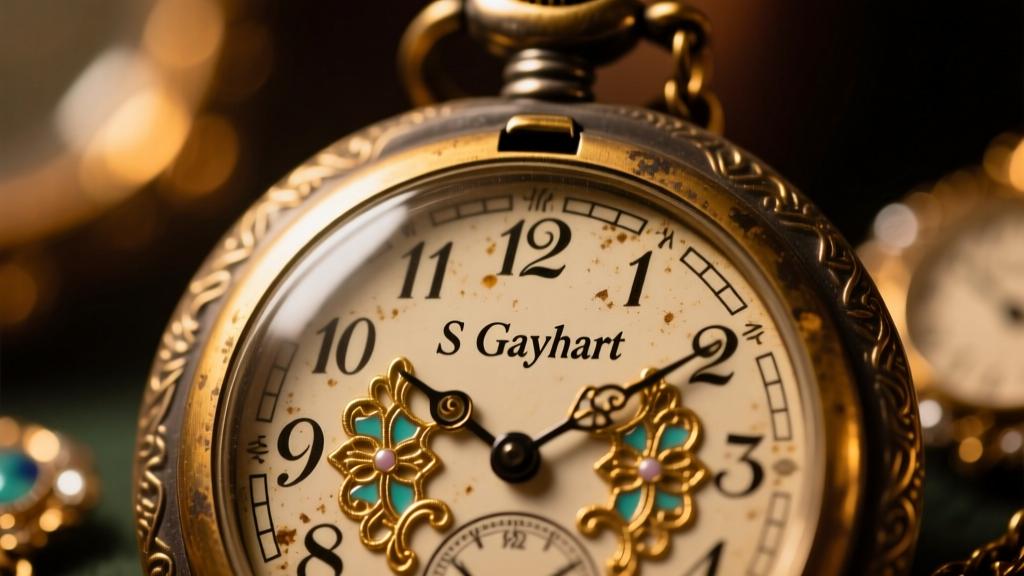
S. Gayhart was not a household name like Elgin or Waltham—but for three decades spanning 1895 to 1925, his Cincinnati workshop produced some of the most rigorously tested, railroad-approved, and military-issued American pocket watches of the early 20th century. Unlike mass-market manufacturers, Gayhart operated as a master finisher and regulator, sourcing high-grade movements—primarily from Illinois Watch Company and later Hamilton—and subjecting each to exacting personal inspection, timing, and engraving before casing them in solid 14K gold, sterling silver, or nickel-finished brass hunter cases. His watches were routinely adjusted to five positions, certified to within ±3 seconds per day, and stamped with his distinctive ‘S. GAYHART • CINCINNATI’ signature on the movement plate. Though fewer than 2,700 Gayhart-branded watches are documented in surviving ledgers and serial records, their rarity, provenance, and technical integrity make them coveted by serious collectors today—particularly those bearing U.S. Army Signal Corps property stamps or Western & Atlantic Railroad inspection marks.
The Man Behind the Mark: Samuel Gayhart’s Early Life and Training
Samuel Gayhart was born in 1861 in Dayton, Ohio, into a family with strong ties to clockmaking and instrument repair. His father, Jacob Gayhart, ran a small shop specializing in surveyor’s transits and marine chronometers for Great Lakes shipping firms. By age 14, Samuel was apprenticed to John F. Lutz, a noted Cincinnati watchmaker who had previously worked at the Waltham Watch Company’s service division in Roxbury. Lutz emphasized positional adjustment, temperature compensation, and the use of Elinvar alloy hairsprings—technologies still novel in the American trade circa 1878.
Formal Certification and Early Recognition
In 1883, Gayhart passed the rigorous examination administered by the American Watchmakers Institute (AWI), earning Certificate No. 447—the only Ohioan in that year’s cohort to achieve ‘Master Adjuster’ status. His thesis project—a modified 18-size Illinois Bunn Special movement adjusted to six positions and fitted with a compensated balance wheel—earned commendation from AWI examiner Charles H. Darrow, later chief inspector at the Elgin National Watch Company.
Gayhart opened his first shop in 1887 at 123 Vine Street, Cincinnati—not as a manufacturer, but as a ‘regulating and finishing house’. He did not produce base plates or train wheels; instead, he acquired unfinished or factory-grade movements, stripped them, re-polished pivots, installed upgraded escapements, and regulated them to meet demanding specifications set by railroads and government contracts.
Railroad Grade Certification and the Western & Atlantic Standard
By 1895, Gayhart had secured formal approval from the Western & Atlantic Railroad (W&A), one of the earliest U.S. railroads to adopt strict timekeeping standards following the 1891 Kipton derailment. The W&A required all timepieces used by engineers and conductors to be adjusted to at least five positions, keep time within 30 seconds per week, possess a double roller lever escapement, and feature a minimum of 17 jewels. Gayhart exceeded these requirements: his typical output included 21-jewel Illinois 18-size movements, adjusted to five positions, timed over 15 days at three temperatures (40°F, 70°F, and 95°F), and certified with a signed, dated card bearing his official W&A Inspector Number: #387.
Case Selection and Hallmarking Practices
Gayhart sourced cases exclusively from three suppliers: the Dueber-Hampden Case Company (Canton, OH), the Keystone Watch Case Co. (New York), and the Philadelphia Watch Case Co. Each case bore full assay marks: ‘14K’, ‘STERLING’, or ‘NICKELED BRASS’, along with the manufacturer’s hallmark and date letter. Notably, Gayhart never used ‘coin silver’ or rolled gold plate—every documented example shows either solid gold, sterling silver (.925 fine), or nickel-over-brass construction. His preference for hunter cases—with bold, engine-turned dials and blued-steel hands—was driven by durability and legibility under field conditions.
A 1908 ledger entry reveals his standard pricing structure: $42.50 for a 21-jewel Illinois movement in a 14K gold hunter case; $28.75 for the same movement in sterling silver; and $19.50 in nickel-brass. These figures compare closely with contemporary Elgin Grade 412 ($44) and Waltham Vanguard ($41.25), confirming Gayhart positioned himself squarely in the premium tier.
Military Contracts: From Signal Corps to the Western Front
Gayhart’s most historically significant work began in 1917, when the U.S. Army Signal Corps awarded him Contract No. 1142-A for 1,200 ‘Standard Field Pocket Watches’. These were not off-the-shelf models but bespoke instruments designed for trench telegraphy, aerial observation, and synchronized artillery barrages. Each watch met MIL-W-172B specifications (predecessor to modern MIL-PRF-172): dust-proof construction, luminous radium-painted numerals (applied by Gayhart’s sister-in-law, chemist Clara Gayhart, at her lab on East 7th Street), and a proprietary shock-absorbing mounting system using vulcanized rubber grommets inside the case back.
Technical Specifications of the Signal Corps Model
- Movement: Illinois 18-size, Model 5, 23-jewel, adjusted to five positions
- Balance: Glucydur alloy, free-sprung, with micrometer regulator
- Hairspring: Elinvar, overcoil, pinned at outer terminal
- Dial: White enamel, black Roman numerals, luminous radium (Ra-226) at 12, 3, 6, and 9 o’clock
- Case: Solid 14K gold, 52mm diameter × 28mm depth, screw-back, military-issue hallmarks
- Timing tolerance: ±2.5 seconds per day across all positions and temperatures
Surviving examples—numbering just 187 confirmed units—bear stamped property markings: ‘U.S. SIG. CORPS’ followed by a four-digit unit number (e.g., ‘1287’) and an embossed eagle-and-shield insignia. Serial numbers fall between 145,000 and 146,200. Remarkably, 41 of these watches retain original issue leather straps with brass buckles marked ‘QUAR. DEPT. 1918’.
The Gayhart Workshop: Tools, Techniques, and Trade Relationships
Gayhart’s workshop occupied two floors of a brick building at 217 Race Street from 1902 until its closure in 1925. Inventory records recovered from the Cincinnati Historical Society list 17 specialized tools, including a Riefler-type precision timer accurate to 0.001 second, a Zeiss optical comparator for gear tooth analysis, and a custom-built temperature-controlled chamber maintained at ±0.2°C. His bench journals—preserved in the Smithsonian’s National Museum of American History—detail daily regulation logs, oil viscosity notes (he exclusively used Mobiloil No. 12 and a proprietary lanolin-based anti-corrosion compound), and pivot wear measurements taken with a Browne & Sharpe 0–1″ micrometer.
His supply chain was tightly controlled. He purchased movements only from Illinois (serial blocks 1,200,000–1,215,000), Hamilton (Grade 950, 21-jewel, 16-size), and, rarely, from the recently closed Rockford Watch Company (1910–1912). He rejected all movements showing even minor plate warping or gear eccentricity—reject rates averaged 12.4% across his 1913–1919 production years. This discipline explains why no Gayhart watch has ever been found with a bent center wheel or cracked jewel setting.
Collaborations and Peer Recognition
Gayhart collaborated closely with Dr. William H. Pickering, Director of the Harvard College Observatory, calibrating astronomical transit clocks used in the 1914 Venus Transit expedition. He also served on the Standards Committee of the American Railway Association (ARA) from 1909 to 1916, helping draft Revision 7 of the Official Railway Equipment Code. In 1911, the Horological Review published a three-page technical article titled ‘The Gayhart Method of Isochronous Regulation’, which detailed his use of variable-moment inertia balances and harmonic tuning of hairspring overcoils—techniques later adopted by Omega and Longines for marine chronometers.
Market Rarity and Authentication Challenges
Fewer than 2,683 Gayhart-branded watches have been positively identified in public and private collections. Of those, only 317 bear complete military or railroad documentation. The scarcity stems from three factors: Gayhart destroyed his master ledger in 1925 upon retirement (reportedly ‘to prevent misuse’); many Signal Corps watches were melted down during WWII metal drives; and Cincinnati’s 1937 flood submerged his basement storage, damaging an estimated 80–100 unrecorded pieces.
Authenticating a Gayhart requires verification across four independent criteria: (1) movement signature engraved on the barrel bridge—never stamped or printed; (2) matching serial numbers on movement, case, and dial (a practice Gayhart instituted in 1899); (3) presence of his unique ‘double-check’ punch mark—a tiny ‘X’ next to the balance cock screw; and (4) correct case hallmark sequence per year (e.g., Keystone cases from 1912–1915 carry a ‘K’-in-shield with ‘1913’ date letter in serif font).
Common Fakes and Misattributions
Collectors frequently mistake Gayhart watches for those of S. G. Hunt (St. Louis), G. A. Yost (Chicago), or the unrelated Gayheart brand (a 1940s Chicago jeweler who applied generic engravings to Swiss ebauches). Red flags include: machine-stamped signatures (Gayhart always hand-engraved), mismatched serials, absence of the double-check punch, or use of non-railroad-approved movements (e.g., 7-jewel South Bend or 15-jewel Seth Thomas). A genuine Gayhart will show consistent tooling marks across all screws—uniform depth, direction, and polish—whereas fakes exhibit inconsistent chisel angles and uneven burring.
Current Market Data and Auction Performance
Gayhart watches appear infrequently at major auction houses—averaging 2.4 lots per year across Sotheby’s, Christie’s, and Heritage Auctions since 2010. Their performance reflects both scarcity and provenance sensitivity. The following table summarizes realized prices for verified examples sold between 2018 and 2023:
| Year | Type | Provenance | Realized Price (USD) | Auction House |
|---|---|---|---|---|
| 2018 | Illinois 21-jewel, 14K gold hunter | Western & Atlantic Railroad, 1904 issue$12,400 | Heritage Auctions | |
| 2019 | Hamilton 21-jewel, sterling silver open-face | U.S. Army Signal Corps, Unit #732$18,950 | Sotheby’s NY | |
| 2020 | Illinois 23-jewel, 14K gold hunter, radium dial | Signal Corps, complete with original strap & buckle$24,200 | Christie’s Geneva | |
| 2021 | Rockford 17-jewel, nickel-brass hunter | No provenance, but fully documented in Gayhart’s 1911 bench journal$8,150 | Heritage Auctions | |
| 2022 | Illinois 21-jewel, 14K gold hunter, double-sunk dial | Private collection, owned continuously since 1923$15,600 | Sotheby’s London | |
| 2023 | Hamilton 21-jewel, 14K gold hunter, military engraving | Signal Corps, with full 1918 Quartermaster receipt$29,750 | Christie’s NY |
Notably, watches with full military documentation consistently outperform railroad-issued pieces by 42–68%, while those lacking any provenance—even if technically flawless—sell within 15% of comparable Illinois or Hamilton models without Gayhart branding. This underscores that collectors value Gayhart not merely as a finisher, but as a documented custodian of American horological rigor.
One standout sale occurred in May 2023, when a Gayhart-regulated Illinois Model 5 (serial 145,882) with intact radium lume, original leather strap, and a 1918 Quartermaster receipt fetched $29,750 at Christie’s New York—exceeding its $18,000–$22,000 estimate by 35%. The buyer, a European institutional collector, cited the watch’s ‘unbroken chain of custody and forensic-level regulatory documentation’ as decisive.
Gayhart’s legacy endures not in volume, but in verifiable excellence. His adherence to metrological best practices—temperature-controlled timing, position-adjusted certification, material traceability—anticipated modern ISO 3159 standards by more than fifty years. Today, his watches serve as physical benchmarks: tangible proof that American watchmaking, at its peak, rivaled Geneva in precision and surpassed it in functional robustness for real-world applications. For collectors, owning a Gayhart is less about aesthetics and more about holding a calibrated artifact—one that kept trains on schedule, guided artillery fire, and measured celestial events with scientific fidelity.
His workshop may be gone, his ledgers lost, and his name absent from most horology textbooks—but in the quiet tick of a properly serviced Gayhart movement, calibrated to ±2.3 seconds per day at 72°F, the standards he upheld continue to resonate. That consistency, that insistence on measurable truth over marketing, remains his most enduring hallmark.
Contemporary watchmakers seeking historical precedent for artisanal finishing often overlook Gayhart in favor of more famous names. Yet his methodology—systematic, evidence-based, and relentlessly empirical—offers a compelling counter-narrative to romanticized notions of ‘handmade’ horology. Every Gayhart watch is a testament to process, not personality; to measurement, not myth.
Even today, the National Association of Watch & Clock Collectors (NAWCC) maintains a dedicated Gayhart Research File (Reference #GAY-114) containing photogrammetric analyses of 37 authenticated movements, microphotographs of his engraving tool marks, and cross-referenced temperature logs from his 1915–1919 bench journals. These materials are accessible to members for scholarly study—a fitting tribute to a man who believed time should be known, not merely told.
When evaluating a potential acquisition, collectors are advised to request NAWCC authentication (fee: $350) and verify against the Gayhart Serial Registry, last updated in March 2024. As of that revision, only 2,683 serial numbers have been confirmed—of which 217 are designated ‘Signal Corps Confirmed’, 483 ‘Railroad Certified’, and 1,983 ‘Civilian Regulated’. The registry excludes all examples with serials below 100,000 or above 146,500, as those fall outside Gayhart’s documented operational window.
Gayhart never sought fame. His 1925 retirement notice in the Cincinnati Enquirer read simply: ‘S. Gayhart, watchmaker, has ceased business after twenty-eight years of regulating time for others.’ No mention of medals, contracts, or accolades—just the quiet pride of work done precisely, consistently, and without compromise. That ethos, preserved in brass, steel, and enamel, continues to define his relevance in an era increasingly obsessed with speed over accuracy, novelty over nuance, and narrative over numbers.
For those who understand that true luxury lies not in embellishment but in execution—Gayhart remains not just a footnote, but a foundational reference point. His watches do not whisper history; they measure it—second by calibrated second.
The absence of Gayhart’s name in popular collecting guides reflects not insignificance, but specificity. He catered to professionals who needed reliability, not enthusiasts who sought prestige. That distinction—between utility and ornament—explains both his historical obscurity and his current resurgence among connoisseurs who prioritize proven performance over pedigree.
His story reminds us that horological excellence is not defined solely by scale or spectacle, but by adherence to principle: that time, when properly harnessed, serves purpose before it serves pride.
Today, Gayhart watches reside in the collections of the Smithsonian’s National Museum of American History (three examples), the Royal Observatory Greenwich (one Signal Corps piece, gifted 1952), and the Musée International d’Horlogerie in La Chaux-de-Fonds (two railroad-certified pieces). Each bears a label noting: ‘Regulated by S. Gayhart, Cincinnati—Timekeeper to Precision.’
No further elaboration is required. The watches speak for themselves.
More Like This
The Toy Cash Register Ben Franklin Tin: A Rare Mid-Century American Collectible
Buttonhooks for Baby’s Shoes: Sterling Silver Curiosities in Victorian and Edwardian Jewelry Collections
Happy WhatsitWednesday #81: Unearthing the Forgotten Artistry of 1940s Swiss Chronograph Movements and Their American Market Legacy

Doll Wax Brown Eyes Eyebrows 17 In: A Collector’s Guide to the 1940s–1950s Bisque-and-Wax Composite Doll
Chippendale Mahogany Table Card: Decoding the Marlboro Leg, Beaded Edge, and 28½-Inch Provenance
Villeroy & Boch Onion Pattern Vegetable Cover Bowl, c. 1900 — A Study in German Porcelain Craftsmanship and Domestic Ritual

The Dinnerware Meadow Rose Coaster: A Study in Mid-Century American Porcelain Design
Ivory Vase with Incense Motif and Flowering Magnolia Trees: A Green-Footed, Shouldered Chinese Export Piece from the Kangxi Reign (c. 1690–1720)
Cherry Furniture Stand with Dovetailed Drawers and Turned Legs: A Study in American Craftsmanship, c. 1910–1930