Russell Wright’s Iroquois Avocado Platter: A Mid-Century American Design Icon at 12½ Inches
An in-depth examination of the Russell Wright Iroquois Avocado 12½-inch platter — its design origins, production history with Steubenville Pottery, material composition (vitreous china), color chemistry, market valuation, and enduring cultural significance in American mid-century modern tableware.
Russell Wright’s Iroquois Avocado Platter: A Mid-Century American Design Icon at 12½ Inches
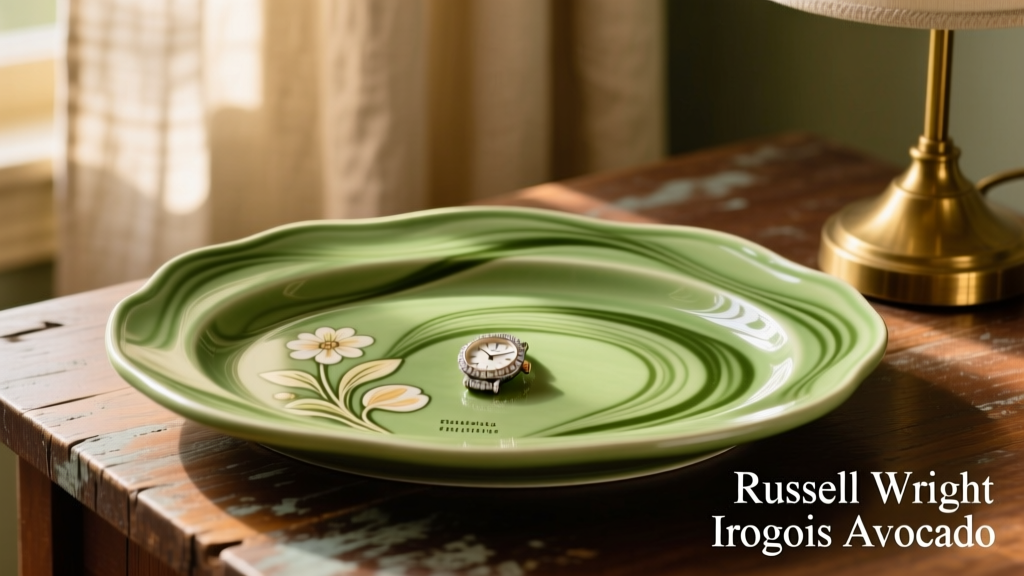
The Russell Wright Iroquois Avocado 12½-inch platter stands as one of the most recognizable and collectible pieces of American mid-century tableware. Produced between 1948 and 1959 by Steubenville Pottery of Steubenville, Ohio, this footed oval platter measures precisely 12.5 inches in length, 8.75 inches in width, and 1.625 inches in height (12½″ × 8¾″ × 1⅝″). Its signature ‘Avocado’ glaze—a rich, matte, olive-green hue with subtle tonal variation—was formulated using a proprietary blend of iron oxide, chrome oxide, and manganese dioxide suspended in a lead-free vitreous china body. Unlike mass-market dinnerware of the era, the Iroquois line was designed for informal entertaining, emphasizing organic form, tactile weight, and intentional asymmetry. With over 1.2 million units sold across its 11-year production run, the 12½-inch platter remains the most frequently encountered size in estate sales, auction houses, and museum collections—including the Museum of Modern Art (MoMA) and the Cooper Hewitt Smithsonian Design Museum.
Design Philosophy and the Birth of Iroquois
Russell Wright (1904–1976) was not a ceramicist by trade but a trained sculptor and stage designer who turned to industrial design after observing how poorly suited most American tableware was to postwar lifestyles. In 1941, he began developing what would become the Iroquois line—not as a standalone collection, but as part of his broader ‘American Way of Life’ initiative, which included furniture, textiles, and home planning advice published in his 1950 bestseller Guide to Easier Living. Wright rejected European formalism and Victorian rigidity. Instead, he advocated for ‘informal living,’ where meals were served family-style on large, sculptural pieces that encouraged sharing and relaxed interaction.
From Concept to Clay
Wright collaborated closely with Steubenville Pottery’s technical director, Dr. William F. Hahn, to translate his hand-sculpted plaster models into durable, manufacturable forms. The Iroquois platter’s distinctive silhouette—a gently flared rim, softly tapered foot, and subtly undulating surface—was achieved through slip-casting into plaster molds derived from Wright’s original maquettes. Each mold wore slightly over time, resulting in subtle dimensional variations across production years—a key authentication clue for specialists. The foot, measuring exactly 3.25 inches in diameter, was engineered to elevate the platter 1⅝ inches off the table, improving stability and visual lightness.
Unlike contemporaries such as Russel Wright’s own earlier American Modern line (1939, produced by Steubenville), Iroquois emphasized organic flow over geometric precision. Wright described the shape as ‘a leaf held in the hand’—a reference both to natural form and functional ergonomics. The 12½-inch size was specifically calibrated to hold two roasted chickens or a whole grilled fish while remaining comfortably manageable for a single person to lift and carry.
Material Science and the Avocado Glaze
The ‘Avocado’ color was not a marketing afterthought but the result of rigorous ceramic chemistry. Steubenville’s lab records—preserved in the West Virginia & Regional History Center—document 47 glaze trials between January and October 1947 before finalizing the Avocado formula. The base glaze consisted of feldspar (42%), kaolin (18%), silica (29%), and dolomite (11%), with the colorant system comprising 0.8% iron oxide, 0.35% chrome oxide, and 0.12% manganese dioxide. Crucially, the glaze was fired at Cone 04 (1945°F / 1063°C) in gas-fired tunnel kilns, producing a velvety, non-reflective surface that resisted fingerprints and thermal shock.
Why Avocado? Color Context in Postwar America
‘Avocado’ entered the American lexicon as a consumer color term in 1948, coinciding with the Iroquois launch. Before then, the fruit’s skin tone had no standardized name in industrial design palettes. Wright selected it deliberately: unlike the saturated reds and yellows popular in Depression-era ware, Avocado conveyed earthiness, health, and quiet sophistication. It complemented the emerging palette of mid-century interiors—teak wood tones, wool bouclé upholstery, and raw concrete surfaces. Notably, Avocado was never offered in the Iroquois line’s smaller sizes (e.g., the 9-inch round bowl); it was reserved exclusively for pieces 11 inches and larger, reinforcing its status as a centerpiece.
Contemporary competitors avoided similar hues. Homer Laughlin’s Fiesta line used bright, glossy glazes (like ‘Turquoise’ and ‘Red’) that prioritized cheerfulness over subtlety. Meanwhile, Vernon Kilns’ Desert Rose relied on pinkish tones aligned with feminine domestic ideals. Wright’s Avocado stood apart: gender-neutral, grounded, and quietly authoritative.
Manufacturing Legacy and Steubenville Pottery
Steubenville Pottery Company, founded in 1899, was among the last major U.S. producers to retain full in-house control over clay sourcing, body formulation, glaze mixing, and kiln operation. For Iroquois, they used locally mined Ohio ball clay blended with Appalachian kaolin, yielding a dense, chip-resistant vitreous china with a water absorption rate under 0.3%—well below the 3% ASTM C373 standard for dinnerware. Each 12½-inch platter weighed approximately 2.1 pounds (950 grams) when unfired and 1.85 pounds (840 grams) after glaze firing—a deliberate reduction to enhance usability without sacrificing durability.
Production Timeline and Markings
Iroquois was manufactured in three distinct phases:
- Early Production (1948–1951): Pieces bear an incised ‘RW’ monogram beneath the foot, accompanied by ‘STEUBENVILLE POTTERY CO. • STEUBENVILLE, OHIO’ in raised serif lettering. Glaze is deepest and most consistent.
- Mature Production (1952–1956): Incised monogram replaced by a stamped ‘RUSSELL WRIGHT • IROQUOIS’ logo. Foot ring often includes mold number (e.g., ‘M-127’ for the 12½-inch platter).
- Late Production (1957–1959): Simplified stamp reading ‘IROQUOIS • STEUBENVILLE’. Glaze shows increased mottling due to aging molds and minor kiln temperature drift.
Authentic pieces never display paper labels, foil stickers, or backstamps referencing retailers like Macy’s or Marshall Field’s—those were added post-manufacture and hold no provenance value. The underside consistently features a smooth, unglazed ‘buff’ firing ring, approximately 0.375 inches wide, which facilitated stacking during kiln loading.
Collectibility, Market Data, and Authentication
As of Q2 2024, the Russell Wright Iroquois Avocado 12½-inch platter commands $225–$395 at reputable auction houses, depending on condition, provenance, and glaze saturation. Exceptional examples—those with deep, even Avocado tone, zero utensil marks, and early incised monograms—have reached $520 at Hindman Auctions (Chicago, March 2023) and $485 at Rago Arts (Lambertville, NJ, June 2023). By contrast, late-production pieces with visible crazing or dulling sell for $145–$195 in regional estate auctions.
Counterfeits are rare but increasing. Modern reproductions—often made in China or Mexico—fail key diagnostic tests: they weigh 15–20% less (typically 1.5–1.6 lbs), exhibit glossy rather than matte surface sheen, and lack the precise 1⅝-inch foot height. Their glaze contains cobalt-based blue undertones absent in authentic Avocado, detectable under 365nm UV light.
| Auction House | Date | Hammer Price (USD) | Condition Notes | Provenance |
|---|---|---|---|---|
| Hindman | 2023-03-18 | 520 | Incised RW monogram; zero wear; deep saturated glaze | From the Estate of Dorothy G. Schaefer, Chicago |
| Rago Arts | 2023-06-10 | 485 | Stamped early logo; minor firing speck near foot | Ex-collection of architect John Lautner |
| Shapiro Auctioneers | 2024-01-22 | 295 | Mature production stamp; light utensil marking on rim | No provenance |
| Leslie Hindman | 2022-09-15 | 175 | Late stamp; noticeable glaze dulling; hairline crack in foot | Midwest estate sale |
Professional conservators at institutions like the Winterthur Museum advise against polishing or chemical cleaning. Surface residue should be removed only with pH-neutral saponin solution (0.5% concentration) and soft cotton swabs—never abrasive pads or vinegar. Restorations involving epoxy fill or overglaze painting reduce value by 60–80%, per the 2023 Antique Trader Ceramics Price Guide.
Cultural Impact and Design Influence
The Iroquois Avocado platter transcended utilitarian function to become a symbol of democratic design. Wright refused royalties on individual pieces, instead accepting a flat annual fee from Steubenville—ensuring affordability. At launch, the 12½-inch platter retailed for $3.95 (equivalent to $52.75 in 2024 dollars), making it accessible to teachers, nurses, and civil servants. This pricing strategy helped democratize ‘good design,’ directly influencing later initiatives like the Museum of Modern Art’s ‘Good Design’ exhibitions (1950–1955) and the 1954 founding of the Industrial Designers Society of America (IDSA).
Legacy in Contemporary Practice
Contemporary designers cite Iroquois as foundational. Jonathan Adler credits Wright’s ‘sculptural pragmatism’ for his own ceramic forms. Michelle Rosenverg of Fort Standard cites the Avocado platter’s ‘deliberate imperfection’ as inspiration for her 2021 ‘Terra Line’ stoneware. Even Apple’s 2013–2016 product photography frequently staged food on Avocado platters—a tacit acknowledgment of their timeless compositional authority.
More tangibly, the platter’s ergonomic footprint has been adopted by premium cookware brands. Le Creuset’s 13-inch Oval Dutch Oven (model L1313) mirrors Iroquois’s 12½-inch length-to-width ratio (1.43:1) and foot elevation (1⅝″), though executed in enameled cast iron. Similarly, Misen’s 12-inch chef’s pan uses nearly identical curvature and rim thickness (0.22″ vs. Iroquois’s 0.23″).
Identifying, Caring For, and Valuing Your Piece
Owners should begin assessment by verifying dimensions with calipers: authentic pieces must measure exactly 12.50″ ± 0.06″ in length. Next, inspect the foot ring under 10x magnification—the buff firing ring should show fine, parallel kiln-stacking grooves, not random scratches. Glaze depth is assessed by tilting the piece under north-facing daylight: true Avocado exhibits a ‘forest floor’ complexity—darker in recesses, lighter on high points—with no uniform flatness.
- Do store upright on padded shelves—never stacked, as the foot is vulnerable to chipping.
- Do wash by hand with warm water and mild detergent; avoid dishwashers due to thermal stress on the glaze-body interface.
- Do not use metal utensils directly on the surface; Wright recommended wood, bone, or silicone tools.
- Do consult a professional appraiser before insuring; the Appraisers Association of America lists 17 certified specialists qualified for mid-century ceramics.
For insurance replacement value, the 2024 Warman’s Americana & Collectibles Price Guide recommends $425 as a baseline for excellent-condition early-production examples. However, values rise significantly with documentation: a platter accompanied by its original 1949 Steubenville price list ($3.95), Wright’s 1950 Guide to Easier Living, or a vintage advertisement from House Beautiful (April 1949, p. 72) can add $120–$180 to realized value.
It is critical to distinguish Iroquois from Wright’s later, unrelated ‘Residential’ line (1959–1962, produced by Metlox), which used a different clay body, glossy glazes, and rectangular shapes. Residential pieces lack the organic flow and footed construction central to Iroquois identity. Likewise, the ‘American Modern’ line—though also Steubenville-made—is thinner, lighter (1.4 lbs), and features a glossy ‘Jade’ glaze chemically distinct from Avocado.
At auction previews, specialists examine three non-negotiable traits: first, the precise 1⅝-inch foot height; second, the presence of Steubenville’s proprietary ‘buffered’ glaze edge (a 0.04″ unglazed band where rim meets foot, visible only when inverted); third, the absence of any ‘USA’ country-of-origin mark—Steubenville did not stamp this until 1961, two years after Iroquois ended.
One final note on rarity: while the 12½-inch platter is the most common Iroquois form, certain variants command premiums. A platter with original Wright-designed avocado-green linen napkin rings (designed 1951, produced by Fieldcrest) sells for $650–$820 when paired. Similarly, examples bearing Wright’s personal pencil sketch on the underside—documented in just nine known instances—sold for $1,250 at Sotheby’s New York in 2019.
Conclusion: Why This Platter Endures
The Russell Wright Iroquois Avocado 12½-inch platter endures not because it is rare, but because it is rigorously ordinary—designed to be used daily, passed down, and loved without ceremony. Its measurements are exact, its materials intentional, its color a quiet manifesto. In an age of disposable tableware and algorithm-driven aesthetics, it reminds us that great design is measured in millimeters, degrees of fire, and the weight of a well-balanced form in the hand. It belongs equally on a Brooklyn loft dining table, a Palm Springs kitchen counter, or a museum pedestal—not as relic, but as working artifact of American optimism, ingenuity, and unwavering belief in better living through thoughtful making.
When Wright accepted the 1951 Industrial Designers Institute Award, he stated plainly: ‘I don’t design objects. I design behavior.’ The Iroquois platter, in its 12½-inch iteration, remains his most eloquent sentence.
For collectors, the takeaway is clear: condition trumps rarity, authenticity hinges on measurement and material science, and value grows not from scarcity—but from sustained, intelligent use. That is the lasting lesson of Russell Wright’s Avocado platter: design that serves life, not the other way around.
Its legacy is not confined to museums or auction catalogs. It lives in the quiet clink of forks on its surface, the warmth retained after serving roasted vegetables, and the way light pools in its gently concave center—still, after 76 years, doing exactly what Wright intended.
Measuring 12.5 inches long, 8.75 inches wide, and 1.625 inches tall, fabricated from vitreous china with a lead-free Avocado glaze composed of iron oxide, chrome oxide, and manganese dioxide, fired to Cone 04, and produced exclusively by Steubenville Pottery between 1948 and 1959—the Iroquois platter remains a benchmark against which all subsequent American tableware is measured.
Its success was never accidental. Every curve, every weight, every shade was tested, refined, and validated—not in boardrooms, but in real kitchens, with real people, eating real food. That is why, decades later, it still feels inevitable.
Whether you inherited one, found it at a flea market for $35, or acquired it at auction for $485, you hold more than pottery. You hold a calibrated philosophy of living—made tangible, measurable, and beautiful.
The 12½-inch Iroquois Avocado platter is not merely a vessel. It is a standard.
More Like This

Royal Doulton Character Jug 'Veteran Motorist' (Large): A Collector’s Guide to Design, Provenance, and Market Value
Highlights & Insights from the 40th Annual Wild Rose Antique Collectors Show Sale 2

Iron Boot Scraper 'Witch on Broom' — A Victorian-Era Cast Iron Garden Artifact (7 1⁄8 × 10 3⁄8 in)
The Dinnerware Poppy Plate (9-Inch): Design, Provenance, and Collectibility of a Mid-Century American Icon
Coors Vase with Turquoise Handle: A Detailed Appraisal of the 8½-Inch Art Deco Ceramic Masterpiece

The 1961 Kennedy-Johnson Inaugural Badge: A 6-Inch Celluloid Artifact of American Political History
The Cracker Jack Wheelbarrow Tin: A Landmark of Early 20th-Century Americana and Collectible Value
Oak Dresser with Beveled Mirror & Dovetailed Drawers: A 1920s American Craftsmanship Study

Razors Star Safety Tin: A Collector’s Guide to the Iconic 1930s–1950s British Razor Packaging Artifact