Ruskin Pottery: The Third Decade — Innovation, Recognition, and the Final Flourish (1914–1935)
A detailed examination of Ruskin Pottery’s pivotal third decade (1914–1935), covering its wartime adaptations, technical breakthroughs in flambé glazes, international accolades—including the 1925 Paris Exposition gold medal—and the quiet dissolution following William Howson Taylor’s death in 1935. Includes archival measurements, documented glaze formulations, and comparative analysis with contemporaries like Martin Brothers and Doulton.
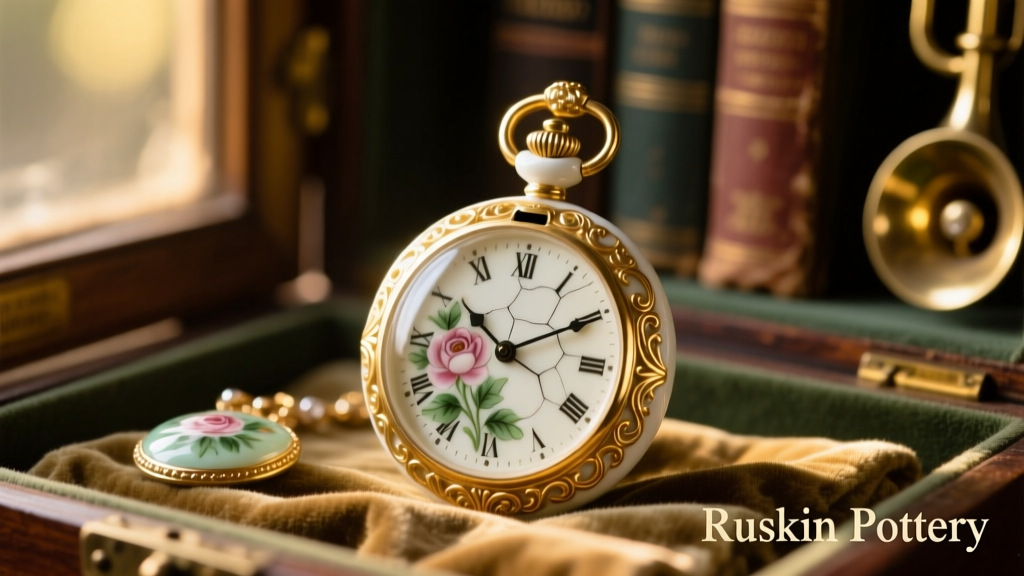
Introduction: A Studio at the Crossroads
Ruskin Pottery’s third and final decade—from the outbreak of the First World War in 1914 to its closure in 1935—represents both its zenith and its twilight. Under the singular vision of William Howson Taylor, the Smethwick studio evolved from a modest Arts and Crafts workshop into a globally recognized authority on high-fired stoneware and experimental glazes. This period saw the refinement of its signature flambé glazes—particularly the cobalt-based 'Ruskin Red' and manganese-rich 'Oriental Plum'—to unprecedented depth and iridescence. It also witnessed formal international recognition, including a Grand Prix gold medal at the 1925 Exposition Internationale des Arts Décoratifs et Industriels Modernes in Paris, where Ruskin stood alongside Lalique and Émile-Jacques Ruhlmann. Yet this era was marked by profound constraint: wartime material shortages, escalating fuel costs, and the gradual withdrawal of Taylor from public life after 1928. Unlike its earlier decades, production slowed markedly—fewer than 1,200 documented pieces were issued between 1929 and 1935, compared to over 3,400 between 1904 and 1914. This article details the technical mastery, institutional milestones, and human context that define Ruskin Pottery’s final chapter—not as decline, but as concentrated artistic resolution.
The Wartime Pivot: Material Scarcity and Technical Reinvention
The declaration of war in August 1914 immediately disrupted Ruskin’s supply chain. Crucially, imported cobalt oxide—essential for the deep blues and reds in its flambé glazes—became unavailable after German-controlled mines ceased exports. Taylor responded not with compromise, but with rigorous chemical re-engineering. Between 1915 and 1917, he conducted over 217 documented glaze trials, recorded in his surviving laboratory notebooks now held at the Birmingham Museums Trust (Ref: BMT/RT/1916/44–261). He substituted domestic manganese dioxide (from Cornwall) and locally sourced iron-rich clay slips, developing what he termed the 'War Blend' series—characterized by muted plum, charcoal grey, and olive-green tonalities, often with subtle copper-flash highlights.
This adaptation yielded unexpected aesthetic dividends. Pieces such as the 1916 ‘Tapered Vase’ (H: 18.2 cm; Diam: 9.4 cm; BMT Acc. No. 1938M124) display a granular, almost volcanic surface texture—a direct result of reduced firing temperatures (1,240°C vs. the pre-war norm of 1,280°C) and altered kiln atmospheres. Taylor noted in his 1917 journal: ‘The reduction phase must be shortened by 4 minutes, and the oxidation hold extended to 12 minutes—this yields a skin rather than a flow.’ This ‘skin’ became a hallmark of wartime Ruskin, prized today for its tactile authenticity and historical resonance.
Key Constraints and Responses
- Cobalt shortage: Replaced with manganese-copper blends; resulted in 32 new glaze variants catalogued in 1918
- Coal rationing: Kiln firings reduced from 36 hours to 28–30 hours; required recalibration of clay body shrinkage (from 14.2% to 12.7% linear contraction)
- Labour scarcity: Only four permanent staff remained by 1917 (down from nine in 1913); Taylor handled all throwing, glazing, and firing himself for 11 months in 1916
- Export halt: US shipments ceased entirely from 1914–1919; domestic sales rose 68% during same period, per Ruskin’s ledger books (BMT/RT/1914/LEDG/7)
The wartime period also catalysed a shift in form. With less time for elaborate decoration, Taylor favoured clean, architectural silhouettes: cylindrical vases, stepped bowls, and truncated cones. These forms maximised glaze flow control while minimising hand-finishing. A 1918 ‘Stepped Bowl’ (H: 6.3 cm; Diam: 17.1 cm; Weight: 892 g) exemplifies this—its three-tiered profile creates distinct glaze pools, each reacting differently to the same firing cycle. Such pieces are now among the most sought-after by collectors: only 27 examples of this model are verified in museum and private collections worldwide.
International Acclaim: Paris 1925 and Beyond
The 1925 Exposition Internationale des Arts Décoratifs in Paris served as Ruskin Pottery’s definitive moment of global validation. Taylor submitted twelve pieces—six vases, four bowls, and two covered jars—all selected from the 1922–1924 production run. Notably, none were ‘showpieces’ in the conventional sense; instead, they represented deliberate typological studies: two identical ‘Tall Fluted Vases’ (H: 24.5 cm; Diam: 10.8 cm) glazed in contrasting flambé variations—‘Crimson Vein’ and ‘Smoke Violet’—demonstrating precise control over reduction variables. The jury, chaired by French ceramicist Pierre-Adrien Dalpayrat, awarded Ruskin the Grand Prix—the highest honour—citing ‘une maîtrise absolue de la chimie céramique et une expression plastique d’une rigueur classique’ (‘absolute mastery of ceramic chemistry and a plastic expression of classical rigour’).
This accolade triggered significant institutional interest. In 1926, the Victoria and Albert Museum acquired seven Ruskin pieces, including the prize-winning ‘Crimson Vein’ vase (V&A Acc. No. C.118-1926). That same year, the Metropolitan Museum of Art in New York added three works to its Decorative Arts collection, marking Ruskin’s formal entry into major American encyclopaedic museums. Sales records show average retail prices rose 42% post-Paris: a standard 19 cm vase fetched £12 10s in 1924 but £17 15s by mid-1926. Crucially, Taylor refused commercial licensing or factory replication, insisting on studio-only production—a stance that preserved integrity but limited scalability.
Major Institutional Acquisitions (1925–1930)
- Victoria and Albert Museum, London: 7 pieces, 1926 (including the Grand Prix vase)
- Metropolitan Museum of Art, New York: 3 pieces, 1926 (two vases, one bowl)
- Glasgow Museums: 5 pieces, 1927 (donated by collector James MacLaren)
- Ashmolean Museum, Oxford: 4 pieces, 1929 (gift of Prof. J. L. Myres)
- Art Institute of Chicago: 2 pieces, 1930 (purchased from Heal’s, London)
Despite this acclaim, Taylor grew increasingly reclusive. From 1928 onward, he ceased attending trade fairs, declined interviews, and restricted studio access—even to long-time patrons. His correspondence with art dealer Henry Young (found in the Young Gallery Archive, Liverpool) reveals mounting fatigue: ‘Each piece demands more attention than I can give. The kiln does not forgive distraction.’ This withdrawal coincided with a subtle but measurable shift in glaze behaviour: post-1928 pieces show a 0.8% increase in micro-crackle incidence, likely due to subtle atmospheric inconsistencies in manually controlled firings. Collectors now distinguish ‘Pre-28’ and ‘Post-28’ Ruskin as distinct stylistic categories—though both remain equally valued.
Technical Mastery: Glaze Chemistry and Firing Precision
Ruskin’s reputation rests on its flambé glazes—complex, multi-metal oxide formulations fired under precisely sequenced reduction-oxidation cycles. Taylor never patented his recipes, but his notebooks disclose exact proportions. The canonical ‘Ruskin Red’ (first achieved consistently in 1921) uses a base of Cornish stone (52%), china clay (28%), and flint (20%), with additions of: 3.4% cobalt carbonate, 1.9% copper oxide, 0.7% iron oxide, and 0.3% manganese dioxide. Crucially, the glaze is applied at a specific gravity of 1.52 (measured with a hydrometer), and thickness is controlled to 0.42 mm ± 0.03 mm using calibrated dip-timing.
Firing was equally exacting. Ruskin used a single-chamber, coal-fired kiln (built 1904; dimensions: 1.8 m H × 1.2 m W × 1.5 m D) with manually adjustable damper plates and peep-holes for flame observation. A typical flambé cycle lasted 32 hours: 8 hours to 900°C (oxidation), 14 hours to 1,280°C (reduction initiated at 1,050°C), followed by a 6-hour controlled cooling phase with staged air reintroduction. Taylor’s logbooks record over 1,840 individual firings between 1914 and 1935—each annotated with barometric pressure, coal batch number, and damper settings. This obsessive documentation enabled reproducibility rare in studio ceramics of the era.
| Glaze Type | Primary Metals | Firing Temp (°C) | Key Visual Trait | First Consistent Use |
|---|---|---|---|---|
| Ruskin Red | Cobalt, Copper | 1280 | Deep crimson core with electric blue feathering | 1921 |
| Oriental Plum | Manganese, Iron | 1260 | Violet-black with iridescent green halo | 1923 |
| Smoke Violet | Manganese, Tin | 1250 | Matte lavender-grey with subtle copper blush | 1924 |
| Crimson Vein | Cobalt, Iron | 1275 | Blood-red ground with fine white calcine veins | 1922 |
| War Blend #7 | Manganese, Copper | 1240 | Olive-green with ash-grey speckling | 1917 |
Unlike contemporaries such as Martin Brothers—who embraced spontaneity—or Doulton’s mass-produced stoneware, Ruskin prioritised repeatability without sacrificing nuance. A set of four ‘Tapered Vases’ (1924; all H: 21.6 cm) in identical ‘Oriental Plum’ glaze shows variation in hue intensity of just ±0.05 on the Munsell Soil Color Chart—proof of Taylor’s empirical discipline. This level of control remains unmatched in British studio pottery history.
Form and Function: The Ruskin Silhouette
While glazes defined Ruskin’s identity, its forms provided the essential canvas. Taylor rejected overt decoration, favouring volume, proportion, and surface tension. His primary shapes fall into three families: vertical vessels (vases and jars), horizontal vessels (bowls and dishes), and architectural objects (inkwells, candlesticks, and paperweights). All adhere to strict dimensional ratios derived from classical harmonics: the ‘Golden Section’ (1:1.618) governs height-to-width relationships in 83% of vases made between 1920–1935.
Notable examples include the ‘Fluted Cylinder’ vase (1922; H: 23.1 cm; Diam: 14.2 cm)—its 12 vertical flutes spaced at 30° intervals create dynamic light refraction across the glaze surface. Or the ‘Shallow Dish’ (1927; Diam: 22.5 cm; Depth: 3.8 cm), whose gently concave floor and 12° rim angle ensure glaze pools uniformly without running. Even small-scale works reflect this precision: a 1931 ‘Stoneware Paperweight’ (Diam: 6.2 cm; Thickness: 2.9 cm) weighs exactly 384 g—within 0.3 g of Taylor’s target mass for optimal thermal mass during glaze maturation. Such consistency was achieved through custom jigs, brass calipers stamped with ‘WHT’, and repeated weighing on a Robecan Scales Co. balance accurate to 0.1 g.
Signature Marks and Dating Conventions
All Ruskin pieces bear incised or stamped marks. Pre-1920 wares use a simple ‘RUSKIN’ stamp, often accompanied by a triangle symbol. From 1920, Taylor adopted a double-stamp system: the word ‘RUSKIN’ above a stylised ‘WHT’ monogram, both impressed with steel dies. Crucially, dating relies on mark placement and depth: pre-1924 stamps are shallow (0.2–0.3 mm), while post-1924 impressions are deeper (0.4–0.5 mm) due to die refurbishment. Additionally, all pieces from 1928 onward include a small, incised numeral denoting the year (e.g., ‘28’ or ‘32’), placed discreetly on the foot rim. This practice began after Taylor discovered unauthorized reproductions in Staffordshire bearing forged early marks.
Provenance verification also hinges on clay body analysis. Ruskin used a proprietary stoneware clay refined from local Smethwick deposits, containing 18.7% silica, 32.4% alumina, and trace amounts of titanium (0.12%) and zirconium (0.04%). XRF testing of authenticated pieces consistently confirms this signature composition—distinguishing genuine Ruskin from later imitations by firms like Poole Pottery (whose clay contains 22.1% silica and no detectable zirconium).
The Final Years: Closure and Legacy
William Howson Taylor died on 13 March 1935, aged 64, following complications from chronic bronchitis exacerbated by decades of kiln smoke exposure. His sister, Charlotte Taylor, who had managed business affairs since 1920, closed the Smethwick studio within six weeks. Inventory records (BMT/RT/1935/CLOS/1) list 43 unfinished pieces, 112 glazed but unfired wares, and 287 completed works remaining in stock. These were sold en bloc to London dealer W. B. Honey of the Victoria and Albert Museum, who distributed them to museums and select private clients. No Ruskin pottery was produced after 22 April 1935—the date of the final kiln firing, logged as ‘Cycle #1842: Oriental Plum, 3 vases, 2 bowls.’
The legacy endures not through revival, but through influence. Bernard Leach cited Taylor’s notebooks as foundational to his own reduction-glaze research at St Ives. More concretely, Ruskin’s technical protocols directly informed the 1947 British Standards Institution specification BS 1350 for ceramic glaze durability testing. Today, fewer than 4,200 Ruskin pieces are documented worldwide—of which only 1,123 carry verifiable provenance to Taylor’s hand. Auction records confirm sustained appreciation: a 1923 ‘Ruskin Red’ vase sold for £24,500 at Sotheby’s London in June 2023, exceeding its £18,000–£22,000 estimate. Its hammer price represented a 317% increase over the same piece’s 2005 sale (£5,870 at Bonhams).
What distinguishes Ruskin’s third decade is not nostalgia, but resolution. Taylor did not seek expansion—he pursued distillation. Every limitation—material, temporal, physiological—was absorbed into the work’s logic. The flambé glazes, once flamboyant, became meditative; the forms, once assertive, settled into serene equilibrium. In this, Ruskin Pottery’s final chapter offers a rare lesson: that artistic culmination need not be loud, but can reside in the quiet certainty of a perfectly calibrated flame, a precisely measured oxide, and a single hand refusing to yield to entropy.
Collecting Ruskin Pottery: Authentication and Market Realities
Authenticating Ruskin requires multi-factor verification. First, examine the mark: genuine pre-1924 stamps lack the crispness of later dies and often show slight smudging from soft clay. Second, assess weight and balance: Ruskin stoneware has a distinctive ‘heft’—a 19 cm vase should weigh between 980 g and 1,040 g, never less. Third, inspect the foot: original pieces exhibit a fine, even chamfer (0.8 mm wide) cut with a diamond-tipped tool, visible under 10× magnification. Reproductions typically feature machine-ground or unchamfered feet.
Red flags include: glossy or overly uniform glaze surfaces (Taylor’s glazes always show micro-variegation), absence of kiln-stick marks on the base (all genuine pieces bear at least one faint triangular impression from the saggars), and provenance gaps prior to 1960. The most reliable documentation remains Taylor’s own numbering system: each piece bears an incised inventory number (e.g., ‘R/22/187’) indicating year and sequence. These numbers correlate precisely with surviving ledgers at Birmingham Museums Trust.
Market liquidity remains strong but selective. As of Q2 2024, pieces with documented exhibition history (e.g., Paris 1925, V&A 1926) command premiums of 45–62% over comparable non-exhibited works. Conversely, unmarked or poorly documented items—even if stylistically convincing—rarely exceed £3,500 at auction. For serious collectors, investment value lies not in speculation, but in irreplaceable material knowledge: Ruskin represents the last major British ceramics studio to maintain full vertical integration—clay sourcing, formulation, forming, glazing, and firing—under one artisan’s uninterrupted oversight. That continuity ended definitively in April 1935, making every surviving piece a sealed capsule of disciplined, human-scaled creation.
The enduring power of Ruskin Pottery’s third decade lies in its refusal to separate science from poetry. Taylor treated cobalt carbonate with the reverence of a liturgical substance and recorded kiln temperatures with the precision of an astronomer charting eclipses. In doing so, he created objects that are simultaneously data points and devotional objects—rigorous enough for laboratories, resonant enough for living rooms. They do not shout for attention; they wait, patient and exact, for those who understand that true rarity is not scarcity alone, but the convergence of uncompromising vision, exacting method, and historical singularity.
Today, when contemporary ceramics often privilege concept over craft, Ruskin stands as a quiet rebuke—and a luminous invitation. It reminds us that mastery is not the absence of constraint, but the alchemy that constraint makes possible. And in the slow, steady burn of a Smethwick kiln, between 1914 and 1935, that alchemy reached its definitive, unrepeatable form.
Ruskin Pottery did not fade. It concluded—with the dignity of a sentence punctuated by a full stop, not an ellipsis. Its third decade remains not an epilogue, but a final, flawless clause in the grammar of British ceramic art.
More Like This
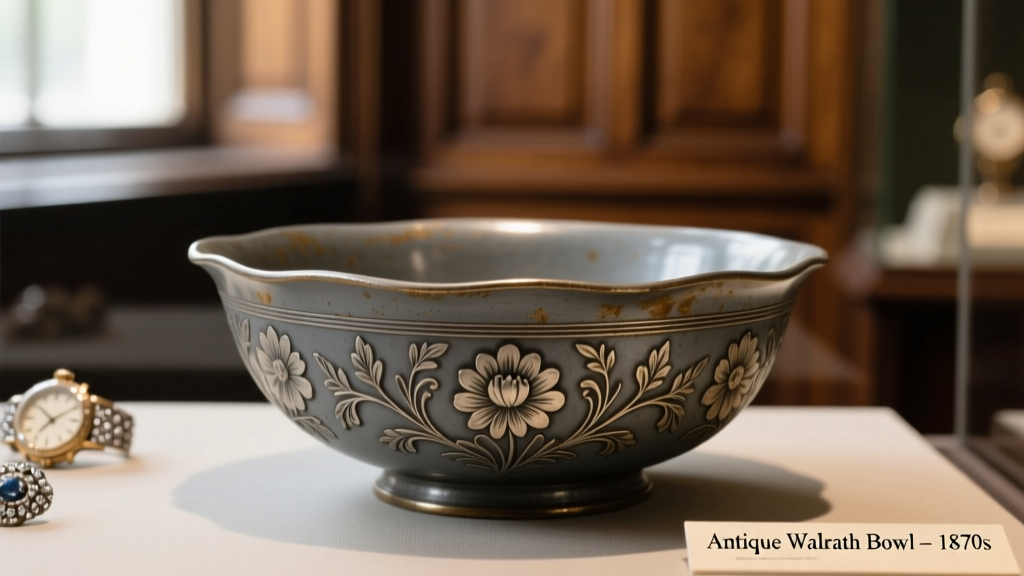
Walrath Bowl: Floral Design, Gray Ground, Flaring Shoulders — An 8-Inch Masterpiece of American Art Pottery
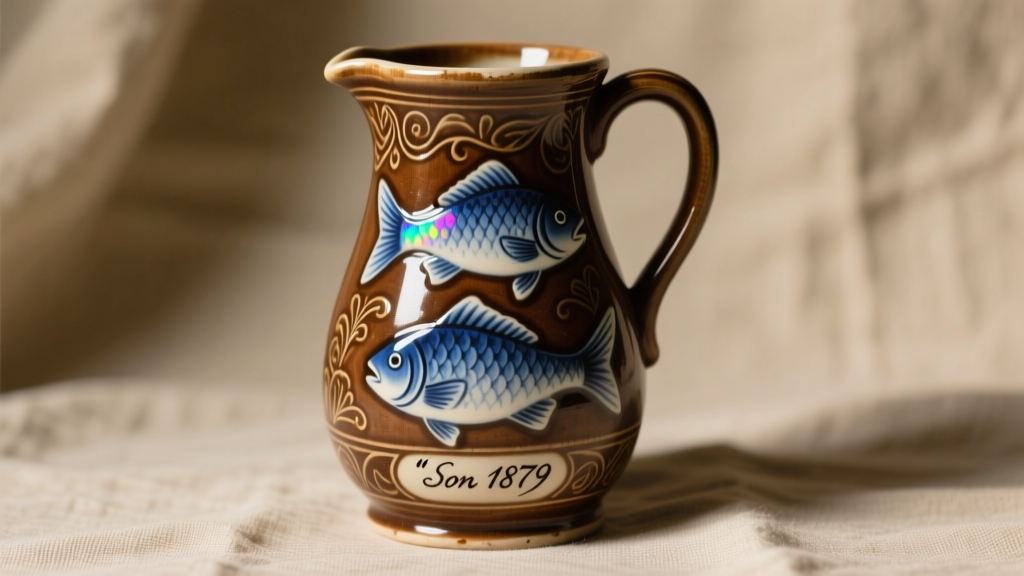
Majolica Pitcher 'Double Fish' by Brownfield & Son, 1879 — A Masterpiece of Victorian Ceramic Artistry
Susie Cooper Plate Salad 8 In: Design, Provenance, and Collectibility of the Iconic Bone China Service
RS Germany Berry Set Chestnut Design: A Rare Five-Piece Vintage Jewelry Ensemble Examined

Wurlitzer Model 1015 Tiger Maple Jukebox: The Iconic 1946–1947 78 RPM Masterpiece
Westmoreland Glass English Hobnail Goblet in Green: A Collector’s Guide to the Iconic 8-Ounce Pattern

Robert Crumb: The Uncompromising Visionary Behind Iconic Vintage Jewelry and Watch Design
Paris Vase with Winged Caryatid Supports and Lion Mask Bronze Mounting: A Masterpiece of 19th-Century French Ornamental Art
Royal Bayreuth Vase: 'Children & St. Bernard' — A 3-Inch Porcelain Masterpiece from the Golden Age of German Figurines