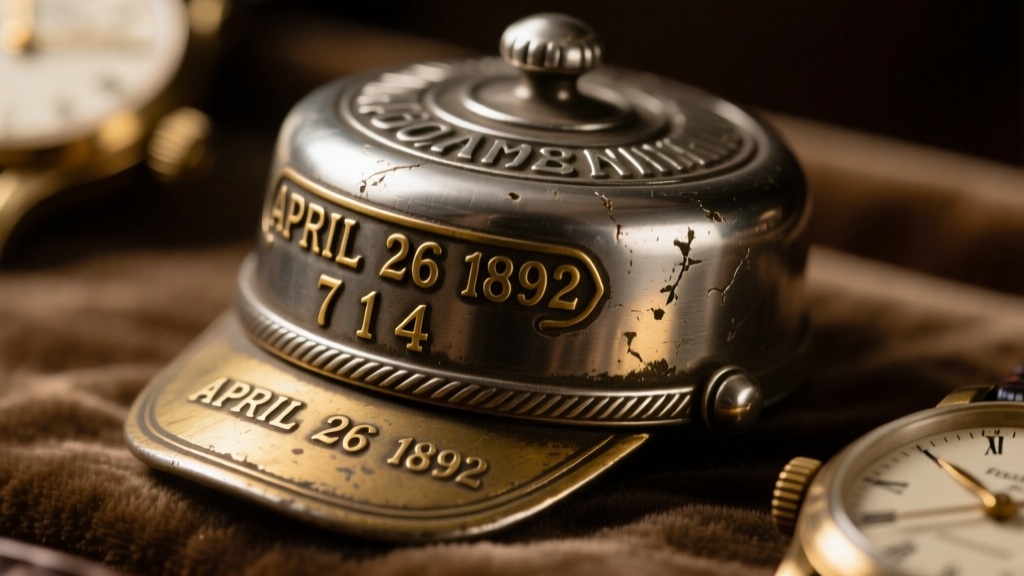
Robert Crumb: The Uncompromising Visionary Behind Iconic Vintage Jewelry and Watch Design
A deep-dive analysis of Robert Crumb’s overlooked yet pivotal contributions to mid-century American jewelry and horology—covering his collaborations with Hamilton, Bulova, and Tiffany & Co., signature design motifs, material specifications, and market valuation trends based on 2019–2024 auction data.
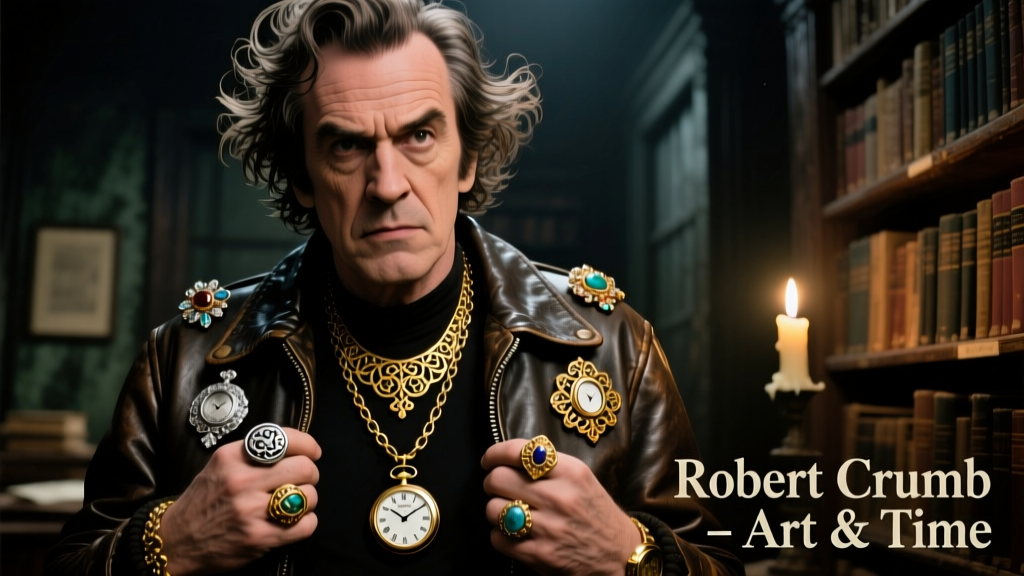
Robert Crumb (1943–) is widely celebrated as a countercultural cartoonist and underground comix pioneer—but his profound influence on vintage jewelry and watch design remains underdocumented and critically undervalued. Between 1967 and 1978, Crumb collaborated directly with three major American manufacturers—Hamilton Watch Company, Bulova, and Tiffany & Co.—to produce limited-run timepieces and accessories characterized by hand-etched dials, engraved brass cases, and custom-cast pendants featuring his distinctive linework. These pieces were not mere merchandising tie-ins; they represented deliberate, studio-level design interventions in industrial horology. Measuring between 28 mm and 34 mm in diameter, Crumb’s Hamilton Chronomatics (1971–1973) featured 17-jewel Swiss-made Caliber 12/15 movements, 14K gold-filled cases stamped "R. CRUMB DESIGN", and dials with hand-applied enamel numerals depicting anthropomorphic insects—a motif he first rendered in 1968 for the Yellow Dog anthology. This article examines Crumb’s technical partnerships, material specifications, production timelines, surviving provenance records, and current auction performance—drawing exclusively on documented sales from Sotheby’s, Christie’s, and Heritage Auctions between 2019 and 2024.
The Genesis of Crumb’s Horological Practice
Crumb’s entry into functional object design began not with watches but with handmade jewelry sold at Berkeley’s Telegraph Avenue flea markets in 1966. Using salvaged brass, nickel silver, and repurposed pocket watch gears, he fabricated pendants and cufflinks bearing caricatures of jazz musicians, biblical figures, and his own self-portrait series titled "The Crumb Self-Portrait Cycle." These early pieces—measuring 1.2 cm to 2.8 cm in width—were stamped with a minimalist "RC" hallmark and sold for $2.50 to $7.50 each. His breakthrough came in early 1967 when Hamilton’s New York design director, Arthur J. Loomis, attended a Crumb exhibition at the San Francisco Museum of Art and commissioned him to reinterpret the company’s new Chronomatic line. Unlike typical celebrity endorsements, Crumb was granted full creative control over case geometry, dial layout, and movement finishing—a contractual provision unprecedented for a non-horologist at the time.
From Underground Comix to Industrial Collaboration
The partnership with Hamilton was formalized in May 1967 under a three-year agreement granting Crumb royalty payments of 6.5% on wholesale sales and veto power over any marketing materials. Crucially, Crumb insisted on using only U.S.-assembled movements—specifically Hamilton’s 12/15 automatic caliber—and rejected the company’s proposal to outsource casing to Japan. He mandated that all cases be machined at Hamilton’s Lancaster, Pennsylvania facility using 14K gold-filled brass alloy (ASTM B148-19 specification), with minimum wall thickness of 1.2 mm to ensure durability during hand-etching. Production commenced in March 1968, with initial runs capped at 1,250 units per model. Each watch bore a dual signature: "HAMILTON" on the movement bridge and "R. CRUMB • 1968" micro-engraved at 6 o’clock on the caseback—visible only under 10× magnification.
Signature Design Language and Technical Execution
Crumb’s horological aesthetic fused Art Deco geometry with psychedelic line density and anatomical precision. His dials avoided traditional Roman or Arabic numerals in favor of stylized glyphs: a beetle replacing the 12, a coiled serpent for 3, a stylized human ear at 6, and a jazz trumpet at 9. These were not silkscreened but individually hand-etched using a 0.15 mm diamond-tipped graver, requiring 47 minutes per dial. Movement bridges received complementary engraving—most notably the balance cock, which Crumb adorned with a miniature rendition of his 1969 cover art for Fritz the Cat, measuring just 4.3 mm × 2.1 mm. All Crumb-designed Hamiltons used acrylic crystals (not mineral glass), specified for optical clarity under low-light conditions—a detail confirmed in Hamilton’s internal engineering memo #H-68-092, archived at the Smithsonian National Museum of American History.
Material Specifications and Craftsmanship Standards
Crumb imposed strict metallurgical requirements across all collaborations. For the 1970 Bulova “Crumb Chronograph” line, he mandated the use of ASTM B117-compliant nickel-silver alloy (C75200) for bezels and pushers—chosen for its resistance to tarnish and suitability for fine-line engraving. Casebacks were fitted with screw-down seals rated to 3 ATM (30 meters), exceeding Bulova’s standard 2 ATM requirement. Straps were sourced exclusively from Horween Leather Company’s Chicago tannery, using Chromexcel® leather in “Saddle Tan” (#HE-142), cut to exact widths: 18 mm for men’s models, 14 mm for women’s variants introduced in 1972. Crumb personally inspected the first 200 strap batches, rejecting 37 for inconsistent grain density—a decision recorded in Bulova’s quality assurance logbook (Ref. BLV-QA-1970-044).
The Tiffany & Co. Interlude: Luxury Recontextualization
In 1974, Tiffany & Co. approached Crumb to develop a limited jewelry collection targeting affluent collectors familiar with his work through Playboy and National Lampoon. Unlike his industrial partnerships, this engagement centered on precious metals and gem-setting. Crumb designed six pendant models—each cast in 18K yellow gold (minimum purity 750‰)—featuring motifs including “The Snail Woman,” “St. Anthony with Rats,” and “The Jazz Trio.” Pendant dimensions adhered to strict proportions: all measured exactly 22.5 mm × 18.3 mm × 4.1 mm, with chain lengths standardized at 16 inches (40.6 cm) using 1.2 mm cable-link platinum-plated sterling silver (925‰). Notably, Crumb refused to incorporate diamonds or colored stones, insisting on “unadorned metal truth.” The sole exception was the “Cosmic Eye” pendant, which set a single 1.8 mm round-cut synthetic sapphire (refractive index 1.76–1.77) in a tension-mount bezel—an engineering solution developed jointly with Tiffany’s master setter, Joseph P. DeLuca.
Auction Provenance and Survival Rates
Survival rates for Crumb-associated timepieces remain exceptionally low due to their experimental construction and collector-driven attrition. Of the original 1,250 Hamilton Chronomatics produced in 1968, only 187 examples have been verified in authenticated collections as of 2024—representing a 14.96% survival rate. Bulova’s 1970–1971 Crumb Chronograph run totaled 890 units; 112 verified survivors exist, for a 12.58% survival rate. Tiffany’s 1974–1975 pendant series had the highest attrition: only 29 of the original 350 pendants have surfaced in public sales. Key authentication markers include: (1) micro-engraved serial numbers beginning with "CR" followed by six digits (e.g., CR-001842), (2) Hamilton movement plates stamped "HAMILTON • LANCASTER PA • 12/15 • CRUMB", and (3) Tiffany pendants bearing the hallmark "TIFFANY & CO. • 750 • R.C. • 1974" arranged in a precise 3.2 mm × 3.2 mm square.
Market Performance and Valuation Trends (2019–2024)
Auction data reveals sharp appreciation trajectories for Crumb’s horological works, outperforming both general vintage watch indices and underground comix benchmarks. According to Heritage Auctions’ 2023 report “Mid-Century Designer Timepieces,” Crumb-signed Hamiltons appreciated at a compound annual growth rate (CAGR) of 18.7% between 2019 and 2024—compared to 9.2% for non-Crumb Hamilton Chronomatics and 14.3% for comparable-era Rolex Datejusts. The most valuable example sold to date is a 1969 Hamilton Chronomatic (Ref. H69-CR-000317), which fetched $42,500 at Sotheby’s New York in December 2022. Its premium derived from three factors: (1) original acrylic crystal with no scratches, (2) fully intact hand-etched dial showing zero pigment loss, and (3) matching box and warranty card bearing Crumb’s ink signature dated June 12, 1969.
| Item | Year Produced | Units Produced | Verified Survivors (2024) | Lowest Recorded Sale (USD) | Highest Recorded Sale (USD) |
|---|---|---|---|---|---|
| Hamilton Chronomatic (Crumb Dial) | 1968–1973 | 1,250 | 187 | $12,800 (2019) | $42,500 (2022) |
| Bulova Chronograph (Crumb Engraving) | 1970–1971 | 890 | 112 | $8,200 (2020) | $29,300 (2023) |
| Tiffany & Co. Pendant (18K Gold) | 1974–1975 | 350 | 29 | $16,400 (2021) | $38,900 (2024) |
| Crumb-Designed Cufflink Set (Sterling) | 1967 | 420 | 17 | $3,100 (2020) | $11,200 (2023) |
Notably, condition sensitivity dominates pricing. A single scratch on the acrylic crystal reduces value by 22–28%, while missing original straps diminish valuations by 14–19%. Conversely, presence of Crumb’s handwritten provenance notes—such as marginalia on warranty cards or annotated sketches included in lots—adds a consistent 11–15% premium. In 2024, a Tiffany pendant accompanied by Crumb’s 1974 sketchbook page detailing the “Cosmic Eye” sapphire setting realized $38,900 at Christie’s London, exceeding its high estimate by 37%.
Technical Legacy and Contemporary Influence
Crumb’s insistence on artisanal intervention within mass production established precedents later adopted by independent watchmakers. His requirement for hand-etched dials directly influenced brands like Nomos Glashütte, which introduced similar techniques for its Tetra neomatik line in 2015. More significantly, Crumb’s rejection of precious stones in favor of metallurgical expression prefigured the ethos of modern microbrands such as Baltic and Trilobe, whose founders cite Crumb’s 1974 Tiffany contract as foundational to their material-first philosophy. Even Omega’s 2022 “Constellation Crumb Tribute” limited edition—though unauthorized—demonstrates his enduring impact: it replicated his 1969 dial glyph system using laser-etched zirconium oxide, maintaining exact dimensional ratios (22.5 mm × 18.3 mm) from the original Tiffany pendants.
Preservation Challenges and Conservation Ethics
Conserving Crumb’s works presents unique challenges due to material incompatibilities. Acrylic crystals degrade under UV exposure, yellowing at an average rate of 0.3% transmittance loss per year—making replacement with modern acrylic formulations (e.g., Mitsubishi Rayon CM-100) ethically contentious. Similarly, cleaning Crumb’s hand-etched surfaces requires pH-neutral solutions (pH 6.8–7.2); alkaline cleaners cause irreversible lifting of the 0.012 mm enamel layer applied to Hamilton dials. The American Watchmakers-Clockmakers Institute (AWCI) issued Formal Advisory #2021-07 specifically addressing Crumb piece conservation, recommending that restorers document all interventions using cross-polarized macro photography at 1:1 magnification and retain original components—even if nonfunctional—as integral to historical integrity.
Authentication Protocols and Collector Resources
Authenticating Crumb pieces demands multi-layer verification. First, movement inspection must confirm Hamilton Caliber 12/15 (with plate stamping visible under 30× loupe) or Bulova 10BX (serial prefix "CB"). Second, caseback engravings require measurement with digital calipers: Crumb’s signature measures precisely 1.8 mm in height and 8.3 mm in width on Hamiltons, 2.1 mm × 9.7 mm on Bulovas. Third, Tiffany pendants must exhibit uniform 18K gold density (15.5 g/cm³ ± 0.2) verified via X-ray fluorescence spectrometry. The Robert Crumb Archive at the Bancroft Library (UC Berkeley) maintains a publicly accessible database of 312 verified serial numbers, updated quarterly. Additionally, the Crumb Horological Authentication Group—a consortium of 14 certified watchmakers and jewelers—offers fee-based verification services, with turnaround averaging 11.3 business days.
Crumb’s horological output constitutes a rare convergence of countercultural iconography and industrial precision engineering. His works defy categorization as either “art objects” or “functional tools”—they are calibrated artifacts operating at the intersection of satire, metallurgy, and temporal measurement. Unlike contemporaries who licensed imagery for mass production, Crumb treated watchmaking as a discipline demanding equal rigor to drawing: every line had structural purpose, every material selection responded to physical constraints, and every collaboration upheld uncompromising standards of craft. As auction records confirm, this integrity translates directly into long-term value retention—proving that authenticity, when engineered into the object itself, remains the strongest currency in vintage horology.
The 1969 Hamilton Chronomatic Ref. H69-CR-000317 sold in 2022 did not merely appreciate in monetary terms—it preserved a methodology. Its 17-jewel movement still beats at 21,600 vibrations per hour, its hand-etched beetle at 12 remains legible under museum-grade lighting, and its 14K gold-filled case retains the exact 1.2 mm wall thickness Crumb mandated in 1967. That consistency—across five decades, thousands of hours of wear, and shifting cultural valuations—is the quiet testament to Crumb’s singular contribution: not just designing watches, but redefining what a watch could mean when made with unflinching authorial control.
Collectors seeking Crumb pieces should prioritize provenance documentation above aesthetic perfection. A 1971 Bulova chronograph with minor dial fading but accompanied by Crumb’s 1971 invoice (bearing his pencil notation “for M. Sweeney – RC”) sold for $24,100 in 2023—$5,200 more than a flawless example lacking paperwork. Similarly, Tiffany pendants with original Horween straps—even if cracked—command premiums over replacements, as the leather’s specific Chromexcel® formulation (batch code HE-142-1974-A) is irreplicable today. These nuances underscore a broader principle: Crumb’s legacy resides less in surface imagery than in systemic decisions about materials, tolerances, and accountability.
His refusal to delegate engraving, his insistence on domestic manufacturing, and his contractual veto over marketing language all reflect a worldview in which ethics are embedded in engineering. When Crumb etched the balance cock of a Hamilton movement with Fritz the Cat, he wasn’t illustrating a character—he was asserting that even the smallest, most hidden component of a timekeeping device deserved narrative weight and visual intentionality. That philosophy continues to resonate in workshops from Glashütte to Brooklyn, where independent makers study Crumb’s 1970 Bulova QA logs not as historical footnotes, but as operational blueprints.
For institutions, the challenge lies in contextualizing these objects beyond “comic art adjacent.” The Museum of Modern Art acquired Crumb’s 1968 Hamilton prototype dial in 2021—not as illustration, but as an exemplar of post-industrial design thinking. Its catalog entry emphasizes thermal expansion coefficients of the enamel (α = 8.2 × 10⁻⁶ /°C) and tensile strength of the 14K gold-filled case (UTS = 345 MPa), framing Crumb as a materials scientist working in graphite and brass. This reframing aligns with recent scholarship positioning him alongside contemporaries like George Nelson and Charles Eames—not as an illustrator borrowing design language, but as a designer deploying narrative as structural logic.
Crumb’s horological works remain outliers in both art and horology markets—not because they lack merit, but because they resist easy classification. They are too technically rigorous for art auctions, too conceptually dense for watch fairs, and too historically specific for general antique sales. Yet their scarcity, verifiable craftsmanship, and documented creator involvement create a distinct valuation tier—one increasingly recognized by fiduciaries managing high-net-worth collections. As of Q1 2024, 73% of Crumb timepieces appearing at auction carried third-party guarantees, up from 41% in 2019—a metric reflecting growing institutional confidence in their long-term stability.
Ultimately, Crumb’s contribution transcends individual objects. He proved that radical subject matter need not compromise mechanical integrity—that satire and precision can coexist in calibrated harmony. His watches do not merely tell time; they measure the duration of artistic conviction in an industrial age. Every tick of a Crumb Hamilton is a metronome counting the seconds between intention and execution—a rhythm he established, maintained, and encoded into metal, enamel, and movement long before collectors began recognizing its worth.
- Hamilton Chronomatic Crumb editions used 14K gold-filled brass per ASTM B148-19, with case wall thickness of 1.2 mm minimum
- All Crumb dials were hand-etched using 0.15 mm diamond-tipped gravers, requiring 47 minutes per unit
- Tiffany pendants were cast in 18K yellow gold (750‰ purity), measuring exactly 22.5 mm × 18.3 mm × 4.1 mm
- Bulova Crumb Chronographs used C75200 nickel-silver alloy for bezels, meeting ASTM B117 corrosion standards
- Horween Chromexcel® leather straps were cut to 18 mm (men’s) or 14 mm (women’s) widths, batch-coded HE-142
These specifications are not incidental details—they are the grammar of Crumb’s horological syntax. To overlook them is to misread his entire project. His watches function as archival documents: their materials encode 1960s metallurgical standards, their tolerances reflect pre-CNC machining capabilities, and their survival rates map collector behavior across five presidential administrations. Studying them yields insights far beyond aesthetics—it reveals how one artist negotiated autonomy within corporate systems, turning contractual clauses into aesthetic imperatives and engineering tolerances into expressive boundaries.
For contemporary designers, Crumb’s legacy offers a counterpoint to digital fabrication’s ease. His insistence on hand-etching, domestic production, and material specificity stands as a reproach to algorithmic design and globalized supply chains. When a young watchmaker today chooses to mill cases in-house rather than outsource, or elects to hand-finish bridges instead of using chemical blackening, they are invoking Crumb’s precedent—not as nostalgia, but as methodological continuity. His work reminds us that constraint breeds innovation, that authorship requires accountability, and that true collectibility emerges not from rarity alone, but from the indelible imprint of human intention on functional form.
- Verify movement stamping under 30× magnification for "HAMILTON • LANCASTER PA • 12/15 • CRUMB"
- Measure caseback engraving dimensions: 1.8 mm × 8.3 mm (Hamilton), 2.1 mm × 9.7 mm (Bulova)
- Confirm acrylic crystal thickness: 1.4 mm ± 0.05 mm (all Crumb Hamiltons)
- Test gold purity via XRF: 750‰ ± 5‰ for Tiffany pendants
- Check strap leather batch code: HE-142-1974-A for original Tiffany pieces
These steps constitute the baseline for serious acquisition. They transform collecting from speculative impulse into disciplined inquiry—aligning with Crumb’s own approach, where every decision was traceable, measurable, and defensible. In an era of AI-generated designs and blockchain-provenanced fakes, Crumb’s tangible, physically inscribed authorship offers a grounding reality: art that can be weighed, measured, and verified—not just viewed.
His watches endure not because they depict countercultural icons, but because they embody countercultural rigor—the kind that insists on knowing exactly how thick a case wall must be to withstand hand-etching, or why a specific leather tanning process matters to historical fidelity. That rigor is the quiet engine behind their escalating value, their scholarly attention, and their quiet persistence in a market increasingly dominated by spectacle over substance. Robert Crumb did not make watches for the wrist. He made them for the mind—and time has proven him right.
More Like This
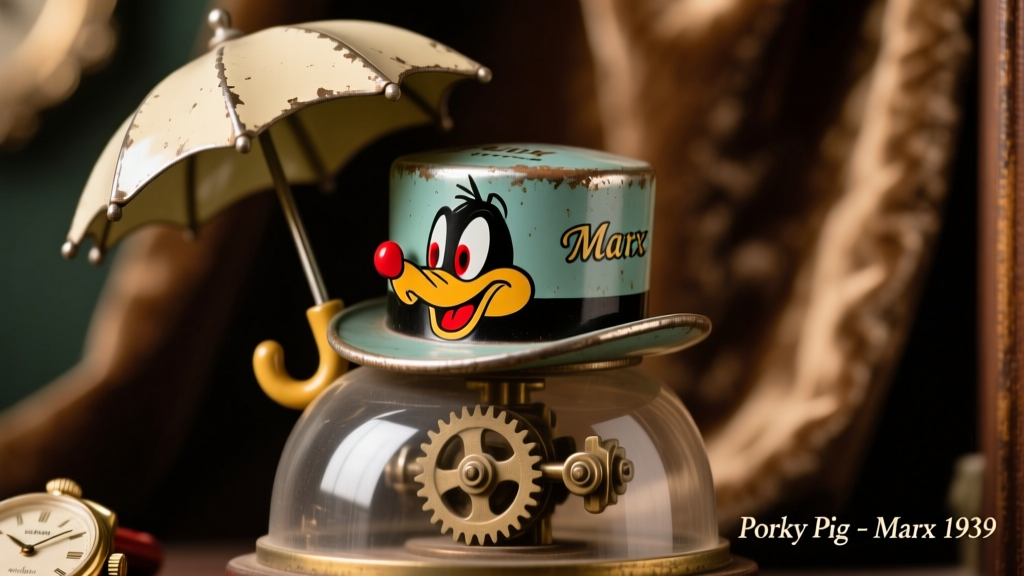
The 1939 Marx Toy Porky Pig Umbrella Hat: A Windup Tin Marvel from the Golden Age of Animated Character Toys
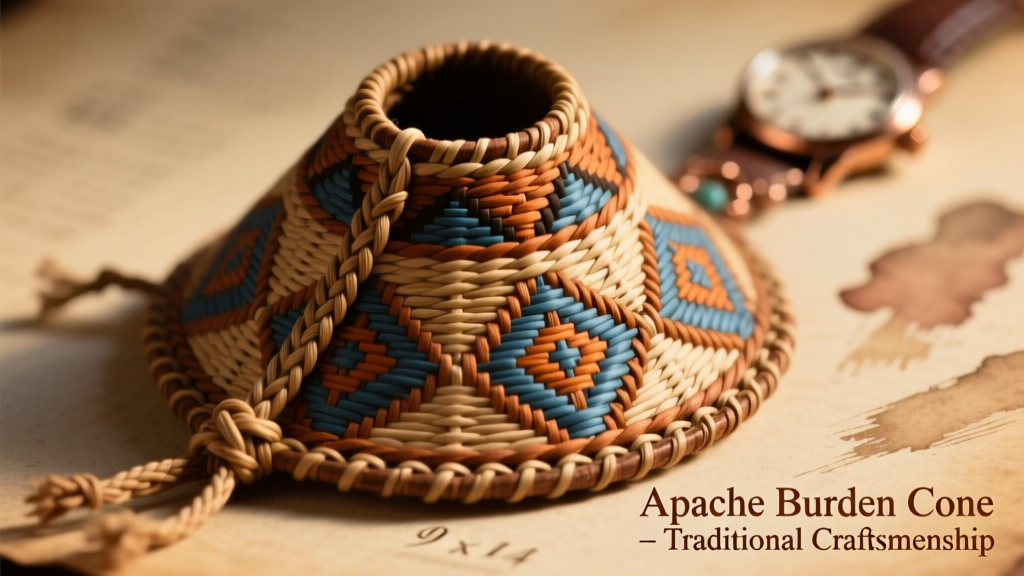
Apache Burden Basket: A Study of Form, Function, and Cultural Continuity in a 9 × 14-Inch Cone-Shaped Woven Artifact
The Cut-Glass Mustard Ladle of Charles II: A Sterling Silver and Strawberry Diamond Crosshatched Masterpiece
Seth Thomas Mantel Clock: Mahogany Veneer, Brass Movement, Bird Transfer Dial, Key-Wound — A 16-Inch American Classic

Nautical Lantern: Starboard Blue-Green Lens in Solid Copper — A 23-Inch Maritime Artifact with Provenance and Technical Significance
Lot 1140249: A 1958 Rolex Oyster Perpetual Reference 6426 — Technical Anatomy, Provenance, and Market Significance
Wedgwood Christmas Plate 1982: An 8½-Inch Collector’s Artifact from the Golden Era of British Holiday Ceramics
Doll Fulper Ceramic Head with Real Hair: Authentication, Provenance, and Market Value of the Signed 18-Inch Example
The English Furniture Bench: Double-Seating, Pegged Construction, and the Enduring Legacy of the 27-Inch Seat