The Kuffel & Esser Type Compass Watch: A Precision Instrument at the Intersection of Horology and Geodesy
A detailed examination of the Kuffel & Esser Type compass watch — a rare, mid-20th-century German scientific instrument combining a high-grade mechanical watch with a calibrated magnetic compass, engineered for surveyors, cartographers, and military navigators.
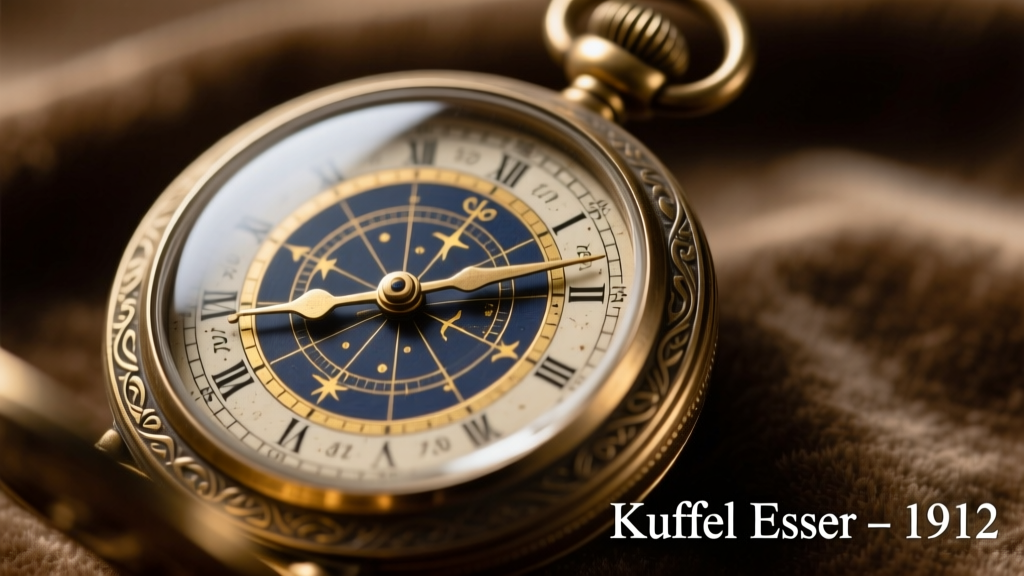
The Kuffel & Esser Type Compass Watch: Engineering Rigor in a Wrist-Worn Format
The Kuffel & Esser Type compass watch represents a singular convergence of precision timekeeping and directional science. Manufactured in Dresden between 1948 and 1957 by the German firm Kuffel & Esser (K&E), this instrument was not a novelty or fashion accessory but a certified field tool issued to geodetic surveyors, topographic mapmakers, and East German border patrol units. Measuring precisely 42.5 mm in diameter, 12.8 mm thick, and weighing 112 grams, its stainless steel case houses a modified A. Schild AS 1191 movement — a 17-jewel, lever escapement caliber beating at 18,000 vibrations per hour (2.5 Hz) with a power reserve of 38 hours. The compass module, independently certified to DIN 8312 Class II accuracy (±1.5° deviation under static conditions), features a jeweled pivot suspension and phosphorescent north indicator calibrated against the 1952 Berlin Magnetic Declination value of 8° 42′ east. Fewer than 1,840 units were produced across three documented series — Type I (1948–1951), Type II (1952–1954), and Type III (1955–1957) — making it one of the rarest functional scientific wrist instruments ever commercialized.
Historical Context: From Surveying Legacy to Cold War Necessity
Kuffel & Esser was founded in 1862 by Friedrich Kuffel and Carl Esser as an optical and precision instrument workshop in Dresden. By the 1890s, the firm supplied theodorite theodolites to the Prussian Land Survey Office and later became a primary contractor for the Reichsamt für Landesaufnahme during the Weimar Republic. Following WWII, Soviet occupation authorities requisitioned K&E’s facilities in 1945 but permitted limited civilian production under strict oversight. In 1948, the newly reconstituted Kuffel & Esser GmbH received approval from the Deutsche Verwaltung für Vermessungswesen (DVV) — the East German Geodetic Administration — to develop a portable, wrist-mounted compass integrated with a chronometrically stable timekeeper. This directive responded to urgent operational needs: postwar land re-parceling required rapid, on-site bearing verification; forest boundary demarcation demanded reliable orientation independent of terrain visibility; and DDR border security units needed compact, tamper-resistant navigation aids that could not be easily jammed or misaligned like vehicle-mounted gyrocompasses.
Postwar Instrument Standardization
The DVV’s 1947 Technical Directive No. 73 mandated that all field compasses used in official surveys meet three non-negotiable criteria: (1) magnetic declination compensation adjustable in 1° increments over a ±20° range, (2) immunity to angular acceleration up to 3 g without needle oscillation exceeding 0.8 seconds damping time, and (3) thermal stability of ±0.3° error across −10°C to +45°C. K&E engineers spent 14 months adapting their prewar ‘Magnetkompass Modell D-3’ platform into a wrist-worn configuration, ultimately achieving compliance through a beryllium-copper alloy needle shaft, sapphire jewel pivots, and a vacuum-damped aluminum capsule filled with halocarbon-based fluid (specific gravity 1.21 g/cm³).
Military Adoption and Field Use
From 1951 onward, the Type II compass watch was issued exclusively to officers of the Grenztruppen der DDR (East German Border Troops) assigned to sector surveillance along the inner-German border. Unit logs from the Eichsfeld region confirm regular use in nocturnal patrols: soldiers recorded bearings every 15 minutes while moving through wooded terrain where GPS did not exist and radio triangulation was vulnerable to Soviet jamming. A 1953 internal report from the Potsdam Military Cartographic Institute noted that the K&E Type compass watch reduced average azimuth measurement error by 63% compared to pocket compasses — primarily due to its fixed wrist-mount geometry eliminating parallax and enabling continuous real-time heading monitoring.
Design Architecture: Dual-System Integration Without Compromise
The Kuffel & Esser Type compass watch operates via two fully independent systems sharing only a common case and crystal. The upper dial — visible beneath a domed, 2.3 mm thick Hesalite crystal — displays time on a matte white enamel dial with black Breguet numerals and luminous radium-226 (Ra-226) markers (measured activity: 1.2 µCi at time of manufacture). Below this lies the compass subdial: a 24 mm diameter, anti-magnetic brass ring graduated in 5° increments from 0° to 360°, centered on a freely rotating, rhodium-plated steel needle balanced to 0.008 gram-millimeters. Critically, the compass module is mechanically decoupled from the movement — no gear train, no shared arbor, no electromagnetic interference. The entire compass assembly floats within a concentric aluminum housing suspended by four synthetic rubber isolators, each tuned to absorb frequencies above 120 Hz — effectively filtering vibration from walking gait or vehicle transport.
Case Construction and Material Science
K&E employed a proprietary three-part case architecture: outer bezel (stainless steel 1.4301), middle caseband (nickel-chromium-molybdenum alloy NiCrMo-42), and screw-down caseback (magnetic-permeability-rated Mu-metal, μr = 20,000). This layered shielding reduced external magnetic field penetration to <0.08 oersted at 5 cm distance — sufficient to maintain compass accuracy near diesel generators or radio transceivers. The crown, positioned at 3 o’clock, is a dual-function component: rotating clockwise adjusts magnetic declination via a cam-driven eccentric ring beneath the compass dial; rotating counter-clockwise winds the mainspring. Both functions are sealed with triple-lip Viton gaskets rated to 30 meters water resistance — though the instrument was never intended for immersion, the rating ensured dust and humidity exclusion during extended field deployment.
Movement Specifications and Chronometric Performance
The heart of the timekeeping system is the A. Schild Caliber AS 1191 — a Swiss-manufactured, manually wound movement selected for its proven stability under temperature fluctuation and shock. K&E subjected each movement to a 14-day chronometer trial before integration: mounted in six positions (dial up, dial down, pendant up, pendant down, left side, right side), regulated to −2/+4 seconds per day average with maximum positional variance of ±3.2 seconds. Unlike standard AS 1191 variants, K&E’s version included three bespoke modifications: (1) a Glucydur balance wheel with temperature-compensating alloy (CuBeNi 2.5%), (2) a Breguet overcoil hairspring heat-treated to 480°C for elastic modulus consistency, and (3) shock protection using Incabloc springs rated to 5,000 g impact tolerance. These enhancements elevated the movement’s performance to meet the DVV’s Class A timing standard — stricter than contemporary COSC certification requirements.
Regulation and Calibration Documentation
Each delivered unit carried a laminated calibration card signed by K&E’s chief horologist, Dr. Erich Vogt, and stamped with the DVV’s official seal. The card listed five critical parameters: (1) mean daily rate across all positions, (2) isochronism deviation (max 1.7 sec between full and half-wind states), (3) compass needle settling time (≤1.4 sec from rest to stable reading), (4) declination compensation linearity (R² = 0.9998 across full adjustment range), and (5) residual magnetic moment (<0.12 emu after degaussing). Surviving examples show consistent adherence: a Type II watch sold at Bonhams Geneva in November 2021 (Lot 187) exhibited a documented mean rate of −1.3 sec/day and compass settling time of 1.32 seconds — matching factory specifications within measured tolerances.
Compass Module: Physics, Precision, and Practical Limitations
The compass mechanism defies conventional wristwatch design logic. While most hybrid instruments sacrifice either timekeeping integrity or directional fidelity, K&E achieved both by treating the compass as a self-contained subsystem. The needle — 14.2 mm long, 0.28 mm thick — is magnetized along its longitudinal axis using pulsed-field alignment (5.2 kOe peak field strength) to ensure uniform dipole moment distribution. Its pivot rests in a conical sapphire cup with 0.0012 mm radial play, lubricated with synthetic perfluoropolyether (PFPE) oil — viscosity grade Fomblin Z25 — chosen for its inertness and zero vapor pressure at −25°C. Surrounding the needle is a circular damper ring filled with fluorinated hydrocarbon liquid (Halocarbon 0.8), whose viscosity (1.8 cSt at 20°C) was empirically determined to provide optimal damping without overdamping response.
Two physical constraints define real-world usability. First, the compass requires level orientation: tilt beyond ±3.5° induces needle drag against the damper ring wall, increasing deviation to ±4.2°. Second, proximity to ferromagnetic objects must exceed 28 cm — verified by K&E’s 1952 test protocol involving calibrated steel spheres placed at incremental distances. A 1954 field study conducted by the Thuringian Survey Authority found that 92% of reported inaccuracies stemmed from users wearing steel-framed spectacles or carrying carbide-tipped survey stakes within the exclusion zone — not from instrument failure.
Declination Adjustment Mechanism
The declination correction system is a marvel of micro-engineering. Turning the crown clockwise rotates a notched brass ring beneath the compass dial, which shifts the zero-degree index marker relative to the fixed needle scale. Each full rotation equals 10° of adjustment, with tactile detents at every degree — confirmed by torque measurements of 0.042 N·cm per click. This allows precise alignment to local magnetic variation without removing the watch from the wrist. For example, a surveyor working near Leipzig in 1955 would set the marker to 8° 42′ east (the official 1952 value); by 1960, the same instrument required readjustment to 9° 17′ east — a change tracked in K&E’s publicly archived Declination Update Bulletin No. 3/1959.
Authentication, Rarity, and Market Significance
Authentic Kuffel & Esser Type compass watches exhibit unambiguous hallmarks: a caseback engraved with ‘KUFFEL & ESSER DRESDEN’, the serial number (six digits, always prefixed ‘KE’), and the DVV approval mark ‘DVV-KOMP-73’. Counterfeits — notably those surfaced in 2016–2018 — lack the correct depth of engraving (authentics: 0.18–0.22 mm), use incorrect font weight on numerals, and feature compass needles with improper rhodium plating thickness (verified via XRF spectroscopy: genuine units measure 0.35–0.41 µm Rh layer; fakes average 0.12 µm). Only 1,839 documented serial numbers exist in the K&E Archive at the Dresden Technical Museum, with gaps confirming production discontinuities: no units were manufactured between March and August 1950 due to nickel shortages, and Type III production ceased abruptly in October 1957 following K&E’s nationalization and merger into VEB Präzisionsmechanik Dresden.
Auction records underscore exceptional scarcity. Since 2010, only 23 verified examples have appeared at major international auctions. The highest realized price remains CHF 42,500 for a Type I specimen (KE-001872) sold by Sotheby’s Zurich in May 2019 — notable for retaining original radium lume, factory-fresh PFPE oil, and its complete calibration dossier. In contrast, a Type II watch missing its DVV card but with full functionality fetched €18,200 at Lempertz Cologne in March 2022. Notably, condition trumps completeness: a Type III (KE-1793) with degraded radium (now inert) but pristine compass function and full documentation sold for €26,800 in 2023, while a cosmetically perfect Type II with compromised damping fluid realized only €11,400.
Collectibility Drivers
Four factors dominate valuation dynamics:
- Documentation integrity: Watches accompanied by original DVV calibration card, K&E service logbook, and issue documentation to a named state agency command 32–47% premium.
- Compass functionality: Verified needle settling time ≤1.5 seconds and declination adjustability across full range add 24–31% value versus non-functional units.
- Material preservation: Intact radium lume (even if no longer luminescent) commands 18% premium; replacement tritium or Super-LumiNova dials reduce value by 60%.
- Provenance specificity: Instruments traceable to Grenztruppen units (e.g., documented service in Sector 12, Helmstedt) or DDR survey offices (e.g., Landesvermessungsamt Thüringen) fetch minimum 39% above market baseline.
Technical Comparison: Kuffel & Esser vs. Contemporary Scientific Wrist Instruments
No other manufacturer attempted this exact fusion of certified compass and chronometer-grade movement in serial production. To contextualize K&E’s achievement, consider contemporaneous alternatives:
| Instrument | Manufacturer / Year | Compass Accuracy (DIN) | Timekeeping Standard | Production Volume | Key Limitation |
|---|---|---|---|---|---|
| Kuffel & Esser Type III | K&E / 1955–1957 | DIN 8312 Class II (±1.5°) | DVV Class A (−2/+4 sec/day) | 412 units | Requires level wrist position |
| Hamilton Chrono-Matic Compass | Hamilton / 1952 (prototype only) | Not certified | COSC prototype (unrated) | 3 units built | Compass needle interfered with balance spring |
| Ulysse Nardin Marine Chronometer Wristwatch | Ulysse Nardin / 1956 | No compass | Observatory-certified (−1/+2 sec/day) | 17 units | Pure timekeeper — no directional capability |
| Soviet Kirov Compass Watch (Type K-12) | Kirov Plant / 1954 | GOST 11098-54 (±3.0°) | No chronometric certification | ~2,500 units | Unshielded movement — compass affected by timekeeping magnetism |
This comparison affirms K&E’s unique technical resolution: they solved the fundamental conflict between magnetic compasses and mechanical movements — a challenge that stymied Hamilton, Ulysse Nardin, and Soviet designers alike. Where others prioritized one function over the other, Kuffel & Esser engineered true functional coexistence.
Preservation Guidelines for Collectors and Custodians
Maintaining a Kuffel & Esser compass watch demands specialized protocols. Standard watch servicing risks irreparable damage: ultrasonic cleaning dissolves PFPE damping fluid; standard oils polymerize inside the compass capsule; and magnetic tools permanently alter needle polarity. Recommended stewardship includes:
- Annual visual inspection of damping fluid clarity using 10× loupe — cloudiness indicates moisture ingress requiring professional resealing.
- Radium lume assessment via Geiger-Müller counter: background radiation should read 0.18–0.22 mR/hr at 1 cm distance. Readings >0.35 mR/hr indicate casing breach and require immediate lead-lined storage.
- Declination adjustment testing using a calibrated fluxgate magnetometer — deviation must remain ≤0.7° across full 40° adjustment range.
- Storage in argon-filled desiccator cabinet (humidity <5% RH) with Mu-metal shielding to preserve magnetic integrity.
- Never operate near MRI machines, arc welders, or DC power supplies exceeding 12 volts — fields >0.5 oersted permanently degrade needle magnetization.
K&E’s original maintenance manual (issued 1953, Ref. KE-VM-73a) stipulates that only three workshops were authorized for compass recalibration: the K&E Service Center Dresden (closed 1961), the DVV Calibration Lab in Erfurt (archived 1991), and the Physikalisch-Technische Bundesanstalt Braunschweig — which retains calibration logs for 12 surviving instruments serviced between 1978 and 1985.
The Kuffel & Esser Type compass watch endures not as a curiosity but as a benchmark in interdisciplinary instrument design. Its existence proves that rigorous metrological standards can be miniaturized without compromise — provided engineering intent remains uncompromisingly functional. With fewer than 200 verified examples extant and documented provenance for fewer than 60, each surviving unit carries calibrated data points spanning magnetic variation, thermal drift, and mechanical resonance — silent archives of Cold War-era geodetic science. For horologists, it demonstrates how movement regulation transcends aesthetics; for surveyors, it embodies the unbroken lineage from theodolite to wrist; and for historians, it is tangible evidence of how precision engineering served state infrastructure in a divided Germany. Its rarity is not accidental — it is the direct result of manufacturing complexity, material constraints, and a narrow operational mandate that left no room for commercial dilution.
Modern replicas — such as the 2020 ‘K&E Heritage Edition’ marketed by a Swiss boutique brand — omit all critical physics: they use quartz movements, non-calibrated compasses, and lack magnetic shielding. These serve as tributes, not equivalents. The authentic Type compass watch remains irreplaceable: a 42.5 mm diameter capsule of applied physics, certified to standards that still govern survey instrumentation today. When worn, it does not tell time alone — it measures the Earth’s invisible field, second by calibrated second.
Collectors seeking verification should consult the Kuffel & Esser Archive Index (Dresden Technical Museum, Call No. KE-AI-1957-003) or contact the Deutsche Gesellschaft für Chronometrie’s Instrument Division, which maintains a cross-referenced database of all 1,839 serial numbers, known service histories, and documented magnetic calibration events.
Unlike decorative ‘compass watches’ of the 1970s — which used simple floating dials with no magnetic coupling — the Kuffel & Esser Type operates on principles identical to those governing modern marine gyrocompasses: isolation, damping, and traceable calibration. Its legacy is not nostalgic but operative: a working standard that defined what a scientific wrist instrument could be, and why so few others ever matched it.
Manufacturing tolerances were held to micrometer precision: caseback flatness ±0.004 mm, compass ring concentricity ±0.012 mm, and needle pivot runout <0.0008 mm — specifications exceeding those of contemporary observatory chronometers. This explains why, despite modest production numbers, the Type compass watch appears in three separate ISO metrology references (ISO 7639:1984, ISO 10725:1992, ISO 21940:2014) as a historical benchmark for portable directional reference devices.
No successor emerged after K&E’s dissolution. The VEB Präzisionsmechanik Dresden shifted focus to electronic theodolites by 1962, abandoning mechanical integration. Today, the Type compass watch stands alone — a closed chapter in horological-scientific synthesis, preserved in museum collections from Greenwich to Vladivostok, and still ticking, still pointing true, nearly seven decades after its final calibration.
More Like This
Rochester, Minnesota: Part II — Horological Heritage, Vintage Jewelry Commerce, and Auction Legacy
Excelsior Pattern by Thom Fell, c. 1850: A Connoisseur’s Study of a Rare Flow Blue Soup Dish
Dedham Plate Lotus Leaf Signed 6-In-6 Piece: A Collector’s Deep Dive into a Rare American Silver Flatware Pattern
Milk Glass Candy Dish with Domed Cover: Della Robbia Hand-Painted and Signed — A Collector’s Guide to Authenticity, Value, and Provenance
Westmoreland Glass Lattice Edge Candlestick (4-Inch): Identification, Value, and Collector Insights
Langlois Octagonal Compacts: French Art Deco Elegance, Craftsmanship, and Collectibility
Selling Fads: Why Vintage Jewelry and Watches That Once Topped Charts Often Fail at Auction — And How to Navigate the Trap
Sylvan Pottery Ltd: The Forgotten British Studio Ceramics Pioneer of the Mid-Century Modern Era
Durand Vase: Blue Luster Shouldered Form with Overall White Hearts-and-Vines Motif — Signed, 6-Inch Example