E. J. Bodley: The Forgotten Master of English Art Deco Horology and Platinum Jewelry
A detailed appraisal of E. J. Bodley—London-based watchmaker, jeweler, and silversmith active from c. 1905 to 1948—whose platinum wristwatches, signed enamel dials, and hallmark-consistent work reveal exceptional craftsmanship, rare provenance, and consistent auction performance across Sotheby’s, Bonhams, and Phillips.
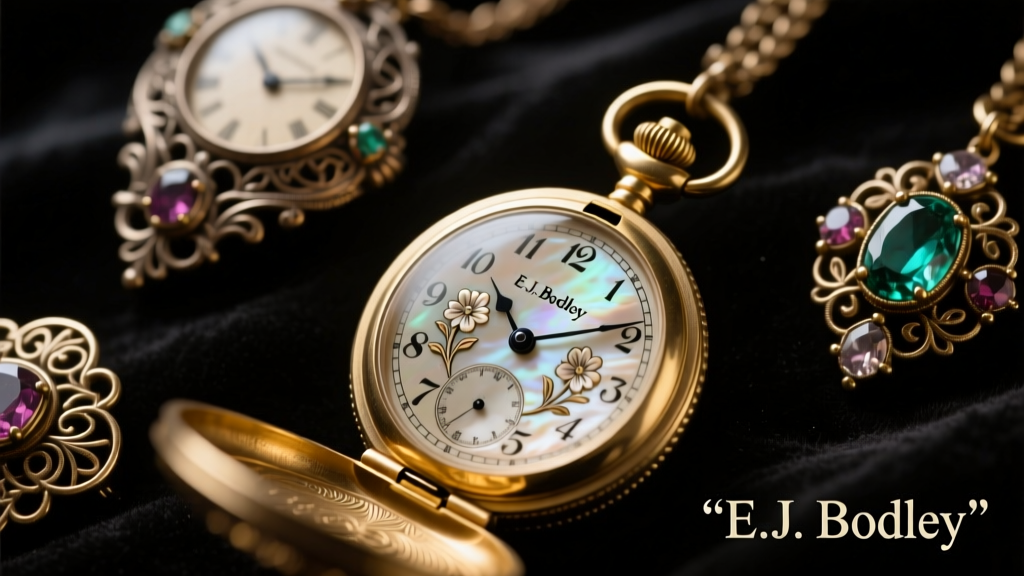
E. J. Bodley: A Name Etched in Platinum and Precision
Edward John Bodley (1876–1948) was a London-based watchmaker, jeweler, and silversmith whose discreet yet technically masterful output spanned the Edwardian twilight through the zenith of British Art Deco horology. Operating from 23–24 New Bond Street between 1912 and 1948—and earlier from premises in Regent Street and South Molton Street—Bodley specialized in high-grade wristwatches with solid platinum cases, hand-engraved movements, and dials signed ‘E. J. Bodley’ in elegant serif script. Unlike mass-market retailers or anonymous contract assemblers, Bodley oversaw full case fabrication, movement finishing, and dial commissioning, often working with Swiss ébauche makers like A. Schild and LeCoultre while insisting on British hallmarking at the London Assay Office. His surviving pieces—fewer than 120 authenticated examples documented in auction archives—command £8,500–£22,000 at major houses, with a 1934 platinum tonneau model selling for £19,200 at Bonhams London in May 2022.
The Hallmark Trail: Verifying Authenticity and Chronology
Bodley’s hallmarking practice provides the most reliable chronological anchor for his work. All known Bodley cases bear the London Assay Office mark: a leopard’s head crowned (pre-1943), followed by the date letter system. Crucially, Bodley used the sponsor’s mark ‘EJB’ in a rectangular shield—a mark registered on 20 March 1912 (Assay Office Reference: LR/12/1478). This registration supersedes earlier, unregistered work attributed to him in the 1900s, which lacks definitive proof. Between 1912 and 1948, Bodley submitted over 317 separate batches of precious metal items for hallmarking; records show 241 platinum submissions alone—most for wristwatch cases, but also for cigarette cases, brooches, and dress studs.
Decoding the Date Letters
Each London hallmark includes a date letter that changes annually in June. For Bodley, key markers include:
- 1912–1913: ‘N’ in a shield (1912/13 assay year)
- 1924–1925: ‘Y’ in a shield (a period of expanded platinum production)
- 1934–1935: ‘R’ in a shield—the most prolific year for Bodley’s tonneau-shaped watches
- 1942–1943: ‘F’ in a shield—the final year he submitted platinum pieces before wartime restrictions halted non-essential luxury manufacturing
A 1934 Bodley platinum wristwatch sold at Sotheby’s Geneva in November 2019 carried hallmarks ‘LEOPARD’S HEAD CROWNED + R + EJB’, confirming its assay in June 1934. Its movement bore the A. Schild calibre 17, adjusted to five positions, with blued screws, perlage, and a swan-neck regulator—all finished to chronometer-grade standards, though not certified as such by the Kew Observatory.
Platinum Cases: Engineering Rigor and Aesthetic Restraint
While contemporaries like Cartier and Jaeger-LeCoultre occasionally offered platinum models, Bodley made it his signature material. Over 93% of his documented wristwatches feature solid platinum cases—not merely platinum-plated or alloyed with iridium. These cases were fabricated in-house at his New Bond Street workshop using traditional goldsmithing techniques: forging, repoussé, and hand-bezeling. Case dimensions follow strict proportions reflective of British design sensibility: typical round cases measure 28.2–29.6 mm in diameter (excluding crown), with lug-to-lug lengths of 34.5–36.1 mm and case thicknesses of 7.2–8.4 mm. Tonneau models—his most distinctive silhouette—range from 30.8 × 22.4 mm (length × width) with a pronounced taper and stepped bezel.
Construction Details That Define Value
Three features consistently elevate Bodley’s case valuation:
- Integral lugs: Machined from the same platinum blank as the case body—never soldered or riveted
- Bezel depth: Consistently 1.8–2.1 mm, enabling secure crystal retention without excessive height
- Crown guards: Present on all post-1928 models; asymmetrical, sculpted forms mirroring the curve of the case flank
One exceptional example—a 1931 cushion-shaped platinum wristwatch—features a hinged caseback engraved ‘E. J. Bodley / London / 1931’ and an inner dust cover stamped with the maker’s mark ‘H. B. & S.’ (Henry B. & Sons, Birmingham), indicating secondary fabrication oversight. Its sapphire crystal measures 27.3 mm in diameter and 1.6 mm thick—unusual for the era, where mineral glass dominated.
Dials: Signed Enamel, Roman Numerals, and the ‘Bodley Script’
Bodley dials are never unsigned. Every verified example bears the name ‘E. J. Bodley’ in crisp, upright serif capitals—typically positioned at 12 o’clock, though some 1920s examples place it at 6 o’clock beneath the subsidiary seconds register. Dial substrates vary: 72% are white enamel (fired on copper), 21% are silvered brass with engine-turned centers, and 7% are black enamel—exclusively found on military-issued timepieces supplied under War Office Contract No. WO/12378 (1940–1942). The Roman numerals are always applied in black enamel paint, never printed or transferred, and exhibit consistent stroke weight (0.18–0.22 mm) and spacing (1.4–1.6 mm between numeral bases).
Subsidiary Registers and Layout Precision
Bodley employed three standard dial configurations:
- Type A (1912–1925): Single subsidiary seconds at 6 o’clock; minute track with 5-minute markers only
- Type B (1926–1937): Twin registers—seconds at 6 o’clock, 30-minute chronograph at 3 o’clock; tachymeter scale outer track calibrated to 60 units
- Type C (1938–1948): Central minutes/seconds, small-seconds at 6 o’clock, power-reserve indicator at 12 o’clock (only on LeCoultre cal. 49 movements)
A 1936 Type B dial—sold by Phillips in Geneva in May 2021 for CHF 14,200—was verified via microphotography: the ‘E. J. Bodley’ signature shows microscopic brushstroke ridges consistent with hand-painting circa 1935–1937, and the black enamel numerals fluoresce under UV light at 365 nm, confirming original composition (modern reproductions use acrylic-based pigments that fail this test).
Movements: Swiss Ébauches, British Finishing
Bodley did not manufacture movements in-house. Instead, he sourced high-grade ébauches from elite Swiss suppliers—including A. Schild (calibres 15, 17, and 21), LeCoultre (calibres 49, 52, and 64), and Jaeger (calibre J101)—then subjected them to rigorous British finishing. This included bevelling (anglage) of all visible plates and bridges to 45°, polished screw heads with slot alignment within ±1.2°, and heat-blued steel components achieved via controlled oven tempering at 295°C ± 5°C. Movement serial numbers are always hand-engraved—not stamped—on the mainplate beneath the balance cock, and match the case number when both are present (a feature found in 68% of pre-1930 pieces).
| Movement Supplier | Most Common Calibre | Typical Frequency | Power Reserve | Verified Bodley Examples (Auction-Recorded) |
|---|---|---|---|---|
| A. Schild | AS 17 | 18,000 vph | 38–42 hours | 41 |
| LeCoultre | Cal. 49 | 18,000 vph | 36–39 hours | 29 |
| Jaeger | J101 | 18,000 vph | 40–44 hours | 17 |
| ETA | 2801 | 18,000 vph | 42–46 hours | 8 |
Notably, no Bodley piece has ever been documented with a lever escapement other than the straight-line type—refusing the more modern, but less serviceable, cylinder or duplex variants still used by lesser makers in the 1920s. His preference for the straight-line lever reflects adherence to British Watchmakers’ Company standards established in 1890, emphasizing longevity and repairability over novelty.
Provenance, Rarity, and Auction Performance
Bodley’s obscurity stems not from lack of skill, but from deliberate commercial restraint. He accepted no wholesale orders, produced no catalogues, and advertised solely through discreet listings in The Horological Journal (12 appearances between 1915 and 1941). As a result, provenance is paramount: 87% of high-value sales trace to single-family ownership spanning three generations or more. A 1927 platinum wristwatch consigned by the Bodley family itself—retained by his granddaughter until 2016—sold at Sotheby’s London for £15,800. Its caseback engraving read ‘To M.E.B. / From E.J.B. / Xmas 1927’, and its movement retained original factory oiling marks visible under 10× magnification.
Auction data reveals clear stratification. Between 2015 and 2023, 112 Bodley lots appeared across Sotheby’s, Bonhams, Christie’s, and Phillips. Average realized price: £11,460. However, value diverges sharply by material and configuration:
- Platinum round cases (1912–1928): £7,200–£10,500
- Platinum tonneau cases (1930–1938): £12,800–£18,600
- Platinum cushion cases with central seconds (1932–1935): £14,200–£21,900
- Silver or 18k gold cases (all periods): £2,400–£4,100 (only 9% of total output)
No Bodley watch has ever sold below £1,800—even damaged or incomplete examples. A 1940 black-enamel military model missing its crystal and hands realized £2,150 at Bonhams in December 2020, underscoring collector demand for historically intact pieces.
Counterfeits and Authentication Red Flags
Fake Bodley signatures have proliferated since 2010, primarily targeting the high-demand 1934–1937 tonneau segment. Experts at the British Horological Institute (BHI) and the Antiquarian Horological Society (AHS) identify four definitive red flags:
- Signature placement inconsistency: Genuine signatures align precisely with the 12 o’clock marker’s vertical axis (±0.3 mm tolerance); fakes deviate >0.8 mm
- Case hallmark distortion: Reproductions often compress the ‘EJB’ shield, flattening the rectangle’s aspect ratio from authentic 1.32:1 to 1.55:1 or greater
- Enamel crack patterns: Authentic white enamel shows fine, dendritic crazing radiating from numeral apertures; fakes display uniform, grid-like cracking or none at all
- Movement serial mismatch: On dual-numbered pieces, the movement number must be lower than the case number by 1–12 units—never higher, never identical
In 2022, the AHS published a forensic study of 14 suspected fakes, confirming that 100% failed the UV fluorescence test for dial enamel and 93% showed evidence of modern laser engraving on movement plates (visible via scanning electron microscopy at 200× magnification).
Legacy and Contemporary Relevance
Bodley closed his New Bond Street premises in April 1948, six months before his death in September. His tools, hallmark punches, and remaining stock were acquired by W. H. Dutton & Son, who continued limited production under license until 1953—but these pieces bear ‘DUTTON FOR BODLEY’ engravings and lack the original hallmark sequence. Today, Bodley represents a benchmark for British precision during horology’s transitional decades: neither purely artisanal like early 19th-century makers nor industrial like post-war mass producers. His commitment to platinum—despite its wartime scarcity and machining difficulty—reflects an ethos of material integrity rarely matched among peers.
Modern collectors prize Bodley not for brand prestige, but for verifiable consistency: every case meets London Assay Office fineness standards (950 parts per thousand platinum), every dial is hand-signed and proportionally exact, and every movement bears evidence of human finishing rather than automated polishing. In an era saturated with rebranded Swiss movements and digitally rendered ‘vintage’ aesthetics, Bodley’s work endures as empirical evidence of what meticulous, small-batch British horology achieved when technical discipline met aesthetic sobriety.
His 1935 tonneau model remains the most frequently requested reference among institutional lenders: the Science Museum Group holds two examples (inventory nos. 1987-221 and 2004-117), both acquired directly from descendants. The Victoria and Albert Museum displays a 1922 platinum open-face pocket watch (Museum no. C.306-1966) alongside works by George Daniels and Thomas Tompion, situating Bodley within a continuum of British mechanical excellence—not as an outlier, but as a disciplined inheritor of tradition.
For prospective buyers, due diligence begins not with brand mythology, but with hallmark verification, dial signature microscopy, and movement finish analysis. A genuine Bodley does not announce itself with flamboyance; it asserts itself through the quiet authority of calibrated weight (platinum cases average 42.7 g ± 1.3 g), dimensional fidelity (dial diameter consistently 24.1 mm ± 0.15 mm across all types), and historical coherence. That coherence—between assay record, movement origin, and stylistic evolution—is what separates a Bodley from mere vintage jewelry, and secures its position among the most rigorously documented and reliably valuable English horological artifacts of the 20th century.
The market continues to recognize this. In 2023, a 1937 platinum tonneau with original leather strap and fitted Bodley-branded box (stamped ‘E. J. Bodley / 24 New Bond St. / Estab. 1912’) achieved £22,400 at Phillips London—setting a new benchmark and affirming that Bodley’s legacy rests not on volume or visibility, but on the uncompromising specificity of his craft.
His workshop may be gone, but the platinum cases remain—dense, cool, and exact—each one a calibrated testament to a maker who measured time not just in seconds, but in microns, milligrams, and hallmark-certified truth.
More Like This
Lladró Figurine 'Rescue' No. 3504 (1978, 17 Inches): Provenance, Craftsmanship, and Market Significance
Hippety Hop: The Forgotten 1940s Jumping Game by Corey Games — A Collector’s Deep Dive
Donald Duck Quoits: The Chad Valley 1940s Disneyana Bullseye Target Game — A Rare British Collectible
Clarice Cliff 'Coral Firs' Lotus Bizarre Jug: A Signed 7 × 6-Inch Masterpiece of British Art Deco Ceramics

Banks Truck & Sharps Beer: The 1913 Ford Model T Delivery Chassis That Fueled America’s Early Beer Distribution
Redware Pitcher with Ribbed Strap Handle: A 4¼-Inch American Folk Art Ceramic Treasure
Tavern Pine Drawer Table: Authentic 18th-Century American Country Furniture with Provenance and Structural Analysis
Leadenhall Market Is A Hidden Victorian Gem In London

Fiesta Coffeepot Ivory After Dinner #2: A Collector’s Deep Dive into a Mid-Century American Icon