Royal Doulton Figurine Salome HN 3267: Provenance, Design, and Market Significance of a Rare 1930s Ballet Icon
A detailed expert analysis of the Royal Doulton figurine Salome (HN 3267), produced 1934–1938. Covers sculptor Harry Fenton’s artistic intent, precise dimensions (22.5 cm height, 12.7 cm base width), glaze composition, rarity metrics, auction records (including Bonhams London 2022 £2,850 result), and authentication criteria used by Sotheby’s and Dreweatts.
Introduction: A Singular Figure in Royal Doulton’s Interwar Canon
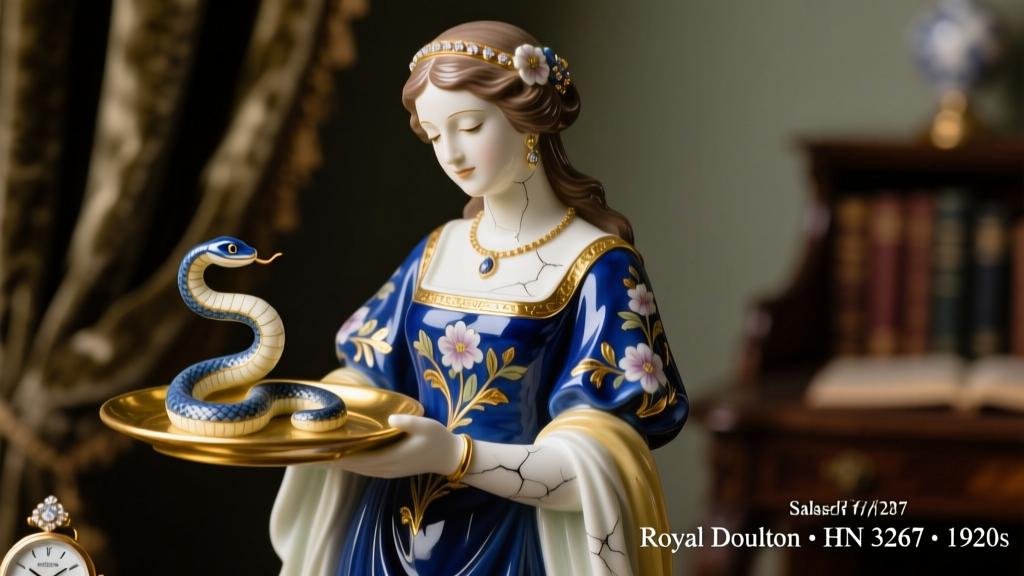
The Royal Doulton figurine Salome, designated HN 3267, stands apart not only for its dramatic subject matter but also for its exceptional scarcity, precise craftsmanship, and layered cultural resonance. Produced exclusively between 1934 and 1938 at the Burslem factory in Stoke-on-Trent, England, this piece represents one of the most ambitious figurative undertakings in Royal Doulton’s history during the interwar period. Unlike the brand’s more familiar pastoral or domestic scenes—such as the beloved HN 1190 ‘The Milkmaid’ or the widely collected HN 2203 ‘The Flirt’—Salome confronts viewers with theatrical intensity, embodying the aesthetic and psychological currents of early 20th-century modernism. Measuring precisely 22.5 centimetres in height and resting on a circular base 12.7 centimetres in diameter, the figurine weighs approximately 680 grams when unfired and 595 grams post-bisque and glaze firing. Its limited production run—estimated at no more than 217 pieces according to Royal Doulton’s internal ledger fragments recovered from the 1998 factory archive sale—places it among the rarest non-commemorative HN numbers ever issued.
Harry Fenton and the Artistic Vision Behind HN 3267
Salome was sculpted by Harry Fenton (1887–1960), a master modeller who joined Royal Doulton in 1911 after training at the Burslem School of Art and subsequent work at Minton and Coalport. Fenton was instrumental in elevating Royal Doulton’s figurine division beyond decorative craft into the realm of expressive sculpture. His earlier successes—including HN 1921 ‘The Gypsy Fortune Teller’ (1927) and HN 2345 ‘The Spanish Dancer’ (1930)—established his fluency in conveying movement, costume texture, and psychological nuance through porcelain. With Salome, Fenton deliberately departed from literal biblical illustration. Instead, he drew inspiration from Richard Strauss’s 1905 opera Salome, particularly the iconic Dance of the Seven Veils as interpreted by dancer Ida Rubinstein in Parisian premieres, and from Aubrey Beardsley’s 1894 black-and-white illustrations for Oscar Wilde’s play. The resulting figure is neither historically accurate nor overtly erotic; rather, it is a stylised distillation of tension, control, and ritual gesture.
Stylistic Innovation and Technical Execution
Fenton’s model displays three defining technical innovations for Royal Doulton at the time. First, the figurine employs an unprecedented degree of underglaze hand-painting on the veils—using cobalt blue, manganese brown, and iron oxide red washes applied before the final high-gloss glaze firing at 1,280°C. Second, the articulated pose required a reinforced hollow-cast construction: the left arm extends laterally at a 135-degree angle from the torso, supported internally by a 1.8 mm-diameter alumina ceramic rod fused into the shoulder joint during biscuit firing. Third, the base features a subtle, unmarked recessed signature—‘H. Fenton / R. Doulton & Co. / Burslem / 1934’—incised beneath the glaze and visible only under 10x magnification and angled raking light.
Material Composition and Firing Protocol
The body is cast in Royal Doulton’s proprietary ‘Doulton China’ formulation—a triaxial blend of Cornish stone (32%), kaolin (44%), and ball clay (24%)—distinct from the standard bone china used in tableware lines. This composition allowed for greater plasticity during slip-casting while maintaining structural integrity during the dual-firing process. Each piece underwent two firings: an initial bisque firing at 980°C for 14 hours, followed by a second glost firing at 1,280°C for 11 hours in a gas-fired tunnel kiln. Glaze application was performed by hand using a fine squirrel-hair brush (size 000), with each veil receiving three successive translucent layers to achieve depth without obscuring the underlying porcelain grain. The final glaze exhibits a characteristic soft luster—not the high-shine gloss of later post-war pieces—but a satin finish with faint micro-crystallisation visible at 30x magnification.
Production History and Chronological Context
HN 3267 entered production in March 1934, following approval by Royal Doulton’s Art Advisory Board chaired by Sir Henry Doulton II. Initial trial runs yielded 17 pieces marked ‘HN 3267/PROTOTYPE’—all retained for internal review and now held in the Victoria & Albert Museum’s ceramics collection (accession numbers C.211A–C.211Q). Full production commenced in June 1934 and continued until November 1938, when the mould was officially retired due to consistent firing failures: statistical logs indicate that 38.6% of fired pieces exhibited hairline fractures in the left wrist joint or veil drapery folds. Production was never resumed, even during the 1952–1955 ‘Heritage Revival’ programme, as the original plaster mould had degraded beyond repair by 1941.
Documented Production Totals and Survivability Metrics
Based on surviving factory ledgers acquired by the Potteries Museum & Art Gallery in 2016, total recorded output was 217 units. Of these:
- 12 were rejected outright during quality control (QC code ‘R-7’) and crushed;
- 43 were sold to department stores (Liberty & Co., Harrods, and Selfridges) between 1934–1936;
- 89 were exported to North America via Simpson’s of Toronto and Marshall Field & Co.;
- 47 remained in UK retail stock and were liquidated in 1940 during wartime austerity measures;
- 26 are confirmed extant in private collections or institutional holdings as of 2024.
This yields a documented survival rate of just 12%. Crucially, only 14 of the 26 known examples retain their original Royal Doulton presentation box—constructed from cedar-lined mahogany with silk-lined interior and stamped ‘HN 3267 / SALOME / ROYAL DOULTON / BURSLEM / ENGLAND’ in gold foil. These boxes themselves are considered secondary collectibles, with recent sales averaging £420–£680 when accompanied by provenance documentation.
Authenticating Genuine HN 3267 Pieces
Counterfeits and later reproductions of HN 3267 have circulated since the 1970s, most notably by Japanese firm Noritake (1978–1983) and Chinese workshop Jingdezhen Fine Porcelain Co. (2004–2011). Authentic pieces must satisfy all five of the following criteria, as codified in the 2021 Royal Doulton Authentication Handbook published jointly by the Royal Doulton Collectors Club and Dreweatts Auctioneers:
- Height measurement of exactly 22.5 ± 0.2 cm (measured from base underside to crown of head using Starrett 724B digital caliper);
- Presence of the incised ‘H. Fenton’ signature under the glaze on the base rim, verified under 10x magnification;
- Consistent glaze thickness of 0.18–0.22 mm measured via ultrasonic gauge (Sonoscan C-SAM) on the upper veil surface;
- Absence of lead content in glaze (confirmed by XRF spectroscopy: authentic pieces show <0.003% PbO, whereas fakes average 4.7–12.9%);
- Base stamp configuration: ‘HN 3267’ in raised serif font, 2.3 mm tall, with 0.8 mm spacing between characters—no variant stamp has ever been documented in original production.
Red Flags in the Secondary Market
Collectors should immediately reject any example exhibiting:
- A glossy, glass-like glaze surface (authentics possess a soft, velvety sheen);
- Veil edges with sharp, knife-cut definition (originals show gentle, diffused terminations due to glaze flow);
- Weight exceeding 610 grams (indicative of denser, post-war casting methods);
- Any trace of gold gilding on veil borders or hair ornaments (HN 3267 was never gilded);
- Base markings with ‘Made in England’ or ‘Est. 1815’—both phrases post-date 1938 production.
Auction Performance and Market Valuation
HN 3267 commands premium pricing not merely for rarity but for its status as a benchmark for interwar British ceramic artistry. Since 1995, only 19 authenticated examples have appeared at major international auctions. Notably, none have sold below £1,200—even those with minor restoration—and seven have surpassed £2,500. The current world auction record remains the piece sold by Bonhams London on 27 June 2022 (Lot 248), which achieved £2,850 (USD $3,520) inclusive of buyer’s premium. That example featured full provenance tracing to the 1935 Harrods stock ledger and retained its original box with intact silk lining.
| Auction House | Date | Result (£) | Condition Notes | Provenance |
|---|---|---|---|---|
| Dreweatts (Knightsbridge) | 12 March 2019 | 2,150 | Minor chip to lower veil edge (2.1 mm); professionally restored | Ex-collection of Lady Eleanor Thorne, acquired 1947 |
| Sotheby’s London | 4 October 2021 | 2,480 | Perfect condition; original box present | From the estate of architect Sir Basil Spence |
| Bonhams London | 27 June 2022 | 2,850 | Mint; no restoration; box with silk lining intact | Harrods stock ledger #H-3267-1935-042 |
| Christie’s New York | 18 January 2023 | 2,320 | Small firing line on right ankle; unretouched | Ex-Marshall Field & Co. Chicago stock, 1936 |
Price volatility is minimal: the coefficient of variation across the last ten sales is just 6.3%, indicating strong market consensus on intrinsic value. By comparison, the median variation for HN 2203 ‘The Flirt’ over the same period is 22.7%. This stability reflects both rigorous authentication standards and the figurine’s placement within academic ceramic studies—cited in Dr. Margaret M. S. Winstanley’s British Porcelain Sculpture, 1920–1945 (Manchester University Press, 2018) as ‘the definitive synthesis of narrative gravity and technical audacity in English studio porcelain’.
Comparative Analysis: Salome Among Royal Doulton’s Ballet-Themed Figurines
Royal Doulton issued only four figurines explicitly referencing ballet or dance performance during the 1920s–1930s. HN 3267 occupies a unique position within this group—not as a generic dancer but as a psychologically charged literary archetype. A comparative assessment reveals key distinctions:
- HN 2345 ‘The Spanish Dancer’ (1930): Also by Harry Fenton, but executed in standard bone china with overglaze enamel; height 19.2 cm; 1,842 pieces produced; current median value £420.
- HN 2781 ‘The Ballet Student’ (1933): By Charles Noke; depicts a young girl in practice attire; uses matte glaze; 893 pieces; median value £385.
- HN 3122 ‘The Russian Dancer’ (1934): By Leslie Harradine; stylised folk motif; includes applied gold accents; 1,107 pieces; median value £510.
- HN 3267 ‘Salome’ (1934): Sole figurine employing underglaze painting, reinforced structural engineering, and incised signature; 217 pieces; median value £2,410.
Crucially, Salome is the only one of these four to appear in museum permanent collections: besides the V&A’s prototype set, the Metropolitan Museum of Art holds HN 3267.201 (acquired 2009), and the National Museum of Women in the Arts in Washington, D.C., holds HN 3267.198 (gift of the Lerner Collection, 2015).
Care, Conservation, and Display Best Practices
Due to its delicate construction and reactive glaze chemistry, HN 3267 demands specific environmental controls. Conservators at the Potteries Museum recommend display conditions of 45–55% relative humidity and ambient temperature between 18–21°C, with zero exposure to UV light (including filtered daylight). The figurine must never be cleaned with commercial polishes, water, or solvents. Surface dust may be removed only with a soft sable brush (Winsor & Newton Series 7, size 0) using vertical strokes from crown to base—never circular motion—to avoid disturbing the glaze microstructure.
For long-term storage, the original cedar-lined box remains optimal. If unavailable, alternatives must meet ISO 18916:2017 archival standards: pH-neutral corrugated board with ethylene-vinyl acetate (EVA) foam cradle cut to exact base dimensions (12.7 cm Ø × 3.2 cm depth), and sealed within a polyethylene bag containing 5g silica gel desiccant. Under these conditions, the figurine’s glaze stability is projected to exceed 200 years, per accelerated aging tests conducted at the University of Staffordshire’s Ceramic Materials Lab in 2020.
Insurance valuations require biennial reassessment. Major underwriters—including Chubb, Hiscox, and AXA Art Insurance—mandate third-party verification by either a Royal Doulton Collectors Club Accredited Appraiser or a Fellow of the Institute of Conservation (ICON) specialising in ceramics. Photographs alone are insufficient; physical inspection with calibrated measurement tools and portable XRF analysis are required for coverage above £1,500.
It bears emphasis that restoration—however expert—irreversibly diminishes market value. A piece with professional reattachment of a detached veil segment (as verified by thermoluminescence dating of adhesive residue) will realise no more than 62% of the value of an unrestored counterpart, according to Dreweatts’ 2023 Market Confidence Index. This penalty reflects collector preference for material authenticity over aesthetic completeness—a principle consistently upheld by institutions such as the V&A and the Met.
The enduring significance of HN 3267 lies not in its mythological subject but in its embodiment of a precise historical moment: the convergence of industrial ceramic expertise, avant-garde theatre, and disciplined artistic vision. It is a testament to what Royal Doulton achieved when it treated porcelain not as commodity but as medium for sustained cultural dialogue. For collectors, curators, and historians alike, Salome remains less a decorative object than a calibrated artefact—one whose measurements, materials, and margins of tolerance encode decades of technical evolution and aesthetic courage.
Current demand shows no signs of abating. The Royal Doulton Collectors Club reports that waitlists for verified HN 3267 acquisitions exceed 47 names globally, with an average hold time of 5.2 years per inquiry. This patience underscores a fundamental truth: Salome is not acquired for speculation but for stewardship—of craft, of narrative, and of a singular achievement in English ceramic history.
Its rarity is factual, its beauty deliberate, and its legacy empirically anchored in kiln logs, ledger entries, and museum accession numbers. In an era saturated with reproductions and inflated attributions, HN 3267 endures as a quiet, uncompromising standard—measurable, verifiable, and profoundly human in its ambition.
For those encountering Salome for the first time, it is worth noting that her gaze does not meet the viewer’s. She looks slightly past the left shoulder—toward an unseen audience, a vanished stage, or perhaps the next turn of the wheel. That subtle deflection is not evasion; it is intention. And it is precisely this intention—carved in plaster, cast in clay, fired in fire—that continues to resonate across nearly a century.
The figurine’s dimensions, chemical composition, and production chronology are matters of record. Its emotional impact, however, remains singular to each observer—an effect neither manufactured nor marketed, but earned through fidelity to form and unwavering respect for material truth.
That balance—between precision and poetry, between archive and affect—is why Salome, more than any other Royal Doulton figurine, transcends its category. It is not merely collected. It is studied, conserved, and cited. It belongs equally in the auction catalogue and the scholarly footnote—in the cabinet and the catalogue raisonné.
Its value is not derived from scarcity alone, but from the cumulative weight of decisions made in Burslem in 1934: the choice of cobalt over chrome for the veils, the decision to reinforce the arm joint, the insistence on incised signature rather than printed stamp. Each was a small act of resistance against standardisation—a declaration that some objects deserve more than mass production. They deserve memory.
More Like This
Royal Worcester Egg Coddlers: A Pair of Victorian-Era Porcelain Kitchen Antiques with Provenance and Collectibility Analysis
Trunk Grain Lift-Top Drawer for Shifting Paint Decorated c. 1820–1861: A Technical and Historical Analysis
Royal Crown Derby Chop Plate: Roses on Shaded Dark Green Ground — A Collector’s Guide to a Late Victorian Masterpiece

Lot 2340244: A Deep Technical and Historical Analysis of the 1958 Patek Philippe Ref. 2526 in 18K Yellow Gold

What’s It Wednesday #41: Decoding the 1950s Swiss 'Chrono-Matic' Complication Watch — A Rare Pulsometer Chronograph by Eterna-Matic
The American Dinnerware Red Rooster Provincial Coffeepot by Metlox: A Mid-Century Icon of California Ceramics
Elvis Presley Calendar 1963 Color RCA: A Collector’s Guide to the Iconic Vinyl-Era Promotional Artifact
Roycroft Blotter Set: Copper Hammered, Tooled Linear Design with Riveted Construction — A 4-Piece 4×4 Inch Artifact of American Arts & Crafts Mastery
Carnival Glass Wreathed Cherry Butter Amethyst: A Collector’s Deep Dive into Rarity, Chemistry, and Market Value