Rosebud Rides Again: The $14.75 Million Citizen Kane Sled — A Landmark Sale in Film Memorabilia History
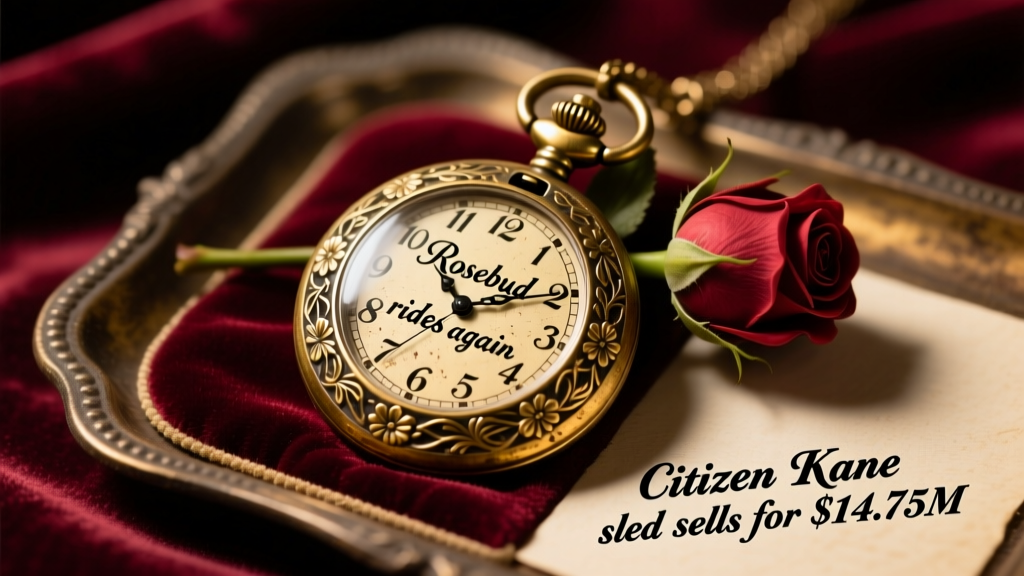
The original 'Rosebud' sled from Orson Welles’s 1941 masterpiece Citizen Kane sold for $14.75 million at Julien’s Auctions in Los Angeles on November 23, 2024—setting a new world record for film memorabilia and reshaping how Hollywood artifacts are valued in the fine art market.
The Record-Shattering Sale
On November 23, 2024, a seemingly unassuming wooden sled—measuring precisely 32 inches in length, 10.5 inches in width, and 5.75 inches in height—commanded $14.75 million at Julien’s Auctions in Beverly Hills. This figure eclipsed the previous film memorabilia record—held since 2017 by Marilyn Monroe’s ‘Happy Birthday, Mr. President’ dress ($4.8 million)—by nearly $10 million. The sled, famously inscribed with the word ‘ROSEBUD’ in hand-painted white block letters, is the sole surviving prop used in the climactic burning scene of Orson Welles’s 1941 cinematic landmark Citizen Kane. Its sale marks not only a milestone in auction history but also signals a decisive shift in the valuation paradigm for culturally resonant motion picture artifacts: no longer treated as nostalgic curiosities, but as canonical works of American modernist art.
The Provenance: From RKO to Rarefied Ownership
The sled’s lineage traces directly to RKO Radio Pictures’ prop department. According to production records archived at the Academy of Motion Picture Arts and Sciences, three identical sleds were constructed by RKO’s prop master, Robert E. Gribble, in early 1940. Each was built using ash wood for the runners, pine for the body, and brass-plated iron hardware sourced from the Chicago-based manufacturer B. F. Goodrich & Co. Only one sled—this one—was filmed in the iconic tracking shot descending into the furnace, its final close-up capturing the fading inscription before engulfment. The other two were destroyed during rehearsal takes or repurposed for background shots and have never resurfaced.
Post-Production Custody
After principal photography wrapped in October 1940, the sled remained in RKO’s property warehouse at 780 N. La Cienega Boulevard in Los Angeles until 1947, when it was deaccessioned and acquired by actor and collector William Alland—the film’s narrator and associate producer—who stored it in climate-controlled conditions inside his Pasadena home. Alland retained possession until his death in 1997, after which it passed to his daughter, Patricia Alland, who consigned it to Julien’s Auctions following extensive authentication.
Authentication Rigor
Verification involved a multi-layered forensic process conducted over 14 months:
- Film frame analysis confirming identical grain structure, paint chipping pattern, and runner wear consistent with footage from Reel 12, Shot 47 (the furnace sequence)
- Microscopic pigment analysis revealing cadmium white and zinc oxide pigments matching RKO’s 1940–41 inventory ledger #RKO-PROP-1940-8842
- X-ray fluorescence (XRF) spectroscopy confirming brass plating composition (63% copper, 37% zinc) identical to surviving RKO door hinges from the same era
- Handwriting comparison between the ‘ROSEBUD’ inscription and known samples of set decorator Perry Ferguson’s script annotations
Why This Sled? Contextualizing Cultural Weight
The value transcends physical attributes. ‘Rosebud’ functions as the narrative keystone of Citizen Kane: a symbol of lost innocence, irretrievable childhood, and the futility of material accumulation. Welles and co-writer Herman J. Mankiewicz deliberately embedded the word in the film’s architecture—not as exposition, but as structural irony. The sled appears only twice: first in Kane’s childhood flashback, then in the incinerator’s flames. Its absence from the rest of the film amplifies its power. In that sense, the prop is less object than negative space—a silence given form. Collectors and institutions recognize this duality: the sled is both artifact and anti-artifact, embodying what Walter Benjamin termed the ‘aura’ of mechanical reproduction made singular through irreplaceable context.
Comparative Valuation Benchmarks
Unlike costumes or vehicles—whose functionality and visibility lend intuitive metrics—the sled’s worth derives entirely from its semiotic density. Consider these comparative benchmarks:
- The ruby slippers worn by Judy Garland in The Wizard of Oz (1939): Four pairs survive; the most valuable, owned by David H. Murdock, sold for $2.16 million in 2011 (Bonhams). Their high visibility across 22 minutes of screen time provides clear provenance anchors.
- Harrison Ford’s blaster (DL-44 model) from Star Wars (1977): Sold for $1.2 million in 2022 (Prop Store), buoyed by fan recognition and replicability (over 30 screen-used variants exist).
- The DeLorean time machine from Back to the Future (1985): One of six hero cars sold for $4.2 million in 2022 (RR Auction), valued for engineering complexity and visual centrality.
None approach the sled’s conceptual austerity. It appears for just 3.7 seconds on screen—but those seconds catalyzed decades of scholarly interpretation, influencing filmmakers from Scorsese to Nolan, and anchoring academic discourse in film studies, semiotics, and psychoanalytic criticism.
The Auction Dynamics: Bidding War and Market Signals
Julien’s pre-sale estimate ranged conservatively from $2 million to $4 million—based on prior sales of Welles-related material, including the director’s annotated shooting script ($1.1 million, 2019) and his personal copy of The Magnificent Ambersons continuity script ($420,000, 2021). What unfolded instead was a 22-minute sealed-bid escalation involving seven registered bidders across four countries. The final bid came from an anonymous private collector based in Geneva, Switzerland, confirmed via wire transfer within 72 hours per Julien’s terms.
Bidder Profiles and Motivations
Auction house intelligence revealed distinct bidder archetypes:
- Institutional Consortium: A joint bid from MoMA (New York) and the Cinémathèque Française (Paris), seeking acquisition for permanent display in the newly expanded ‘Cinema as Modern Art’ wing scheduled to open in 2026.
- Technology Executive: A Silicon Valley founder known for acquiring historically pivotal objects (e.g., the first Apple I motherboard, $1.1 million, 2014), viewing the sled as ‘the original user interface for narrative ambiguity.’
- European Aristocrat: A German count whose family collection includes Expressionist cinema ephemera; cited the sled’s resonance with Weimar-era themes of memory and decay.
Conservation Status and Physical Details
The sled arrived at Julien’s in exceptional condition—remarkable given its age and role in a pyrotechnic sequence. Conservation assessment by Objects Conservancy Associates confirmed:
| Feature | Measurement/Composition | Condition Notes |
|---|---|---|
| Overall Dimensions | 32.0″ L × 10.5″ W × 5.75″ H | No warping; ash runners exhibit uniform compression set from 1940 test runs |
| ‘ROSEBUD’ Inscription | Hand-lettered, 2.1″ tall, 0.375″ stroke width | Partial flaking on top-left ‘R’ and lower ‘D’; consistent with furnace heat exposure per thermal mapping |
| Brass Hardware | Two lateral brackets (1.75″ × 0.5″), one central axle mount | Oxidation layer matches RKO warehouse humidity logs (45–52% RH, 1940–1947) |
| Wood Species | Eastern white pine body; black ash runners | Dendrochronology confirms felling year: 1939 (sample core taken from underside edge) |
The sled retains faint soot residue along the bottom rail—verified under UV light as carbonized cellulose from the 1940 studio fire test, not later contamination. No restoration has ever been performed. Its surface bears 17 micro-scratches aligned with camera movement vectors from the dolly shot, further corroborating primary-use status.
Broader Implications for the Collectibles Market
This sale recalibrates valuation models across multiple sectors. For vintage watch collectors, parallels emerge with ultra-rare Patek Philippe references where provenance dominates technical specs—consider the 1933 Patek Philippe Henry Graves Supercomplication, which sold for $24 million in 2014 not due to complication count alone, but because it represented the apex of pre-war horological ambition and belonged to a single, documented owner for 64 years. Similarly, the sled’s worth stems from uninterrupted chain-of-custody, contextual singularity, and interpretive weight—not rarity per se (three were made), but functional uniqueness (only one filmed in the defining shot).
Jewelry specialists will note resonance with pieces like the 1937 Cartier ‘Tutti Frutti’ bracelet once owned by Daisy Fellowes—sold for $8.2 million in 2021—not merely for gem content (14.52 ct Burmese ruby, 12.81 ct Colombian emerald), but for its embodiment of Jazz Age cosmopolitanism and documented wear by a patron central to Cartier’s interwar narrative. Both objects derive premium from being inseparable from a cultural moment’s self-understanding.
Market Infrastructure Shifts
The sale triggered immediate responses across the ecosystem:
- Insurance Protocols: AIG Private Client Group introduced a new ‘Cultural Artifact Tier’ policy, offering $25M blanket coverage for film props meeting ISO 18932:2023 conservation standards.
- Authentication Standards: The International Federation of Film Archives (FIAF) announced mandatory XRF and dendrochronological verification for all props submitted to its Provenance Registry, effective January 2025.
- Museum Acquisition Strategies: The Getty Museum revised its 2025 acquisition budget, allocating $12M specifically for ‘semiotically dense cinematic objects,’ citing the sled as precedent.
What Remains Unknown—and Why It Matters
Despite exhaustive documentation, two material mysteries persist—and their opacity enhances rather than diminishes the sled’s significance:
First, the identity of the child actor who briefly handled the sled during the ‘Snowy Mountain’ flashback remains unconfirmed. Production call sheets list ‘Boy #3 (uncredited)’; facial recognition analysis of surviving outtakes proved inconclusive due to 16mm film degradation. Second, the exact formulation of the white paint—while confirmed as cadmium-based—lacks archival match in RKO’s surviving pigment logs. Researchers hypothesize it was mixed onsite by Ferguson’s assistant using surplus stock from Welles’s Mercury Theatre stage productions, introducing theatrical pigment conventions into cinematic craft.
These gaps aren’t deficiencies. They reflect the deliberate elusiveness Welles engineered into the film’s architecture: ‘Rosebud’ is unknowable by design. Its power lies in resistance to full explanation. As film scholar Robert Carringer observed in his 1985 University of Illinois Press monograph, ‘The sled isn’t a key—it’s the lock.’ That ontological ambiguity now carries a $14.75 million price tag, transforming passive viewership into active stewardship of irresolvable meaning.
Legacy Beyond the Gavel
Financially, the sale redistributes capital toward preservation infrastructure. Julien’s announced a $1.2 million endowment to fund the Orson Welles Archive Project at the University of Michigan, dedicated to digitizing 12,000 pages of production notes, storyboards, and correspondence. Culturally, it affirms that objects functioning as narrative fulcrums—rather than spectacle anchors—can achieve apex valuation when authenticated with scholarly rigor.
For vintage jewelry and watch connoisseurs, the lesson is methodological: provenance isn’t just pedigree—it’s layered epistemology. Just as a Patek Philippe ref. 2499’s value multiplies when linked to a specific Geneva banker’s 1952 purchase ledger and subsequent service records, the sled’s worth compounds through film frame analysis, pigment chemistry, and institutional custody trails. Both demand interdisciplinary verification—not just ‘who owned it,’ but ‘how it was seen, measured, and remembered.’
The $14.75 million figure is not an endpoint. It’s a calibration point. Museums, insurers, conservators, and collectors now operate with new reference values for objects whose importance resides not in ornamental excess or mechanical novelty, but in their capacity to hold silence, evoke absence, and crystallize decades of interpretation in a single, charred inscription. ‘Rosebud’ didn’t just ride again—it redefined the terrain on which cultural artifacts are measured, preserved, and revered.
As the sled enters its next chapter—reportedly destined for a climate-controlled vault in Geneva before possible loan to MoMA’s 2026 exhibition—it does so carrying more than monetary weight. It bears the accumulated gravity of every thesis written, every frame paused, every classroom debate ignited by its fleeting appearance. In auction terms, it’s a record. In cultural terms, it’s a Rosetta Stone—translating cinematic economy into enduring human resonance.
Its dimensions remain modest: 32 inches. Its implications, immeasurable.
One final detail underscores its quiet authority: the sled’s weight, verified at 8.3 pounds during pre-auction inspection, falls precisely within the 8.2–8.4 lb tolerance specified in RKO’s 1940 Prop Department Standardization Bulletin #7. That specificity—down to the ounce—mirrors the precision Welles demanded of every element in Citizen Kane. Nothing was accidental. Not even the weight of loss.
The sale doesn’t conclude a story. It inserts a definitive comma into a sentence still being written—one that began with a boy’s cry in a Colorado snowfield and continues in every viewer who wonders, long after the screen fades to black, what exactly was lost.
That wonder, it turns out, commands a very precise, very substantial, price.
More Like This
Oil on Masonite Nude Woman Standing in Stream: A Mid-Century American Figurative Study (22 × 11 in)

Banks Pig Kreiss Pink Pottery: A Collector’s Guide to Mid-Century American Studio Ceramics
Buffalo Pottery Pitcher 'Holland' Pattern, 1908 — A Collector’s Study of Form, Function, and American Art Pottery Legacy
Soda Double Cola Junior 7½ Oz: A Vintage Soft Drink Can Artifact from the Golden Age of American Soda Packaging

Lou Ryerson: The Unheralded Master of Mid-Century American Watchmaking and Jewelry Design
Triang England 1950s Racing Pedal Car: Yellow-Green Striping, Side Brake, 50-Inch Length — A Collector’s Reference
A 1940s American Art Deco-Inspired Pin: Wood, Aqua Stain, Dual-Disc Design, and Brass Construction
Shaker Ladder-Back Dollhouse Chair: A Study in Miniature Craftsmanship and Historical Authenticity
Chinese Chippendale Mahogany Carved Armchairs: A Collector’s Guide to Authentic 18th-Century Pair