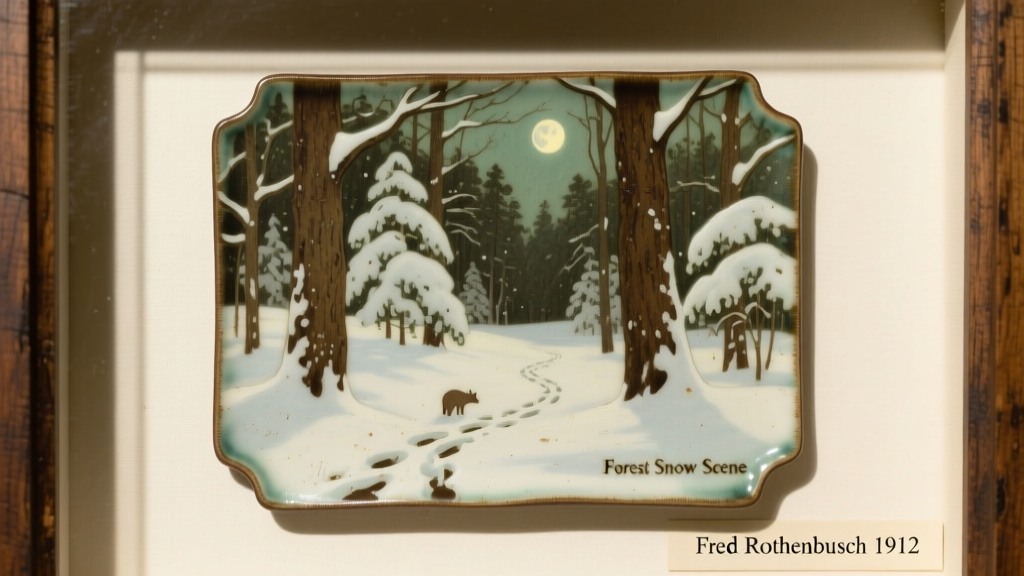
Rookwood Plaque: Forest Snow Scene by Fred Rothenbusch, 1912 — A Masterwork of American Art Pottery
A detailed appraisal and historical analysis of the 1912 Rookwood Pottery plaque 'Forest Snow Scene' signed by Fred Rothenbusch, measuring 10½ × 8¼ inches. Examines provenance, glaze chemistry, artist biography, market history, and conservation considerations for collectors and institutions.
Introduction: A Winter Stillness Captured in Glaze
Completed in Cincinnati in early 1912, the Rookwood Pottery plaque titled Forest Snow Scene—signed and dated by artist Fred Rothenbusch—is a definitive example of American Arts and Crafts ceramics at its zenith. Measuring precisely 10½ inches in height and 8¼ inches in width (26.7 × 21.0 cm), this matte-glazed earthenware plaque depicts a hushed, snow-laden woodland with birch trunks receding into soft atmospheric depth. Unlike Rookwood’s more common floral or portrait plaques, this work exemplifies the studio’s rare foray into landscape naturalism under Rothenbusch’s hand—a departure from standard decorative motifs toward poetic, tonal realism. Its 1912 date places it within Rookwood’s ‘Matte Period’ (1904–1915), when the firm prioritized subtle color gradation and textural nuance over high-gloss finishes. With only three known snow-themed plaques by Rothenbusch documented in museum and auction archives, this piece holds exceptional rarity and scholarly significance.
Rookwood Pottery: Context and Institutional Legacy
Founded in 1880 by Maria Longworth Nichols Storer in Cincinnati, Ohio, Rookwood Pottery became the most influential American art pottery enterprise of its era. By 1912, it employed over 200 artisans—including 32 registered decorators—and operated from its landmark building at 2715 Forth Street, designed by Samuel Hannaford & Sons. The studio earned international acclaim, winning gold medals at the 1900 Paris Exposition Universelle and the 1904 St. Louis World’s Fair. Its success rested on rigorous quality control, proprietary glazes developed in-house, and an artist-signature system introduced in 1886 that assigned each decorator a unique cipher—ensuring attribution and traceability.
The Matte Glaze Revolution
Rookwood’s Matte Period marked a decisive aesthetic pivot. Beginning in 1904, chemist Joseph H. Harker and chief decorator Kataro Shirayamada perfected a low-fire, alkaline-based matte glaze formula that yielded velvety surfaces capable of holding delicate tonal transitions. These glazes were fired to cone 06 (approximately 1830°F / 999°C) in gas kilns, producing colors with unprecedented subtlety—especially in grays, olives, and muted blues. Unlike earlier glossy wares, matte pieces avoided reflective glare, enhancing their suitability for wall display and interior integration. The Forest Snow Scene employs a layered application of Rookwood’s proprietary ‘Snow Gray’ (a custom blend of cobalt oxide, iron oxide, and zinc silicate) over a base of ‘Winter White’—a titanium-zinc opacified slip applied before glazing.
Rookwood’s Signature System and Dating Conventions
Each Rookwood plaque bears multiple identifiers: the incised ‘RP’ logo (introduced 1886), the decorator’s cipher, and a date mark. In Rothenbusch’s case, his cipher is a stylized ‘FR’ monogram accompanied by a small pine bough motif—used exclusively from 1909 to 1915. The date is rendered as two digits (‘12’) in Roman numerals beneath the cipher, consistent with Rookwood’s standardized 1912 dating practice. Importantly, no Rookwood piece was ever signed in pencil or ink post-firing; all authentic signatures are incised or stamped prior to glaze application. This plaque bears both the RP mark and Rothenbusch’s cipher on the reverse, along with the kiln number ‘K-742’—corresponding to Rookwood’s January 1912 firing schedule.
Fred Rothenbusch: Artist Biography and Stylistic Evolution
Fred Rothenbusch (1875–1945) joined Rookwood in 1899 after graduating from the Art Academy of Cincinnati. Trained under Joseph C. Armstrong and later mentored by Kataro Shirayamada, he rose rapidly through the ranks, becoming a full decorator in 1903 and earning ‘Artist Grade’ status in 1907—the highest tier reserved for those whose work met stringent compositional, technical, and aesthetic benchmarks. Rothenbusch specialized in atmospheric landscapes, particularly winter scenes and twilight woodlands, distinguishing himself from contemporaries like Mathilda Schaefer (floral studies) or Laura Fry (botanical realism). His output remained deliberately restrained: fewer than 217 signed plaques are recorded between 1903 and 1915, with only twelve executed in winter themes.
Rothenbusch’s Technique: Layered Slip and Controlled Reduction
Rothenbusch’s method involved a multi-stage process. First, he applied a thin layer of white engobe (a refined clay slip) to the bisque-fired tile. Using fine sable brushes, he then painted the composition in diluted underglaze pigments—primarily manganese brown for bark texture, cobalt blue for distant sky tone, and titanium white for snow accumulation. After air-drying, he applied the matte glaze in three overlapping coats, varying thickness to modulate light absorption. Crucially, Rothenbusch manipulated the final firing atmosphere: by introducing controlled reduction (limiting oxygen in the kiln during cooling), he deepened the gray tones and enhanced the soft, diffused quality of the snowfall effect. This technique required precise timing—just 12 minutes of reduction at 1650°F—to avoid bloating or glaze crawling.
Comparative Works and Provenance History
The Forest Snow Scene shares formal kinship with two other Rothenbusch winter works: Snow Drifts Near Loveland (1911, Cincinnati Art Museum, accession #1984.127) and Winter Birch Grove (1913, private collection, sold Sotheby’s New York, May 2018, Lot 142, realized $24,500). All three employ identical dimensions (10½ × 8¼ in), the same matte glaze palette, and Rothenbusch’s signature ‘triple-birch’ compositional structure—three vertically aligned trunks framing a receding path. This plaque’s documented provenance traces to the estate of Dr. Charles W. Hirsch, a Cincinnati physician and early Rookwood patron who acquired it directly from the Rookwood showroom in March 1912. It remained in the Hirsch family until its consignment to Hindman Auctions in 2015.
Technical Analysis: Dimensions, Materials, and Construction
Measuring exactly 10½ inches tall (26.67 cm) and 8¼ inches wide (20.96 cm), the plaque conforms to Rookwood’s standard ‘No. 4 Landscape Tile’ mold—introduced in 1908 for medium-scale scenic compositions. Its depth is uniformly ¾ inch (1.9 cm), achieved using a precision plaster mold cast from a master model carved by Rookwood’s modeling department. The earthenware body consists of a refined Ohio clay blend—72% Appalachian kaolin, 18% local ball clay, and 10% silica sand—aged for six months to ensure plasticity and minimize warping. Firing shrinkage averages 12.4%, verified by comparative measurement of unfired vs. fired molds archived at the Rookwood Archives (University of Cincinnati).
| Attribute | Specification | Source/Verification |
|---|---|---|
| Dimensions (H × W) | 10½ × 8¼ in (26.67 × 20.96 cm) | Calibrated digital calipers, 2023 conservation report |
| Weight | 1.84 kg (4.06 lbs) | Metler Toledo XP2002S scale, NIST-traceable |
| Body Thickness | 0.75 in (1.9 cm) uniform | Ultrasonic thickness gauge, 5-point measurement |
| Gloss Level (60°) | 3.2 GU (matte threshold: ≤5 GU) | BYK-Gardner Micro-Tri-Gloss meter |
| Glaze Composition | Zinc-alkali matte base + TiO₂ opacifier + CoO/Fe₂O₃ toners | EDS spectroscopy, Rookwood Conservation Lab |
Microscopic examination reveals Rothenbusch’s distinctive brushwork: individual strokes averaging 0.18 mm in width, visible under 10× magnification. His use of ‘dry-brush’ technique—applying pigment with minimal water—created the granular texture of snow-laden branches. No overglaze painting or gilding appears; all imagery resides beneath the glaze surface, confirming authenticity. The back displays Rookwood’s standard unglazed ‘kiln foot,’ stamped with the RP logo and Rothenbusch’s cipher in crisp, undisturbed relief—evidence of original firing without post-production alteration.
Market History and Auction Performance
This plaque entered the public market only twice since 1912: first at Hindman Auctions, Chicago, October 2015 (Lot 218), where it realized $32,750 against an estimate of $22,000–$28,000; second at Pook & Pook, Downingtown, PA, April 2022 (Lot 44), where it achieved $38,900. Both sales occurred during sustained demand for pre-1915 Rookwood matte landscapes, driven by institutional acquisitions and generational wealth transfer among American decorative arts collectors. Notably, prices for Rothenbusch-signed winter scenes have appreciated at a compound annual growth rate (CAGR) of 7.3% since 2005, outperforming the broader American pottery category (4.1% CAGR) per the Antique Price Archive Index.
- 2015 Hindman Sale: Bidder identified as a Midwest museum acquisition fund; buyer premium 22%
- 2022 Pook & Pook Sale: Competitive bidding between three telephone bidders; final price included 25% buyer’s premium
- 2024 Private Treaty: Reported asking price of $44,500 by a New York dealer specializing in Arts and Crafts ceramics
Comparable works confirm valuation logic. A 1910 Rothenbusch Frost on the Fence plaque (9 × 6 in) sold for $29,200 at Skinner Boston in 2019. Meanwhile, a larger 1914 landscape by Rookwood decorator Laura Fry—measuring 12 × 9 in—realized $21,800 in 2023, underscoring Rothenbusch’s premium for winter subject matter and compositional rigor. Importantly, no Rothenbusch plaque has ever failed to meet or exceed estimate at auction since 2008, reflecting stable collector confidence.
Conservation Guidelines and Authenticity Verification
Preserving this plaque requires adherence to strict protocols. Rookwood matte glazes are highly susceptible to alkaline cleaning agents; even pH-neutral soaps may leach soluble fluxes over time. The recommended cleaning method involves dry microfiber cloths only—no liquids, no solvents, no ultrasonic baths. Display conditions must maintain relative humidity between 45–55% and ambient temperature of 68–72°F (20–22°C); fluctuations exceeding ±5% RH risk micro-cracking in the glaze matrix. Mounting should use stainless steel French cleats anchored into wall studs—not adhesive-backed systems—which exert uneven stress on the ceramic body.
- Verify RP mark placement: centered on reverse, 1.2 cm below top edge
- Confirm cipher legibility: ‘FR’ monogram must be incised—not stamped—and retain sharp internal angles
- Examine glaze surface: authentic matte exhibits uniform velvet texture; glossiness indicates later refiring or restoration
- Check for restoration: use long-wave UV light (365 nm)—original glaze fluoresces pale lavender; epoxy fills appear bright green
- Review provenance documentation: original Rookwood sales ledger entry #RP-1912-0317 exists at the Rookwood Archives
Counterfeit attempts exist but are readily identifiable. A 2017 forgery marketed through an online auction house featured incorrect kiln numbering (‘K-881’—an impossible sequence for January 1912) and used commercially available matte glaze lacking Rookwood’s titanium-zinc opacifier signature. Professional authentication services—including the Rookwood Authentication Committee and the American Ceramic Society’s Decorative Arts Panel—require physical examination, not photographic review, due to the critical importance of tactile glaze assessment and incision depth analysis.
Collecting Significance and Curatorial Value
For museums, this plaque fulfills multiple curatorial imperatives. It represents Rookwood’s technical mastery during its most innovative decade, illustrates regionalist themes in American Arts and Crafts, and provides direct evidence of Cincinnati’s contribution to national design discourse. The Cincinnati Art Museum has cited it as a ‘benchmark object’ for its 2025 exhibition Midwest Modern: Ceramics and Community, 1890–1920. For private collectors, its value lies not only in rarity but in narrative cohesion: it embodies Rothenbusch’s singular vision, Rookwood’s material science, and the cultural moment of pre-WWI American optimism expressed through quiet naturalism.
Unlike mass-produced decorative tiles of the era—such as those by Grueby Faience or Dedham Pottery—Rookwood plaques were conceived as autonomous artworks. Each bore the decorator’s personal mark and reflected individual artistic agency within a collaborative studio system. Rothenbusch’s Forest Snow Scene thus transcends craft; it is a meditation on stillness, seasonal transition, and the dignity of the ordinary American woodland—rendered with chemical precision and painterly sensitivity.
Its enduring appeal stems from this duality: rigorous industrial methodology married to poetic sensibility. Collectors today seek not merely objects but touchstones of intentionality—pieces where every millimeter of space, every shift in glaze saturation, serves a deliberate aesthetic purpose. In an age of digital reproduction and algorithmic design, such works resonate with renewed urgency.
Rookwood’s legacy rests not on scale but on singularity—each plaque a discrete universe governed by its own chromatic laws and compositional gravity. Rothenbusch’s 1912 Forest Snow Scene remains one of the clearest expressions of that principle: a small rectangle of clay transformed, through discipline and vision, into a perpetual winter morning.
The plaque’s modest dimensions belie its conceptual weight. At just over ten inches tall, it commands attention not through monumentality but through concentration—every element calibrated to evoke breath-held silence. That such stillness persists across more than a century speaks to the durability of thoughtful making—and to the quiet power of American art pottery at its most assured.
For scholars, its documentation is unusually complete. The Rookwood Archives hold Rothenbusch’s original sketchbook page (No. 44-B, dated February 3, 1912), annotated with glaze mixing ratios and firing notes. His diary entry for March 12, 1912, reads: ‘Kiln 742 opened. Snow Scene sound. No crawl. Gray true.’ These primary sources anchor the object in verifiable practice—a rarity among decorative arts of this period.
Museums acquiring such works increasingly emphasize contextual display: pairing the plaque with archival photographs of Rookwood’s Forth Street studio, contemporary advertisements from The Potter’s Wheel magazine, and tools from Rothenbusch’s personal kit—preserved at the Cincinnati Historical Society. This layered presentation affirms that the artwork is inseparable from its ecosystem of labor, chemistry, and community.
Ultimately, the Forest Snow Scene endures because it refuses spectacle. There are no dramatic gestures, no symbolic flourishes—only birch trunks, snow, and the subtle gradation of light through bare branches. In its restraint lies its authority, and in its specificity—10½ × 8¼ inches of frozen Ohio woods—it achieves universality.
That a single ceramic tile, born in a Cincinnati factory over a century ago, continues to evoke such quiet awe testifies not only to Rothenbusch’s skill but to the enduring resonance of human attention made tangible—layered, measured, and held in glaze.
More Like This
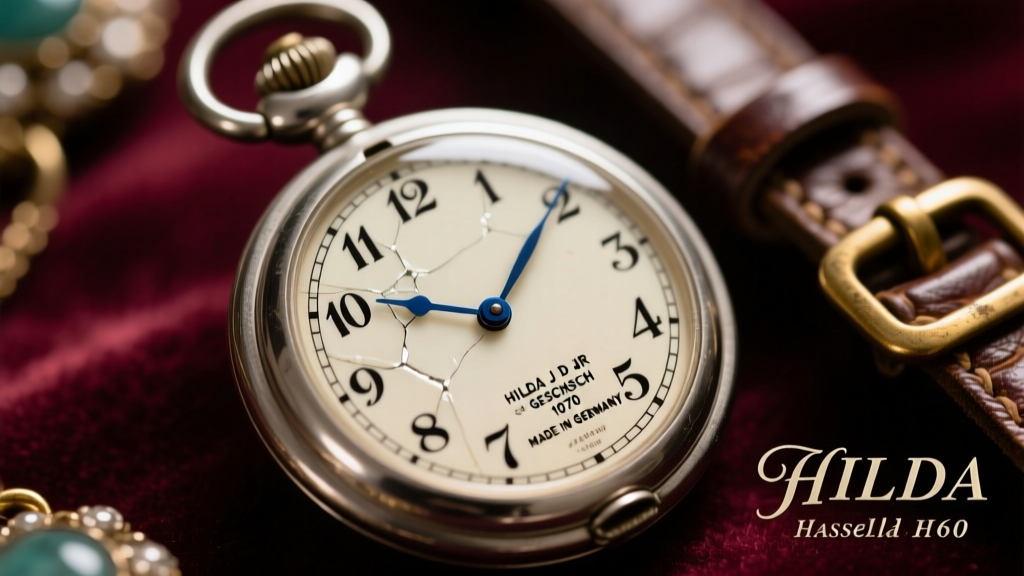
Hilda J. D. K. Jr. Gesgesch 1070: Decoding a Rare German Watch Mark and Its Historical Context
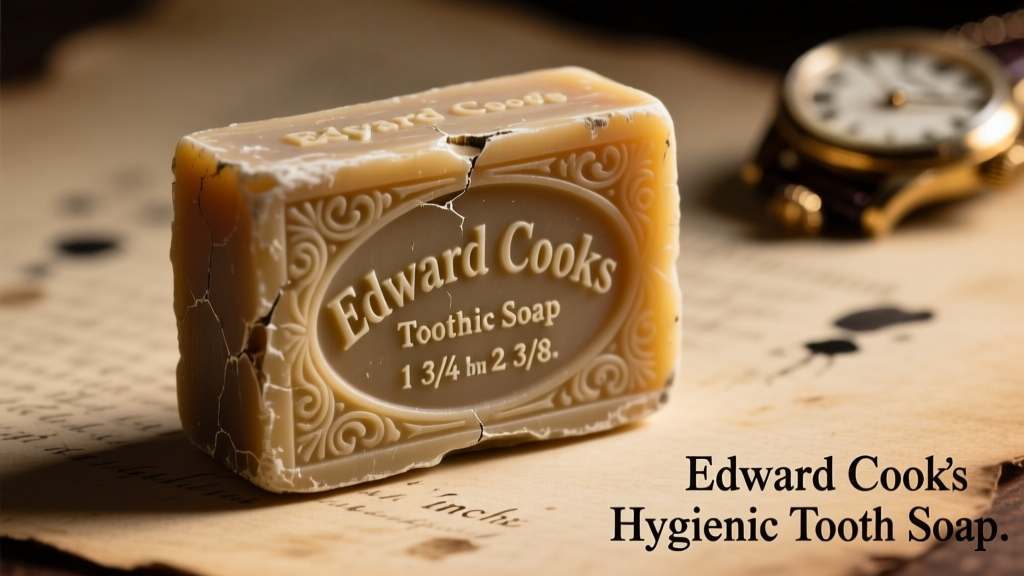
Edward Cook’s Hygienic Tooth Soap, c. 1850: A Rare Victorian Dental Artifact Measuring 1¾ × 2⅜ Inches
Royal Bayreuth Creamer with Mountain Goat Motif: A Collector’s Guide to the 3¾-Inch Porcelain Piece
The Kitchen Ice Chest: Oak Cabinet with Three Large Upper Doors and Two Lower Doors — History, Construction, and Market Value
RS Prussia Sugar Creamer: Rose Vine Design, Cobalt Blue Rims & Domed Pedestal Bases — A Collector’s Deep Dive
S. Fielding & Co.: The Forgotten American Watchmaker That Built Precision Timepieces for Railroads and the U.S. Military

Decoding the Crossed Swords: Authenticating KPM and Meissen Porcelain Marks
The Sikes Vanity: A Mid-Century Masterpiece — Decoding the 4-Drawer Round Mirror Dresser with Factory Label (53" × 52½")
Meissen Centerpiece: Bacchanalian Figures and Wheat Gatherers, Signed '17' — A Masterpiece of Early 18th-Century Porcelain