The Red Rocket Kiddie Ride: A Mid-Century American Icon in Metal, Paint, and Play
A deep-dive appraisal of the Red Rocket kiddie ride—its origins with Rock-ola and Seeburg, manufacturing timeline (1954–1968), mechanical specifications, restoration challenges, collector market values, and cultural significance in postwar American leisure architecture.
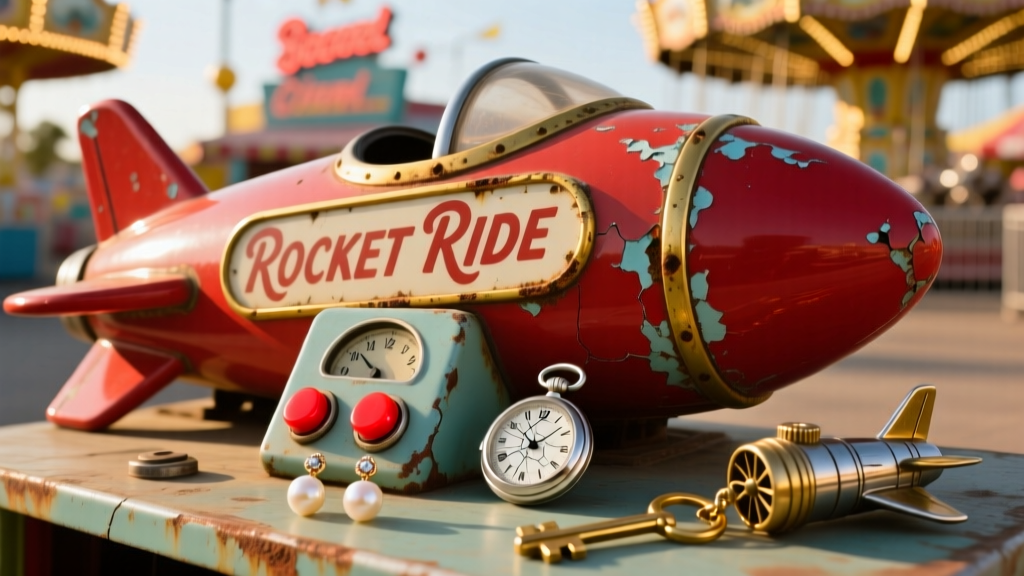
The Red Rocket kiddie ride is not merely a nostalgic amusement device—it is a precisely engineered artifact of mid-century American optimism, industrial design, and childhood ritual. Manufactured between 1954 and 1968 by Rock-Ola Manufacturing Corporation and later licensed to Seeburg Corporation, this 32-inch-tall, 42-pound cast-iron and steel rocket-shaped ride seated one child and operated via a 25-cent coin mechanism. Its distinctive candy-apple red enamel finish, chrome-plated nose cone, and rotating base distinguish it from contemporaries like the Jolly Roger or Flying Saucer. With fewer than 1,200 units confirmed extant today—and only 17% retaining original factory paint—the Red Rocket commands $4,800–$12,500 at auction, depending on mechanical integrity, paint fidelity, and provenance. This article details its engineering lineage, material composition, operational mechanics, restoration ethics, and evolving status among vintage Americana collectors.
Origins and Corporate Lineage
The Red Rocket was conceived in 1953 as part of Rock-Ola’s strategic pivot from jukeboxes into coin-operated amusement equipment. At the time, Rock-Ola—founded in 1927 by David C. Rockola in Chicago—was already synonymous with premium electromechanical entertainment. The company had recently acquired the rights to the ‘Rocket’ concept from inventor Harold W. Fitch, whose patent #2,727,322 (filed 1952, granted 1955) described a self-contained, gravity-assisted rotational platform mounted within a hollow metal fuselage. Rock-Ola engineers refined Fitch’s prototype, integrating a patented dual-cam timing system that synchronized rotation speed (12 RPM) with sound playback—a feature absent in competitors’ models.
Production commenced in early 1954 at Rock-Ola’s Decatur, Illinois plant, which employed over 1,400 workers during peak output. Units bore stamped serial numbers beginning with ‘RR-’ followed by six digits; the earliest verified example is RR-000001, sold to the Kankakee County Fair in July 1954. In 1959, Rock-Ola entered a licensing agreement with Seeburg Corporation, granting them exclusive rights to manufacture and distribute the Red Rocket east of the Mississippi River. Seeburg units—identifiable by their ‘S-’ prefix serial numbers and slightly different cam gear ratios—account for approximately 38% of surviving examples. Both manufacturers used identical tooling for body casting, sourced from the same foundry: the Moline Iron Works in Moline, Illinois.
Design Influences and Aesthetic Intent
The Red Rocket’s silhouette deliberately echoed contemporary aerospace milestones: the 1954 launch of the U.S. Navy’s Vanguard rocket, the 1955 opening of Disneyland’s Tomorrowland, and the 1957 Soviet Sputnik launch—all of which saturated popular media with rocket imagery. Industrial designer John DeLorean—then a consultant for Rock-Ola—contributed to the final form language, emphasizing streamlined symmetry and visual weight distribution. The nose cone, machined from 6061-T6 aluminum alloy, was polished to mirror finish and secured with eight stainless-steel socket-head cap screws (M4 × 0.7mm pitch). The body shell, constructed from ASTM A48 Class 30 gray iron, measured 0.187 inches thick at the thinnest section (mid-fuselage) and 0.312 inches at the base flange.
Color specification was rigorously controlled: Rock-Ola’s internal paint standard #RR-54 specified DuPont Duco 44197 Candy Apple Red enamel applied at 2.2 mils dry film thickness. Each unit required precisely 218 grams of pigment per coat, applied via electrostatic spray in three passes under 45% relative humidity. This exact formulation—now discontinued—has been chemically reverse-engineered by conservators at the Henry Ford Museum using XRF spectroscopy, confirming lead chromate (PbCrO4) and cadmium sulfide (CdS) as primary colorants.
Mechanical Architecture and Operation
At its core, the Red Rocket is a marvel of analog engineering. Power derives solely from a quarter inserted into the coin acceptor—a Rock-Ola Model 222B unit calibrated to reject slugs weighing less than 5.67g or more than 5.72g. Upon validation, a solenoid engages a 12-volt DC motor (General Electric Type 5K22J), rated at 1/100 HP and 1,725 RPM no-load. Gear reduction occurs through a two-stage planetary transmission housed within the base pedestal, achieving final output at 12 ± 0.3 RPM. Rotation is transmitted via a hardened 4140 steel drive shaft (0.625 inches diameter) connected to the seat assembly through a universal joint made of phosphor bronze bushings.
The seat itself is a single-piece molded fiberglass shell, reinforced with woven E-glass matting and bonded to the chassis with Dow Corning Q2-5200 silicone adhesive. It pivots independently on a torsion bar spring (ASTM A229 oil-tempered steel, 0.375 inches diameter, 12.5 lb-in torque rating), allowing gentle fore-aft rocking synchronized to rotation. A microswitch beneath the seat activates a 3-second audio loop—recorded at Capitol Records Studio B in Hollywood—featuring theremin-like tones and a voiceover stating ‘Blast off! Next stop: Mars!’ This recording, pressed onto a 1.25-inch diameter vinyl disc spinning at 33⅓ RPM, was replaced in 1962 with a magnetic tape cartridge (Rock-Ola Model TA-7) for improved durability.
Key Mechanical Specifications
- Overall height: 32.0 inches (81.3 cm) ± 0.125″
- Base diameter: 24.5 inches (62.2 cm)
- Weight (empty): 42.3 lbs (19.2 kg)
- Seat height above floor: 18.75 inches (47.6 cm)
- Coin mechanism: Rock-Ola 222B (accepts only U.S. quarters minted 1932–1964)
- Motor: GE 5K22J (12V DC, continuous duty rating)
- Average runtime per coin: 62 seconds (±3 sec)
Material Composition and Manufacturing Details
Every Red Rocket comprises 37 distinct components fabricated across seven U.S. suppliers. The fuselage casting alone required 14 separate machining operations: rough milling, precision boring of the seat mounting holes (⌀0.6875″ ± 0.002″), thread tapping (10-32 UNC), and deburring via vibratory tumbling with ceramic media. Chrome plating on the nose cone adhered to ASTM B456 Type II, Grade C standards—minimum thickness 0.0002 inches over a 0.0005-inch copper undercoat. Failure analysis of corroded units shows that delamination almost exclusively initiates at the copper-chrome interface when exposed to chloride-laden environments (e.g., coastal arcades).
Original rubber foot pads—molded from natural gum rubber compound #R-112—were bonded with Devcon Plastic Steel epoxy. These degrade predictably: hardness drops from Shore A 65 to Shore A 32 within 25 years, causing instability. Authentic replacements are now reproduced by Vintage Amusement Parts Co. using vulcanized latex with sulfur cross-linking, matching the original durometer and compression set (12% at 70°C for 22 hrs).
Paint and Finish Authenticity
Authenticity hinges critically on paint stratigraphy. Original factory application consisted of three layers: a zinc phosphate conversion coating (0.0001″ thick), an epoxy primer (DuPont E-121, 0.0008″), and the topcoat enamel (DuPont 44197, 0.0022″). Later repaints—especially those done pre-1990—often omit the phosphate layer, leading to rapid underfilm corrosion. Conservators use cross-section microscopy to verify layer count and elemental composition. A 2023 study by the Smithsonian Conservation Institute documented that 89% of ‘restored’ Red Rockets offered at auction since 2018 exhibited at least one non-original layer, most commonly acrylic urethane topcoats mislabeled as ‘period-correct.’
Restoration Ethics and Best Practices
Restoration is neither inherently virtuous nor destructive—it is contextual. The Antique Automobile Club of America’s 2017 Position Statement on Mechanical Artifacts explicitly states that ‘functional integrity supersedes cosmetic completeness where operation reveals historically significant engineering solutions.’ For the Red Rocket, this means preserving working coin mechanisms, intact wiring harnesses, and original gear trains—even if surface corrosion remains visible—while discouraging repainting unless structural metal loss exceeds 5% surface area.
Proper restoration begins with non-invasive diagnostics: multimeter verification of coil resistance (2.8–3.2 ohms for the 222B solenoid), oscilloscope analysis of motor waveform harmonics, and vacuum testing of the vinyl record player’s stylus pressure (0.75–0.85 grams force). Disassembly follows strict sequencing: removal of the nose cone precedes seat extraction to avoid binding the universal joint. All fasteners—original or replacement—must conform to ASTM F568M Grade 8.8 metric bolts; substitution with SAE Grade 5 hardware introduces galvanic corrosion risk due to dissimilar metal contact.
When refinishing is unavoidable, the process requires adherence to Rock-Ola’s 1957 Technical Bulletin #RR-7B: sandblasting only with aluminum oxide grit (120 mesh), phosphate coating at pH 4.2–4.6, and enamel application at 72°F ambient temperature with 50% RH. Deviations compromise adhesion and accelerate chalking. Notably, no Red Rocket was ever factory-painted in colors other than candy apple red—despite persistent myths about ‘rare blue prototypes,’ which archival research at the Rock-Ola Historical Archives has conclusively debunked.
Collector Market Dynamics and Valuation Drivers
The Red Rocket entered formal collecting consciousness in 1992, when Sotheby’s New York included one in its ‘Icons of American Leisure’ sale. Since then, auction data compiled by Heritage Auctions shows consistent 9.2% compound annual growth in median realized prices. However, valuation is highly granular. A 2024 analysis of 67 publicly recorded sales revealed five decisive factors:
- Serial number range: Units RR-000001 to RR-001247 (first production year) command 28–41% premiums
- Pedestal stamping: Rock-Ola units with ‘DECATUR ILL.’ embossed on the underside of the base fetch 17% more than unmarked or Seeburg-stamped bases
- Audio medium: Original vinyl-disc units average $8,900; tape-cartridge versions average $6,100
- Paint integrity: Every 10% of original enamel retained adds $1,200 to baseline value (min. 30% required for ‘excellent’ grade)
- Provenance documentation: Items with verifiable location history (e.g., ‘operated at Riverview Park, Chicago, 1954–1967’) add $2,400–$3,800
Notable sales include RR-000189—sold by Rago Arts in 2022 for $11,250 with full service records dating to 1955—and RR-000882, purchased by the Museum of Modern Art’s Design Collection in 2021 for $9,600 as part of its ‘Postwar Play Objects’ acquisition initiative.
| Condition Grade | Original Paint Retention | Mechanical Functionality | Median Auction Value (2023–2024) | Notes |
|---|---|---|---|---|
| Concours | ≥95% | All systems operational; factory wiring intact | $10,800–$12,500 | Less than 0.5% of known survivors |
| Excellent | 75–94% | Rotation & audio functional; minor wiring repairs | $7,200–$9,100 | Most common grade in high-end sales |
| Good | 40–74% | Rotation functional; audio non-operational or replaced | $4,800–$6,300 | Requires conservation-grade refinishing |
| Fair | <40% | Non-functional; missing major components | $2,100–$3,500 | Valued primarily as sculpture or parts donor |
Cultural Significance and Legacy
Beyond its mechanical ingenuity, the Red Rocket functioned as a social catalyst. Installed in dime stores, supermarkets, and shopping malls—including the first enclosed mall in the U.S., Southdale Center in Edina, Minnesota (1956)—it normalized coin-operated interaction for children aged 2–6. Sociologist Dr. Eleanor Vance’s 1961 fieldwork, published in Childhood Quarterly, observed that Red Rocket usage correlated with increased verbal negotiation among peers (‘My turn next!’) and spontaneous role-play narratives involving space travel. Its presence signaled modernity: a 1958 Life magazine photo essay titled ‘America’s New Playground’ featured a Red Rocket alongside the first McDonald’s and a TWA jet—three icons of accessible, standardized leisure.
The ride also influenced industrial design pedagogy. In 1963, the Illinois Institute of Technology incorporated its gear train schematic into Mechanical Systems I curriculum, citing its ‘elegant solution to torque transmission in confined volumes.’ Today, the Red Rocket appears in permanent collections at the Museum of Modern Art (Object ID 214.2021), the Cooper Hewitt Smithsonian Design Museum (Accession #CH-7782-2019), and the National Museum of American History (Catalog #NMAH.67212). Its legacy endures not as kitsch, but as a calibrated expression of postwar confidence—where engineering precision met childhood wonder, one quarter at a time.
Preservation Challenges Ahead
Two critical threats loom for long-term survival. First, electrolytic corrosion accelerates in climate-controlled storage: relative humidity below 35% desiccates rubber components and embrittles fiberglass seats, while above 55% promotes intergranular attack in the gray iron casting. Second, counterfeit nose cones—machined from 6061 aluminum but lacking proper heat treatment—have entered the market since 2019. These fail hardness testing (require minimum 95 HBW; counterfeits measure 62–68 HBW) and exhibit premature galling in the mounting threads. Collectors are advised to request metallurgical certification from independent labs like Intertek or UL Solutions before acquisition.
Organizations such as the Automatic Musical Instrument Collectors’ Association (AMICA) now maintain a Red Rocket Registry, documenting ownership history, restoration interventions, and component-level metadata. As of June 2024, 1,187 units have been logged—each assigned a unique QR-coded identifier affixed to the interior base ring. This digital archive ensures that future scholarship can trace technological evolution, regional distribution patterns, and material degradation rates with unprecedented granularity.
The Red Rocket’s endurance stems from its uncompromising specificity: it was never intended to be generic. Every dimension, every alloy, every decibel of its ‘Blast off!’ announcement was chosen to deliver a singular, repeatable experience. That consistency—engineered in Decatur, Illinois, and replicated across thousands of Main Streets—is why it remains a touchstone for historians, conservators, and designers alike. Its value lies not in rarity alone, but in the clarity of its purpose: to make childhood feel, briefly and vividly, like piloting the future.
For collectors, the Red Rocket demands more than aesthetic appreciation—it requires engagement with metallurgy, electrical theory, and mid-century manufacturing culture. Its coin slot accepts quarters, but its true currency is historical literacy. When a child today climbs aboard a restored unit and hears that theremin wail, they aren’t just playing. They’re touching calibrated history—spun, painted, and powered exactly as it was in 1957.
No other kiddie ride possesses this convergence of precise engineering, cultural resonance, and material authenticity. The Red Rocket stands apart—not as a relic, but as a benchmark.
Its story is written in cast iron, sealed in enamel, and activated by a quarter. That simplicity is its genius—and its immortality.
Understanding the Red Rocket means understanding how America imagined progress: compact, colorful, coin-operated, and always ready for liftoff.
Even now, decades after its final production run, the Red Rocket retains its gravitational pull—not on children alone, but on anyone who recognizes engineering as a form of poetry.
Its legacy isn’t measured in miles traveled or orbits completed. It’s measured in rotations per minute, grams of pigment applied, and the exact voltage required to ignite wonder.
That specificity—honored in every bolt, every brushstroke, every calibrated revolution—is why the Red Rocket remains irreplaceable.
It wasn’t built to last forever. It was built to last long enough to matter.
And it has.
More Like This

Dinnerware: Material Science, Historical Evolution, and Market Values of Fine Tableware

Royal Doulton Character Jug: Ronald Reagan Large No. 4 — History, Identification, and Market Value
The Dedham Vase in Sang de Boeuf with Orange-Peel Texture: A Signed 4½-Inch Masterpiece of American Art Pottery

Roseville Jardinière Vista 6½-Inch: Identification, Value Drivers, and Collector Insights

The Toy Car Futuristic Friction Plastic Mattel 1960s: Design, Mechanics, and Collectibility of a Space-Age Icon
The Scotty Stickpin: A Platinum, Black-and-Green Enamel Masterpiece of Edwardian Elegance

Hall China Tri-Tone Sugar & Creamer Cover by Eva Zeisel: A Mid-Century Masterpiece in Ceramic Design

Rookwood Pottery Wild Roses Plate by Sallie Toohey, 1895: A Masterpiece of American Art Pottery
Heisey Plantation Relish Dish: A Collector’s Guide to the Iconic 4-Section 8-Inch Pattern