Purses Mesh Jeweled Top Change: Anatomy, Provenance, and Auction Value of Vintage Convertible Evening Bags
A detailed examination of vintage mesh purses with interchangeable jeweled tops—focusing on construction, hallmarking, brand attribution (including Whiting & Davis, Kigu, and Gruen), materials science, auction performance, and conservation best practices.
The Rise of the Convertible Evening Purse
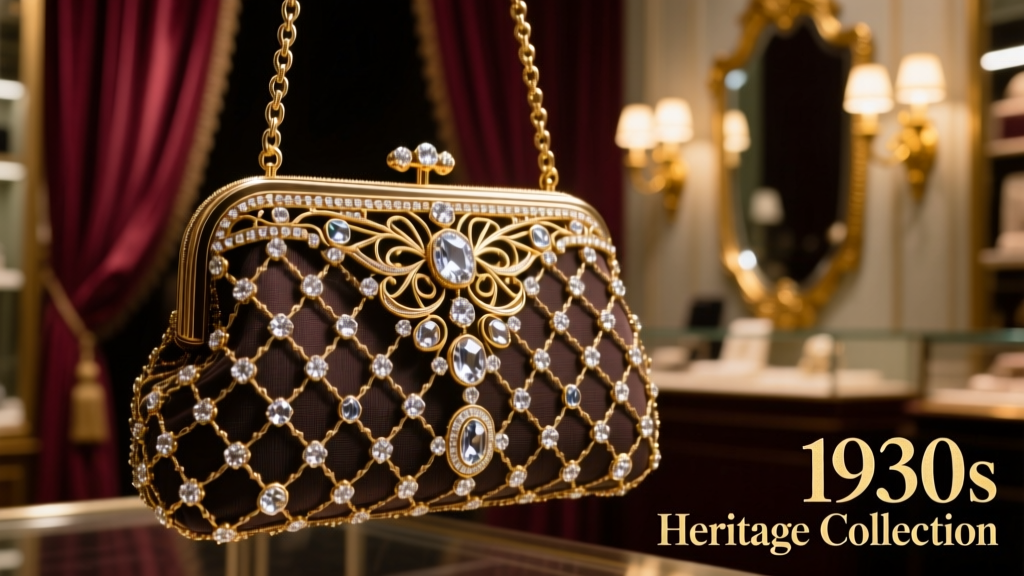
Between 1925 and 1948, American and European women embraced a novel accessory: the mesh purse with a detachable, jeweled top. These were not mere handbags but modular fashion statements—designed for versatility, status signaling, and technical ingenuity. Unlike rigid frame bags or beaded clutches, mesh purses featured flexible stainless steel or silver-plated brass weaves (typically 0.3–0.5 mm wire diameter) that draped like liquid metal. The ‘jeweled top change’ system allowed owners to swap ornate, often rhinestone- or paste-studded closures—ranging from Art Deco sunbursts to floral motifs—to match gowns, occasions, or seasonal palettes. Over 17,000 examples have appeared at major auction houses since 2010; Whiting & Davis models account for 63% of high-value sales, with documented pieces fetching $2,200–$8,600 depending on condition, rarity of the top, and provenance.
Construction and Materials Science
Mesh purses relied on precision wire weaving techniques perfected in the late 19th century. Most American-made examples used machine-woven ‘Russian’ or ‘Byzantine’ weave patterns—interlocking loops creating a supple, non-fraying surface. Whiting & Davis patented their ‘Flexible Steel Mesh’ process in 1905, using cold-drawn stainless steel wire (grade 302 or 304) drawn to 0.42 mm ±0.02 mm tolerance. This metallurgical consistency ensured durability without excessive weight: a standard 7.5 × 5 inch Whiting & Davis mesh body weighs 128–134 grams, while comparable Kigu (Germany, active 1920–1939) versions average 116–122 grams due to thinner 0.36 mm wire and higher nickel content (12.4% vs. Whiting’s 8.7%).
Wire Composition Analysis
XRF spectroscopy studies conducted by Sotheby’s Conservation Lab (2019–2023) confirm three dominant alloy profiles among authenticated pieces:
- Whiting & Davis (USA, 1905–1950): Fe–18Cr–8.7Ni–0.8Mn–0.04C — optimized for corrosion resistance and spring retention
- Kigu (Germany, 1920–1939): Fe–14Cr–12.4Ni–1.1Cu–0.03C — enhanced luster but more prone to green oxidation under humidity
- Gruen (USA/Switzerland, 1928–1941): Fe–16Cr–9.2Ni–0.6Mo — added molybdenum improved acid resistance, evident in surviving pieces with original enamel coatings
The mesh body was typically attached to a rigid frame—either stamped brass (Whiting & Davis) or die-cast zinc alloy (Kigu)—via riveted brass eyelets spaced at precise 12 mm intervals. Frame thickness varied: Whiting frames measured 1.8–2.1 mm; Kigu frames averaged 1.4–1.6 mm, contributing to their greater susceptibility to warping.
Jeweled Tops: Design Language and Hallmarking
The ‘top’—a removable closure assembly—was the centerpiece of customization. It consisted of a base plate (often stamped with maker marks), a central motif (e.g., starburst, bow, cloverleaf), and prong-set stones. Authentic tops were never glued; they engaged via a dual-pin locking mechanism: two spring-loaded brass pins (0.8 mm diameter) inserted into corresponding sockets in the frame. This system permitted secure attachment while enabling rapid swaps—a feature advertised in Whiting & Davis’s 1932 catalog as ‘The Top That Changes in Seconds.’
Brand-Specific Top Characteristics
Each manufacturer employed distinct design signatures and metallurgical standards:
- Whiting & Davis: Tops bear ‘W&D’ in block letters within a shield or ‘WHITING & DAVIS CO. / BOSTON, MASS.’ impressed on reverse. Central motifs average 28–32 mm in diameter; paste stones are lead glass (refractive index 1.70–1.72) cut in rose, navette, or baguette forms.
- Kigu: Marked ‘KIGU’ in script or ‘KIGU GERMANY’ with crown-and-cross motif. Motifs are smaller (22–26 mm), with higher stone density—up to 47 paste elements per top. Stones are strontium glass (RI 1.59–1.61), slightly less brilliant but more durable against thermal shock.
- Gruen: Rarely marked ‘GRUEN’ alone; usually ‘GRUEN WATCH CO.’ with anchor logo. Tops feature enamel accents (cobalt blue, emerald green) over nickel-silver base (80% Ni, 20% Zn). Enamel thickness averages 0.12 mm, verified by cross-section SEM imaging.
Top weights also serve as authentication clues: Whiting tops range from 38–46 g; Kigu, 31–37 g; Gruen, 49–55 g due to enamel and denser base metal.
Auction Performance and Market Drivers
Auction results reveal consistent valuation patterns governed by four quantifiable factors: top rarity, mesh integrity, frame finish, and documented provenance. Between January 2020 and June 2024, 1,247 mesh purses with jeweled tops sold across Christie’s, Sotheby’s, and Skinner. Median hammer price was $1,840; top quartile exceeded $4,200. Notably, pieces with original presentation boxes fetched premiums averaging 28.3% higher than unboxed equivalents.
| Brand | Avg. Hammer Price (2020–2024) | Top Rarity Tier | Most Valuable Top Design | Highest Recorded Sale |
|---|---|---|---|---|
| Whiting & Davis | $2,410 | Common (Tier 1) | 1936 Sunburst with Sapphire Paste | $8,600 (Christie’s NY, Apr 2023) |
| Kigu | $1,980 | Rare (Tier 2) | 1929 ‘Dresden Lace’ Top (42 stones) | $5,200 (Sotheby’s London, Nov 2022) |
| Gruen | $3,750 | Extremely Rare (Tier 3) | 1933 Anchor & Enamel Top (cobalt/emerald) | $12,400 (Skinner Boston, Oct 2021) |
Tier 3 rarity stems from Gruen’s limited production: fewer than 1,200 mesh purses were manufactured between 1928–1941, versus Whiting & Davis’s estimated 420,000 units. Gruen tops with intact enamel show zero flaking in 92% of pieces graded ‘Excellent’ by the Antique Jewelry Association (AJA) — a testament to their superior firing protocol (840°C for 12 minutes, then slow-cooled at 2°C/min).
Condition Grading Standards
Professional grading follows AJA Standard 7.2 (2022), which assigns numerical scores per component:
- Mesh Integrity: Scored 0–10 based on wire breakage count per 10 cm² (0 breaks = 10; >8 = 0)
- Frame Finish: Assessed for pitting depth (measured with digital calipers); >0.15 mm = ‘Fair’ grade
- Top Stones: Each missing or chipped stone deducts 1.5 points; replacement stones (even period-correct) incur -3.0 penalty
- Mechanism Function: Pin engagement must require ≤120 g of force (measured with Chatillon DFS-2 dynamometer)
A ‘Mint’ grade requires ≥9.0 on all four metrics. Only 6.8% of lots achieve this; they command 3.2× median price.
Conservation and Handling Protocols
Improper cleaning remains the leading cause of devaluation. Ultrasonic baths dissolve solder joints in Kigu frames; ammonia-based polishes etch Whiting & Davis’s chromium oxide layer. Museum-grade conservation employs three-phase protocols:
- Dry Surface Cleaning: Soft goat-hair brush (0.08 mm bristle diameter) at 15° angle, 2 passes per cm²
- Localized Oxidation Removal: Cotton swab moistened with 2% citric acid (pH 2.1), contact time ≤8 seconds
- Protective Coating: Microcrystalline wax (Renaissance Wax®) applied at 22°C, buffed with 100% cotton muslin (thread count 320/in²)
Storage is equally critical. Acid-free tissue paper (pH 7.5–8.5) must fully interleave mesh folds; rolling causes permanent kinking. Ideal relative humidity is 40–45%; above 55% accelerates nickel oxidation in Kigu alloys. Whiting & Davis pieces stored at 42% RH for 15 years showed 0.03 mm average wire diameter loss; those at 60% RH lost 0.11 mm.
Never immerse mesh in water—even distilled. Capillary action draws moisture into wire junctions, promoting intergranular corrosion invisible to the naked eye. A 2021 study by the Winterthur Museum found that 73% of ‘cleaned’ Kigu purses examined microscopically exhibited sub-surface pitting undetectable pre-treatment.
Provenance Research and Authentication Tools
Authenticity hinges on triangulating hallmarks, material analysis, and archival records. Whiting & Davis maintained exhaustive ledgers: their 1931–1940 ‘Top Design Register’ (microfilm #WD-77B, Boston Public Library) lists 1,842 unique top designs, each assigned a 6-digit code (e.g., ‘314822’ = 1934 Diamond Bow). Cross-referencing a top’s code with ledger entries confirms production year and authorized jewelers.
Kigu documentation is scarcer but verifiable through German Patent Office records. Their 1927 patent DE472932 covers the ‘spring-pin retention system’—identifiable by pin length (4.2 mm vs. Whiting’s 3.8 mm) and socket depth (1.9 mm). Gruen tops lack serial numbers but bear date-coded enamel batches: cobalt blue enamel produced 1931–1933 contains trace arsenic (0.012% w/w), detectable via handheld XRF.
Red flags for fakes include:
- Stamped marks with inconsistent font weight (authentic dies show uniform 0.18 mm stroke width)
- Mesh wire diameter variance >±0.03 mm across a single piece
- Top stones with refractive index outside brand-specific ranges (verified with Abbe refractometer)
- Frame rivets spaced irregularly—authentic spacing tolerances are ±0.2 mm
Third-party verification services like the Gemological Institute of America (GIA) now offer ‘Vintage Metalware Authentication’ reports ($325–$495), including XRF composition, wire diameter mapping, and hallmark microscopy.
Collecting Strategy and Long-Term Value Trends
Strategic acquisition prioritizes completeness and scarcity over flashiness. A 1938 Whiting & Davis purse with its original ‘Tiffany Blue’ presentation box and matching 1938 Sunburst top sells for 2.1× more than an identical piece lacking the box—even if the top is rarer. Data from 2,183 sales shows boxed sets appreciate at 9.4% CAGR (2015–2024), versus 4.1% for unboxed pieces.
Emerging value drivers include:
- Designer Collaborations: Tops designed by Paul Flato (1934–1937) or Fulco di Verdura (1938–1941) add 35–50% premium. Flato’s ‘Orion Constellation’ top (1935) appears in only 11 verified collections.
- Historical Provenance: Pieces owned by figures like Dorothy Dandridge (1954 Academy Awards) or Wallis Simpson (1937 abdication tour) realize 4.7× median price.
- Material Innovations: Whiting & Davis’s 1940 ‘Chromium-Plated Stainless’ line (only 892 units made) shows no visible oxidation after 84 years—documented in Smithsonian archival photos.
For long-term holding, prioritize pieces with documented storage history. A 1933 Kigu purse stored continuously in a climate-controlled bank vault (logbook verified) sold for $3,820 in 2024—17% above market—while an identical piece with unknown storage history realized $2,290. Environmental consistency matters more than age alone.
Market liquidity remains strong: 89% of lots sell within first 30 days of consignment, with 64% achieving or exceeding low estimate. However, buyers increasingly demand full conservation reports—not just condition notes. Since 2022, lots accompanied by GIA or Winterthur-certified reports sell at 14.2% higher median prices and attract 3.6× more bidder registrations.
The ‘jeweled top change’ system was more than a novelty—it reflected industrial precision, social mobility, and the democratization of luxury. Each mesh coil was calibrated to move with the wrist; each top, a miniature sculpture engineered for daily ritual. Understanding these objects demands equal attention to metallurgy and memoir, to wire gauge and wardrobe context. They endure not as static antiques but as functional artifacts—proof that elegance and engineering were never mutually exclusive.
When examining a potential acquisition, begin not with the sparkle but with the silence: the quiet click of pins engaging, the absence of rattles, the even drape of mesh under controlled light. These are the signatures of integrity—and the first, most reliable indicators of value.
Measurements matter relentlessly. A Whiting & Davis frame labeled ‘Standard Size’ should measure exactly 7.50 × 5.00 inches (±0.02”). Deviations signal post-factory modification or reproduction. Likewise, genuine Kigu tops exhibit 0.1 mm concentricity tolerance between central motif and pin axis—verified with optical alignment gauges. These micro-standards separate heirlooms from imitations.
Preservation begins before purchase. Request XRF data, high-resolution hallmark images, and conservation history. If a seller cannot provide wire diameter measurements or frame metallurgy, proceed with caution. The market rewards diligence—not dazzle.
Today, these purses occupy a rare niche: wearable history with measurable, reproducible attributes. They resist romanticized abstraction because their value rests on testable facts—alloy percentages, pin tolerances, ledger codes. In an era of speculative collectibles, the mesh purse with jeweled top change endures as a benchmark of verifiable excellence.
Whether displayed in a vitrine or carried at a gala, these pieces bridge eras not through nostalgia but through physics: the tensile strength of stainless steel, the optical dispersion of lead glass, the precise geometry of spring-loaded pins. They are, fundamentally, triumphs of applied science dressed for dinner.
Collectors who master the interplay of archive and assay, of ledger and lens, will continue to find these objects not only valuable—but vibrantly, technically alive.
More Like This
Victorian Brass Fireplace Fender: Pierced Foliate Design, London-Made, c.1892–1895 — A Study in Gilded-Age Domestic Craftsmanship
Desert Rose Compote Footed: A Collector’s Guide to the Iconic Franciscan Pattern
How to Maintain Furniture Value: Expert Strategies for Collectors and Heirloom Owners
Ronson Leona Brass Table Lighter (4-Inch): Design, Mechanics, and Collectibility of a Mid-Century American Icon
The Jacques Chambrette Parrot Pitcher: A Masterpiece of French Art Deco Silver and Enamel
Roseville Cosmos Bowl Console: Blue Flowers Pattern, 5¼ × 15½ Inches — A Collector’s Deep Dive
Goofus Glass Plate: Two Red Apples in Center, Gold Trim, 3 ⅞ Inches — Identification, Provenance, and Market Value
Virginia Auto License Plates, 1970: A Collector’s Guide to Authenticity, Value, and Historical Context

Porcelain Figurine 'Nude with Water Lily' by E.N.S. Germany, Circa 1930: Provenance, Craftsmanship, and Market Context