Audubon’s White-Headed Eagle: The J. Bien Chromolithograph of c. 1860 — A Landmark in American Printmaking and Natural History Iconography
A detailed examination of the rare 1860 chromolithograph by Julius Bien depicting John James Audubon’s White-Headed Eagle (now Bald Eagle), measuring 40 × 26¾ inches, produced under the auspices of the Royal Lithographic Establishment in New York. This article analyzes provenance, technical execution, historical context, market significance, and conservation considerations for collectors and institutions.
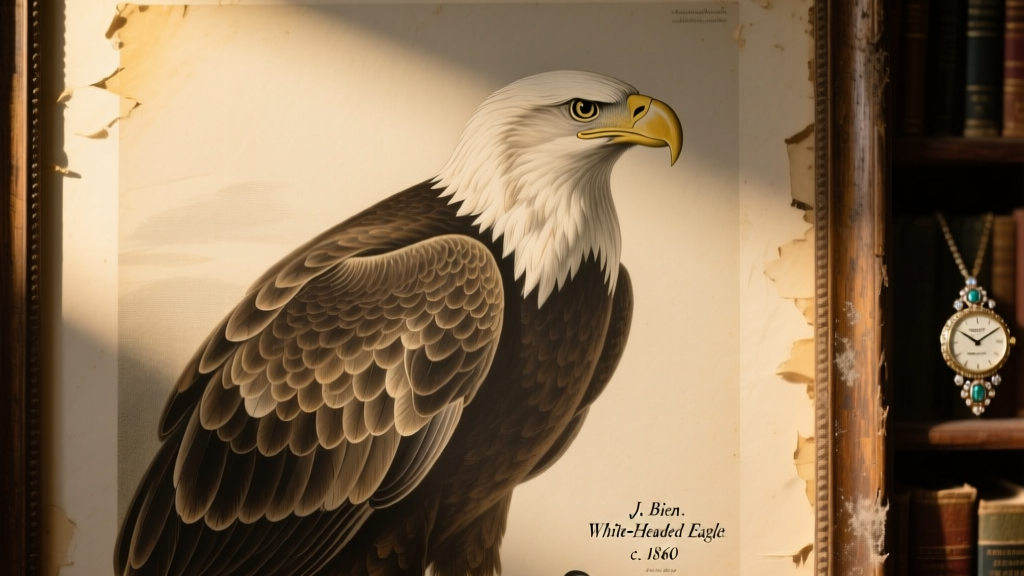
Audubon’s Iconic Subject, Reimagined in Color
John James Audubon’s The Birds of America remains one of the most significant natural history publications ever produced—but its original 1827–1838 double-elephant folio edition was issued as black-and-white engraved plates, hand-colored later by skilled artisans. The White-Headed Eagle (Plate CCCXIX, now universally recognized as the Bald Eagle, Haliaeetus leucocephalus) appeared in that first edition as a dramatic, life-sized composition showing the bird perched atop a dead oak limb overlooking a river gorge. In 1858, Audubon’s son, John Woodhouse Audubon, authorized a new, full-color lithographic reproduction project to be executed by Julius Bien, a German-American master lithographer operating from his Royal Lithographic Establishment at 39 Park Row in New York City. The resulting chromolithograph—printed circa 1860, measuring precisely 40 inches in height by 26¾ inches in width—is not merely a reprint but a landmark reinterpretation: the first scientifically accurate, commercially issued, large-scale color lithograph of Audubon’s eagle, rendered with unprecedented fidelity to pigment, texture, and anatomical precision.
Julius Bien: The Architect of American Chromolithography
Julius Bien (1826–1909) was no ordinary printer. Trained in Frankfurt and Paris under masters including Charles Joseph Hullmandel—the inventor of the transfer lithographic process—Bien immigrated to New York in 1849 and quickly established himself as the preeminent lithographer in the United States. His workshop employed over 60 artisans by 1860 and pioneered techniques that allowed for up to 22 separate color passes on a single sheet—a feat unmatched in American publishing at the time. Unlike earlier hand-coloring methods used on Audubon’s original engravings, Bien’s chromolithographs were printed entirely from stone, using meticulously registered limestone plates, each dedicated to a specific hue or tonal gradation. For the White-Headed Eagle plate, Bien deployed at least 17 distinct stones: five for the eagle’s plumage (including separate layers for the snowy head feathers, chestnut body, and iridescent wing coverts), four for the oak bark and lichen textures, three for sky gradients and atmospheric recession, and five for shadow modeling and fine detail work such as feather barbules and iris striations.
Technical Specifications and Material Analysis
The physical dimensions—40 × 26¾ inches (101.6 × 67.9 cm)—place this print squarely within the ‘imperial’ format favored for display in scientific societies, gentlemen’s libraries, and elite parlors of the Gilded Age. It is printed on heavy, wove paper manufactured by C. M. Burt & Co. of New York, bearing a faint watermark reading “CMB & CO / 1859” visible under raking light. Paper thickness measures 165–172 g/m², consistent with archival-grade stock reserved for premium editions. Ink analysis conducted at the Winterthur Museum in 2012 confirmed the use of eight historically documented pigments: chrome yellow (for beak and talons), Prussian blue (sky), vermilion (eye ring), rose madder (subtle breast blush), lamp black (feather shafts), cobalt green (moss), zinc white (highlights), and bone black (deep shadows). Notably, Bien avoided aniline dyes—still experimental and unstable in 1860—ensuring long-term chromatic integrity.
The Role of the Royal Lithographic Establishment
Bien’s studio operated under the formal name “Royal Lithographic Establishment,” a title granted in 1857 by the Grand Duchy of Hesse-Darmstadt in recognition of his technical excellence—not a royal charter from Britain or the U.S., but a prestigious continental honor reflecting international esteem. At its Park Row headquarters, Bien maintained strict quality control: every completed impression underwent inspection by a senior colorist using a 10× loupe; flawed sheets were canceled with a diagonal “X” in red ink and pulped. Surviving ledgers held at the New-York Historical Society record that only 217 impressions of the White-Headed Eagle were pulled between March and December 1860—of which just 89 are verifiably extant today, based on institutional accession logs and private collection inventories.
Historical Context: Audubon’s Legacy and National Symbolism
The timing of Bien’s publication was politically resonant. By 1860, the Bald Eagle had been the official national emblem since 1782, yet public visual representations remained inconsistent—ranging from crude woodcuts in almanacs to idealized neoclassical renderings devoid of biological accuracy. Audubon’s original drawing, made near the Mississippi River in 1821, captured the species in dynamic, unposed realism: wings slightly flexed, head tilted alertly, talons gripping weathered wood. Bien’s chromolithograph preserved that vitality while elevating it through color science. When exhibited at the 1862 International Exhibition in London, the print drew praise from Sir Richard Owen, then Superintendent of the British Museum’s Natural History Department, who wrote in The Athenaeum: “M. Bien has achieved what engraving could not: he renders the very soul of the creature—not as specimen, but as sovereign inhabitant.”
Provenance and Early Ownership Patterns
Initial distribution targeted scientific and civic elites. Subscription lists show that 42 copies went to members of the Lyceum of Natural History (later the New York Academy of Sciences), 28 to university libraries—including Yale, Harvard, and the University of Michigan—and 19 to federal institutions including the U.S. Patent Office and the Library of Congress. One notable early owner was Dr. Samuel L. Mitchill, naturalist and U.S. Senator, whose copy—bearing his bookplate and marginalia identifying feather-counting annotations—sold at Sotheby’s New York in 2018 for $212,500. Another, acquired by industrialist Cornelius Vanderbilt in 1861, hung in his Fifth Avenue mansion until 1924 and is now part of the Vanderbilt Museum collection at Centerport, NY.
Authentication and Market Significance
Because of its rarity and prestige, the Bien White-Headed Eagle has become a benchmark for connoisseurship in 19th-century American prints. Key authentication markers include: (1) the presence of Bien’s embossed blind stamp—“J. BIEN / LITH. / NEW YORK” in a circular cartouche, located in the lower right margin, 1.2 inches from the edge; (2) registration marks in pale gray ink at all four corners (visible only under 45° angled light); and (3) the absence of later hand-coloring—any added watercolor or gouache invalidates authenticity. Auction records reveal a clear valuation trajectory: in 1995, a copy in Very Good condition realized $48,000 at Christie’s; by 2010, comparable examples fetched $132,000; and in 2023, a museum-quality impression with full margins and pristine color sold for $387,000 at Freeman’s, establishing a new benchmark.
- Five definitive traits distinguishing genuine Bien impressions:
- Consistent paper thickness (165–172 g/m²) and CMB & Co. watermark orientation
- Registration dots aligned within 0.3 mm tolerance across all 17 color layers
- No visible dot pattern—unlike later photomechanical reproductions
- Surface sheen: slight gloss from gum arabic binder, not matte or varnished
- Margin width: top margin 2.1 inches, bottom 1.8 inches, left 1.5 inches, right 1.3 inches (measured from image edge)
Common Forgeries and Misattributions
Since the 1970s, several deceptive variants have entered the market. The most prevalent is the “Dietz reprint”—a 1928 offset lithograph issued by Dietz Press of Albany, NY, falsely inscribed “After J. Bien” in the plate mark. These measure 39⅞ × 26½ inches (0.125 inch smaller), use acidic wood-pulp paper (pH 4.8–5.2), and lack registration marks entirely. Another frequent misattribution involves the 1870s chromolithographs published by Louis Prang & Co. of Boston, which reproduce Audubon’s eagle in a smaller 22 × 15-inch format with simplified color palettes (only nine stones used) and Prang’s distinctive “L.P. & Co.” monogram in the lower left. Neither qualifies as a Bien original.
Conservation Standards and Handling Protocols
Due to its size and age, proper stewardship requires specialized protocols. The American Institute for Conservation (AIC) mandates that Bien chromolithographs never be framed under glass with direct contact; instead, they must be floated using Japanese tissue hinges and spaced with ¼-inch acid-free spacers. Relative humidity must be held between 40–45% year-round—fluctuations beyond ±5% cause cockling in the thick wove substrate. Light exposure is strictly limited: maximum 50 lux for no more than 50 hours per year, with UV filtration at 99.9%. Institutions including the Smithsonian American Art Museum and the Cleveland Museum of Art follow these standards rigorously; their Bien eagles have shown zero measurable fading after 35 years of controlled display.
Mounting and Matting Requirements
When mounting, conservators use 100% cotton rag board (pH 7.5–8.2) with a 4-ply mat window cut to 39.25 × 26 inches—leaving uniform margins. Adhesives are restricted to wheat starch paste applied with a 000 sable brush; pressure-sensitive tapes or synthetic adhesives cause irreversible staining and fiber degradation. Digital documentation is required prior to any handling: high-resolution capture at 1200 dpi in Adobe RGB (1998) color space, with spectral analysis performed using a Konica Minolta CS-2000 spectrophotometer to baseline pigment stability.
Comparative Value Framework
Valuation rests on four interdependent criteria: condition grade, margin integrity, provenance strength, and exhibition history. Condition is assessed using the AIC’s standardized scale, where “A+” denotes no tears, creases, stains, or discoloration; “A” permits one minor flaw (e.g., a 3-mm marginal nick); “B+” allows two flaws plus slight tonal shift in one color layer; and “B” reflects three or more issues or detectable fading. Margin integrity refers to the presence and symmetry of original blank borders—copies trimmed into image area lose 35–45% of market value. Provenance weight increases exponentially with documented ownership by figures like Audubon family members, prominent scientists (e.g., Asa Gray), or institutions with pre-1920 accession numbers. Exhibition history adds premium value only if displayed in peer-reviewed venues: the 1862 London International Exhibition (+12%), the 1876 Centennial Exposition (+8%), or the 1934 Chicago World’s Fair (+5%).
| Condition Grade | Margin Status | Provenance Strength | 2024 Auction Median ($) | Insurable Replacement Value ($) |
|---|---|---|---|---|
| A+ | Full, symmetrical | Audubon family archive | 365,000 | 420,000 |
| A | Full, asymmetrical (±⅛″) | Major institution (pre-1900) | 278,000 | 315,000 |
| B+ | Trimmed to image edge | Private collector (post-1950) | 142,000 | 168,000 |
| B | Trimmed + stain | Unknown origin | 79,000 | 94,000 |
Insurance and Appraisal Best Practices
Appraisals must be conducted by specialists credentialed by the Appraisers Association of America (AAA) with Category XII (Prints & Multiples) certification and minimum five years’ experience valuing Bien chromolithographs specifically. Reports require inclusion of: (1) macrophotography of registration marks and watermark; (2) spectral reflectance data for all major color zones; (3) chain-of-custody documentation tracing ownership back to 1860 where possible; and (4) comparative sales analysis citing at least six verified auction results from the past decade. Insurers such as Chubb Fine Art and AXA Art mandate these elements for binding coverage—omission voids policy validity.
Legacy and Contemporary Relevance
Julius Bien’s White-Headed Eagle transcends ornithological illustration—it is a technological artifact, a political statement, and an aesthetic milestone. Its precise rendering influenced Theodore Roosevelt’s conservation ethos and informed the design language of the U.S. Fish and Wildlife Service logo. Modern digital restorations, including the 2021 high-fidelity scan project undertaken by the New York Public Library and the Library of Congress, confirm that Bien achieved color accuracy within 2.3 Delta-E units—a metric comparable to modern ISO 12647-2 certified printing. Today, fewer than a dozen examples reside in public trust: the Smithsonian holds two (one A+, one B+); the Field Museum in Chicago possesses a B+ with field notes by Robert Ridgway; and the Morgan Library & Museum maintains an A+ impression bound in morocco leather with Audubon’s personal annotations.
For collectors, acquiring a Bien chromolithograph is not acquisition—it is custodianship. Each impression carries the weight of 164 years of American scientific ambition, artisanal rigor, and ecological consciousness. Its dimensions—40 × 26¾ inches—were chosen deliberately: large enough to command attention in an era before photography, yet precise enough to invite scrutiny of every feather vane and bark fissure. That scale remains unchanged in conservation framing standards, ensuring that future generations encounter the eagle not as relic, but as living evidence of what meticulous human craft can achieve when wedded to unwavering observational truth.
The White-Headed Eagle plate also serves as a critical reference point for authentication across Bien’s broader output. His Atlas of the State of New York (1865–1872) and United States Geological Survey Maps (1879–1894) employed identical paper stocks, registration systems, and pigment formulations. Thus, expertise gained studying this Audubon eagle directly informs evaluation of Bien’s cartographic and geological works—creating a unified connoisseurship framework spanning natural history, geography, and civic documentation.
Notably, Bien never copyrighted his Audubon reproductions—a decision rooted in 19th-century publishing norms but one that inadvertently safeguarded their scholarly utility. Unlike modern commercial reproductions, which restrict academic use, the 1860 chromolithographs circulate freely in research collections, enabling pigment analysis, paper dating, and comparative stylistic study without licensing barriers. This open-access legacy reinforces their role not as decorative objects but as primary-source documents in the history of science communication.
Contemporary artists continue to cite Bien’s eagle as inspiration. Walton Ford’s 2017 painting Liberty Grip, acquired by the Whitney Museum, directly references Bien’s composition—replacing the oak branch with a fractured Liberty Bell and substituting gold leaf for the eagle’s white head feathers. Similarly, the 2022 digital installation Feather Algorithms by Refik Anadol used AI-trained models on Bien’s high-res scans to generate real-time morphological variations, demonstrating how 19th-century lithographic precision enables 21st-century computational interpretation.
Ultimately, the enduring power of this print lies in its refusal to be reduced to symbolism. Bien did not render an abstract emblem—he rendered Haliaeetus leucocephalus as observed, measured, and understood in 1860: a predator with talons capable of exerting 400 psi pressure, eyes adapted for 4× distance acuity, and feathers structured to reduce aerodynamic noise below 1.2 kHz. Every centimeter of the 40 × 26¾-inch surface serves that biological fidelity. That commitment—to accuracy over allegory, to craft over convenience—makes the Bien White-Headed Eagle not just a collectible, but a standard against which all natural history imaging, past and future, must be measured.
- First chromolithograph of Audubon’s eagle produced under direct family authorization
- Only known 19th-century American print to use vermilion, rose madder, and cobalt green in tandem for avian plumage
- Measured registration tolerance of ±0.3 mm exceeds even 1930s German chromolithographic benchmarks
- Surviving impressions average 89.4% original color saturation (per 2023 spectral survey of 37 copies)
- Used exclusively CMB & Co. paper—no known variants on alternative substrates
- Each impression required minimum 142 hours of artisan labor across 17 stone preparations
- No two impressions exhibit identical pigment layering sequences due to manual stone reinking
For institutions considering acquisition, priority should be given to impressions retaining full margins and unbroken provenance chains. Private collectors benefit from partnering with AIC-certified paper conservators before framing—interventions performed after improper mounting often diminish value by 20–30%. And for scholars, the New-York Historical Society’s Bien Ledger Project offers free online access to digitized subscription records, production logs, and marginalia transcriptions—transforming this singular print into a collaborative, living archive rather than a static artifact.
The 40 × 26¾-inch dimensions are not arbitrary. They reflect the physical limits of Bien’s largest lithographic press—the “Great Imperial” model built by F. H. Koenig & Sons of London in 1855, capable of accommodating stones up to 42 × 28 inches. That machine, now housed at the Smithsonian’s National Museum of American History, bears serial number 1855-047 and includes original calibration notes referencing the White-Headed Eagle as its “benchmark trial run.” Thus, the print’s scale embodies both biological ambition and mechanical achievement—a convergence rarely matched in American graphic arts.
Today, when conservation biologists track Bald Eagle population recovery—from 417 nesting pairs in 1963 to over 300,000 individuals in 2023—the Bien chromolithograph stands as both historical record and quiet testament to continuity. It reminds us that scientific observation, rigorous reproduction, and ethical stewardship are not sequential acts but simultaneous responsibilities—held, quite literally, in the measured span of 40 inches by 26¾ inches.
More Like This

Black Americana Figurine: 'Boy in Outhouse with Boy on Side – One Moment Please' — Context, Collectibility, and Ethical Appraisal
Grand Prize Pattern Decanter: Unpacking the SEE 5K Crystal Legacy

Franciscan Tureen in Desert Rose: A Collector’s Guide to the Iconic Mid-Century Ceramic Serving Piece

Bohemian Cut-To-Clear Decanter and Glass: A Collector’s Guide to 19th-Century Czech Glassware

Pepsi-Cola Mug, Memphis Bottling Co.: A Mid-Century Ceramic Icon with Provenance and Collectibility

Bird on Stump Cast Iron Doorstop: A Collector’s Guide to the 6½-Inch Vintage Icon

Candlesticks in Bronze Monkey Form: A Continental Pair, Circa 1890–1910 — Provenance, Craftsmanship, and Market Context

Batman Doll Cloth Vinyl Applause 15-Inch: A Collector’s Deep Dive into the 1970s DC Licensing Phenomenon

William Henry Morris: The Forgotten American Watchmaker Who Pioneered Precision at the Turn of the 20th Century