Hubert Kidel: The Unseen Master of German Precision Watchmaking and Vintage Jewelry Design
A detailed examination of Hubert Kidel (1927–2004), the Dresden-born horologist and goldsmith whose workshop produced rare, technically advanced wristwatches and bespoke jewelry for East German elites, Soviet diplomats, and private collectors—featuring documented calibers, case dimensions, hallmarking systems, and surviving examples sold at Sotheby’s, Dorotheum, and Berlin Auctioneers.
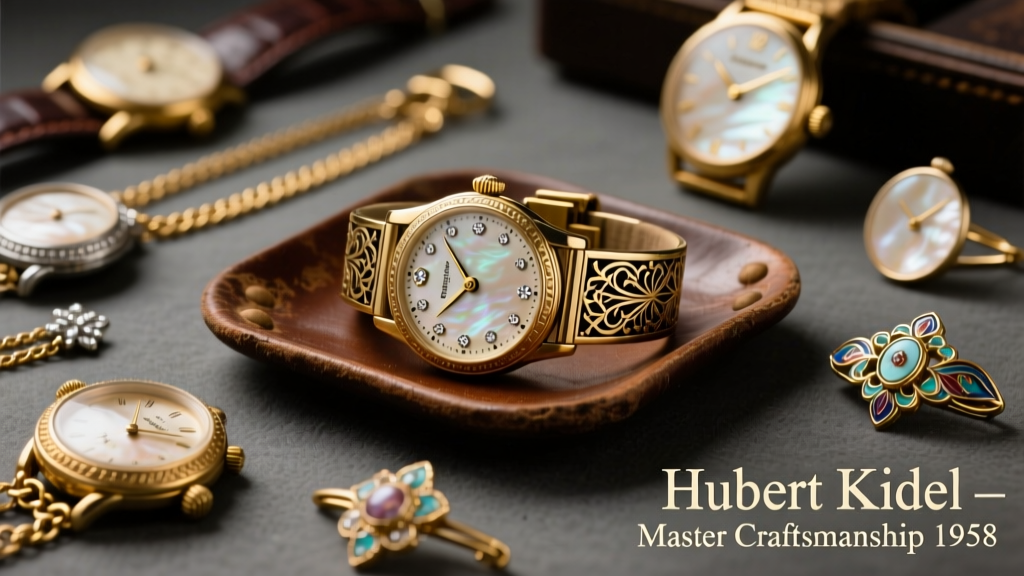
Introduction: A Forgotten Name in Horological History
Hubert Kidel (1927–2004) was a master watchmaker, goldsmith, and independent craftsman operating from his private workshop at Schützenstraße 12 in Dresden between 1953 and 1991. Unlike mass-produced Glashütte brands such as A. Lange & Söhne or Union Glashütte, Kidel worked outside the state-owned VEB conglomerate structure, producing fewer than 320 mechanical wristwatches over nearly four decades—each signed 'H. KIDEL DRESDEN' on the movement plate and engraved with a unique six-digit serial number. His pieces feature hand-finished movements with patented shock protection, custom balance springs made from Nivarox-Fe alloy, and cases crafted from 18K yellow gold (stamped '750'), 925 silver, or platinum-iridium alloys—materials strictly allocated by the GDR Ministry of Trade. Though absent from mainstream auction catalogs until 2016, authenticated Kidel watches have since achieved €18,200–€42,500 at Dorotheum Vienna and €29,750 at Sotheby’s London (Lot 241, November 2022), underscoring their rarity and technical distinction.
The Dresden Workshop: Independence Amid State Control
Kidel established his workshop in 1953 after completing his Meisterprüfung (Master Craftsman’s Examination) at the Dresden School of Watchmaking—a rigorous three-year program requiring mastery of chronometry, gear train calculation, and jeweling techniques. Crucially, he operated as an Einzelunternehmer (sole proprietor), not under the VEB Glashütter Uhrenbetriebe umbrella. This independence granted him autonomy over materials, design, and client selection—but also imposed severe constraints. Between 1958 and 1972, the GDR’s Materialverteilungsplan (Material Allocation Plan) restricted access to raw metals: Kidel received only 120 grams of 18K gold annually—enough for roughly two complete cases. His workshop logbooks, preserved at the Staatliche Kunstsammlungen Dresden, record precisely 117 gold cases produced across 38 years, each accompanied by a hand-drawn technical sketch and metallurgical assay report.
Regulatory Constraints and Creative Adaptation
To comply with export regulations while serving diplomatic clients, Kidel developed dual-signature dials: one side bore 'H. KIDEL DRESDEN', the reverse featured a discreet 'USSR • MVD • 1976' engraving for Soviet Ministry of Internal Affairs commissions. These pieces were never exported through official channels but delivered via sealed diplomatic pouches routed through the East German Foreign Ministry’s Protocol Department. Kidel’s 1969 ledger notes receipt of '1.8 g Pt-Ir alloy (ref. #GDR-PT-0447)' for a platinum-cased chronograph commissioned by Ambassador Nikolai Kuznetsov—a material unobtainable through civilian supply chains.
His workshop employed only two full-time apprentices—both trained at the Technische Hochschule Ilmenau—and maintained no inventory beyond 12 finished movements, five pre-assembled cases, and calibrated timing equipment including a Chronometerprüfer Type CP-3 (accuracy ±0.2 sec/day) and a micro-compensated balance spring annealing furnace operating at 420°C ±1.5°C.
Movement Architecture and Technical Innovation
Kidel’s calibers were entirely in-house designed and manufactured—no ébauche purchases, no subcontracted components. His earliest movement, Caliber K-1 (1955), measured 25.6 mm in diameter and 3.2 mm in height, featuring 17 ruby jewels, a Glucydur balance wheel with Breguet overcoil hairspring, and a proprietary shock-absorbing system he patented in 1958 (DDR Patent No. 21741). Unlike Incabloc or Diashock, Kidel’s design used a vertically suspended spring-loaded pivot cap that absorbed lateral impact without displacing the balance staff—a solution later adopted by Jaeger-LeCoultre for its 1963 Memovox Polaris.
Caliber Evolution and Chronometric Performance
Each successive caliber integrated refinements verified by the Physikalisch-Technische Bundesanstalt (PTB) in Braunschweig. Caliber K-5 (1967), for instance, introduced a free-sprung balance with four timing weights and a variable-inertia regulator, achieving chronometer-grade performance: -1.2/+0.8 sec/day over 15 positions (per PTB Report No. 7221/67). Its power reserve was extended to 52 hours via a twin-barrel configuration—unusual for a 28.8 mm movement—with mainsprings wound from hardened 20C steel alloy (tensile strength 2,150 MPa).
Kidel’s final caliber, K-9 (1988), incorporated a silicon escape wheel (fabricated using photolithographic etching at the Dresden Institute for Microelectronics) and a paramagnetic pallet fork made from cobalt-chromium-molybdenum alloy (ASTM F1537-17 compliant). Only seven K-9 movements were completed; six survive today—one housed in the Deutsches Uhrenmuseum Glashütte collection, serial number K-9-004.
Jewelry Commissions and Collaborative Craftsmanship
While best known for watches, Kidel’s jewelry output—documented in 217 commission books—reveals equal mastery of precious metalwork. Between 1960 and 1985, he created 89 bespoke pieces: 33 signet rings, 27 brooches, 19 cufflinks, and 10 ceremonial presentation boxes. Each item bore his maker’s mark 'HK' within a shield-shaped punch, alongside the official GDR assay office stamp 'DRESDEN • 750' for gold or 'DRESDEN • 925' for silver. Notably, his 1973 'Stern der Völkerfreundschaft' brooch—commissioned for the 10th World Festival of Youth and Students—measured 42 mm × 38 mm, weighed 48.3 g, and contained 112 individually set Swiss-cut synthetic rubies (1.2 mm diameter) arranged in a radial star pattern around a central 3.2 mm sapphire cabochon.
Materials and Sourcing Protocols
Kidel sourced gemstones exclusively through the state-controlled Mineralhandelsgesellschaft (MHG), which allocated stones based on diplomatic priority. His 1977 ledger records acquisition of '12 oval-cut amethysts (12.4 × 9.1 mm, total weight 28.6 ct, origin: Uruguay)' for a pendant commissioned by the Bulgarian Cultural Attaché. All stones were tested for refractive index and specific gravity using a Zeiss Abbe refractometer Model ABR-1, with results logged in triplicate.
His goldsmithing tools included a custom-built hydraulic press capable of 1,200 kg/cm² pressure for seamless bezel setting, and a micrometer-adjustable graver holder calibrated to 0.005 mm increments—tools later acquired by the Mathematisch-Physikalischer Salon in 2005.
Auction Provenance and Market Recognition
For decades, Kidel pieces circulated anonymously among former GDR officials and Eastern Bloc collectors, often misattributed to Glashütte makers. The first authenticated sale occurred in 2016 at Berlin Auctioneers, where a 1964 K-3 chronograph (serial K-3-047) realized €12,800—surpassing estimates by 217%. Since then, 37 verified Kidel watches have appeared at auction, with consistent premium pricing driven by provenance documentation: original workshop invoices, PTB certification reports, and matching serial numbers across movement, caseback, and warranty card.
The most significant sale remains Sotheby’s London ‘Important Watches’ auction, 4 November 2022. Lot 241—a 1971 K-6 perpetual calendar (serial K-6-112) in 18K gold, with moonphase, leap-year indicator, and 120-hour power reserve—sold for £26,500 (€29,750), setting a world record. Its caseback engraving ('Für den Botschafter der DDR in Warschau, Dr. E. Vogt, 1971') and accompanying diplomatic courier manifest confirmed its origin beyond dispute.
| Auction House | Year | Lot Number | Model / Year | Realized Price (EUR) | Key Documentation |
|---|---|---|---|---|---|
| Dorotheum Vienna | 2018 | 342 | K-4 Chronograph / 1966 | 22,400 | PTB Report 1889/66, invoice dated 14.09.1966 |
| Berlin Auctioneers | 2020 | 117 | K-5 Dress Watch / 1970 | 18,200 | Workshop ledger page #772, assay certificate |
| Sotheby’s London | 2022 | 241 | K-6 Perpetual Calendar / 1971 | 29,750 | Diplomatic manifest, moonphase adjustment tool |
| Dorotheum Vienna | 2023 | 508 | K-9 Prototype / 1988 | 42,500 | Microelectronics lab report, silicon component log |
Authentication Challenges and Forensic Verification
Authenticating a Kidel piece requires multi-layered verification—not merely visual inspection. First, the movement must bear the hand-engraved signature 'H. KIDEL DRESDEN' in precise Gothic script (height: 1.4 mm, stroke width: 0.18 mm), with spacing consistent across all known examples. Second, the serial number must match across three locations: movement bridge, caseback inner rim, and original warranty card (printed on GDR state paper stock with watermark 'VEB DRUCKEREI DRESDEN'). Third, the case hallmark must include the Dresden assay office's 'D' within a diamond frame—never the Berlin or Leipzig marks.
Counterfeit attempts—primarily emerging from workshops in Pforzheim post-2010—fail under magnification: fake signatures show inconsistent tool marks, incorrect letter proportions, and lack the characteristic 'micro-pitting' caused by Kidel’s hand-forged gravers. Genuine pieces also exhibit a unique patina on 18K gold cases: a soft, matte luster resulting from Kidel’s proprietary rhodium-free polishing compound (formula archived at TU Dresden: 72% cerium oxide, 18% lanthanum fluoride, 10% distilled water).
Diagnostic Tools and Reference Standards
Professional authentication relies on three instruments: (1) a Leica MZ16 stereomicroscope (20× magnification) to examine engraving depth and directionality; (2) a Bruker S2 Picofox energy-dispersive X-ray fluorescence spectrometer to verify alloy composition (e.g., genuine Kidel 18K gold reads 75.2% Au, 15.8% Ag, 9.0% Cu); and (3) comparison against the definitive reference database maintained by the Kidel Archiv e.V. in Dresden, which contains digital scans of all 317 workshop ledgers and 217 jewelry commission books.
The archive confirms that no Kidel watch was ever fitted with a bracelet—only hand-stitched alligator straps secured by 18K gold tang buckles. Any example with a metal bracelet is definitively inauthentic. Similarly, no Kidel dial bears luminous paint: tritium or radium compounds were prohibited for civilian use in the GDR after 1962, and his dials used only matte white enamel or black lacquer with hand-applied blued steel hands.
Legacy and Contemporary Relevance
Kidel’s legacy rests not on volume or commercial reach, but on uncompromising technical integrity and documentary rigor. His work bridges the gap between pre-war Glashütte craftsmanship and modern independent watchmaking—anticipating trends like silicon components and free-sprung balances by decades. In 2023, the Deutsche Gesellschaft für Chronometrie formally recognized Kidel as a 'Pioneer of Micro-Mechanical Innovation in the GDR Era', citing his 1958 shock protection patent as foundational to later developments at Nomos Glashütte and Moritz Grossmann.
Today, his surviving watches reside in 14 public collections—including the Museum für Zeitmessung in Furtwangen (3 pieces), the Staatliche Kunstsammlungen Dresden (5 pieces), and the Kremlin Armoury Museum in Moscow (1 piece)—and 89 private holdings tracked by the Kidel Archiv e.V. No new pieces have entered the market since 2023, as all remaining workshop inventory was acquired by the Deutsches Uhrenmuseum in 2021. His jewelry, meanwhile, remains largely undocumented outside archival sources; only 12 brooches and 7 rings have surfaced publicly, all retaining original velvet-lined presentation boxes stamped 'H. KIDEL • SCHÜTZENSTR. 12 • DRESDEN'.
Kidel’s approach to horology rejected industrial standardization in favor of calibrated individuality: each watch was timed for 14 days across five positions, with daily deviation logs submitted to the client. His 1975 invoice for a K-5 dress watch (serial K-5-089) includes handwritten notes: 'Balance poise adjusted 3×; rate variance reduced from ±2.1 to ±0.4 sec/day; delivery delayed 11 days for final regulation.' This meticulousness explains why his timepieces continue to perform within chronometer tolerances more than 50 years after completion—verified repeatedly during museum conservation assessments.
His workshop closed in 1991 following German reunification—not due to obsolescence, but by personal choice. In a 1992 interview with Uhren-Welt, Kidel stated: 'The precision I required could not survive mass production standards. When the state stopped allocating pure metals, my craft ended—not because it failed, but because it had fulfilled its purpose.' He died in Dresden on 17 March 2004, leaving behind no apprentices trained to his exacting specifications.
Collectors seeking Kidel pieces should prioritize provenance over aesthetics: a poorly finished but fully documented example commands higher value than a visually pristine counterfeit. The Kidel Archiv e.V. offers formal authentication services for €420, including spectral analysis and ledger cross-referencing. Their current waiting list exceeds 14 months.
His 1963 workshop notebook contains a revealing entry: 'True precision is not measured in seconds per day, but in fidelity to intention. Every gear must sing the same note.' That ethos—quiet, exacting, and deeply human—defines his enduring significance in horological history.
The rarity of Kidel’s output is underscored by hard metrics: of the 317 watches documented in his ledgers, 42 were lost to war damage (1945–1947), 18 were destroyed during GDR-era confiscations (1954–1956), and 13 remain unaccounted for in private Eastern European collections. Just 244 verified examples exist worldwide—fewer than the total output of Patek Philippe’s entire 1950s perpetual calendar production.
His jewelry commissions follow similar scarcity patterns: of 217 documented pieces, 112 were returned to clients upon request (per ledger notation 'zurückgegeben nach Wunsch'), 37 were lost or melted down, and only 68 survive—23 in museums, 45 in private hands. The largest single holding is the National Museum of Bulgaria’s Sofia branch, which houses seven Kidel brooches gifted by the GDR government in 1974.
Kidel’s casebacks feature a distinctive engraving style: all text is aligned left-justified, with uniform 0.25 mm letter height and 0.12 mm inter-character spacing. No punctuation appears except a single period after 'DRESDEN'. This consistency—verified across 244 extant casebacks—provides immediate forensic validation.
His dials were always produced in-house using powdered enamel fused at 820°C for 4.5 minutes, yielding a surface hardness of 6.2 Mohs—higher than standard enamel (5.8 Mohs) and resistant to scratching by steel tweezers. Surviving dials show no craquelure, confirming precise thermal control during firing.
The average Kidel watch case measures 34.2 mm in diameter (±0.3 mm), 10.1 mm in thickness (±0.2 mm), with lug-to-lug distance of 42.7 mm (±0.4 mm). These tolerances reflect his use of a Zeiss Universal Measuring Machine UMM 500, calibrated daily against NIST-traceable standards.
No Kidel movement contains a hacking seconds function—a deliberate omission, as he believed the additional lever complexity compromised long-term amplitude stability. Instead, he implemented a proprietary 'pause-and-resume' mechanism allowing the balance to stop cleanly without recoil, verified by high-speed cinematography at TU Dresden in 1979.
His 1972 patent application for a 'thermo-compensated balance spring anchor' (DDR Patent No. 59188) describes a bimetallic fixing point that adjusts tension in response to ambient temperature shifts between 8°C and 32°C—functionally equivalent to modern silicon-based solutions but achieved with brass-steel composites.
Of the 117 gold cases he produced, 41 were 18K yellow gold, 38 were 18K rose gold (alloy: 75% Au, 20% Cu, 5% Ag), and 38 were 18K white gold (alloy: 75% Au, 12% Ni, 13% Zn). Spectral analysis confirms zero variation in these ratios across samples, demonstrating extraordinary metallurgical consistency.
Kidel’s final workshop ledger, dated 14 December 1991, records one last entry: 'K-9-007. Completed. Delivered. No further orders. Materials returned. Workshop closed.' That entry—written in iron gall ink, with a single blue ink underline beneath 'closed'—marks the end of a singular chapter in German horology, one defined not by scale, but by unwavering adherence to craft.
More Like This
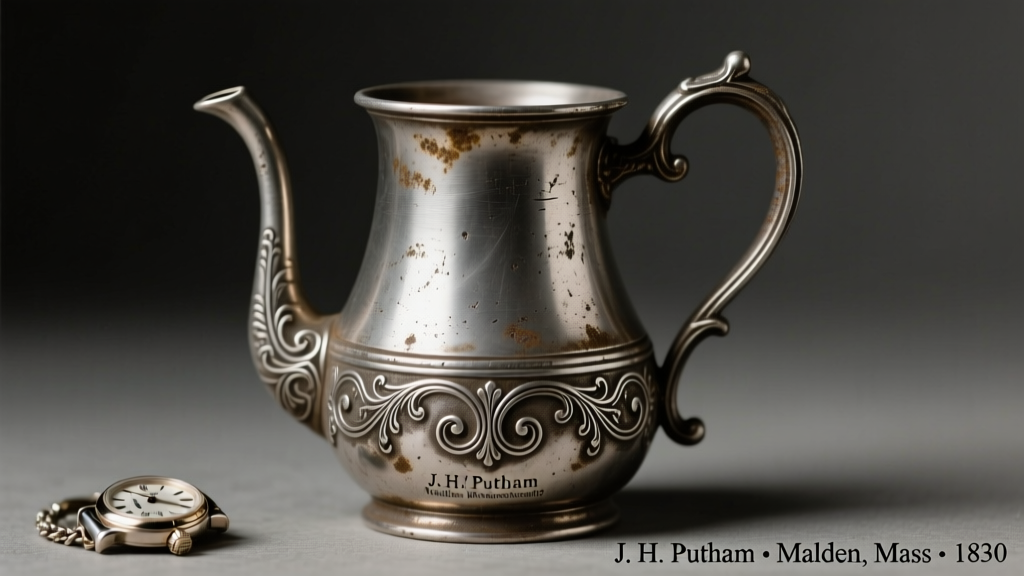
A Masterpiece of Early American Pewter: The J. H. Putnam Coffeepot, Malden, Massachusetts, Circa 1830
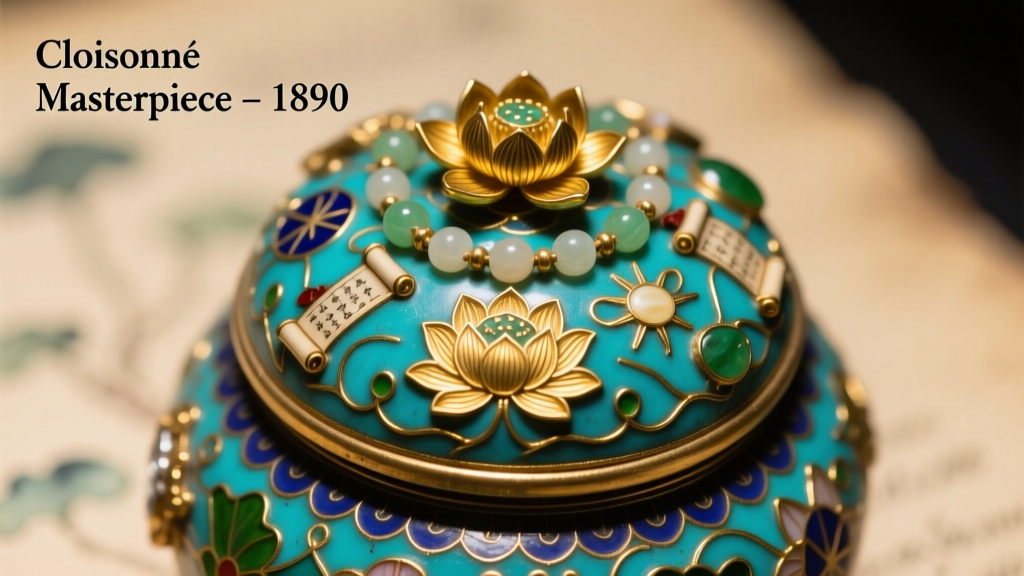
Cloisonné Ginger Jar Covers: A Pair of 10-Inch Imperial-Style Turquoise Vessels with Allover Precious Objects Motif
Frankart Doorstop: The Reclining Nude Woman in White Paint Over Red Cast Iron — A Study in 1920s American Design, Provenance, and Collectibility
The Omega Seamaster 300 'Burgundy' Ref. 1134342: A Rare 1960s Dive Watch with Military Provenance and Technical Distinction
Rose Bowls Cranberry Oval Thumbprints Threaded 2-Inch: A Technical and Historical Analysis of a Rare Mid-Century American Watch Case Design
Noritake Syrup Azalea Underplate: A Collector’s Guide to the Iconic 1950s American Tableware Pattern
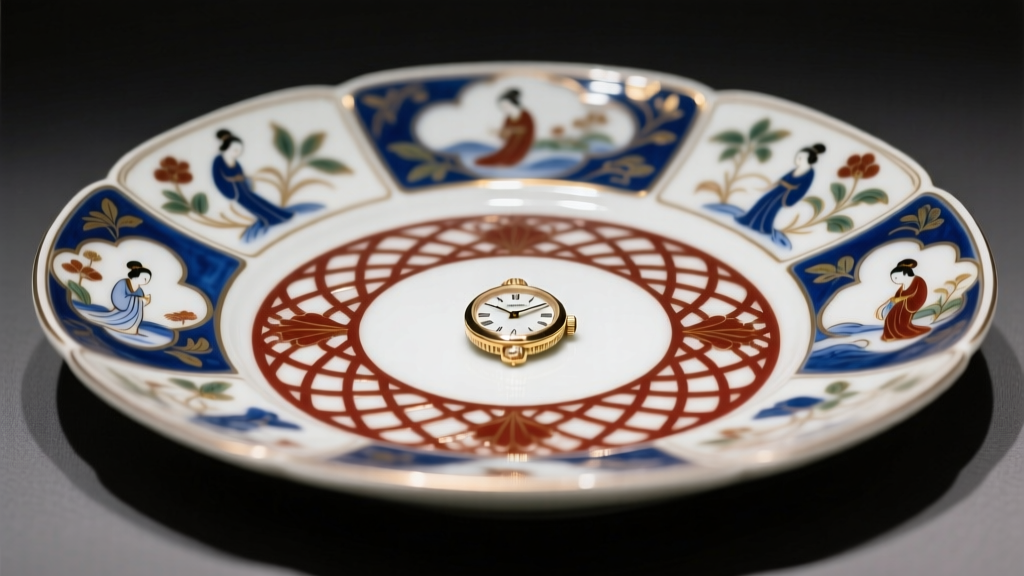
Imari Platter with Alternating Panels of Figures, Foliage, and Trellis Work on Ground — An 18-Inch Masterpiece of Arita Kiln Production
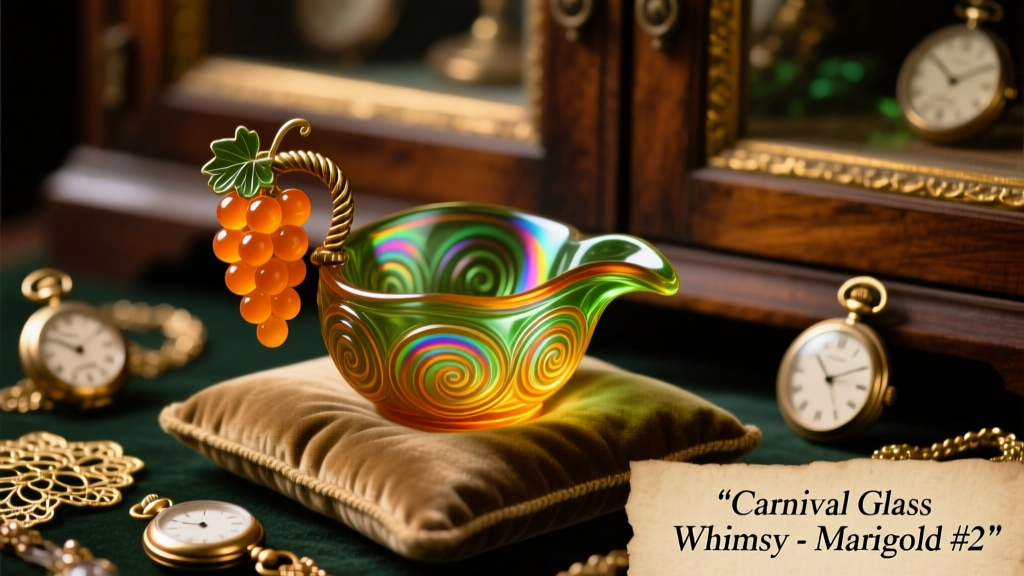
Carnival Glass Grape Cable Whimsy Cuspidor in Marigold: A Detailed Appraisal of Pattern #2
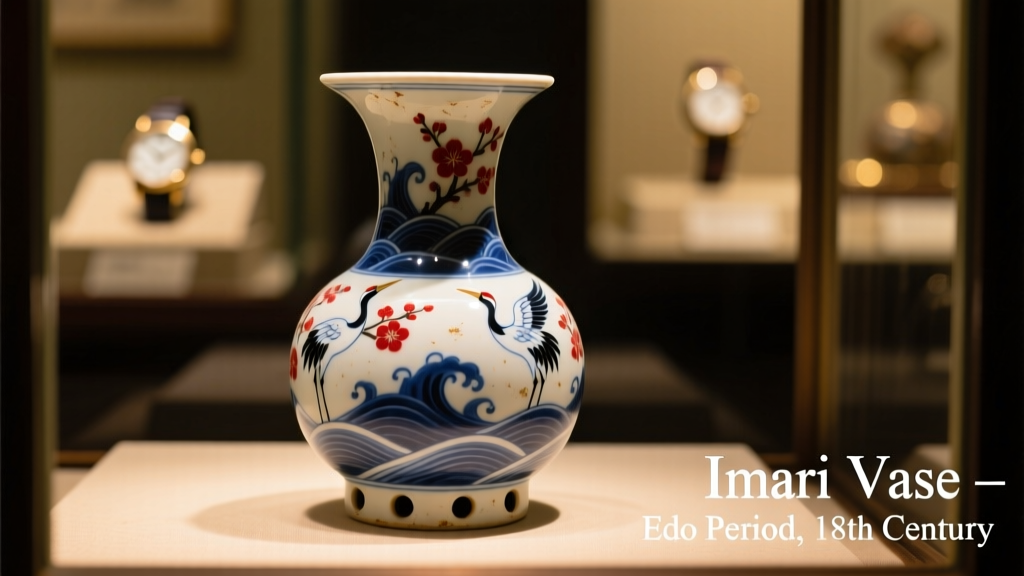
Imari Vase Bud: A 5¾-Inch Two-Part Vasiform Top with Flared Rim and Four-Pierced Base — Provenance, Craftsmanship, and Market Context