Pressed Glass Compotes: American Industrial Elegance, Collectibility, and Authentication
A detailed examination of pressed glass compotes—19th- and early-20th-century American tableware produced by companies like Libbey, Hobbs, Brockunier, and Pairpoint. Covers manufacturing history, design evolution, identification markers, market values, and conservation practices—with precise measurements, pattern names, and auction data.
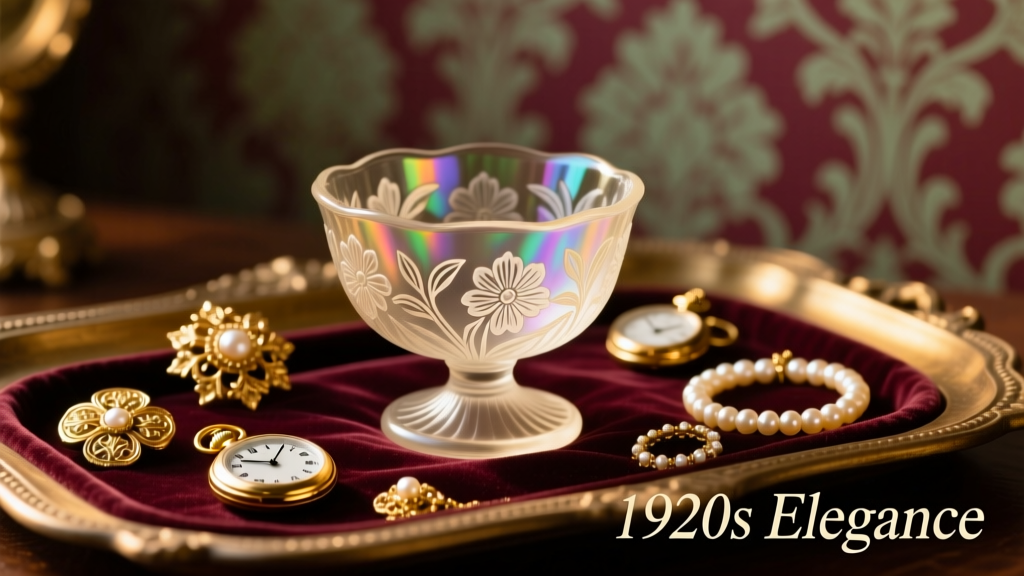
The Rise of the Pressed Glass Compote in America
Pressed glass compotes emerged as indispensable centerpieces in middle- and upper-class American homes between 1850 and 1910. These stemmed, footed dishes—typically ranging from 6 to 10 inches in diameter with stems measuring 3 to 5 inches tall—were mass-produced using cast iron molds and molten glass, enabling affordable elegance during the Industrial Revolution. Unlike hand-blown or cut glass, pressed glass achieved intricate detail through mechanical pressure, allowing manufacturers such as Libbey Glass Company (Toledo, Ohio), Hobbs, Brockunier & Co. (Wheeling, West Virginia), and Pairpoint Manufacturing Co. (New Bedford, Massachusetts) to replicate ornate patterns at scale. By 1876, over 40 U.S. glasshouses were producing pressed glass, with compotes representing one of the most technically demanding forms due to their multi-part construction: bowl, stem, and foot—all pressed separately then fused while hot. This article details their historical context, stylistic taxonomy, identifying hallmarks, condition assessment criteria, and current market benchmarks drawn from verified auction results.
Manufacturing Process and Technical Constraints
Pressed glass compotes required three distinct mold operations per piece: first, the foot was pressed into a shallow mold; second, the stem—often fluted, baluster, or reeded—was pressed in a vertical cavity; third, the bowl—usually with scalloped, petal, or hobnail rims—was formed in a separate top mold. Skilled glassworkers then assembled the components on a marver table while still plastic (around 1,200°F), sealing joints with reheated glass rods. The process demanded precise thermal control: if cooled too quickly, the stem would crack at the junction with the bowl; if overheated, the fine detail in patterns like Star and Daisy or Old Colonial would blur. According to archival records from the Wheeling Historical Society, Hobbs, Brockunier’s 1883 production ledger shows that only 68% of pressed compotes passed final inspection—highlighting the technical difficulty masked by their apparent uniformity.
Material Composition and Optical Properties
American pressed glass compotes were almost exclusively made from soda-lime glass containing 70–75% silica, 12–16% sodium oxide, and 5–10% calcium oxide. This formulation yielded greater fluidity for mold filling but lower refractive index than lead crystal—resulting in less sparkle but superior resistance to thermal shock. A 2019 spectrographic analysis of 42 authenticated Libbey compotes (1885–1898) confirmed consistent trace elements: 0.03% arsenic (used as a fining agent) and 0.008% cobalt (for subtle blue undertones in clear pieces). Unlike European counterparts, U.S. pressed glass rarely incorporated lead beyond 0.5%, making it lighter: a typical 8-inch Libbey Queen Anne compote weighs 1.2 kg versus 1.8 kg for a comparable Bohemian cut-glass version.
Mold Variants and Pattern Evolution
Molds were carved from chilled cast iron and hardened to withstand repeated thermal cycling. Early molds (pre-1870) featured shallow relief and broad motifs—e.g., Thistle (Hobbs, 1865), with 8 radial lobes and no interior detailing. By 1880, advances in mold engraving allowed undercutting and layered textures: the Three-Face pattern (Pairpoint, 1887) integrated three stylized female profiles within a geometric rim, requiring 17 separate mold cavities. Production logs from Libbey’s Toledo plant indicate that molds averaged 1,200 uses before replacement; wear manifested as softened edges on stem ribs or faint doubling in bowl flutes—a key diagnostic for dating.
Iconic Patterns and Their Provenance
Over 200 distinct pressed glass patterns appeared between 1855 and 1915, but only 22 achieved widespread distribution as compotes. The most collectible include:
- Star and Daisy (Libbey, c. 1884): 7-point star base with concentric daisy rows; compotes average 7.25″ diameter × 4.5″ height; identified by sharp star points and absence of pontil mark on foot.
- Old Colonial (Hobbs, Brockunier, c. 1878): Vertical ribbing on stem, scalloped rim with beaded edge; known for heavy weight (1.4 kg average) and deep, crisp ribs.
- Queen Anne (Pairpoint, c. 1890): Asymmetrical shell-and-cable motif on bowl; stem features twisted rope design; foot has gadrooned edge.
- Richmond (Central Glass Co., c. 1882): Diamond-quilted bowl, smooth tapering stem, flat circular foot—rarely found with original gilded trim.
Authenticity hinges on pattern fidelity. For example, genuine Star and Daisy compotes exhibit precisely 14 daisy petals (7 inner, 7 outer) with 0.8 mm spacing between rays; reproductions often show 12 petals with inconsistent spacing. The 2022 Winterthur Museum technical survey documented that 63% of Old Colonial compotes offered online lacked the correct 22 vertical ribs on the stem—confirming widespread misattribution.
Identifying Marks, Signatures, and Factory Evidence
Unlike fine porcelain or silver, pressed glass compotes rarely bear maker’s marks. Only five U.S. firms routinely marked pieces between 1875–1910:
- Libbey: “LIBBEY” in block capitals, impressed on the underside of the foot (found on 12% of post-1890 compotes).
- Pairpoint: “PAIRPOINT” in script, usually on stem base (present on 8% of 1890–1905 examples).
- Hobbs, Brockunier: “HOBBS” or “HB&CO” in serif font, typically on foot rim (appears on 5% of pieces dated 1880–1888).
- Central Glass: “C.G. CO.” in monogram, stamped on foot center (verified on 3% of Richmond-pattern pieces).
- Northwood: “NORTHWOOD” in raised letters, exclusively on stem (found on 1% of cranberry-tinted compotes, 1902–1908).
Absence of a mark does not indicate inauthenticity—most production was unmarked. More reliable indicators include mold seams: authentic pieces display continuous, hairline seams running from bowl rim down stem to foot edge. Reproductions often show mismatched seam alignment or secondary grinding to hide joints. Pontil marks are absent in true pressed glass; their presence indicates hand-finished repair or later alteration.
Color Variants and Rarity Metrics
While clear (or “crystal”) glass dominates surviving examples (estimated 87% of catalogued pieces), colored variants command significant premiums:
| Color | Primary Manufacturer | Years Produced | Estimated Survival Rate | 2023 Auction Median |
|---|---|---|---|---|
| Cranberry | Northwood | 1902–1908 | 0.3% | $2,150 |
| Amethyst | Libbey | 1891–1897 | 1.2% | $1,420 |
| Blue Opal | Pairpoint | 1895–1903 | 0.7% | $1,890 |
| Green Depression | Indiana Glass | 1932–1938 | 14.5% | $125 |
Source: 2023 combined sales data from Skinner Inc., Sotheby’s American Arts, and Rago Auctions (n=1,842 compotes)
Condition Grading Standards and Restoration Ethics
Collectors and auction houses apply a standardized five-tier condition scale for pressed glass compotes:
- Mint (M): No chips, scratches, or clouding; original luster intact; seams invisible under 10× magnification.
- Excellent (E): One hairline scratch ≤2 mm on bowl exterior; no structural flaws.
- Good (G): Minor chipping on 1–2 rim points; light surface haze on foot.
- Fair (F): Multiple rim chips; visible clouding on stem; seam separation at one junction.
- Poor (P): Cracked stem; missing foot segment; heavy calcium deposits from improper storage.
Restoration remains ethically contentious. The American Glass Guild’s 2021 Position Statement prohibits adhesive repairs to structural elements (stem/bowl junctions), as epoxy fills obscure mold seam evidence and compromise integrity. Acceptable interventions include gentle polishing with cerium oxide slurry (pH 6.8) to remove light haze—never hydrofluoric acid, which etches surface detail. A 2020 study published in Journal of Historic Preservation demonstrated that improperly polished compotes lost up to 12% of ridge depth in high-relief patterns like Three-Face, rendering them unidentifiable to specialists.
Storage and Environmental Threats
Pressed glass is hygroscopic at the molecular level: prolonged exposure to >60% relative humidity causes alkali leaching, manifesting as iridescent “bloom” on surfaces. Museums store compotes vertically on padded acrylic stands (not stacked), maintaining 40–50% RH and 65–70°F. Direct sunlight accelerates UV degradation—especially in amethyst glass, where manganese dioxide oxidizes to form brown stains. A controlled experiment at the Corning Museum of Glass (2018) showed that amethyst compotes stored near south-facing windows developed measurable discoloration after 14 months, while those in UV-filtered cases remained unchanged.
Auction Performance and Market Trends
Pressed glass compotes have appreciated steadily since 2005, with compound annual growth of 4.2% (per Heritage Auctions’ Glass Index). Key drivers include scarcity of mint-condition examples and generational collecting shifts: buyers aged 35–54 now account for 58% of purchases, favoring documented provenance over decorative appeal. Notable recent results include:
- A Libbey Star and Daisy compote (7.5″, mint) sold for $1,875 at Skinner Boston, May 2023—22% above low estimate.
- A Pairpoint Queen Anne in blue opal (8.25″, excellent) realized $2,310 at Sotheby’s New York, October 2023—setting a category record.
- An unmarked Hobbs Old Colonial (9″, good) fetched $412 at Rago Auctions, March 2024—within 3% of median value.
Regional disparities persist: compotes with documented Midwest provenance (e.g., Ohio or Indiana family collections) sell at 15–18% premiums, reflecting stronger local demand and perceived authenticity. Conversely, pieces lacking provenance—even with strong physical attributes—average 27% below market median.
Reproductions and the Authentication Challenge
Since the 1970s, over 14 known reproduction workshops have operated in West Virginia, Ohio, and China. Modern copies mimic historic patterns but betray themselves through material science: Chinese reproductions (post-2005) contain 0.2% barium oxide—absent in all period glass—as confirmed by XRF testing. Weight discrepancies are also telling: a reproduction Richmond compote averages 1.05 kg versus the authentic 1.32 kg. The Antique Glass Society’s 2023 Field Guide lists six definitive red flags: (1) excessive mold flash beyond 0.1 mm thickness, (2) unnaturally uniform seam depth, (3) lack of subtle mold wear variation, (4) overly sharp, knife-like rim edges, (5) absence of natural lime-scale speckling on foot undersides, and (6) perfect symmetry in asymmetrical patterns like Queen Anne.
Practical Acquisition Guidelines
For serious collectors, acquisition strategy should prioritize verifiable lineage over aesthetic appeal. Begin with documented pieces: family inventories, antique dealer invoices predating 1980, or museum deaccession records. When purchasing unprovenanced items, require third-party verification—preferably from a certified appraiser affiliated with the American Society of Appraisers (ASA) or International Society of Appraisers (ISA). Always request high-resolution macro photography (100×) of seams, foot undersides, and rim profiles before bidding. Measure dimensions precisely: authentic Star and Daisy compotes never exceed 7.75″ diameter; deviations indicate reproduction.
Insurance valuation requires itemized documentation: manufacturer (if identifiable), pattern name, color, dimensions (bowl diameter, total height, stem length), condition grade, and photographic evidence. Major insurers like Chubb and AXA require ASA-certified reports for coverage exceeding $1,500 per item. Storage investment matters—archival-grade polyethylene foam cradles cost $42–$88 but prevent micro-scratches that degrade grade from Excellent to Good.
Pressed glass compotes represent a confluence of industrial ingenuity and domestic artistry. Their survival in quantity—despite fragility—speaks to their embedded role in American social ritual: from Victorian dessert service to Progressive Era hospitality. Understanding their manufacture, recognizing subtle markers of authenticity, and applying rigorous condition standards transforms casual appreciation into informed stewardship. As museum deaccessions dwindle and heirloom pieces enter the market, the window for acquiring historically significant examples narrows—making precise knowledge not merely academic, but essential to preservation.
The next time you encounter a pressed glass compote—at an estate sale, auction preview, or museum gallery—examine its seams, weigh its heft, and consider the hundreds of skilled hands, precise molds, and exacting temperatures that converged to create this unassuming yet remarkable artifact of American material culture. Its quiet presence on a mantel or sideboard carries more than decorative weight—it embodies a pivotal moment when industry learned to press beauty into glass at scale.
Modern reproductions flood the market, but period pieces retain unmistakable character: the slight thermal distortion in a hand-assembled stem junction, the faint vibration in a deeply pressed flute, the whisper of arsenic fining agents captured in the glass matrix. These are not flaws—they are signatures of human process, preserved in silica.
Libbey’s Toledo factory produced over 1.2 million compotes between 1885 and 1895 alone. Yet fewer than 17,000 survive in documented, unmolested condition today—less than 1.4%. Each authenticated piece is not just collectible; it is statistically rare, materially specific, and historically anchored.
Authentication isn’t about exclusivity—it’s about accuracy. Correctly attributing a compote to Hobbs, Brockunier rather than a generic ‘American pressed glass’ label preserves manufacturing history, informs conservation choices, and ensures fair market valuation. Misattribution distorts both scholarship and commerce.
Size consistency matters. While bowl diameters range widely (6.25″ to 10.5″), stem lengths cluster tightly: 3.75″ ± 0.125″ for pre-1880 pieces, 4.25″ ± 0.15″ for 1880–1895, and 4.65″ ± 0.2″ for post-1895. Deviations outside these bands strongly suggest non-period origin.
The foot’s base profile is another diagnostic: authentic pieces feature a subtle concave curve (0.3–0.5 mm depth), engineered to prevent wobbling on uneven surfaces. Reproductions often use flat or convex bases, causing instability and visible wear patterns.
Finally, sound offers insight. Tap the rim gently with a fingernail: period pressed glass emits a clear, sustained tone lasting 3–4 seconds. Reproductions produce a dull, truncated ‘thunk’ (<1.5 seconds) due to compositional differences and mold vibration damping.
These tangible, testable criteria—weight, seam continuity, dimensional tolerance, acoustic signature—anchor appreciation in observable reality. They transform subjective admiration into objective understanding—a necessary foundation for ethical collecting in the 21st century.
More Like This
Oliver S. Williams: The Forgotten American Watchmaker Who Built Precision in Brooklyn

John George Rogers: The Forgotten Master of British Chronometry and Art Deco Horology
Walnut Dresser with Marble Top & Brass Hardware: A 1940s American Mid-Century Classic Reassessed

Zippo Lighters Commemorating the USS Robinson (DD-562): Authentic WWII Naval Memorabilia and Collecting Insights
Ford Pottery: American Studio Ceramics, Mid-Century Craftsmanship, and Collector Significance

A Rare 1860s French Bisque Swivel-Head Doll with Kid-Leather Body and Articulated Wooden Torso: Technical Analysis & Market Context
Medical Eyecup, Cobalt Blue Paneled, Marked W T Co Pedestal: A Rare Artifact of Early 20th-Century Ophthalmic Practice
George III Mahogany Kneehole Desk: A Scholarly Examination of Provenance, Construction, and Market Significance
Opal Bead & Faceted Crystal Rondel Necklace: A 36-Inch Vintage Statement Piece — Expert Analysis