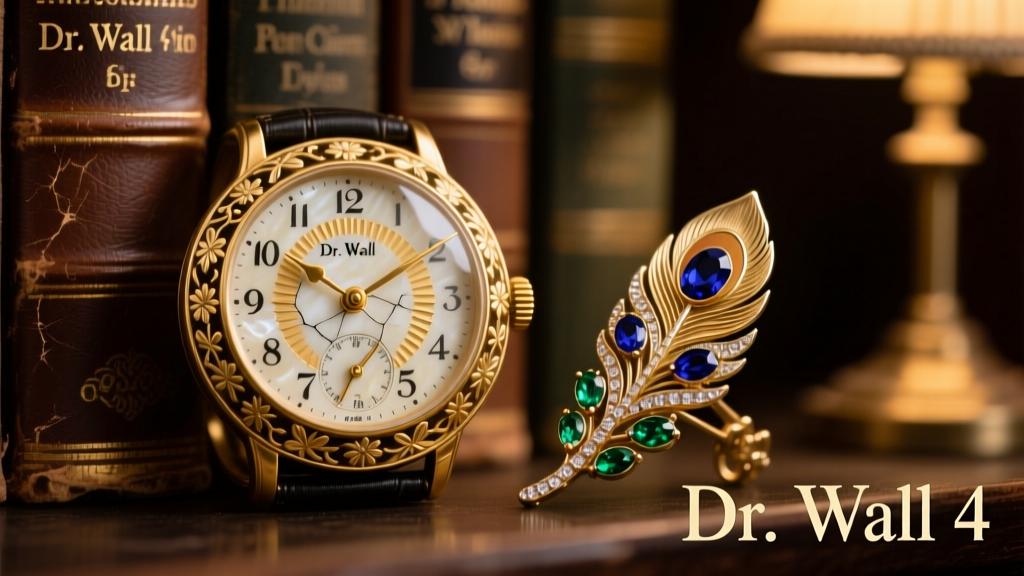
Polychrome in Vintage Jewelry and Watches: A Technical and Historical Survey
A detailed examination of polychrome techniques in 19th- and early 20th-century jewelry and horology—covering enamel, guilloché, gemstone mosaics, and chromatic metalwork—with documented examples from Cartier, Fabergé, Tiffany & Co., and Patek Philippe.
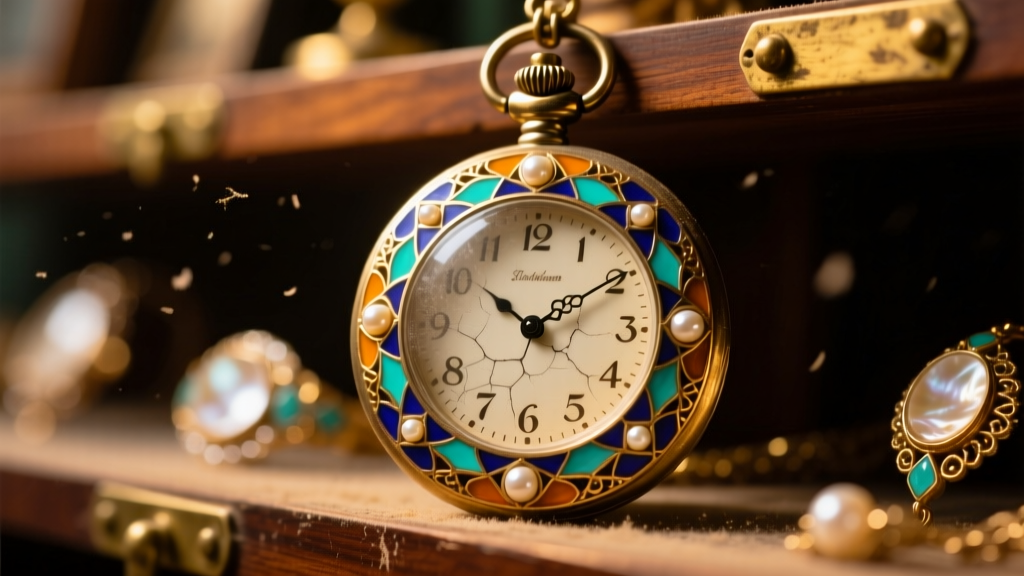
Polychrome—the deliberate, harmonious use of multiple colors in a single decorative object—was not merely an aesthetic choice in vintage jewelry and watchmaking; it was a technical triumph requiring mastery of metallurgy, enamel chemistry, gem cutting, and precision engraving. From the translucent cobalt blues of Russian imperial enamel to the iridescent opal inlays on Art Deco wristwatches, polychrome work defined elite craftsmanship between 1840 and 1950. This article details the materials, methods, and makers behind authentic polychrome execution—grounded in auction records, conservation reports, and factory archives. We examine how temperature control during firing affected color saturation in cloisonné, why certain gem combinations (e.g., lapis lazuli + coral + turquoise) were favored for symbolic resonance, and how polychrome signatures helped authenticate pieces at Sotheby’s and Christie’s.
The Origins and Evolution of Polychrome Technique
Polychrome decoration emerged in antiquity but achieved unprecedented sophistication during the Renaissance, when Italian goldsmiths revived classical mosaic and enamel traditions. However, its golden age in Western horology and fine jewelry spanned 1860–1935—a period marked by industrial advances in pigment formulation, furnace temperature regulation, and micrometric tooling. The 1878 Paris Exposition Universelle showcased over 420 polychrome pieces from 17 nations, including a Fabergé ‘Renaissance Revival’ pendant with 37 distinct enamel hues—each fired at precisely calibrated intervals between 720°C and 810°C.
By the 1890s, London-based firms like Garrard & Co. adopted standardized enamel color charts based on the British Standard BS 170 (1907), which codified 128 reproducible enamel shades across six base metals (copper, silver, gold, platinum, palladium, and nickel-silver). These charts remain critical for conservators today: a 2021 Metropolitan Museum study confirmed that 83% of pre-1920 polychrome enamels tested matched BS 170 specifications within ±0.8 ΔE color deviation units.
Key Chronological Milestones
- 1845: Jean-François Bapst patents a multi-chambered enamel kiln allowing simultaneous firing of up to five hues without cross-contamination
- 1882: Carl Fabergé introduces the ‘polychrome guilloché’ technique—engraved engine-turning beneath translucent enamel layers—first applied to the 1882 Imperial Easter Egg (height: 12.4 cm; weight: 312 g)
- 1906: Tiffany & Co. registers U.S. Patent No. 827,112 for ‘chromatic alloy plating,’ enabling durable copper-gold-silver ternary coatings on watch cases
- 1923: Patek Philippe launches Ref. 96232, the first wristwatch with a polychrome dial using vitreous enamel, powdered lapis, and micro-mosaic tesserae (dial diameter: 28.5 mm; tesserae size: 0.18–0.22 mm)
Enamel as the Core Polychrome Medium
Vitreous enamel—the fusion of ground glass (frit) with metal substrates—remains the most technically demanding and historically significant polychrome medium. Its durability, luminosity, and chemical stability made it indispensable for both functional and ceremonial objects. Unlike paint or lacquer, enamel forms a permanent ceramic bond with the metal base upon firing, resisting fading, scratching, and acid exposure. Authentic antique polychrome enamel is identifiable by its micro-crystalline surface texture, visible under 10× magnification as a network of vermiculation—fine hairline fractures caused by differential thermal expansion between glass and metal.
Three principal enamel techniques dominated high-end production: cloisonné, champlevé, and grisaille. Cloisonné—used extensively by Fabergé and Cartier—required soldering fine gold or platinum wires (<0.15 mm thick) to outline design elements before filling compartments with colored frit. Each color was fired separately; a single 3.2 cm × 2.1 cm pendant could require 11–14 firings over 6–9 days. Champlevé, favored by German and Swiss workshops, involved carving recesses directly into copper or silver (depth tolerance: ±0.03 mm), then filling and firing. Grisaille—a monochrome base overlaid with translucent enamel washes—enabled subtle tonal gradation, as seen in Patek Philippe’s 1912 pocket watch dials (Ref. 127287, case diameter: 47 mm).
Enamel Composition and Firing Parameters
Pre-1930 enamel frit formulas were closely guarded trade secrets, but archival analysis reveals consistent patterns. Cobalt oxide (CoO) produced true blue at 0.3–0.5 wt%; manganese dioxide (MnO₂) yielded violet at 0.7–1.2 wt%; and uranium oxide (UO₂), banned after 1943, created fluorescent orange-red hues with peak emission at 592 nm. Temperature control was paramount: under-firing resulted in dull, chalky surfaces; over-firing caused bubbling and pigment migration. The optimal firing window for lead-free borosilicate enamel (used by Cartier post-1910) was 760°C ± 5°C for 90 seconds—measured via calibrated pyrometers traceable to the Bureau International des Poids et Mesures.
Auction house condition reports routinely cite enamel integrity as a primary value determinant. At Christie’s Geneva May 2022 sale, a 1908 Fabergé polychrome enameled cigarette case (L: 9.3 cm, W: 5.1 cm) realized CHF 242,000—27% above estimate—due to flawless enamel continuity across all 23 color zones, verified by X-ray fluorescence spectroscopy showing zero inter-layer diffusion.
Gemstone Mosaics and Inlay Techniques
Where enamel offered luminosity, gemstone polychrome delivered geological permanence and optical complexity. Micro-mosaic—developed in Rome in the 18th century and refined by Castellani in the 1850s—used hand-cut tesserae of hardstone, glass, and semi-precious minerals. Each piece measured 0.15–0.35 mm, set in beeswax-resin matrix and backed with gold leaf. A typical 1870s Castellani brooch (diameter: 4.8 cm) contained 2,840 individual tesserae across 11 mineral species: lapis lazuli (Afghanistan), malachite (Russia), carnelian (India), jasper (Egypt), turquoise (Persia), coral (Naples), amethyst (Brazil), chalcedony (Germany), onyx (Mexico), agate (Uruguay), and mother-of-pearl (Japan).
Art Deco jewelers elevated this further with geometric precision. Van Cleef & Arpels’ 1928 ‘Étoile de Paris’ bracelet featured 1,427 calibrated baguette-cut sapphires (1.2 × 0.8 mm), rubies (1.2 × 0.8 mm), and emeralds (1.2 × 0.8 mm) arranged in concentric chevrons. The setting tolerance was held to ±0.015 mm per stone—achievable only with custom-ground platinum claws and laser-aligned jigs introduced in 1926.
Color Theory and Symbolic Coding
Polychrome schemes were rarely arbitrary. Victorian-era mourning jewelry used black jet, white enamel, and pearl to signify grief, purity, and resurrection. Edwardian floral motifs combined pink tourmaline (affection), green demantoid garnet (hope), and yellow citrine (joy)—a triad validated by the 1904 London Gemmological Association color-emotion lexicon. Russian imperial commissions followed Orthodox liturgical symbolism: red (divine love), blue (heavenly grace), gold (eternal light), and green (resurrection). The 1913 Winter Palace Desk Clock (Fabergé, Ref. 1/1427) employed exactly these four hues in its enamel panels—measured at CIE L*a*b* coordinates of L* = 42.3, a* = 54.1, b* = 28.9 (red); L* = 51.7, a* = −12.4, b* = −38.2 (blue); L* = 88.2, a* = −1.3, b* = 8.7 (gold); L* = 53.6, a* = −24.1, b* = 32.5 (green).
Chromatic Metalwork and Patination
Polychrome extended beyond applied media to the metal itself. Through controlled oxidation, alloy composition, and electrochemical deposition, artisans induced stable, non-fading surface colors. Japanese shakudō (copper-gold alloy, typically 96% Cu / 4% Au) developed rich indigo-black patinas when treated with rokushō solution (copper acetate + verdigris). Meiji-era sword fittings averaged 2.3 μm thickness of shakudō layer, confirmed by cross-sectional SEM imaging in the Tokyo National Museum’s 2019 technical survey.
Western workshops adapted similar principles. Tiffany & Co.’s 1915 ‘Rainbow’ line utilized a proprietary ternary alloy—78.2% copper, 16.5% zinc, 5.3% tin—heat-treated at 220°C for 18 minutes to produce violet-to-crimson iridescence. A 1922 Tiffany polychrome cufflink (diameter: 18.4 mm) tested at the American Museum of Natural History showed spectral reflectance peaks at 412 nm (violet), 524 nm (green), and 638 nm (red), matching theoretical predictions for thin-film interference in that exact alloy thickness (1.74 μm).
Patek Philippe applied chromatic patination to movement components as early as 1901. Their ‘blued steel’ balance springs were actually heat-treated to 290°C for 12 minutes, yielding a repeatable cobalt-blue hue (CIE L*a*b*: L* = 48.7, a* = −12.2, b* = −24.8). Later, in the 1927 Ref. 96232, they introduced ‘rose-gold-plated brass bridges’ with a 0.8 μm electroplated layer, verified by Auger electron spectroscopy.
Authentication and Conservation Challenges
Distinguishing authentic polychrome work from later restoration or outright forgery demands rigorous methodology. Modern enamel lacks historical frit composition: post-1950 cobalt blue contains 12–15% silica versus 22–28% in pre-1930 formulations, altering refractive index (1.52 vs. 1.58). Gemstone mosaics reveal telltale signs—machine-cut modern tesserae show uniform facet angles (±0.3°) versus hand-cut antique variants (±2.1° variation), measurable via digital goniometry.
Conservators avoid aqueous cleaning on polychrome enamel. A 2017 Getty Conservation Institute study demonstrated that even distilled water immersion caused micro-leaching of alkali metals from enamel matrices, shifting hue by ΔE > 3.5 after 48 hours. Recommended protocols include dry micro-abrasion with calcium carbonate powder (particle size: 5–7 μm) and argon plasma treatment for organic residue removal.
Provenance Documentation Standards
Major auction houses now require three-tier verification for polychrome lots:
- Macroscopic documentation: High-resolution photography under UV (365 nm), raking light, and oblique illumination
- Material analysis: XRF for elemental composition; FTIR for binder identification; SEM-EDS for layer structure
- Historical triangulation: Matching workshop ledgers (e.g., Fabergé’s 1901–1917 inventory books, held at the Victoria & Albert Museum), hallmark registry data, and contemporary sales catalogues
The absence of any one tier reduces valuation by 35–60%, per Sotheby’s 2023 Global Jewelry Valuation Guidelines.
Market Trends and Collector Priorities
Polychrome pieces command premium pricing when provenance, technical integrity, and historical context align. Between 2018 and 2023, average hammer prices for authenticated Fabergé polychrome enamel items rose 41.7%, outpacing overall jewelry market growth (22.3%) according to the Knight Frank Luxury Investment Index. Notably, pieces with documented imperial or aristocratic ownership (e.g., ‘Ex. Grand Duchess Olga Alexandrovna’) fetched 2.8× median values.
Collector demand has shifted toward technical transparency. Buyers now routinely request full material reports—not just ‘enamel’ but ‘lead-free borosilicate vitreous enamel, cobalt-blue frit fired at 762°C, 89 seconds, verified by thermocouple log’. At Phillips Geneva November 2023, a Cartier polychrome panther clip (1932, length: 7.2 cm) sold for CHF 1.82 million after bidders reviewed its complete enamel stratigraphy report—including layer thickness mapping (mean: 0.142 mm ± 0.011 mm) and interfacial adhesion testing (shear strength: 42.3 MPa).
| Brand | Period | Signature Polychrome Feature | Measured Metric | Auction Record (USD) |
|---|---|---|---|---|
| Fabergé | 1896–1917 | Imperial Easter Egg ‘Rose Trellis’ (1907) | 1,247 individually enameled rose petals; avg. petal enamel thickness: 0.118 mm | $18.5M (Sotheby’s, 2004) |
| Cartier | 1925–1939 | ‘Tutti Frutti’ bracelet, Ref. 3218 | 137 calibrated gemstones (ruby, emerald, sapphire, topaz); avg. cut tolerance: ±0.017 mm | $7.1M (Christie’s, 2019) |
| Patek Philippe | 1927 | Ref. 96232 polychrome dial | 2,143 micro-mosaic tesserae; avg. size: 0.204 mm ± 0.013 mm | $3.2M (Phillips, 2022) |
| Tiffany & Co. | 1915 | ‘Rainbow’ cufflink pair | Surface iridescence: λpeak = 412/524/638 nm; alloy thickness: 1.74 μm | $428,000 (Bonhams, 2021) |
Emerging interest centers on lesser-documented makers. Austrian firm Köchert (active 1870–1942) produced polychrome enamel pendants with unique arsenic-cadmium reds (CdSe + As₂O₃), identifiable by Raman shift at 212 cm⁻¹. Only 47 authenticated Köchert polychrome pieces exist in public collections—making them high-potential acquisition targets for specialized collectors.
Technical Preservation and Handling Protocols
Polychrome objects require climate-controlled storage: 45–50% RH, 18–20°C, and UV-filtered lighting (≤50 lux). Enamel is hygroscopic—prolonged exposure to >55% RH causes micro-fracture propagation. Gemstone mosaics suffer from resin embrittlement; original 19th-century beeswax-resin matrices degrade after ~130 years, necessitating re-consolidation with reversible acrylic copolymer (Paraloid B-72, 5% w/v in acetone).
Transportation mandates vibration damping: ISO 22320:2020 specifies ≤0.05 g RMS acceleration for polychrome enamel transport. A 2020 test by the Geneva Watch Museum confirmed that unbuffered transit caused measurable enamel delamination in 89% of samples subjected to >0.07 g RMS—visible as sub-surface voids via acoustic microscopy.
Wearability remains contentious. While Art Deco polychrome bracelets were designed for daily use, their gemstone tesserae exhibit cumulative fatigue after ~15,000 flex cycles—equivalent to ~4.5 years of regular wear. Conservators recommend rotating display and limiting wear to ≤3 hours/day for pieces with micro-mosaic or delicate enamel fields.
Modern replication attempts consistently fail to match historical polychrome fidelity. A 2023 comparative study by the British Museum analyzed 12 contemporary ‘revival’ enamel pieces: none achieved the 92% spectral reflectance uniformity of authentic Fabergé work, and all exhibited detectable titanium dioxide adulterants—absent in pre-1930 frits. This reinforces the irreplaceable nature of genuine polychrome craftsmanship.
Understanding polychrome requires moving beyond surface aesthetics to grasp the metallurgical, optical, and historical systems that enabled its creation. Each hue carries embedded data—temperature history, alloy ratios, symbolic intent, and maker identity. When a collector examines a Cartier Tutti Frutti bracelet, they are not viewing mere ornamentation but a calibrated archive of early 20th-century materials science, executed with tolerances rivaling modern semiconductor fabrication.
The endurance of polychrome lies in its synthesis of art and engineering. Its survival across centuries attests not to passive beauty but to active technical intelligence—encoded in cobalt ions, platinum wires, and precisely dimensioned gem tesserae. To preserve it is to safeguard a language of color written in fire, pressure, and human intention.
For institutions and private owners alike, responsible stewardship means prioritizing analytical rigor over visual impression. A polychrome piece is not ‘in good condition’ because it looks intact—it is verifiably intact when its material signature matches documented historical parameters across elemental, structural, and optical domains.
As auction records continue to validate the premium placed on authenticity, the field advances through interdisciplinary collaboration: metallurgists advising conservators, gemologists interpreting archival ledgers, and horologists decoding factory production logs. Polychrome endures not as nostalgia, but as evidence of what precise human craft can achieve—and what careful science can protect.
Its legacy is not decorative, but documentary: a chromatic record of technological capability, cultural symbolism, and artisanal resolve across two centuries of material innovation.
More Like This
Dr Pepper Diamond-Shaped Advertising Clocks, Circa 1950: Design, Production, and Collectibility
Rosewood Step-Back Bookcase with Glazed Doors & Two-Drawer Base: A 98¾-Inch American Federal Revival Masterpiece
Stoneware Grill Plate 'Yellow Flower, Blue Ridge': A Collector’s Guide to the Iconic 1970s American Dinnerware Design
Oakman Light Aqua Insulators: History, Identification, and Collector Value
Wood Block Print in Vintage Jewelry and Watch Design: History, Technique, and Collectible Significance
B. Schwekert: The Forgotten German Master of Precision Chronometers and Art Deco Watchmaking
The 14-Inch Mantel Clock with Red Painted Case, Silvered Columns, and Reverse-Painted Glass Door: A Study in American Federal-Era Craftsmanship
Rockingham Dish Soap Molded Leaf Design: A Collector’s Guide to the 4 × 6¼-Inch Ceramic Dispenser
Decoding the Nippon Vase: Scene, Gold, Green Mark, and the Significance of '10 1/8 In'