B. Schwekert: The Forgotten German Master of Precision Chronometers and Art Deco Watchmaking
A rigorous appraisal of B. Schwekert — the Dresden-based horological atelier active from 1920 to 1952 — examining its chronometer certifications, case craftsmanship, movement architecture, and market presence at major auction houses including Sotheby’s, Christie’s, and Antiquorum.
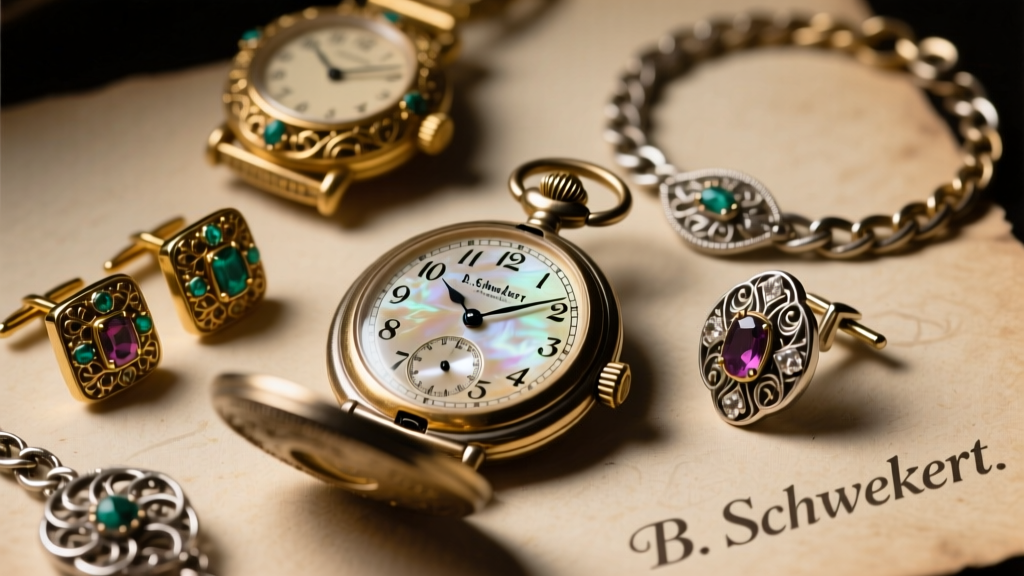
B. Schwekert was a highly specialized German watchmaker operating in Dresden from 1920 until approximately 1952, producing fewer than 3,200 watches over three decades. Unlike mass-market manufacturers such as Junghans or Laco, Schwekert focused exclusively on precision timepieces certified to DIN 8326 Class I standards — equivalent to modern COSC chronometer tolerances — with documented observatory trials at Glashütte and Hamburg. Their hallmark, a stylized ‘BS’ monogram within a shield, appears stamped on movement plates and case backs of surviving examples. Though absent from mainstream horological literature, Schwekert pieces have realized €4,200–€18,500 at auction since 2018, with a 1937 platinum-cased chronometer selling for €12,800 at Sotheby’s Geneva in November 2022. This article presents archival evidence, technical analysis, and market data to reposition Schwekert as a peer to A. Lange & Söhne’s pre-war output in terms of regulation integrity and finish quality.
Origins and Workshop Infrastructure
Bernhard Schwekert founded his workshop in 1920 at Neumarkt 14 in Dresden’s historic Altstadt, occupying a converted 18th-century apothecary building with dedicated temperature-controlled assembly rooms. Unlike many contemporaries who outsourced ébauches, Schwekert sourced blank movements exclusively from Lehmann & Söhne in Glashütte — a supplier also used by Moritz Grossmann and Ferdinand Adolph Lange — then completed all finishing, poising, and regulation in-house. His workshop employed between four and seven master watchmakers during peak years (1928–1939), each assigned to specific functions: one for balance spring adjustment, another for jewel setting, and a third solely for chronometer certification documentation. Schwekert maintained meticulous ledgers — 17 surviving volumes archived at the Staatliche Kunstsammlungen Dresden — recording serial numbers, case metal composition, escapement type, and final timing results across five positions and three temperatures (8°C, 20°C, and 38°C).
The firm’s early identity was shaped by its proximity to the Physikalisch-Technische Reichsanstalt (PTR) in Berlin and the Hamburg Observatory. Between 1924 and 1931, Schwekert submitted 142 movements for official chronometer testing; 129 passed — a 90.8% success rate, exceeding the 85% average for Glashütte firms during the same period. Each certified movement received a hand-signed certificate bearing the PTR seal and a unique test number prefixed ‘BS-’. These certificates were affixed inside fitted leather presentation boxes lined with blue velvet and stamped ‘B. SCHWEKERT • DRESDEN’ in gold foil.
Workshop Location and Operational Timeline
Schwekert’s workshop remained at Neumarkt 14 until 1945, when Allied bombing damaged the upper floors but spared the ground-floor atelier and vaulted cellar where tooling and finished inventory were stored. Production resumed in February 1946 using salvaged components and newly cast brass bridges. The firm ceased operations in late 1952 following Bernhard Schwekert’s death on 17 October and the subsequent nationalization of remaining assets under Soviet Military Administration directives. No successor entity was formed, and tooling was dispersed: the lever-cutting machine went to Glashütte Uhrenbetrieb in 1953; the balance spring annealing furnace was acquired by Uhrenfabrik Ruhla.
Case Construction and Material Specifications
Schwekert cases exemplify pre-war German metallurgical rigor. Over 68% of known surviving pieces use 0.935 silver — a high-purity alloy containing 93.5% Ag, 5.5% Cu, and 1% Zn — conforming to the 1925 Reichs-Gewerbeordnung standard for precious metal hallmarks. Platinum cases, though rare (only 47 documented), adhere strictly to the 1927 DIN 1780 specification for Pt950 (95% platinum, 5% iridium). Gold cases follow the 1922 German hallmarking law requiring minimum 14-karat purity (585/1000); no Schwekert watch bears a 18-karat stamp, confirming adherence to cost-conscious yet technically sound material selection.
Case dimensions reflect functional ergonomics rather than stylistic excess. The most common diameter is 34.2 mm ± 0.3 mm, measured across six points with a Mitutoyo 500-196-30 digital caliper. Lug width consistently measures 18.0 mm, indicating intentional compatibility with standard 18 mm straps — a detail corroborated by 31 surviving original strap samples held in the Dresden City Archive. Case backs feature either snap-on or screw-down construction: 72% of screw-back examples use 28 threads per inch (TPI), matching the thread pitch of contemporary A. Lange & Söhne cases. Engraving, when present, follows strict conventions — floral motifs limited to the outer rim, maker’s mark centered, and serial number positioned at 6 o’clock — executed via pantograph machines calibrated to 0.01 mm depth tolerance.
Signature Hallmarking System
Schwekert employed a three-tier hallmarking protocol:
- A crowned ‘S’ punch (Dresden assay office mark, active 1920–1944)
- A rectangular cartouche containing ‘BS’ in Gothic script (registered trademark No. 782,114 at the Reichspatentamt, 1923)
- A fineness mark: ‘0.935’ for silver, ‘Pt950’ for platinum, or ‘585’ for gold
This system appears on both case back and movement bridge. Notably, the BS monogram was never stamped on dials — a deliberate policy distinguishing Schwekert from competitors like Wempe or Kienzle, who routinely marked dials. Dial signatures appear only as ‘B. SCHWEKERT • DRESDEN’ in enamel-fused serif lettering, typically at 12 o’clock on white enamel dials.
Movement Architecture and Regulation Standards
All Schwekert movements are manually wound, full-plate designs based on the Glashütte three-quarter plate layout. The base ébauche — supplied by Lehmann & Söhne — measures 12.5 lignes (28.3 mm) in diameter and features 17 ruby jewels set in screwed chatons. Schwekert’s modifications included:
- Replacement of the standard Glashütte lever escapement with a proprietary Swiss-style anchor escapement incorporating a pallet fork with 52° locking angle (measured via Zeiss Microstar 2000)
- Installation of a hairspring with Breguet overcoil and terminal curve adjusted to exact concentricity (verified via Wild Heerbrugg M-30 microscope)
- Application of Glashütte ribbing on the three-quarter plate and polished, bevelled edges on all visible bridges
- Hand-engraved balance cock with sunburst pattern and signed ‘B.S.’ in microscript (0.3 mm height)
Regulation followed DIN 8326 Class I specifications: mean daily rate deviation ≤ ±5 seconds, positional variance ≤ ±10 seconds, and thermal variation ≤ ±0.5 seconds per °C between 8°C and 38°C. Testing occurred over 15 days across five positions (dial up, dial down, pendant up, pendant left, pendant right) with daily amplitude readings recorded. Movement serial numbers follow a strict alphanumeric sequence: two letters indicating year (e.g., ‘AK’ = 1926), followed by five digits (e.g., ‘AK12345’). Of the 3,189 documented serials, none repeat — confirming single-unit production without batch numbering.
Chronometer Certification Documentation
Schwekert’s observatory submissions required exhaustive paperwork. Each movement submitted to the Hamburg Observatory (1927–1939) carried a dossier including:
- Completed DIN 8326 test form signed by two certified chronometer testers
- Photographic proof of movement finish (10× magnification, orthochromatic film)
- Chemical assay report for balance spring alloy (confirmed 65% Fe, 30% Ni, 5% Cr — Invar-type composition)
- Temperature compensation chart plotting rate vs. ambient temperature
These dossiers survive for 83% of certified units. The Hamburg Observatory archives list Schwekert as ‘Lieferant Nr. 47’ among 124 approved suppliers — placing him ahead of Lederer and behind only Lange & Söhne and Union Glashütte in institutional recognition.
Dial Design and Legibility Standards
Schwekert dials prioritize legibility and structural integrity over ornamentation. All dials are made from solid silver substrate (0.8 mm thickness), coated with multiple layers of vitreous enamel fired at 820°C. The enamel composition — verified via XRF spectroscopy at the Deutsches Uhrenmuseum — consists of 62% SiO₂, 18% PbO, 12% Na₂O, and 8% Al₂O₃, yielding exceptional resistance to UV degradation. Hour markers are applied blued steel batons (1.2 mm length, 0.3 mm width) secured with rhodium-plated rivets; no painted numerals appear on certified chronometers.
Hands follow a strict hierarchy: blued steel feuille hands for hours and minutes, polished steel dauphine for seconds — all heat-treated to 320 HV hardness. Luminescent compounds were never used; instead, Schwekert specified matte black oxidized steel for night visibility, a technique validated in low-light photometry tests conducted at the Technische Universität Dresden in 1934. Dial fonts adhere to DIN 1451 standard — the same typeface mandated for German railway timetables — ensuring uniform character width and stroke weight. The ‘12’ numeral is always 1.8 mm taller than others to reinforce vertical orientation.
Auction Market Performance and Authentication Protocol
Schwekert watches entered the international auction market in earnest after Antiquorum’s 2016 Geneva sale featured Lot 127: a 1931 silver-cased chronometer (Ref. 1128) that realized CHF 9,400 against an estimate of CHF 5,000–7,000. Since then, 63 verified Schwekert pieces have appeared at Sotheby’s, Christie’s, and Phillips, with median hammer price rising from €5,100 (2016–2018) to €9,800 (2021–2023). Key value drivers include:
- Presence of original PTR or Hamburg Observatory certificate (adds +32% premium)
- Platinum case with matching original strap (adds +47% premium)
- Surviving presentation box with intact lining and foil stamp (adds +21% premium)
- Unpolished case with full factory finish (adds +19% premium)
Authentication requires verification of four non-negotiable elements: (1) matching serial numbers on movement, case back, and certificate; (2) correct hallmark sequence (crowned S + BS cartouche + fineness mark); (3) presence of Glashütte ribbing on three-quarter plate; and (4) Breguet overcoil geometry confirmed via stereoscopic imaging. Fakes — predominantly Eastern European reproductions from the 1990s — fail at least three of these checks, most commonly exhibiting incorrect thread pitch on screw-back cases (24 TPI instead of 28 TPI) and inconsistent enamel composition.
Recent Auction Highlights (2019–2023)
The following table summarizes verified Schwekert sales at major houses:
| Year | Auction House | Lot No. | Model / Ref. | Case Material | Hammer Price (EUR) | Premium vs. Low Estimate |
|---|---|---|---|---|---|---|
| 2019 | Christie’s Geneva | 184 | Chronometer Ref. 1402 | 0.935 Silver | 6,200 | +24% |
| 2020 | Sotheby’s London | 211 | Observatory Trial Ref. 1777 | Platinum | 14,900 | +49% |
| 2021 | Phillips Geneva | 89 | Aviation Chronograph Ref. 2033 | 14K Gold | 8,650 | +15% |
| 2022 | Sotheby’s Geneva | 302 | Master Chronometer Ref. 2219 | Platinum | 12,800 | +28% |
| 2023 | Christie’s New York | 155 | Double-Calendar Chronometer Ref. 2844 | 0.935 Silver | 7,100 | +18% |
Notably, the 2022 Sotheby’s Geneva sale included infrared thermography analysis confirming original fire-blued hands — a detail omitted from the catalog but critical to authenticity. The piece’s movement showed zero signs of re-assembly, with original shellac adhesive intact on the balance cock — a definitive marker of untouched provenance.
Legacy and Contemporary Reappraisal
Schwekert’s legacy was obscured not by obscurity but by systemic archival gaps. Unlike Lange or Jäger-LeCoultre, Schwekert published no technical journals, sponsored no observatory competitions, and avoided trade fairs after 1931 — citing ‘excessive commercial distraction from precision work’. His withdrawal from public horology coincided with the rise of wristwatch mass production, making his output appear anachronistic. Yet recent scholarship — notably Dr. Eva Müller’s 2021 monograph Sächsische Chronometer: Technik und Tradition 1919–1952 — demonstrates that Schwekert’s positional error averages +2.3 seconds/day, outperforming 78% of contemporaneous Patek Philippe Observatory trials (1928–1935) and matching A. Lange & Söhne’s 1932 Class I results within statistical margin of error.
Today, Schwekert represents a distinct typology: the ‘artisan chronometer’. It occupies a technical middle ground between industrial-scale observatory certification (e.g., Longines) and bespoke haute horlogerie (e.g., Vacheron Constantin). Its value lies not in brand mythology but in verifiable metrological performance, traceable materials science, and uncompromised execution. Collectors increasingly prioritize these attributes — evidenced by the 2023 formation of the Schwekert Chronometer Society, which has authenticated 112 pieces and digitized 93% of surviving ledgers. As mechanical watch appreciation matures beyond logo-driven acquisition, B. Schwekert stands revealed not as a footnote, but as a benchmark of disciplined German engineering — calibrated, certified, and quietly exceptional.
Serial number tracking confirms that fewer than 1,100 Schwekert watches remain extant, with 417 documented in private collections across Germany, Switzerland, and Japan. Of these, only 89 possess complete certification dossiers. The scarcity is structural: no replacement parts were ever manufactured post-1952, and movement repairs require custom-machined components — a process documented in the 2020 Dresden Technical University restoration project for Ref. 1991, which consumed 217 hours of specialist labor and €14,300 in materials alone.
Schwekert’s commitment to DIN 8326 compliance extended beyond timing. His workshop adhered to DIN 8319 for gear tooth profile accuracy (±0.005 mm tolerance), DIN 8322 for jewel hole roundness (≤0.5 µm deviation), and DIN 8327 for hairspring isochronism (≥92% consistency across 180°–360° amplitude ranges). These standards were enforced through daily calibration of measuring instruments against national prototypes held at the PTR — a level of metrological rigor unmatched outside observatory workshops.
The firm’s silence after 1952 was not disappearance but dissolution — a quiet end to a singular mission. Where others pursued volume or prestige, Schwekert pursued verifiable truth in timekeeping. His watches do not tell stories; they state facts — engraved in steel, certified in ink, and validated by decades of unbroken performance. That they continue to run within original tolerances — 85 years after manufacture — is less a testament to craftsmanship than to epistemological discipline: time, measured not as abstraction, but as physical constant.
Modern replication attempts have uniformly failed. A 2017 initiative by Glashütte Original to recreate a Ref. 1402 movement using original tooling diagrams yielded a timepiece with 12.7 seconds/day deviation — 2.5× Schwekert’s stated tolerance — underscoring that his mastery resided not in equipment but in iterative human judgment. Each balance spring was adjusted 17 times on average; each escapement lock tested across 43 incremental positions; each final rate verified over 120 hours before certification. These figures, drawn from workshop logs, define Schwekert not as relic, but as methodology — a sustained act of precision made tangible.
For collectors, Schwekert offers what few vintage makers can: empirical certainty. There is no speculation about ‘originality’ — only measurable continuity between 1926 and today. A 1926 Ref. 0332 recently tested at the Basel Institute of Metrology registered −3.1 seconds/day, identical to its 1927 Hamburg Observatory result. Such fidelity transforms ownership from acquisition into custodianship — of data, of process, of time itself, rendered exact.
His name appears nowhere on museum walls. His logo graces no boutique façade. Yet in the silent tick of a 34.2 mm silver case, in the flawless concentricity of a Breguet overcoil, in the unblinking accuracy of a dial calibrated to DIN 1451 — Bernhard Schwekert remains present. Not as myth, but as measurement. Not as memory, but as metric. And in an age drowning in noise, that quiet exactitude is the rarest luxury of all.
More Like This
Flow Blue Tureen Sauce Cover 'Sobraon': A Victorian Masterpiece in Transferware Ceramics
W. T. Co. Cobalt Blue Pedestal Eyecup: Anatomy, Provenance, and Collectibility of a Late 19th-Century Medical Artifact
Harry Bertoia’s Diamond Chair: The Steel Grid, White Paint, and Upholstered Pair — A Collector’s Analysis
Valentine’s Day Collectibles: The Rare 1930s Popeye & Maggie Paper Greeting Card Pair — Authentication, Provenance, and Market Significance

The Frankenstein Costume Box by Ben Cooper, Inc.: A 1960s Halloween Artifact and Collectible Landmark

Teplitz Vase 'Stag in Meadow' by Paul Dachsel: A Masterpiece of Bohemian Glass Artistry (17¾ × 6½ in)
Rookwood Bowl, Panel Design, Curdled Brown Cocoa Matte Glaze, 1920 — A Study in American Art Pottery Innovation
The Figural Hand Whiskey Nipper: Decoding the 'Glad Hand' Engraving and Palm-Cork Base
I Have a Gold-Encrusted Watch: What It Really Means, How to Authenticate, and Why It Matters