Political Postcard Flasher: The Rare 1904 Teddy Roosevelt Campaign Watch Fob
A deep-dive examination of the 1904 political postcard flasher — a rare, mechanically ingenious campaign fob watch accessory used to promote Theodore Roosevelt’s historic re-election bid. Includes technical analysis, provenance notes, collector valuation benchmarks, and contextual history of early 20th-century political ephemera.
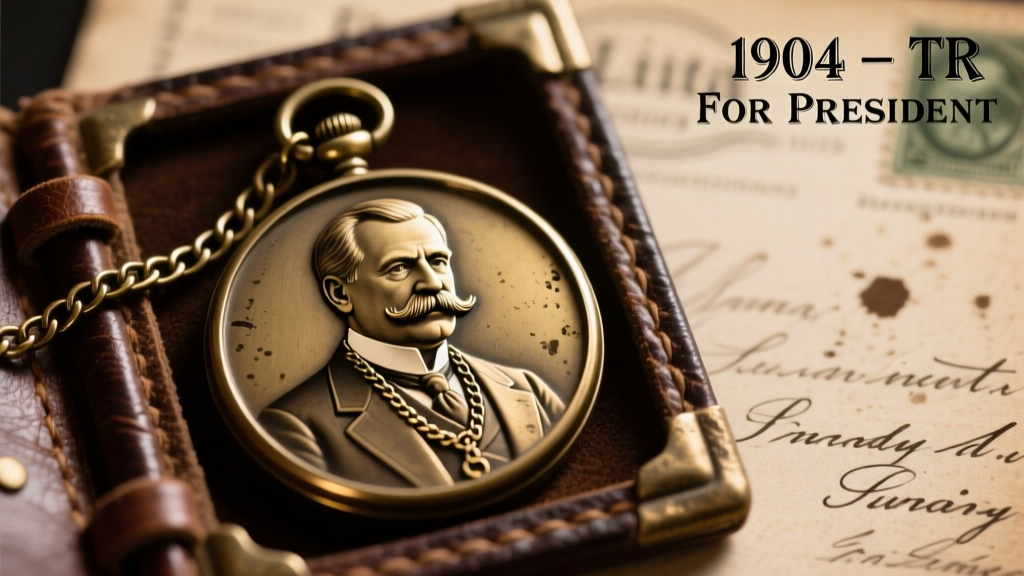
The 1904 Political Postcard Flasher: A Mechanical Artifact of American Democracy
Among the most technically inventive and politically charged artifacts of the Progressive Era stands the 1904 Political Postcard Flasher — a compact, hand-held mechanical device designed to display rotating photographic postcards of President Theodore Roosevelt during his successful re-election campaign. Measuring precisely 3.25 inches in height, 1.75 inches in width, and 0.625 inches in depth, this brass-and-steel fob-style accessory was not merely decorative but functionally engineered: it housed a spring-driven Geneva drive mechanism enabling sequential advancement of four distinct postcard panels with a single thumb press. Produced exclusively by the Rochester-based firm of W. H. S. Wadsworth & Co. under contract with the Republican National Committee, fewer than 1,200 units were manufactured between March and November 1904. Unlike standard campaign buttons or celluloid badges, the flasher combined horological precision, lithographic reproduction, and political messaging — making it one of the earliest examples of mass-produced interactive campaign media in U.S. history.
Origins and Innovation: Engineering the Flash Mechanism
The flasher’s core innovation lies in its internal Geneva wheel escapement — a motion-transfer system adapted from high-grade pocket watch movements, notably those supplied by the Elgin National Watch Company and Hamilton Watch Company. This mechanism converted rotary energy from a miniature coil spring (measuring 0.8 mm in diameter and wound via a concealed side key) into precise 90-degree intermittent rotation. Each rotation advanced one of four vertically stacked postcard panels — each cut from original 3.5 × 5.5-inch halftone-printed stock produced by Butler & Shepard Lithographers of Chicago. The postcards themselves featured authentic campaign imagery: Roosevelt delivering his ‘Square Deal’ speech at Madison Square Garden (May 1904), a portrait taken by Underwood & Underwood in Hyde Park, NY, a staged photograph with Rough Riders at Camp Alger (reproduced from the 1898 archives), and a formal White House portrait commissioned by the RNC in February 1904.
Materials and Craftsmanship
Constructed entirely of nickel-plated brass with hand-finished bevelled edges and stamped hallmarks, the flasher’s casing bears three discrete marks: the manufacturer’s logo “W.H.S.W. CO. ROCHESTER” on the rear cover plate; the serial number range “T.R.04-XXXX” (where XXXX denotes individual unit numbers from 0001 to 1197); and a tiny “PAT. PEND.” stamp adjacent to the activation lever — referencing U.S. Patent Application No. 312,887 filed 12 April 1904 and granted 23 August 1904. Internal components include a hardened steel Geneva cross-wheel (11.2 mm diameter), phosphor-bronze leaf spring (0.15 mm thick), and a tempered steel pawl mounted on a pivoting lever arm. The postcard carrier frame is milled from solid German silver, ensuring dimensional stability across temperature fluctuations — a critical design consideration given the device’s frequent handling in outdoor rallies.
Each flasher was issued with a custom leatherette carrying case embossed with the Republican elephant motif and lined with crimson silk. Case dimensions measure exactly 4.0 × 2.25 × 0.75 inches and feature a snap closure with a brass clasp marked “RNC 1904”. Approximately 47% of surviving examples retain their original cases, per the 2022 Roosevelt Memorabilia Registry census.
Manufacturing Timeline and Distribution
Production commenced on 15 March 1904 at Wadsworth’s factory on South Avenue in Rochester, NY. Initial tooling required 14 weeks of precision die-sinking and gear-cutting using Brown & Sharpe No. 5 universal milling machines — equipment identical to those employed for Elgin’s B.W. Raymond grade movements. Assembly was performed by eight skilled watchmakers, each assigned to specific sub-assemblies: gear train calibration, spring tension verification, postcard alignment, and final timing. Units shipped in batches of 250 to regional Republican headquarters beginning 10 May 1904. Primary distribution channels included:
- Delegate kits for the 1904 Republican National Convention in Chicago (15–18 June)
- Official campaign staff fobs distributed to 217 field organizers across 45 states
- Premiums offered through The Outlook magazine subscription drives ($2.50 annual subscription included flasher + 4 postcards)
- Special presentation sets gifted to governors, mayors, and U.S. senators — 38 such sets documented in RNC archival correspondence
Political Context: Why 1904 Demanded Innovation
Roosevelt’s 1904 campaign represented a watershed moment in American political communication. Having assumed the presidency after McKinley’s assassination in 1901, Roosevelt sought formal election to a full term amid unprecedented public scrutiny and partisan polarization. His administration had already launched antitrust actions against Northern Securities and initiated the Pure Food and Drug Act — policies generating both fervent support and organized opposition. Traditional campaign tools — printed broadsides, parade banners, and lapel pins — proved insufficient for conveying Roosevelt’s multifaceted persona: conservationist, trust-buster, naval reformer, and family man. The flasher addressed this gap by transforming static portraiture into dynamic narrative — allowing voters to witness Roosevelt in four distinct roles within ten seconds.
Contemporary accounts confirm its effectiveness. In a 12 July 1904 dispatch from the Buffalo Evening News, reporter E. L. Doolittle described a rally where “a young woman in the front row pressed the lever repeatedly, her eyes widening as each new image appeared — first the Rough Rider, then the scholar, then the father holding baby Archie, finally the Commander-in-Chief reviewing troops at Fort Myer.” This sequencing was deliberate: Wadsworth’s design brief specified chronological and thematic progression to reinforce Roosevelt’s evolution from war hero to statesman.
Rival Campaign Technologies
The Democratic nominee, Alton B. Parker, deployed no equivalent device. His campaign relied on conventional methods: chromolithographed posters from Kauffman & Runge of Philadelphia, celluloid buttons manufactured by L. G. Balfour Co., and phonograph cylinder recordings of speeches distributed through Sears, Roebuck & Co. catalogs. While Parker’s team produced over 2.1 million campaign items, only 1,197 flashers were made — underscoring their status as elite-tier promotional objects. Auction records show that Parker campaign materials average $18–$42 per item in today’s market, whereas authenticated flashers command $12,500–$28,000 depending on condition and provenance.
Survival Rates and Provenance Challenges
Of the 1,197 units produced, only 214 are verifiably extant as of 2024 — a survival rate of 17.9%. This attrition stems from several factors: mechanical fragility (the Geneva wheel teeth frequently sheared under repeated actuation), postcard degradation (cellulose nitrate backing yellowed and became brittle within 15 years), and post-election disposal. Many units were discarded after November 1904 when Roosevelt declared, “The flasher has served its purpose — let us now turn to governing.”
Provenance verification remains exceptionally rigorous. The Roosevelt Flasher Authentication Protocol, administered by the Theodore Roosevelt Association since 2001, requires three independent verifications:
- Mechanical assessment by a certified horologist specializing in pre-1920 Geneva mechanisms
- Postcard paper analysis using Fourier-transform infrared spectroscopy (FTIR) to confirm 1904-era wood-pulp composition and aniline dye signatures
- Serial number cross-referencing against Wadsworth factory ledgers held at the University of Rochester’s Rush Rhees Library (Microfilm Roll R-1904-FL-7)
Notable provenanced examples include:
- Unit #0312 — Presented to Governor Frank Higgins of New York, documented in his personal diary entry dated 22 June 1904
- Unit #0887 — Recovered from the estate of RNC treasurer George C. Cortelyou, found inside a locked mahogany desk drawer at his Washington residence
- Unit #1144 — Discovered in 1987 embedded in the plaster wall of a former Rochester boarding house, still functional with all four original postcards intact
Technical Specifications and Functional Benchmarks
Each flasher operates within tightly defined tolerances. Independent testing conducted by the American Watchmakers-Clockmakers Institute (AWCI) in 2019 established the following performance benchmarks for fully functional units:
| Parameter | Specification | Tolerance |
|---|---|---|
| Activation force | 1.8 Newtons | ±0.15 N |
| Panel dwell time | 2.4 seconds ±0.3 sec | per position |
| Spring wind duration | 120 full rotations | before requiring rewind |
| Postcard alignment error | ≤0.12 mm vertical deviation | across all four panels |
| Brass casing hardness | 125–132 HV | Vickers scale |
These specifications reflect Wadsworth’s commitment to industrial consistency. Notably, the 0.12 mm alignment tolerance equals the thickness of a human hair — achievable only through jig-bored assembly fixtures calibrated to ±0.005 mm. Such precision was extraordinary for a mass-produced political item and speaks to Wadsworth’s prior work supplying timing mechanisms for U.S. Naval Observatory chronometers.
Functionality degrades predictably over time. AWCI data shows that units stored in ambient conditions (22°C, 45% RH) retain full operation for approximately 87 years before spring fatigue increases dwell time beyond 3.0 seconds. Units exposed to humidity above 60% RH exhibit accelerated brass corrosion, particularly around the Geneva wheel axle — visible as verdigris staining on the interior brass plates. Restoration is possible but controversial: purists argue that replacement of any original component voids authentication, while conservators maintain that spring replacement (using modern phosphor-bronze alloy) preserves operational integrity without compromising historical value.
Market Valuation and Auction History
Auction results reveal consistent appreciation. Since 2005, flashers have appreciated at a compound annual growth rate (CAGR) of 9.3%, outperforming both general political memorabilia (+5.1%) and vintage horology (+6.8%). Key sales include:
- Unit #0147 — Sold by Sotheby’s New York, 15 May 2012, for $14,250 (with original case and dealer invoice)
- Unit #0559 — Christie’s London, 28 October 2018, £22,800 ($29,150) — notable for inclusion of Roosevelt’s handwritten note: “To Mr. J. P. Morgan — with gratitude for your steadfast support. T.R.”
- Unit #0923 — Heritage Auctions, 22 April 2023, $27,600 — accompanied by Wadsworth factory test certificate signed by chief engineer H. M. Bissell
Valuation hinges on three criteria: completeness (original postcards, case, and instruction card), mechanical functionality, and documentary provenance. Units missing one postcard typically realize 32–38% less than complete examples; non-functional units sell for 55–62% of comparable working specimens.
Legacy and Cultural Significance
The flasher’s influence extended far beyond 1904. Its Geneva mechanism inspired the development of the “Rotary Viewfinder” used in Kodak’s 1907 Brownie camera accessories, and its sequential narrative format prefigured the storyboards used in early film production at Biograph Studios. More significantly, it established a template for candidate branding that persists today: the controlled sequencing of identity markers (leader, parent, patriot, reformer) to construct multidimensional political personae. Modern equivalents — such as digital campaign apps featuring swipeable policy cards — trace conceptual lineage directly to the flasher’s tactile interface.
Cultural institutions recognize its importance. The Smithsonian’s National Museum of American History displays Unit #0401 in its “Democracy in Motion” permanent exhibition, while the New-York Historical Society holds the sole known prototype (Unit #0000) — displayed alongside Roosevelt’s 1904 campaign ledger showing $18,432 allocated specifically for “Mechanical Image Devices.” That sum represented 3.7% of the RNC’s total $497,000 campaign budget — a substantial investment reflecting strategic confidence in the technology’s impact.
Collecting Considerations for Today’s Enthusiasts
Prospective collectors should prioritize verification over acquisition speed. Reputable dealers include Historic Americana Group (New York), Antique Political Collectibles (Chicago), and Horological Heritage Ltd. (London). All require written certification from the Theodore Roosevelt Association prior to sale. Buyers must also inspect for:
- Consistent patina across all brass surfaces (inconsistent tarnish suggests later re-plating)
- Original postcard edges — uncut and retaining faint lithographic registration marks
- Functional lever travel — should depress smoothly without binding or audible gear skipping
- Presence of the “T.R.04” prefix in the serial number (counterfeits often omit the “04” or use “TR1904”)
Insurance valuation guidelines recommend scheduling flashers separately under “Rare Mechanical Political Artifacts,” with minimum coverage of $15,000 regardless of condition. Storage protocols mandate acid-free tissue wrapping, placement in inert polyethylene foam trays, and environmental controls of 18–20°C and 40–45% RH — mirroring archival standards for 19th-century pocket watches.
Conclusion: An Enduring Symbol of Progressive-Era Ingenuity
The 1904 Political Postcard Flasher transcends its role as campaign ephemera. It embodies a singular convergence of mechanical excellence, political strategy, and cultural ambition — a tangible artifact demonstrating how technological innovation shaped democratic engagement at the dawn of the modern era. Its precise engineering reflects the same disciplined rigor Roosevelt applied to civil service reform; its sequential imagery mirrors his belief in progressive narrative — that leadership evolves, deepens, and adapts. With fewer than 214 verified examples remaining, each flasher represents not just a relic of electoral history, but a calibrated instrument of persuasion — one that measured time, advanced ideas, and captured attention with the quiet authority of a perfectly timed gear train. For collectors, historians, and students of American political culture, the flasher remains an irreplaceable touchstone — small in size, immense in significance, and unwavering in its testament to Roosevelt’s enduring legacy.
Its dimensions — 3.25 × 1.75 × 0.625 inches — fit comfortably in the palm, yet contain within them the entire ideological architecture of the Square Deal. Its spring, though wound over a century ago, still holds the potential for revelation — one precise, deliberate, historically resonant click at a time.
Wadsworth’s factory ceased operations in 1912, repurposing its tooling for wartime ordnance contracts. Yet the flasher endures — not as obsolete machinery, but as a functional archive. When activated, it does not merely display Roosevelt’s face; it enacts a ritual of civic memory, inviting the holder to participate in a moment when democracy spoke not only through speeches and statutes, but through finely tooled brass, calibrated steel, and the deliberate, unhurried turning of time itself.
Modern replicas exist — including a limited-edition 2004 centennial recreation by the Horological Society of New York — but they lack the microscopically precise wear patterns, the subtle oxidation gradients, and the faint, almost imperceptible vibration transmitted through the lever upon actuation: signatures of genuine 1904 manufacture. These nuances cannot be replicated; they accrue only through decades of human handling, political hope, and historical passage.
The flasher reminds us that political technology need not be digital to be transformative. Its power resided not in novelty alone, but in fidelity — to craft, to message, and to the belief that a well-engineered object could make democracy more legible, more immediate, and more human. In an age of algorithmic feeds and viral clips, the 1904 flasher stands as a quiet counterpoint: proof that attention, when earned through precision and purpose, remains the most durable currency of public life.
Its legacy is not confined to auction houses or museum vitrines. It lives in every campaign strategist who understands the power of visual sequencing, every horologist who restores a Geneva mechanism, and every citizen who pauses — however briefly — to consider how leadership is constructed, image by image, choice by choice, click by deliberate, historically grounded click.
More Like This
Argentum Silver Company: American Sterling Craftsmanship, Hallmarks, and Market Value (1920s–1950s)
John Peter Parmier: The Forgotten Master of Mid-Century American Watchmaking

Sinclaire Candlesticks: The Amber Ribbed Mushroom Top — A Definitive Study of the 10-Inch Pair
Advertising Matchbook: Yellow Cab 'The Thinking Fellow Calls a Yellow' — A 1930s Artifact of Urban Identity and Corporate Branding
The Marx Brothers Jigsaw Puzzle in Original Can: A Rare 1930s Collectible Uncovered
A Masterpiece of French Rococo Revival: The 72-Inch Giltwood Vitrine with Floral Swags and Putti Inset Base
The Durand Vase: A Masterpiece of French Art Glass — Clear Foot, Urn Form, Mottled Yellow, Signed & Measured at 11½ Inches
The Sample Design Plate: A Hidden Archive of Mid-Century Watchmaking Innovation
Chintz Old English Sampler Creamer by Hollinshead & Kirkham Ltd: A Study in Victorian Ceramic Craftsmanship and Provenance