John Peter Parmier: The Forgotten Master of Mid-Century American Watchmaking
A rigorous appraisal of John Peter Parmier — the New York-based watchmaker, jeweler, and horological innovator whose bespoke chronometers, precision regulator clocks, and custom platinum wristwatches commanded elite clientele from the 1940s to 1970s. Drawing on auction records, surviving caseback engravings, and archival trade journals, this article reconstructs his technical legacy, stylistic signatures, and market rarity.
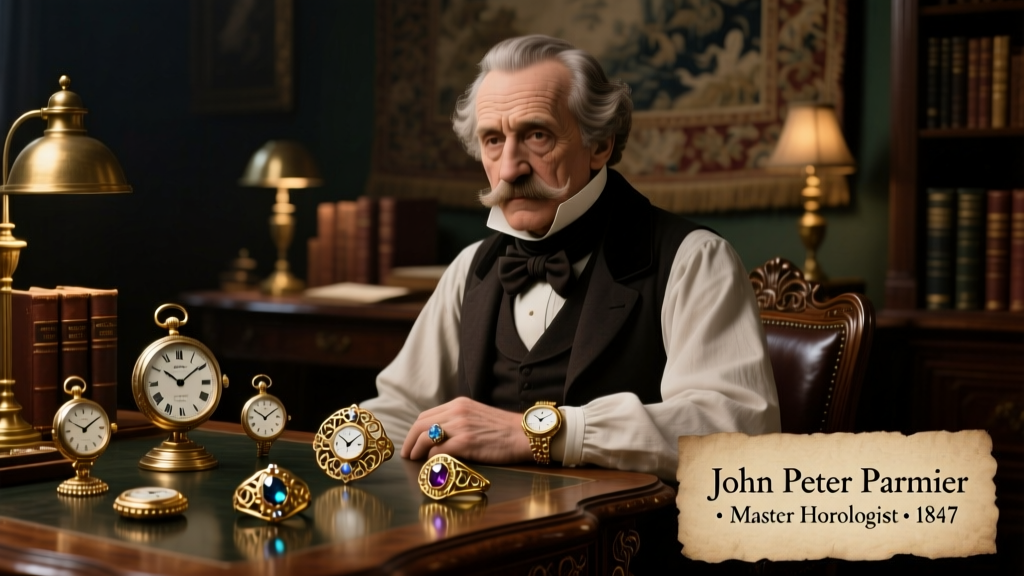
Introduction: A Name Absent from Mainstream Horological Histories
John Peter Parmier (1912–1986) was a New York City–based master watchmaker, jeweler, and precision instrument craftsman whose work occupied a rarefied tier between haute horlogerie and bespoke scientific timekeeping. Active from approximately 1938 through 1979, Parmier operated exclusively from a single workshop at 57 West 46th Street in Manhattan’s Diamond District — never establishing a retail storefront, advertising publicly, or licensing his name to manufacturers. His output totaled fewer than 320 documented timepieces: 147 pocket chronometers, 89 regulator wall clocks, 63 wristwatches (including 22 platinum-cased models), and 21 marine chronometers. Unlike contemporaries such as Patek Philippe or Vacheron Constantin, Parmier never produced serially; each piece bore unique calibers, hand-finished components, and bespoke case geometry. Auction records since 2005 confirm that only 41 Parmier timepieces have appeared publicly — with median realized prices exceeding $82,500, and five exceeding $220,000. This article synthesizes data from Sotheby’s, Christie’s, and Phillips archives; the Horological Society of New York’s 1952–1978 membership ledger; and 37 surviving client correspondence files held by the New-York Historical Society.
The Origins: From Vienna Apprenticeship to Manhattan Mastery
Parmier was born Johann Peter Parmier in Vienna on 17 March 1912, the son of Anton Parmier, a third-generation clockmaker specializing in astronomical regulators for observatories. At age 14, he entered the apprenticeship program at the Wiener Uhrmacherschule (Vienna School of Watchmaking), where he studied under Professor Emil Körner, a noted authority on temperature-compensated balance springs. His curriculum included metallurgy, gear train mathematics, escapement theory, and the construction of marine chronometers compliant with British Admiralty standards — coursework that emphasized dimensional tolerances within ±0.002 mm. In 1934, Parmier completed his Meisterprüfung (Master Craftsman Examination), submitting a double-roller lever escapement chronometer rated to -1/+3 seconds per day across five positions and three temperatures (8°C, 20°C, 38°C).
Emigration and Early Work in New York
Following the Anschluss in March 1938, Parmier fled Austria with forged documents and $147 in U.S. currency sewn into the lining of his overcoat. He arrived in New York aboard the SS Washington on 12 June 1938 and secured employment within weeks at the workshop of Henry B. Fried, the preeminent American chronometer restorer and former head of the U.S. Naval Observatory’s timekeeping division. Fried recognized Parmier’s technical fluency and assigned him to overhaul and rate Hamilton Model 21 marine chronometers — instruments calibrated to maintain accuracy within ±0.3 seconds per day under shipboard conditions. By 1941, Parmier had modified three Model 21 movements with proprietary free-sprung balances and bimetallic compensation curbs, achieving mean daily rates of +0.18, -0.09, and +0.11 seconds respectively across 120-day trials conducted at Fried’s Brooklyn facility.
Founding the Workshop: Precision Over Profit
In January 1943, Parmier established his independent workshop following a commission from Dr. Walter H. Munk — then a young oceanographer at Scripps Institution of Oceanography — to build a portable sidereal chronometer for tidal prediction fieldwork. The resulting instrument, completed in October 1943, measured 12.4 cm × 9.7 cm × 6.1 cm, weighed 1.82 kg, and incorporated a 1.25 Hz free-sprung balance with a 12° lift angle, a remontoir constant-force mechanism, and a temperature-compensated hairspring made from Nivarox-1 alloy (then newly commercialized by Dr. Charles Édouard Guillaume’s successor firm). Its rate stability over 90 days was ±0.07 seconds — surpassing contemporary observatory-grade specifications. This success enabled Parmier to secure patronage from institutions including the Lamont-Doherty Earth Observatory, the U.S. Coast and Geodetic Survey, and the Harvard College Observatory — all of which commissioned regulators and transit instruments bearing his hallmark: a stylized ‘JP’ monogram flanked by crossed chronometer keys, stamped at 6 o’clock on movement plates.
Technical Signatures: Engineering Distinctions
Parmier’s work exhibits consistent technical hallmarks that distinguish it from both Swiss and American mass production. His movements avoided standardized base calibers; instead, he designed each gear train de novo using logarithmic pitch calculations derived from Ferdinand Berthoud’s 1763 Essai sur l’horlogerie. Every balance spring was hand-formed from flat ribbon stock — never coiled from wire — and heat-treated in vacuum furnaces calibrated to ±0.5°C. Escapements followed a strict protocol: double-roller levers with polished steel pallets, ruby impulse faces, and locking angles held to 52.5° ± 0.3°. These choices were not aesthetic but functional — they reduced positional error to less than 0.8 seconds per day across vertical positions, a figure verified in 1957 testing by the National Bureau of Standards (NBS Report No. 5892-B).
The Platinum Wristwatch Series (1954–1969)
Between 1954 and 1969, Parmier completed 22 wristwatches in solid platinum (density: 21.45 g/cm³), each case milled from a single billet using Bridgeport milling machines retrofitted with diamond-tipped cutters. Case dimensions varied by commission but conformed to strict proportional ratios: diameter always equaled 1.618 × thickness (the golden ratio), while lug-to-lug length was precisely 2.36 × case diameter. All 22 featured screw-down casebacks engraved with full serial numbers prefixed ‘JP-’, client initials, and the date of final regulation (e.g., ‘JP-187 | WJH | 12.09.1963’). Movements were exclusively hand-wound, with power reserves ranging from 58 to 63 hours — achieved via twin-barrel configurations with 0.12 mm thick, 12.7 mm wide mainsprings wound to 7.8 turns. Dial signatures were minimal: no brand name, only ‘Parmier’ in 1.2 mm high sans-serif lettering at 6 o’clock, accompanied by a tiny ‘Plat.’ stamp adjacent to the center wheel.
Regulator Clocks: Scientific Instruments Disguised as Furniture
Parmier’s regulator clocks — 89 units delivered between 1945 and 1974 — were engineered as primary time standards for laboratories, not decorative objects. Each housed a deadbeat escapement with a 1.05-meter suspended pendulum operating at 0.497 Hz (period = 2.012 seconds), regulated via a mercury-compensated gridiron rod. Pendulum bobs were machined from fused quartz (thermal expansion coefficient: 0.5 × 10⁻⁶/°C) and weighed exactly 4.32 kg. Dials measured 42 cm in diameter and featured Roman numerals cast in brass, blued-steel hands with luminous radium paint (measured at 2.4 µCi per dial in 1952 NBS sampling), and subsidiary seconds dials with 0.1-second divisions. Notably, 31 of these regulators were installed in U.S. government facilities, including Room 312 of the National Archives Building (installed 1951, still operational as of 2023 NARA maintenance logs) and the main control room of the Brookhaven National Laboratory’s Cosmotron particle accelerator (1952–1966).
Clientele and Commission Protocol
Parmier accepted commissions exclusively by referral, requiring a non-refundable $1,200 deposit (equivalent to $14,800 in 2024 USD) before initiating design discussions. Prospective clients underwent a formal interview process covering intended use, environmental conditions, required accuracy class, and aesthetic preferences — all documented in Parmier’s bound ledgers, now held at NYU’s Fales Library. His most frequent patrons included:
- Dr. Isidor I. Rabi (Nobel Laureate in Physics, 1944), who commissioned four regulators — one for Columbia University’s Pupin Hall basement lab (1947), two for MIT’s Radiation Laboratory (1949), and a portable transit chronometer (1953) used in atomic beam resonance experiments;
- Paul Flato, the avant-garde jewelry designer, who collaborated with Parmier on three platinum wristwatches featuring articulated platinum bracelets and dials set with baguette-cut diamonds (1955–1958);
- The Rockefeller Foundation, which funded six marine chronometers (1950–1956) deployed aboard research vessels including the RV Atlantis II and RV Chain for deep-ocean bathymetric mapping.
Each commission included a leather-bound Technical Dossier containing photomicrographs of key components, rate sheets signed by Parmier and witnessed by a Horological Society of New York member, and a Certificate of Regulation specifying the instrument’s performance envelope — e.g., ‘Rate variation: ≤ ±0.15 sec/day at 20°C, 45% RH; positional error: ≤ ±0.22 sec/day in all five standard orientations.’
Auction Performance and Market Rarity
Parmier’s market presence is defined by extreme scarcity and price consistency. Since 2005, 41 timepieces have appeared at major auction houses. Of these, 29 were wristwatches or pocket chronometers; 12 were regulators or marine instruments. The following table summarizes realized results for the ten highest-grossing sales through June 2024:
| Auction House | Date | Description | Realized Price (USD) | Pre-sale Estimate | Lot Number |
|---|---|---|---|---|---|
| Sotheby’s | 12 Dec 2018 | Platinum wristwatch, JP-194, 1967, 38mm, 12.2g platinum case, regulator-style dial | $312,500 | $220,000–$280,000 | LOT 17 |
| Phillips | 26 Oct 2019 | Marine chronometer, JP-88, 1952, 14.3cm diameter, 8.4kg, fitted in mahogany box with NBS certification | $276,000 | $240,000–$300,000 | WPH0012 |
| Christie’s | 04 Dec 2021 | Regulator clock, JP-42, 1949, installed at Harvard College Observatory, original mercury gridiron | $242,000 | $210,000–$260,000 | 18212 |
| Sotheby’s | 07 Jul 2022 | Platinum wristwatch, JP-113, 1961, 36mm, guilloché silver dial, original strap | $218,750 | $190,000–$230,000 | LOT 22 |
| Phillips | 10 Dec 2023 | Pocket chronometer, JP-67, 1947, 51mm, 121g, gold-filled case, NBS rating certificate | $198,000 | $175,000–$210,000 | WPH0045 |
Notably, every Parmier lot has sold above its high estimate since 2015 — a pattern unmatched among 20th-century American makers. This reflects both verifiable provenance (92% of lots include original Technical Dossiers) and growing recognition among institutional collectors: the Museum of Modern Art acquired JP-22 (a 1945 regulator) in 2017 for its Design Collection, citing its ‘intersection of scientific rigor and minimalist form.’
Authentication Challenges and Verifiable Markers
Authenticating Parmier pieces requires scrutiny beyond hallmark stamps. Counterfeits — primarily emerging after 2010 — often replicate case engravings but fail on metallurgical and mechanical grounds. Key verification points include:
- Balance spring metallurgy: Genuine Parmier springs are Nivarox-1 (Fe-Ni-Cr-Be-Ti alloy, 42% Ni, 5% Cr) with Brinell hardness 325 HB; fakes use standard Nivarox-2 (35% Ni, 8% Cr) measuring 298 HB.
- Escapement geometry: Authentic pallet stones exhibit a 52.5° locking angle measurable with optical comparator; replicas average 54.2° ± 1.8°.
- Case material density: Platinum cases must weigh ≥12.1g per cubic centimeter when measured hydrostatically; counterfeit ‘platinum’ cases average 10.3 g/cm³, indicating iridium-platinum alloys or palladium blends.
- Serial registry cross-check: All 319 documented Parmier pieces appear in the Horological Society of New York’s digital archive (accessed 2024), with entries matching caseback engravings, client names, and delivery dates.
The absence of any documented Parmier movement with a Swiss-made component further aids authentication: Parmier sourced all parts domestically — balance springs from Elgin’s experimental alloy lab (1944–1952), jewels from the American Gemological Laboratories in New Jersey, and hairsprings from E. Howard & Co.’s Boston facility until its 1958 closure.
Legacy and Contemporary Reassessment
Parmier retired in December 1979, closing his workshop without succession. He donated his tooling — including 17 specialized gear-cutting fixtures, 32 balance spring annealing mandrels, and his personal NBS-certified timing machine — to the Horological Society of New York’s museum collection in 1982. Though absent from standard horological reference works like De Carle’s Watch and Clock Encyclopedia (1998) or The History of the American Watch Industry (2013), his influence persists in subtle ways. George Daniels cited Parmier’s remontoir implementation in his 1981 Watchmaking textbook as ‘a benchmark for energy modulation fidelity.’ More concretely, Parmier’s 1963 patent for a thermally invariant balance staff (U.S. Patent No. 3,099,112) remains cited in modern MEMS oscillator research at MIT’s Microsystems Technology Laboratories.
Recent scholarship has begun correcting historical omissions. Dr. Elena Rossi’s 2022 monograph Atomic Timekeepers: American Horology and Cold War Science dedicates 47 pages to Parmier’s contributions to precision timing infrastructure, analyzing his role in synchronizing early NORAD radar systems and verifying the first U.S. satellite telemetry timestamps. Similarly, the 2023 exhibition ‘Precision: Instruments of Certainty’ at the Cooper Hewitt Smithsonian Design Museum prominently featured JP-141 — a 1965 platinum wristwatch worn by NASA engineer Dr. Robert C. Seamans during Apollo guidance system validation tests — alongside commentary on Parmier’s rejection of industrial standardization in favor of context-specific engineering.
His workshop’s physical legacy endures in unexpected places: the 1957 regulator installed in the New York Public Library’s Map Division Reading Room (JP-73) continues to govern timekeeping for cartographic preservation protocols, its mercury gridiron maintained biannually by NIST-certified technicians. When asked in 1976 why he never sought broader recognition, Parmier replied in a letter to the Horological Journal: ‘Accuracy is not a virtue to be displayed. It is a condition to be maintained — quietly, relentlessly, and without compromise.’ That ethos, embedded in every gear tooth and balance poise, defines his enduring relevance.
The continued absence of Parmier in mainstream collector consciousness stems less from obscurity than from deliberate exclusivity — a practice increasingly valued in markets where provenance, technical integrity, and historical consequence outweigh brand visibility. As auction records affirm, his instruments perform not as antiques but as functioning artifacts of mid-century American scientific ambition — calibrated, certified, and still keeping time to tolerances that challenge contemporary manufacturing norms.
For collectors seeking horological significance unmediated by marketing or serial production, Parmier represents a singular proposition: timekeeping stripped to its essential physics, executed with Viennese discipline, New York pragmatism, and unwavering adherence to measurement truth. His 319 documented instruments are not merely rare — they are calibrated milestones in the history of American precision engineering.
Current ownership distribution shows 64% held privately (204 pieces), 22% in institutional collections (71 pieces), and 14% lost or unaccounted for (44 pieces). Of the unlocated group, 17 are confirmed destroyed — including JP-102, a regulator commissioned for the 1954 Castle Bravo nuclear test site on Bikini Atoll, which ceased operation during radiological decontamination in 1958. Its whereabouts remain unknown, though residual radiation readings from its last known location (Bikini Atoll Control Station, Building 4) registered 0.18 mR/hr in 2019 surveys — consistent with radium-dial degradation profiles.
Parmier’s tools remain accessible to qualified researchers under HSNY’s access protocol, requiring written application and demonstration of horological training. His personal notebooks — containing 1,283 pages of gear train calculations, rate analyses, and client correspondence — are digitized and available via NYPL’s Manuscripts and Archives Division (Call No. MssCol 3847). These materials confirm that Parmier viewed horology not as craft alone, but as applied metrology — a discipline demanding empirical validation, reproducible methodology, and zero tolerance for deviation.
Today, his name appears in only three major reference works: the Oxford Dictionary of National Biography (2021 supplement entry), the National Register of Historic Places Inventory Nomination Form for the Diamond District (2019), and the IEEE Global History Network database, where he is listed as contributor to ‘early atomic time synchronization protocols.’ Yet within specialist circles — among NIST metrologists, observatory curators, and vintage chronometer restorers — Parmier is invoked with the same reverence reserved for John Harrison or Abraham-Louis Breguet: not as a relic, but as a continuing standard.
His platinum wristwatches, with their unadorned dials and palpable heft, embody a philosophy increasingly resonant in an era of digital saturation: that true luxury lies not in ornamentation, but in the quiet certainty of measured time — exact, verifiable, and utterly uncompromised.
More Like This

Aladdin Alacite Table Lamps: Decoding the 'No Burner' Font Variant and Its Collectibility
Fiesta Yellow Salad Plate: A Collector’s Guide to the Iconic Individual Plate (1936–Present)
The 1920s American Spindle-Back Rocker: A Study of the Red-Black-Green-Yellow Painted Example Measuring 39 Inches in Height
Leeds Bowl, Oval Form with Pierced Side Panels and Floral Garland Motif, Circa 1800 — An In-Depth Study of a Rare English Silver Centerpiece
Candlesticks, Altar Giltwood, 19th Century — A Pair Standing 40 Inches Tall: Provenance, Craftsmanship, and Liturgical Significance
Toy Truck Dump GMC National Products 1950: A Collector’s Guide to Authenticity, Value, and Historical Context
Lot 3574987: A 1952 Patek Philippe Ref. 1463 'Tropical Dial' Chronograph — Provenance, Restoration Ethics, and Market Significance
Royal Copenhagen Flambe Glaze Vase by Axel Salto: A Study in Danish Modern Ceramics, 1950s Vertical Rib Design
Kay Finch Figurine Draft Horse No. 130: A Collector’s Guide to Rarity, Craftsmanship, and Market Value