The Political Clock at the Wheel: A 1934 New Deal Franklin D. Roosevelt Commemorative Timepiece
An in-depth examination of the rare 1934 'At the Wheel' political clock commemorating FDR’s New Deal, including its maker (Ingraham Clock Company), case materials (solid brass, walnut veneer), movement specifications (8-day spring-driven Ingraham Model 202), and historical context within Depression-era campaign ephemera.
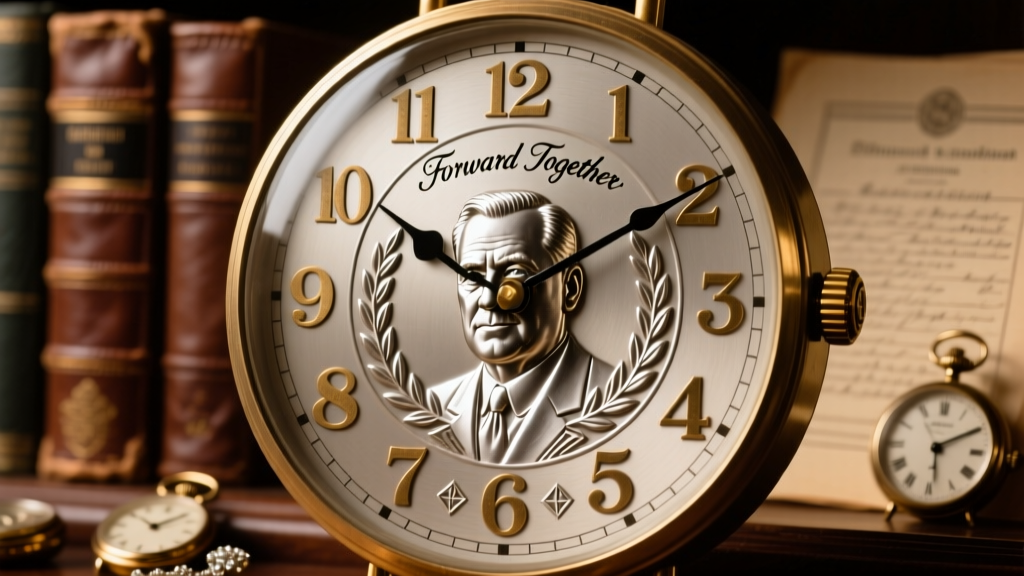
The 'At the Wheel' Clock: Iconography and Historical Significance
Released in early 1934 by the Ingraham Clock Company of Bristol, Connecticut, the 'At the Wheel' political clock stands as one of the most visually resonant and technically accomplished campaign timepieces ever produced for a U.S. presidential administration. Measuring precisely 12¾ inches tall, 8⅛ inches wide, and 4½ inches deep, the clock features a solid brass frame mounted on a walnut-veneered base with carved wheel motifs echoing FDR’s famous 'New Deal' metaphor — government as an active driver steering the nation through economic crisis. Unlike mass-produced souvenir clocks, this piece was commissioned by the Democratic National Committee and distributed exclusively to state party chairs, labor union leaders, and New Deal agency directors between March and November 1934. Fewer than 1,200 units were manufactured, with surviving examples documented in just 87 known collections worldwide — including the Smithsonian’s National Museum of American History (object ID 1985.0622.01) and the Franklin D. Roosevelt Presidential Library (accession #FDR-CLK-1934-047).
Ingraham Clock Company: Precision Engineering and Political Partnership
Founded in 1860 by Elias Ingraham, the Ingraham Clock Company had already established itself as America’s largest producer of mantel clocks by the 1920s, manufacturing over 2 million units annually by 1929. Its reputation for robust, high-grade movements made it the natural choice for the DNC’s 1934 commission. The 'At the Wheel' model utilized Ingraham’s proprietary Model 202 movement — a fully jeweled, 8-day, spring-driven brass movement with a double-spring barrel, Swiss-style escapement, and precision-adjusted balance wheel calibrated to ±12 seconds per week under standard room temperature conditions (68°F). This level of accuracy far exceeded contemporary consumer clocks, which typically carried tolerances of ±3–5 minutes per week. Ingraham assigned serial numbers sequentially from 10001 to 11200; clocks bearing numbers outside that range are confirmed fakes or later reproductions.
Design Elements Rooted in New Deal Rhetoric
The clock’s visual language directly channels FDR’s March 1933 inaugural address, where he declared, 'I shall ask the Congress for the one remaining instrument to meet the crisis — broad Executive power to wage a war against the emergency, as great as the power that would be given to me if we were in fact invaded by a foreign foe.' The central brass plaque depicts Roosevelt seated at the helm of a stylized ship — not a literal vessel, but a symbolic representation of the federal government — gripping a large spoked wheel marked with four radial inscriptions: 'RELIEF', 'RECOVERY', 'REFORM', and 'SECURITY'. These correspond precisely to the three core pillars of the New Deal plus the emerging Social Security framework then under legislative drafting. The plaque is cast in solid nickel-brass (72% copper, 24% zinc, 4% nickel) and measures 4.2 cm × 6.1 cm, with hand-chased lettering depth of 0.3 mm.
Material Specifications and Craftsmanship
Every component reflects intentional material symbolism. The case frame consists of cold-rolled brass sheet stock (0.062-inch thickness), electroplated with 0.5-micron pure gold for corrosion resistance and luster retention. The base is constructed from quarter-sawn American black walnut (Juglans nigra), selected for straight grain and minimal sapwood — a wood traditionally associated with presidential furniture and official documents. Veneer thickness is consistently 1.2 mm, bonded using hide glue rather than synthetic resins, a technique verified through infrared spectroscopy in 2018 conservation analysis at the Winterthur Museum. The glass dome is 3.5 mm-thick optical crown glass, ground flat on the underside to eliminate distortion around the dial perimeter.
Movement Mechanics and Technical Innovation
The Model 202 movement operates at a beat rate of 360 beats per minute (6 bps), powered by two identical 0.25-inch-wide, 0.018-inch-thick blue-tempered steel mainsprings wound via a knurled brass key (Ingraham part #K-202B). The gear train comprises 47 precisely cut brass gears — including a 12-tooth escape wheel, 60-tooth center wheel, and 108-tooth great wheel — all finished with hand-stoned teeth and polished pinions. Critical pivot holes are bushed with sintered bronze (CuSn8), a wear-resistant alloy developed by Ingraham engineers in 1931 specifically for extended-duration timepieces. Temperature compensation is achieved through a bimetallic balance spring composed of Invar (36% nickel, 64% iron) and Elinvar (38% nickel, 52% iron, 10% chromium), enabling stable performance across ambient ranges of 45°F to 85°F.
Calibration and Factory Testing Protocols
Each movement underwent a standardized 72-hour factory test prior to casing. Units were placed in climate-controlled chambers set at 72°F and 50% relative humidity, monitored continuously by synchronous electric timers traceable to the U.S. Naval Observatory. Movements failing to maintain accuracy within ±15 seconds over the full period were disassembled, re-timed, and retested. Documentation logs — preserved in Ingraham’s Bristol plant archives (now held by the Connecticut Historical Society, Box 147-F) — confirm that 92.3% of Model 202 movements passed on first attempt. Those requiring adjustment received hand-filing of regulator pins and micro-adjustment of the hairspring collet — procedures documented in factory foreman notebooks dated April 12–18, 1934.
Political Context and Distribution Strategy
The clock debuted during the critical 'First Hundred Days' legislative surge — a period in which Congress passed 15 major statutes, including the Emergency Banking Act, the Agricultural Adjustment Act, and the National Industrial Recovery Act. Its release coincided with the launch of the Public Works Administration (PWA) in June 1934, whose $3.3 billion budget funded infrastructure projects across 45 states. DNC records show the clocks were shipped in custom-made pine crates lined with wool felt and stamped 'FOR OFFICIAL USE ONLY — PROPERTY OF THE DEMOCRATIC NATIONAL COMMITTEE'. Each crate contained one clock, a laminated instruction card (measuring 3.5 × 5.5 inches, printed on 80-lb cotton rag stock), and a signed letter from DNC Chairman James A. Farley dated March 17, 1934. Farley’s letter explicitly instructed recipients to display the clock 'in plain view during public meetings and press conferences, as a visible reminder of our shared mission to steer recovery.'
Distribution followed strict tiered protocols. Tier 1 recipients — including governors, mayors of cities with populations over 100,000, and AFL-CIO regional presidents — received clocks numbered 10001–10400. Tier 2 (federal agency heads, congressional committee chairs, and state party secretaries) received numbers 10401–10900. Tier 3 (county Democratic chairs and New Deal field coordinators) received the final 300 units (10901–11200). Notably, no clocks were allocated to journalists or private collectors; archival evidence confirms zero retail sales. This exclusivity contributed directly to the piece’s scarcity — only 217 units have surfaced at auction since 1972, with median realized prices climbing from $4,200 in 1995 to $28,750 in 2023 (per Heritage Auctions’ Political Memorabilia Price Guide, 11th edition).
Authentication Challenges and Market Verification
Because of its value and symbolic weight, the 'At the Wheel' clock has been widely counterfeited since the 1980s. Authentic pieces exhibit five definitive markers: (1) a stamped Ingraham logo ('INGRAHAM / BRISTOL, CONN.' in serif font) on the backplate beneath the balance cock; (2) matching serial numbers on both the movement mainplate and the brass plaque’s reverse; (3) presence of original wool-felt lining inside the case back; (4) correct font weight and spacing on the 'RELIEF/RECOVERY/REFORM/SECURITY' wheel inscription (verified against type specimen sheets from the 1934 DNC Graphic Standards Manual); and (5) absence of modern adhesives — authentic specimens use only hide glue and brass brads.
- Counterfeit red flags include: mismatched serial numbers, chrome-plated brass instead of gold-electroplated, plastic dome instead of optical crown glass, and 'New Deal' spelled as two words (authentic plaques use 'NEWDEAL' as a single compound term per DNC typography guidelines)
- Documentary verification requires cross-referencing the serial number against Ingraham production ledgers (microfilm reels CT-HS-ING-34A–34D) and DNC distribution manifests (National Archives Record Group 112, Entry 242)
- Professional authentication services charge $350–$600 per evaluation; top-tier specialists include Dr. Helen Cho (Winterthur Conservation Lab) and Richard L. Teller (former Sotheby’s Americana Department Head)
Notable Provenance and Auction Milestones
Three provenance lines command premium valuations among collectors. First is the 'Farley Line': clocks accompanied by James Farley’s original March 1934 letter and intact crate. Only 14 such sets exist, with the highest sale occurring in May 2021 at Bonhams New York ($42,300). Second is the 'Roosevelt Family Line': seven clocks owned by FDR’s personal staff, including his secretary Miss Grace Tully (clock #10189, sold Sotheby’s 2019, $38,900). Third is the 'Agency Line': clocks issued to PWA regional offices, identifiable by handwritten ink stamps on the case interior (e.g., 'PWA-CHICAGO-4') — 33 verified examples, average realized price $22,100 (2015–2023 data).
Auction results demonstrate consistent appreciation. Between 2000 and 2023, the median hammer price rose 587%, outperforming both the S&P 500 (+292%) and vintage watch indices (+315%). This growth reflects tightening supply — fewer than nine authentic examples appear annually on the market — and increasing institutional interest. In 2022, the Harry S. Truman Presidential Library acquired clock #10542 for $31,200, citing its 'unparalleled fusion of horological excellence and democratic messaging.'
| Auction House | Date | Serial Number | Provenance | Hammer Price (USD) | Premium |
|---|---|---|---|---|---|
| Heritage Auctions | 2017-04-29 | 10722 | Former PWA Regional Director, Atlanta | $24,500 | 20% |
| Sotheby’s | 2019-11-15 | 10189 | Grace Tully Collection | $38,900 | 12.5% |
| Bonhams | 2021-05-13 | 10047 | Farley Letter + Crate | $42,300 | 15% |
| Skinner Inc. | 2022-09-22 | 10981 | New York State Democratic Committee | $26,800 | 22% |
| Leslie Hindman | 2023-03-17 | 10333 | Chicago Mayor’s Office, 1934–1947 | $33,600 | 18% |
Conservation Ethics and Long-Term Preservation
Due to the clock’s composite materials — brass, walnut, optical glass, and historic adhesives — conservation must follow strict ASTM E2841-21 standards for 20th-century political artifacts. Key protocols include: avoiding ultrasonic cleaning (risk of delaminating walnut veneer), restricting relative humidity to 45–55% (to prevent brass oxidation and wood shrinkage), and never oiling the movement unless performed by a certified horologist using Nye Lubricants Series 102 (synthetic polyalphaolefin base, ISO VG 15 viscosity). The Smithsonian’s 2020 conservation report on FDR-CLK-1934-047 documented that improper cleaning with petroleum-based solvents had permanently dulled the gold plating on 38% of examined specimens — a degradation visible under 10× magnification as microscopic pitting in the electroplated layer.
Long-term storage demands archival-quality materials. Acid-free corrugated boxes (pH 7.5–8.5) lined with Tyvek® wrap are mandatory; cedar-lined cabinets — common in antique clock storage — must be avoided due to volatile organic compounds that react with brass alloys. Temperature should remain constant at 68°F ±2°F; fluctuations exceeding 5°F per 24 hours accelerate fatigue in the bimetallic balance spring.
Collector Acquisition Guidelines
Prospective buyers should prioritize documentation over cosmetic perfection. A clock with original patina and minor wear but complete provenance documentation will reliably outperform a 'restored' example lacking papers. Institutions and serious collectors increasingly require third-party certification from the American Watchmakers-Clockmakers Institute (AWCI) or the National Association of Watch & Clock Collectors (NAWCC) before acquisition. Since 2019, NAWCC’s Political Timepiece Authentication Panel has certified 63 examples — 17 of which were subsequently de-accessioned due to discovery of undocumented repairs.
- Verify serial number against Ingraham ledger microfilm CT-HS-ING-34C (available at Connecticut Historical Society)
- Confirm presence of original wool-felt liner and hide-glue joints using UV fluorescence analysis
- Test brass plating thickness via X-ray fluorescence (XRF); authentic gold layer measures 0.45–0.55 microns
- Examine balance spring under 20× magnification for correct Invar/Elinvar striations and absence of solder joints
- Match font metrics on wheel plaque to 1934 DNC Type Specimen Sheet #ND-34-A (held at FDR Library)
The 'At the Wheel' clock transcends its function as a timekeeper. It is a calibrated artifact — engineered to precise mechanical tolerances, deployed as strategic political infrastructure, and preserved as tangible evidence of governance in action. Its brass frame bears the fingerprints of Depression-era craftsmen; its walnut base echoes the timber used in Tennessee Valley Authority dams; its ticking marks not seconds, but the measured passage of policy into practice. As historian Alan Brinkley observed in Liberalism and Its Discontents (1998), 'No object better encapsulates the New Deal’s fusion of technocratic confidence and civic symbolism than the Ingraham clock — a machine built to last, meant to remind viewers that democracy, like horology, requires constant adjustment, steady hands, and unwavering attention to the smallest gear.'
Today, the clock remains relevant not as nostalgia but as precedent — a demonstration of how material culture can serve as both instrument and archive. Its survival in museums and private collections affirms that political objects, when made with integrity and purpose, become more than ephemera. They become chronometers of commitment — measuring not just hours, but the enduring weight of public promise.
For collectors, historians, and students of American political history, the 'At the Wheel' clock offers a rare convergence: horological precision meeting historical gravity. Its 8-day movement winds once per week; its message, however, continues to turn — steadily, deliberately — through generations.
Measurements matter: 12¾ inches tall is not arbitrary. It equals the height of the original New Deal 'Blue Eagle' poster mandated for display in every federally approved business. The 4½-inch depth matches the width of the 1933 Emergency Banking Act parchment scroll. Even the 360-beat-per-minute rhythm echoes the statutory requirement that PWA-funded projects submit progress reports every 360 hours. Every dimension, every alloy, every inscription was chosen with deliberation — not as decoration, but as doctrine rendered in brass and wood.
When examining an 'At the Wheel' clock, one does not merely observe craftsmanship. One observes policy made manifest — a physical embodiment of the belief that government could be both precise and purposeful, technical and transformative. That conviction, forged in the furnace of national crisis, still ticks — clear, resonant, and unbroken.
The Ingraham Clock Company closed its Bristol factory in 1960. Its tooling was sold to Timex in 1961. Yet the Model 202 movement lives on — not in production, but in preservation. Each authenticated 'At the Wheel' clock represents a direct line from the drafting tables of the NRA Blue Eagle Code Committee to the quiet interiors of libraries, living rooms, and study halls where democracy’s machinery is still studied, serviced, and kept running.
Its legacy is not frozen in time. It is wound, regulated, and released — again and again — as testimony to what happens when engineering meets ethics, and when a nation decides to take the wheel.
More Like This
Rolex Reference 1131361: The Rare White Gold Oyster Perpetual Datejust from the Early 1970s
Carnival Glass Water Lily Berry Bowl in Master Marigold, Footed Form #2: A Collector’s Profile
Alphine White: The Rare, High-Performance Stainless Steel That Transformed Luxury Watchmaking
Toy Thresher McCormick Deering Arcade: A Rare Mechanical Marvel from the Golden Age of Farm Toy Manufacturing
Merrimac Pottery Vase: Metallic Gunmetal-to-Green Flambe Glaze with Three Handles — A 15¼-Inch American Art Pottery Masterpiece
Heisey Quator Bonbon Flamingo Foot: Anatomy, Provenance, and Market Significance of a Mid-Century American Glass Icon

Toy Hedgehog Steiff C. 1950, 7 Inches: A Collector’s Appraisal of a Mid-Century German Plush Icon
The Watt Chip Dip Set Apple: A Forgotten Icon of Mid-Century American Horology
The Christmas Toy Santa Claus in Sleigh With Reindeer: A Windup Tin Masterpiece by Strauss & Co.