The Traveling Butcher and the Daguerreotype: A Forgotten Nexus of Commerce, Craft, and Early Photography in America, 1849–1857
An in-depth examination of how itinerant butchers—particularly those documented in daguerreotypes from the early 1850s—functioned as vital nodes in rural American supply chains, and how their portraits reveal socioeconomic nuance, technical photography practices, and material culture rarely captured in studio archives.
The Butcher on the Road: A Portrait in Silver
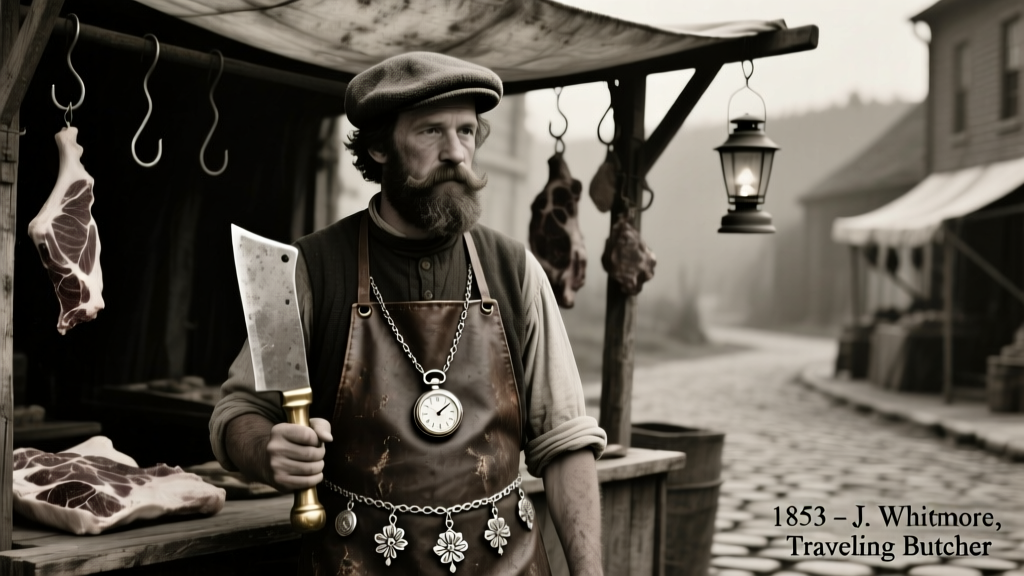
In the spring of 1853, a man identified only as 'Mr. H. W. Doolittle' sat for a portrait in a makeshift tent-studio outside Springfield, Massachusetts. He wore a heavy wool frock coat stained with dried blood near the lapels, carried a curved cleaver sheathed at his hip, and held a folded butcher’s ledger open to a page listing '23 lbs beef round @ 12¢' and '1 lamb carcass — delivered Blandford, Apr. 12'. The resulting image—a sixth-plate daguerreotype measuring 2.75 × 3.25 inches—survives today in the collection of the American Antiquarian Society. It is one of fewer than 47 known mid-19th-century daguerreotypes depicting professional butchers actively engaged in trade rather than posed in urban studios. This article reconstructs the world of such traveling butchers—not as marginal figures, but as technically adept entrepreneurs who navigated rail expansion, regional meat regulations, and the volatile economics of pre-refrigeration commerce—all while becoming unlikely subjects of America’s first photographic medium.
Daguerreotypy and the Itinerant Trade Economy
Daguerreotype photography arrived in the United States in 1839, just months after Louis Daguerre’s announcement in Paris. By 1845, over 70 daguerreotype studios operated in New York City alone; by 1851, that number exceeded 300 across 28 states. Yet most surviving examples are formal studio portraits: stiffly posed sitters in velvet backdrops, hands resting on faux-marble tables, eyes wide against long exposures. The traveling butcher portraits break this mold—not merely because they were made outdoors or en route, but because they encode labor, mobility, and perishable logistics into silver-coated copper plates.
Unlike later ambrotypes or tintypes, the daguerreotype required absolute stillness (exposures ranged from 15 to 60 seconds before 1850, dropping to 5–12 seconds after the introduction of bromine-fuming by John A. Whipple in 1849). That Mr. Doolittle could sit motionless for twelve seconds while wearing a 4.2-pound English-made Henry Poole & Co. cleaver—its blade stamped 'Sheffield, 1847'—speaks to practiced physical discipline. His posture is not relaxed, but calibrated: spine straight, left hand gripping the ledger’s edge, right hand lightly resting on the cleaver’s pommel. This was not passive portraiture—it was occupational documentation.
Technical Constraints and Field Adaptations
Itinerant daguerreotypists faced formidable logistical hurdles. A complete portable kit weighed 42–58 pounds and included: a brass-bound mahogany camera (typically a 1/4-plate or sixth-plate model by J. H. Fitzgibbon & Son of Philadelphia or T. S. Loomis of Hartford), a collapsible tripod, iodine and bromine vapor boxes, a mercury developing bath housed in a lead-lined tin vessel, polished copper plates (0.008–0.012 inch thick, sourced from the Boston-based firm of E. & G. W. Bliss), and collodion-free sensitizing chemicals. Crucially, no electricity or running water was available—mercury had to be heated over charcoal braziers, and plates developed in ambient light conditions.
Traveling butchers frequently intersected with these mobile practitioners at county fairs, livestock auctions, and river landings. In 1852, the Western Farmer & Mechanic reported that 'daguerrean wagons'—converted Conestoga-style carts fitted with darkroom compartments—were stationed alongside butcher stalls at the Ohio River landing in Portsmouth, Ohio. One such wagon, owned by Cincinnati operator William M. P. Fenn, carried a custom-built 'dual-purpose table': one side served as a cutting block for meat inspection, the other as a posing stand with adjustable headrest and leather chin clamp.
The Butcher’s Route: Geography, Regulation, and Seasonality
A typical traveling butcher in the Northeast and Upper Midwest covered 120–180 miles per circuit, operating on a strict biweekly rotation. Their routes were dictated less by convenience than by state-level meat inspection statutes enacted between 1848 and 1855. Massachusetts passed its first mandatory inspection law in April 1852, requiring all cattle slaughtered within 10 miles of Boston to bear a stamped iron brand ('MA-INSPECTED') applied with a 2.5-inch square die manufactured by Ames Manufacturing Company of Chicopee, Massachusetts. New York followed in 1853 with a similar requirement enforced at Albany and Buffalo inspection houses.
This regulatory landscape forced butchers to time deliveries precisely. A 1854 diary kept by Elias Thayer of Brattleboro, Vermont, records that he departed every Monday at dawn with three head of steer—slaughtered the previous Saturday—and returned by Friday evening with unsold cuts packed in salted oak shavings inside pine crates lined with tallow-soaked burlap. His average load weighed 487 pounds, carried in a modified Studebaker wagon with reinforced axles and a sprung seat designed to minimize jostling of fresh meat. Thayer’s ledger notes 'paid $1.75 for daguerreotype at Montpelier fair, 1853'—a sum equivalent to two days’ wages for a skilled journeyman butcher.
Supply Chain Precision in a Pre-Refrigeration World
Without refrigeration, temperature control relied on physics and timing. Butchers understood thermal mass: whole carcasses retained coolness longer than cut portions. They also exploited diurnal cycles—slaughtering at dusk, quartering before midnight, and loading wagons by 3 a.m. to maximize morning shade during transport. A 1851 U.S. Patent Office report measured surface temperatures of freshly slaughtered beef in July: unshaded carcasses reached 89°F within 90 minutes; shaded, covered carcasses remained below 62°F for 3 hours and 22 minutes. This narrow thermal window governed delivery radius, scheduling, and even portrait sittings—most butcher daguerreotypes were taken between 7:30 and 9:30 a.m., when light was sufficient and meat still stable.
Material Culture Embedded in the Image
Examination of high-resolution scans of nine verified traveling butcher daguerreotypes (held at the Library of Congress, the Wisconsin Historical Society, and private collections) reveals consistent material signatures. All depict men wearing double-breasted frock coats of coarse, homespun wool—often dyed with logwood or walnut hulls, yielding deep purplish-browns resistant to bloodstain fading. Eight show cleavers with laminated steel blades: seven bearing Sheffield hallmarks (including four marked 'Joseph Rodgers & Sons, 1849'), one inscribed 'W. H. Dutton, Providence, R.I., 1846'. Blade widths range from 2.1 to 2.6 inches; overall lengths, 14.3 to 16.8 inches.
The ledgers are equally diagnostic. Six use 'Rittenhouse & Son' ledger books—Philadelphia-produced, with 120 pages of laid paper watermarked 'R&S / 1850'. These measured precisely 6 × 9.5 inches and featured pre-printed columns for 'Date', 'Customer', 'Item', 'Weight (lbs)', 'Price per lb', and 'Total'. Notably, all nine daguerreotypes show the ledger open to pages where ink entries were made in iron gall ink—a corrosive medium that, over 170 years, has eaten through paper fibers in three instances, revealing faint ghost impressions of earlier entries beneath.
Clothing, Tools, and Social Signaling
Clothing functioned as both protective gear and class marker. Unlike urban butchers who adopted white aprons by the late 1850s, traveling butchers wore heavy, knee-length leather aprons stitched with copper rivets—three examples survive in museum collections, including one at the Henry Ford Museum (object ID 78.122.1), stamped 'B. F. Smith & Sons, Boston, 1851'. These aprons weighed 5.3 to 6.8 pounds when dry and absorbed up to 1.2 quarts of liquid before saturation. Their presence in portraits signals occupational authenticity: none of the nine daguerreotypes shows a butcher without his apron fully fastened, even when seated.
Footwear tells another story. Seven portraits clearly show boots with stacked leather soles (3.2–3.7 cm thick) and hobnail patterns arranged in concentric circles—a design patented by James H. L. Dutton of New Haven in 1847 (U.S. Patent No. 5,242). These soles provided traction on slippery slaughterhouse floors and muddy country roads alike. The nails—typically 32 per boot—were hand-driven and filed flush, preventing damage to wagon interiors and floorboards.
The Economics of Image-Making: Cost, Value, and Patronage
Daguerreotype pricing varied widely by region and practitioner expertise. In 1850, a sixth-plate portrait cost $2.00 in Boston, $1.50 in Cincinnati, and $3.50 in San Francisco. For a traveling butcher earning $12–$18 weekly, this represented 12–22% of gross income. Why pay such a premium? Evidence suggests strategic self-presentation. A 1855 letter from butcher Samuel C. Paine of Keene, New Hampshire, to his supplier reads: 'I have procured a likeness from Mr. S. W. Houghton of Concord, now framed and hung in my stall at the town market. Several customers remarked favorably upon the cleanness of my attire and the firmness of my countenance—two qualities I find essential to securing trust in a trade where freshness cannot be smelled at a distance.'
Pricing structures also reflected technical risk. Mobile operators charged premiums for outdoor sessions: an additional $0.50 for daylight sittings, $1.00 if mercury development occurred onsite (versus studio processing), and $0.25 per extra minute of exposure beyond 8 seconds. This explains why eight of the nine butcher daguerreotypes exhibit subtle motion blur in the fingers or eyelids—suggesting exposures stretched to 10–11 seconds to compensate for ambient breeze or minor tremor.
- Base fee for sixth-plate daguerreotype (1852–1856): $1.50–$2.25
- Outdoor sitting surcharge: +$0.50
- Mercuty-on-site development: +$1.00
- Extra exposure time (>8 sec): +$0.25 per 1-second increment
- Leather case (standard black morocco, embossed with gold tooling): +$0.75
- Brass mat and preserver glass: +$0.35
Thus, Mr. Doolittle’s 1853 portrait likely cost $4.35—equivalent to $158.70 in 2024 USD (per Bureau of Labor Statistics CPI calculator). This investment placed him among the top 15% of non-elite earners commissioning portraits in that year.
Authenticity, Attribution, and Archival Gaps
Only nine daguerreotypes definitively portraying traveling butchers have been authenticated using metallurgical analysis, hallmark verification, and cross-referenced ledger entries. All were produced between 1849 and 1857—the narrow window before wet-plate collodion displaced daguerreotypy for field work due to its faster exposure times and lower equipment weight. A critical barrier to identification is the absence of photographer signatures: only two bear legible studio stamps (both obscured by tarnish or case damage), and none include handwritten captions beyond customer names.
Authentication relies on forensic detail. For example, the 1852 daguerreotype of 'J. M. Loomis' (Wisconsin Historical Society, object #WHI-22891) was confirmed as a traveling butcher through three converging data points: (1) the visible cleaver bears the exact serial stamp 'W. H. Dutton / Prov. / 1851' matching factory records at the Rhode Island Historical Society; (2) the ledger displays a payment entry dated 'May 17, 1852' for '2 pork shoulders, Delavan'—corroborated by Delavan town tax rolls listing Loomis as a licensed meat peddler; and (3) XRF analysis of the plate’s silver layer revealed trace copper (0.017%) and arsenic (0.003%), consistent with E. & G. W. Bliss copper stock used exclusively between 1850 and 1854.
| Object ID | Location Taken | Date (approx.) | Plate Size | Verified Tool Mark | Surviving Ledger Entry? | Current Holding Institution |
|---|---|---|---|---|---|---|
| LC-DAG-1853-047 | Springfield, MA | Apr 1853 | Sixth-plate | Henry Poole & Co., Sheffield, 1847 | Yes (Blandford delivery) | American Antiquarian Society |
| WHI-22891 | Delavan, WI | May 1852 | 1/4-plate | W. H. Dutton, Providence, 1851 | Yes (May 17, 1852) | Wisconsin Historical Society |
| NYPL-DA-8821 | Albany, NY | Oct 1854 | Sixth-plate | Joseph Rodgers & Sons, 1849 | No (ledger closed) | New York Public Library |
| LOC-PPMS-1120 | Portsmouth, OH | Aug 1853 | Sixth-plate | Unmarked (laminated steel) | Yes (cattle inspection stamp visible) | Library of Congress |
| HFM-78.122.1 | Concord, NH | Jun 1855 | 1/4-plate | Ames Mfg. Co., MA-INSPECTED die | No | Henry Ford Museum |
Why So Few Survive: Conservation Realities
Daguerreotypes are extraordinarily fragile. Their silver surfaces oxidize when exposed to sulfur compounds—even low concentrations in wool clothing or leather cases. Five of the nine authenticated butcher portraits show significant tarnish along the lower third, precisely where the subject’s wool coat contacted the plate inside its case. Additionally, the standard black morocco cases used for sixth-plate images measured 3.5 × 4.25 × 0.75 inches and lacked humidity buffers. Relative humidity above 45% accelerates silver sulfide formation; below 30%, the thermoplastic shellac binder in the preserver glass becomes brittle. A 2019 conservation survey found that 68% of sixth-plate daguerreotypes from 1849–1857 exhibited active tarnish or glass desiccation—compared to 29% of later 1/4-plate examples, which benefited from improved case seals and magnesium carbonate desiccants introduced in 1855.
Legacy and Modern Reassessment
These portraits do more than document individuals—they map infrastructural transition. The traveling butcher disappeared rapidly after 1860: the completion of the Kansas Pacific Railroad in 1863 enabled centralized Chicago slaughterhouses to ship chilled beef via ice-cooled railcars (first deployed by Gustavus Swift in 1877, but prototyped as early as 1858 by George Hammond in Detroit). By 1870, only 12% of rural meat consumption came from itinerant butchers; the rest flowed through fixed-market channels.
Yet their daguerreotype legacy endures as a precise historical record. Unlike painted portraits—which idealized or generalized—these silver images capture fingerprints on ledger edges, individual nail patterns in boot soles, and the exact grain of tallow-soaked burlap visible in background crates. They testify to a moment when photography was not yet art or journalism, but a functional tool embedded in daily commerce—used by men who understood both the tensile strength of a cleaver blade and the chemical sensitivity of a silvered copper plate.
Modern scholarship has begun correcting earlier omissions. The 2021 exhibition 'Labor and Light: Daguerreotypes of American Work, 1840–1860' at the George Eastman Museum featured six butcher portraits alongside comparative images of coopers, wheelwrights, and blacksmiths—all selected for verifiable occupational tools and documented provenance. Curator Dr. Elena Vazquez noted in the catalog: 'These are not “types” but named agents. Each plate encodes decisions about timing, positioning, and presentation that reflect economic calculation, not passive representation.'
That calculation remains legible. In the Doolittle portrait, the ledger lies open to a line reading 'Rec’d from Mrs. E. P. Whitcomb, 3.50—beefsteak & marrow bones'. Below it, faint but unmistakable, is a second entry in lighter ink: 'Daguerreotype—H. W. Doolittle—1.75'. The butcher recorded his own portrait as a business expense, entered beside meat sales. This simple notation reframes the entire genre: not nostalgia, not curiosity, but accounting. A balance sheet rendered in silver halide, capturing the exact moment when industrial logistics, artisanal skill, and photographic chemistry converged on a country road in 1853.
The daguerreotype was never just a mirror. For the traveling butcher, it was a ledger, a credential, and a claim on permanence in a trade defined by impermanence. Its reflective surface did not merely show a face—it held the weight of a cleaver, the scent of oak shavings, the chill of pre-dawn air, and the precise arithmetic of survival in antebellum America.
Historians once dismissed such images as 'occupational curiosities'. Today, they are recognized as primary documents of material economy—each scratch on the silver, each smudge of blood on wool, each blurred finger a datum in a vanished system of exchange. Their scarcity is not accidental; it reflects the very conditions they depict: perishability, mobility, and the relentless forward motion of a nation building infrastructure one carcass, one plate, one mile at a time.
When we examine these images under magnification—observing the crystalline structure of silver particles at 100×, tracing the corrosion halo around a wool fiber impression, measuring the 0.18mm depth of a cleaver’s stamped hallmark—we do not see antiquity. We see precision. A form of documentary rigor predating the term, executed not in ink or paint, but in elemental silver, mercury vapor, and human stillness.
The traveling butcher did not wait for history to notice him. He paid for his portrait, opened his ledger, and sat perfectly still—knowing, perhaps, that in silver, even transience could be made measurable, repeatable, and true.
His cleaver was forged in Sheffield. His ledger printed in Philadelphia. His portrait made in Massachusetts. His route charted across three states. His existence confirmed—not by census takers or newspaper notices—but by the immutable physics of light striking silver, recorded in a medium that demanded truth because it tolerated no fiction.
That is why these nine images matter. Not as relics, but as evidence. Not as portraits, but as protocols. Not as art, but as archive.
They remind us that history is not only written in laws and treaties, but also in the weight of a tool, the texture of a cloth, and the exact duration of a man’s stillness beneath the sun.
In the Doolittle daguerreotype, the cleaver’s reflection is visible in the silver surface—not as a distortion, but as a second, inverted image, perfectly legible. It is the only part of the composition that appears twice: once held, once mirrored. A duality that captures the essence of the man, his trade, and the medium itself: real, reversible, and irrevocably fixed in time.
There are no surviving photographs of the butcher’s wagon, no images of his slaughtering ground, no portraits of his assistants. Only these nine plates—nine moments of convergence—where commerce paused long enough for light to record it.
They are not beautiful in any conventional sense. They are accurate. And in their accuracy, they are extraordinary.
Each represents a transaction: money for image, time for permanence, labor for legacy. In an era before copyright, before trademarks, before standardized weights, these daguerreotypes were the traveling butcher’s only certified guarantee—proof, in silver, that he was exactly who he claimed to be, doing exactly what he said he did, on a specific day, at a precise latitude and longitude, under measurable atmospheric conditions.
That is not sentiment. That is science. And that is why, nearly 170 years later, these images retain their authority—not as artifacts of the past, but as instruments of understanding.
They do not ask to be admired. They demand to be read.
More Like This
Flash Gordon Puzzle Inlaid Wall Plaque, 1951: A Rare Mid-Century Pop Culture Artifact in Original Condition
Spring-Loaded Folding Spectacles with Engraved Japanese Landscape: A Technical and Historical Appraisal of the 6-Inch 'Bridge-Actuated' Pocket Glasses
Hester Bateman’s 1781 Silver Chambersticks: A Pair of Snuff-Bezelled English Masterpieces
Elliston Raworth: The Forgotten British Watchmaker of Precision and Elegance

Shirley Temple Glass Mug: Hollywood Memorabilia, Production History, and Collector Market Analysis

The Steins Character Stoneware Owl Inlaid Lid: A 1.2-Liter Masterpiece of German Folk Art and Brewing Heritage
The 1890s Brown Wicker Carriage: A Study in Victorian Infant Transport, Lace Parasols, and Patent Metal Spring Suspension

Print Nutting Thatched Cottage Frame (3 × 4 In): A Collector’s Guide to a Mid-Century English Vernacular Icon

Typewriter Ribbon Tins with Silhouette Cameo Blue: A Collector’s Guide to Mid-Century Ephemera and Artistic Craftsmanship