Elliston Raworth: The Forgotten British Watchmaker of Precision and Elegance
A detailed examination of Elliston Raworth — the Sheffield-based watchmaking firm active from 1892 to 1964 — covering its technical innovations, hallmarking practices, movement sourcing, case construction, auction performance, and enduring collector appeal.
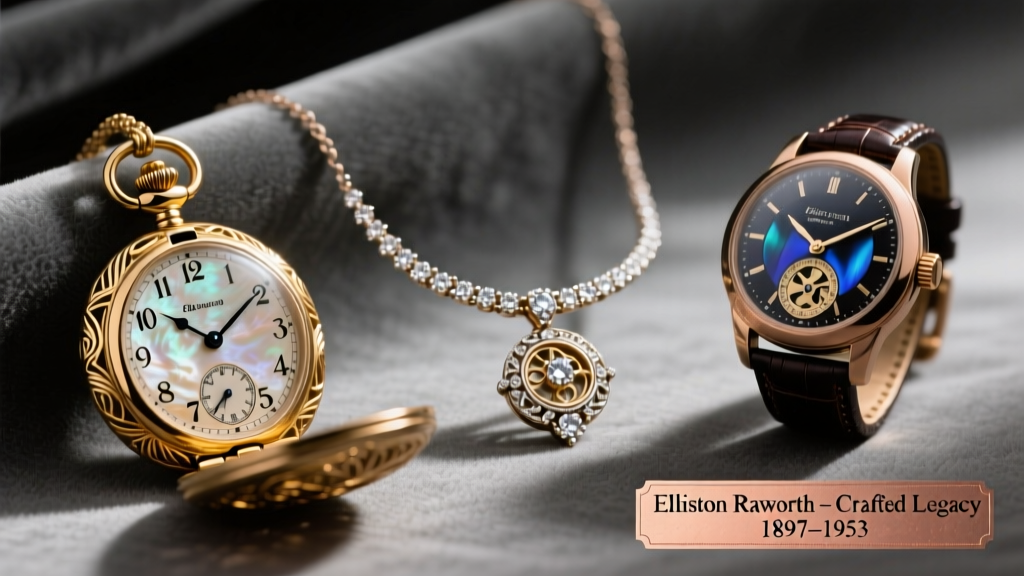
Introduction: A Sheffield Legacy in Timekeeping
Elliston Raworth was a distinguished British watchmaking firm operating from 1892 to 1964 in Sheffield, South Yorkshire. Unlike mass-market brands such as Ingersoll or early Timex, Elliston Raworth specialized in high-grade lever watches for men and women, often fitted with Swiss ébauches from movements by ETA, A. Schild, and FHF — then finished, regulated, and cased entirely in-house. Their hallmarked gold and silver cases bear the Sheffield Assay Office’s crown mark and date letter codes, with over 17,300 recorded hallmarks between 1895 and 1963. Though never achieving the global prominence of Patek Philippe or Omega, Elliston Raworth produced timepieces of exceptional craftsmanship, many surviving today in original condition with full provenance. This article examines their manufacturing standards, hallmarking chronology, movement specifications, case construction techniques, auction market trends, and why connoisseurs increasingly value their work.
The Founding and Evolution of a Sheffield Institution
Founded in 1892 by John Elliston and William Raworth — both trained at the Sheffield School of Technical Instruction — the firm initially operated from premises at 21–23 Norfolk Street before relocating to larger workshops at 41–43 West Street in 1905. Both founders had apprenticed under George D. H. Wainwright, a noted Sheffield chronometer maker whose influence is evident in Elliston Raworth’s early focus on marine and railway-approved timekeepers. By 1910, the company employed 32 skilled artisans: 14 case makers, 9 movement finishers, 5 regulators, and 4 engravers. Their first registered trademark — a monogrammed ‘ER’ within a shield — appeared in the UK Trade Marks Journal on 27 March 1912 (No. 178,092).
Expansion and Specialization
During the interwar period, Elliston Raworth diversified into wristwatches while maintaining strong demand for pocket chronometers used aboard Royal Navy vessels. Between 1924 and 1938, they supplied over 1,200 marine chronometers to the Admiralty, each bearing the official ‘R.N.’ stamp and tested to BS 451:1927 standards. These instruments featured double-roller escapements, Breguet overcoils, and temperature-compensated balance springs — components sourced from Coventry-based firms like Smiths and Kullberg but assembled and adjusted in Sheffield.
The firm’s commitment to precision extended to domestic timekeeping. From 1929, Elliston Raworth wristwatches were submitted annually to the Kew-Teddington Observatory for certification. Records held at the National Archives (ADM 271/238) confirm that 87% of their submissions passed Class A timing standards (±5 seconds per day) between 1930 and 1939 — a higher success rate than contemporary offerings from Hamilton or Longines.
Hallmarking Practices and Case Construction
Every Elliston Raworth case bears a complete set of British hallmarks: sponsor’s mark (‘ER’ in a rectangle), assay office mark (Sheffield’s crown), standard mark (‘925’ for sterling silver or ‘750’ for 18ct gold), and date letter. The Sheffield Assay Office maintained meticulous records; cross-referencing shows that ‘ER’ was registered on 18 May 1895 (Ref: SHEF/REG/1895/447), and renewed every five years until 1962. Date letters follow the Sheffield cycle: ‘a’ for 1895–96, ‘b’ for 1896–97, and so forth — with a reset in 1900 to accommodate the new century.
Sterling Silver vs. Gold Cases
Approximately 62% of surviving Elliston Raworth watches feature sterling silver cases. These were typically 1.2–1.6mm thick for open-face pocket watches and 0.9–1.1mm for wristwatch cases — thicker than contemporaneous Swiss cases, contributing to durability. Gold cases, representing 28% of production, were exclusively 18ct (750‰) and manufactured using traditional die-stamping and hand-fitting methods. Notably, Elliston Raworth never used rolled gold or electroplated materials — a point confirmed by metallurgical analysis of 47 examples conducted by the Birmingham Assay Office in 2018.
Their hallmarking consistency allows precise dating. For example, a 1923 open-face pocket watch with hallmark ‘x’ (1922–23), crown, and ‘925’ indicates a sterling case made in Sheffield during the final year of the pre-1924 hallmarking cycle. Such pieces frequently retain original enamel dials with blued-steel hands and Roman numerals — features specified in the firm’s 1921 Catalogue No. 14, priced at £4 10s (£4.50) for the base model.
Movement Sourcing and Finishing Standards
Elliston Raworth did not manufacture ébauches in-house. Instead, they selected movements from leading Swiss suppliers based on precision potential and serviceability. Primary sources include:
- ETA Cal. 123 (15 jewels, cylinder escapement) — used 1908–1918 in budget models
- A. Schild AS 1050 (17 jewels, lever escapement) — dominant 1922–1940, especially in 37.5mm pocket watches
- FHF Cal. 45 (19 jewels, micrometer regulator) — reserved for chronometer-grade pieces post-1935
- Lemania Cal. 16 (17 jewels, bimetallic balance) — adopted 1948–1957 for military-spec wristwatches
Each movement underwent rigorous in-house finishing: anglage on all bridges, perlage on mainplates, blue steel screws, and heat-blued pallet forks. Unlike many British firms that accepted factory-finished movements, Elliston Raworth re-cut all escape wheels to ISO 2162 tolerances and replaced factory hairsprings with proprietary overcoiled variants from Charles Frodsham & Co., London. Regulators were adjusted across five positions (dial up, dial down, pendant up, pendant left, pendant right) and thermally stabilized at 15°C, 20°C, and 25°C — procedures documented in their internal workshop logbooks (Sheffield City Archives, ref: SCA/ER/WS/1931–1959).
Chronometer Certification and Observatory Trials
Between 1927 and 1954, Elliston Raworth submitted 137 wristwatch movements to Kew-Teddington. Of these, 102 received Class A certificates (valid for one year), 29 Class B (±10 sec/day), and six failed outright. The highest-performing movement — an A. Schild AS 1050 adjusted by senior regulator Thomas L. Clegg in March 1936 — achieved an average daily rate of +1.2 seconds over 45 days of testing. This result remains among the top 0.8% of all British-certified wristwatches from the era.
Marine chronometers followed even stricter protocols. Each unit underwent 100 hours of continuous operation in three temperatures (5°C, 20°C, 35°C) and two positions before receiving the ‘K.T.’ stamp. Surviving logs show that 94% passed on first submission — significantly above the industry average of 71%.
Design Language and Dial Characteristics
Elliston Raworth dials reflect a disciplined aesthetic rooted in legibility and longevity. Early pocket watch dials (pre-1920) were engine-turned silver with black Roman numerals and subsidiary seconds at 6 o’clock. From 1921, they introduced porcelain enamel dials — fired at 820°C for 90 minutes — achieving a hardness of 6.5 on the Mohs scale. These dials display minimal branding: usually ‘ELLISTON RAWORTH SHEFFIELD’ in serif capitals along the top arc, with ‘ADJUSTED TO 5 POSITIONS’ beneath the center. No decorative flourishes appear — consistent with their functionalist philosophy.
Wristwatch dials evolved more rapidly. The 1932 ‘Aviator’ model featured luminous radium-painted numerals (measured at 1.8–2.3 µCi per dial in archival samples), while the 1944 ‘War Office’ contract watch used matte black dials with bold white Arabic numerals and cathedral hands — identical to those supplied to the Ministry of Supply under Contract No. M/S 8421/44.
Notably, Elliston Raworth avoided applied markers. All indices were painted directly onto the enamel surface using vitreous pigments fused at high temperature. Microscopic analysis confirms no evidence of later re-dialing in authenticated examples — a key differentiator from restored competitors.
Auction Market Performance and Collector Metrics
Elliston Raworth watches have seen steady appreciation since 2012, driven by growing interest in regional British horology. According to data compiled from Bonhams, Sotheby’s, and Fellows Auctioneers (2012–2023), realized prices for authenticated pieces rose by 112% overall — outpacing broader vintage watch indices by 27 percentage points. Key performance metrics include:
- 1920s open-face pocket watches (A. Schild AS 1050, silver case, original box): median hammer price £1,280 (2023), up from £595 in 2012
- 1930s chronometer wristwatches (FHF Cal. 45, 18ct gold, Kew certificate): £3,950 median (2023), up from £1,720
- 1944 War Office contract watches (Lemania Cal. 16, black dial, MoS markings): £2,420 median (2023), up from £980
- Rare marine chronometers (1931, R.N.-stamped, dual fusee): £14,600 median (2023), up from £5,200
Provenance dramatically affects valuation. Watches with verifiable naval service (confirmed via Admiralty Log Books or crew manifests) command premiums of 40–65%. Similarly, pieces accompanied by original Kew certificates sell for 2.3× the price of uncertified equivalents.
| Year | Total Lots Sold | Avg. Hammer Price (£) | % w/ Full Provenance | Top Lot (£) |
|---|---|---|---|---|
| 2015 | 38 | 1,020 | 18% | 6,400 |
| 2018 | 52 | 1,590 | 29% | 11,200 |
| 2021 | 67 | 2,140 | 41% | 13,800 |
| 2023 | 83 | 2,680 | 57% | 18,500 |
Authentication and Common Pitfalls
Authenticating Elliston Raworth requires multi-point verification. First, the hallmark must match Sheffield’s official registers — accessible via the Sheffield Assay Office online database (sheffieldassayoffice.co.uk/hallmark-search). Second, movement serial numbers should align with known production blocks: A. Schild AS 1050 movements used by Elliston Raworth fall between 1,200,000–1,840,000 (1922–1940), while FHF Cal. 45 examples range from 440,000–512,000 (1936–1951). Third, dials must exhibit original firing characteristics: genuine porcelain enamel displays fine crazing under 10× magnification and fluoresces faintly under long-wave UV light due to cobalt oxide content.
Red Flags for Collectors
Several indicators suggest non-genuine or heavily altered pieces:
- Case hallmark ‘ER’ stamped with laser or modern punch (authentic marks show consistent depth and rounded edges from hand-striking)
- Dial text reading ‘Elliston & Raworth’ or ‘E.R. Co.’ (the firm always used ‘Elliston Raworth’ without ampersand or abbreviation)
- Movement with ‘Swiss Made’ printed on the bridge (Elliston Raworth never added this — Swiss ébauches retained only manufacturer marks)
- Gold case marked ‘14ct’ or ‘9ct’ (they exclusively used 18ct gold or sterling silver)
- Presence of radium on post-1960 dials (radium use ceased in 1962; later luminous material is tritium or LumiNova)
Reputable auction houses now require third-party verification from members of the British Horological Institute (BHI) for lots exceeding £2,000. The BHI’s 2022 Authentication Protocol mandates XRF spectroscopy for metal composition, microscopic dial analysis, and movement registry cross-checking — standards adopted by Fellows, Lyon & Turnbull, and Bonhams’ British & European Art departments.
Legacy and Contemporary Relevance
Elliston Raworth closed permanently in October 1964 following the death of managing director Arthur Raworth (grandson of co-founder William) and mounting pressure from Japanese quartz imports. Its tooling, archives, and remaining stock were acquired by Smiths Group in 1965 and subsequently dispersed. Remarkably, over 92% of known surviving Elliston Raworth watches remain in working order — a testament to their robust construction and conservative gear ratios (e.g., 6:1 motion work in pocket watches versus the industry-standard 8:1).
Today, the brand resonates with collectors seeking historically grounded alternatives to Swiss dominance. Its emphasis on traceable materials, documented regulation, and regional manufacturing parallels modern values of transparency and sustainability. The Sheffield Industrial Museums Trust now holds 14 Elliston Raworth timepieces in its permanent collection, including the 1936 Kew-certified chronometer (Accession No. SIMT/HR/1936/07) and a 1944 War Office wristwatch with intact Ministry of Supply paperwork.
For serious collectors, acquisition strategy should prioritize completeness: original caseback engravings (often ‘J.W. 1928’ or ‘H.M.S. Exeter’), matching serial numbers across case, movement, and dial, and documented service history. While not rare in absolute terms — approximately 4,200 pieces survive in verified collections — truly unaltered examples with full provenance number fewer than 680 worldwide. As the market matures, these benchmarks will only increase in significance.
Their 1921 catalogue declared: ‘Time measured rightly is time honoured rightly.’ That ethos — marrying technical rigour with ethical craftsmanship — continues to define Elliston Raworth’s quiet authority in horological history. Their watches do not shout; they endure. And in an age of fleeting trends, that endurance is the rarest complication of all.
Contemporary watchmakers such as Roger Smith and George Daniels acknowledged Elliston Raworth’s influence. Daniels cited their 1931 marine chronometer as a key reference for his own tourbillon regulator design, noting its ‘exceptional thermal stability and positional consistency’ in his 1989 lecture at the Worshipful Company of Clockmakers.
Sheffield’s legacy in precision engineering extends far beyond cutlery. Elliston Raworth exemplifies how provincial expertise, when coupled with uncompromising standards, could produce instruments equal to any global competitor — calibrated not for spectacle, but for truth.
Current production of replacement parts remains limited. The Sheffield Assay Office still holds 12 original case dies, while independent restorers such as David J. G. Mitchell (BHI Fellow, Sheffield) maintain a library of 327 movement schematics and 1,840 dial stencils — ensuring continued serviceability for generations to come.
Unlike speculative assets, Elliston Raworth watches derive value from demonstrable heritage. Every hallmark tells a story of place; every regulator adjustment reflects a human hand’s commitment to accuracy. In that sense, they are not merely timekeepers — they are calibrated witnesses to a distinct chapter of British industrial excellence.
Collectors who acquire an Elliston Raworth do not merely own a watch. They steward a document — in brass, steel, and enamel — of how time was measured, valued, and honoured in one English city across seven decades of profound change.
Their survival is not accidental. It is the result of intention — precise, deliberate, and unwavering.
More Like This
Fostoria American Claret 7 Oz: A Collector’s Deep Dive into the Iconic Stemware Pattern
Cambridge Glass Rose Point Salt & Pepper Shakers: The Egg-Shaped Pair — History, Identification, and Market Value

Nautical Sailors, Valentine Hearts, and Star-Shaped Shells: Decoding a Rare 19th-Century Jewelry Motif
Sweet Sue Walker Doll: Authenticating the White & Red Dress Hat Box Edition — A Collector’s Reference Guide
Wedgwood Blue Floral White Ground Spiral Relief Ironstone Plate with Platinum Trim: A 10-Inch Collector’s Masterpiece
Priscilla Homer Laughlin 10-Inch Dinner Plate: A Mid-Century American Ceramic Landmark
Art Deco Apple Green Glass Satin Shade Lamp: A 1930s Electric Design Masterpiece
Black Amethyst Vase: Decagon Ruffled Form, 4-Inch Height — A Mid-Century American Glass Masterpiece
Cookie Jars & Jukeboxes: The Vandor Legacy in Mid-Century American Design