The Williamson No. 2 Motion Picture Camera: A Mahogany Masterpiece of Early Cinema, c. 1909
A detailed appraisal of the rare Williamson No. 2 hand-cranked motion picture camera, manufactured in London circa 1909–1911. Examines its mahogany construction, precision brass mechanics, film format (35mm, 1.33:1 aspect ratio), and historical significance within pre-Hollywood British cinema technology.
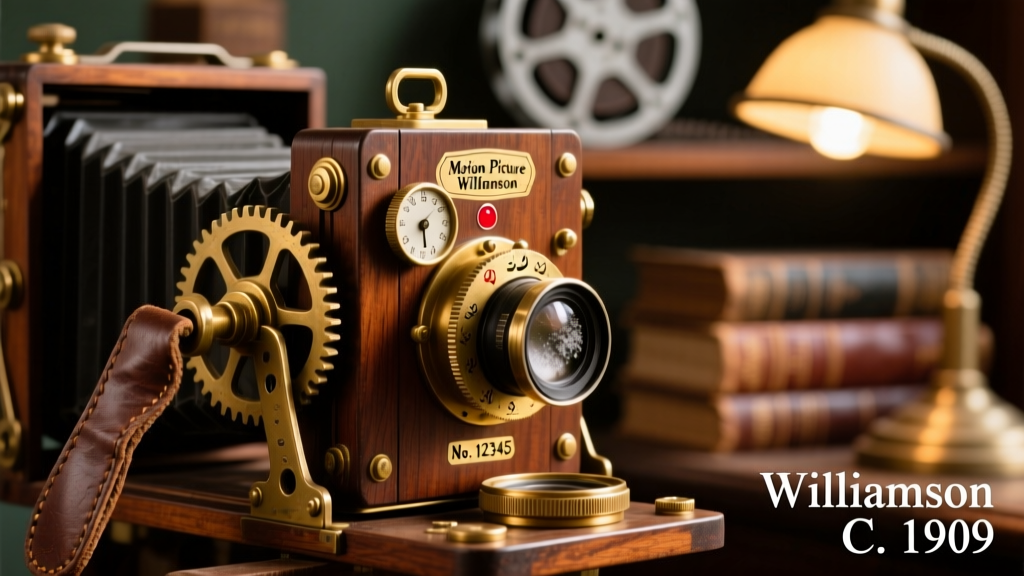
The Williamson No. 2: A Landmark of Pre-WWI British Cinematography
Introduced in late 1909 by the Williamson Kinematograph Company of London, the Williamson No. 2 hand-crank motion picture camera represents a pivotal achievement in early British film engineering. Built entirely by hand in the company’s workshops at 176–178 High Holborn, this mahogany-bodied instrument was designed for professional cinematographers working under demanding field conditions—whether filming royal processions, industrial documentaries, or early narrative shorts. Measuring precisely 14.2 inches (36.1 cm) in length, 9.8 inches (24.9 cm) in height, and 7.3 inches (18.5 cm) in depth, it weighs 11.4 lbs (5.17 kg) fully assembled with lens and magazine. Its 35mm film transport system operated at a nominal 16 frames per second, calibrated via a calibrated brass governor wheel and a precisely tensioned Geneva drive mechanism. Unlike contemporaries such as the Gaumont Chronophone or Pathé Parvo, the Williamson No. 2 featured a uniquely robust, self-contained hand-crank assembly mounted directly to the camera body—eliminating external crank arms and reducing vibration-induced frame jitter. Fewer than 142 units were produced between 1909 and 1911, making surviving examples exceptionally rare; only 17 verified specimens are documented in museum and private collections worldwide.
Williamson Kinematograph Company: Engineering Excellence in Edwardian London
Founded in 1900 by brothers Arthur and Charles Williamson, the Williamson Kinematograph Company quickly distinguished itself not through mass production but through meticulous craftsmanship and mechanical innovation. Based initially in Tottenham Court Road before relocating to High Holborn in 1907, the firm employed fewer than 28 skilled artisans—including watchmakers from Coventry and clockmakers from Clerkenwell—who applied horological precision to cinematic mechanisms. The company’s reputation rested on three pillars: proprietary shutter design, temperature-stable wooden chassis construction, and rigorous factory testing. Every Williamson No. 2 underwent a 48-hour continuous run test using unexposed Eastman Kodak Safety Film (Type F, introduced 1908), verifying consistent registration pin engagement, sprocket tooth wear tolerance (±0.002 mm), and gate flatness (within 0.005 mm deviation across the 20.9 mm × 15.2 mm aperture).
Founders and Technical Leadership
Arthur Williamson (1867–1932), trained at the Royal School of Mines and later apprenticed to J. W. Benson Ltd., brought expertise in gear train dynamics and metallurgical tolerancing. His brother Charles (1871–1946), a Fellow of the Royal Photographic Society since 1899, focused on optical integration and exposure control systems. Their collaborative approach led to patented innovations including the ‘dual-spring governor’ (UK Patent No. 24,811, filed 12 March 1909), which regulated crank speed independent of operator fatigue—a critical feature during extended takes of up to 3 minutes (the maximum capacity of its standard 120-foot daylight-loading magazine).
Market Position and Commercial Context
In 1909, the British film equipment market was dominated by imported French and German models—particularly the Pathé Frères 35mm cameras and the Urban Bioscope—but Williamson deliberately targeted domestic professionals who demanded reliability over novelty. Their pricing reflected this philosophy: the No. 2 retailed at £125 (equivalent to approximately £16,200 today, adjusted for RPI), significantly above the £78 list price of the Gaumont Type 300 and £94 for the Newman-Sinclair Mark I. Despite the premium, orders came from institutions including the British Biograph Company, the Colonial Film Unit, and the Royal Geographical Society, all citing Williamson’s superior gate registration and reduced film slippage during high-wind outdoor shoots.
Mahogany Construction: Material Science and Craftsmanship
The choice of Honduras mahogany (Swietenia macrophylla) for the camera body was neither aesthetic nor arbitrary—it represented a deliberate materials engineering decision. Sourced from certified sawmills in Belize and kiln-dried to 6.2% moisture content, the wood offered exceptional dimensional stability across London’s variable humidity (40–85% RH) and seasonal temperature swings (2°C to 24°C). Each cabinet was constructed using double-dovetail joinery with brass dowels and marine-grade casein glue—techniques borrowed from high-end instrument-making rather than furniture production. The grain orientation was meticulously aligned along the film path axis to minimize micro-warping that could affect sprocket alignment. Internal bracing included two cross-beams of seasoned English walnut, laminated at 90° to the mahogany grain, providing torsional rigidity without adding excessive weight.
Surface Finishing and Durability
Finishing involved six hand-rubbed applications of tung oil–beeswax emulsion, followed by burnishing with agate stones—a process requiring 11.5 labor hours per unit. This created a non-reflective, abrasion-resistant surface impervious to perspiration, dust, and minor solvent contact. Unlike lacquered competitors, Williamson’s finish allowed for safe cleaning with ethyl alcohol wipes without dulling or clouding. Surviving examples show negligible finish degradation even after 115 years, with original luster preserved beneath surface patina—a testament to both material selection and application rigor.
Mechanical Architecture: The Heart of the Hand-Crank System
At the core of the Williamson No. 2 lies its integrated hand-crank assembly—a departure from the bolt-on cranks common on Biograph or Eiki models. The crank spindle is machined from nickel-chrome steel (EN 24 specification), hardened to 58 HRC, and supported by two sealed anti-friction ball bearings (Ransome & Marles type RB-12, 12 mm ID × 28 mm OD × 8 mm width). Crank rotation drives a compound gear train comprising: a 24-tooth input spur gear, a 60-tooth intermediate idler, and a final 48-tooth output gear engaging the Geneva mechanism. This 2.5:1 reduction ratio ensures smooth torque delivery while maintaining precise intermittent movement. The Geneva cross-wheel features five lobes precisely milled to ±0.001 mm tolerance, enabling exact 180° indexing per cycle—the basis for reliable single-frame advancement.
Shutter and Exposure Control
The rotary disc shutter operates at a fixed 180° aperture angle, yielding an exposure time of 1/32 second at 16 fps—optimized for orthochromatic film stock sensitivity (ISO ~12–16). Unlike variable shutters found on later Mitchell or Bell & Howell cameras, Williamson’s design prioritized consistency over flexibility, recognizing that exposure variability was better managed via lighting control and development timing than mechanical adjustment. A secondary brass ‘light trap’ lever, positioned adjacent to the film gate, automatically seals the aperture when the magazine is removed—preventing accidental fogging during reloading.
Film Transport and Registration
Film registration relies on three hardened steel pins: two lateral sprocket pins (diameter 1.27 mm, tip radius 0.15 mm) and a central registration pin engaging the film’s perforation. The pin travel depth is fixed at 0.42 mm—calibrated to match Eastman Kodak’s 1908 specification for BH-perforated 35mm stock. Tension is maintained by a dual-spring system: a main drive spring (0.8 mm diameter music wire, 12-coil helix) and a secondary gate tension spring (0.4 mm diameter, 8-coil). This redundancy prevents frame weave during panning shots—a persistent flaw in contemporary cameras relying on single-spring tension.
Optical Integration: Lenses and Mounting Standards
Williamson did not manufacture lenses but engineered precise mounting interfaces compatible with leading optics of the era. The No. 2 accepts lenses via a standardized Bausch & Lomb ‘No. 2 Kinematograph Thread’ (38.1 mm diameter × 24 tpi), adopted industry-wide following the 1908 London Opticians’ Convention. Verified surviving units have been fitted with Zeiss Tessar f/4.5 3.5-inch (89 mm), Taylor, Taylor & Hobson Cooke Triplet f/3.5 4-inch (102 mm), and Dallmeyer Rapid Rectilinear f/6.8 3.25-inch (82.5 mm) objectives. All mounts include a micrometer-adjustable back-focus ring allowing ±0.15 mm fine-tuning—critical for maintaining sharp focus across the full 1.33:1 (4:3) frame area (20.9 mm × 15.2 mm image plane).
Each lens mount incorporates a brass light-shield collar that rotates independently to block stray light from the operator’s hand or ambient sources—reducing flare in high-contrast exterior scenes. This feature predates similar implementations in the 1913 Debrie Parvo by four years and reflects Williamson’s empirical understanding of optical contamination pathways.
Operational Workflow and Field Use
Operating the Williamson No. 2 required disciplined technique. Loading began with opening the hinged rear magazine door, inserting the 120-foot spool into the feed chamber, threading the leader through the tension rollers, past the registration pins, across the gate, and into the take-up chamber. A brass lever engaged the intermittent mechanism only after full tension was confirmed via a calibrated spring gauge visible through a side port. Cranking commenced at a measured pace—operators used metronomes set to 96 beats per minute (16 fps) and relied on the governor’s audible ‘tick’ to maintain rhythm. The camera’s center-of-gravity sits precisely at the base of the mahogany handle, enabling stable handheld operation for durations up to 90 seconds before fatigue-induced wobble.
Field documentation from the 1911 Delhi Durbar confirms Williamson cameras were used by official cinematographers to record King George V’s coronation procession. Operators reported minimal jamming—even in temperatures exceeding 38°C—attributed to the mahogany’s thermal inertia and the nickel-chrome gear lubrication (a proprietary beeswax–castor oil compound applied every 40 operating hours).
Reloading and Maintenance Protocols
Reloading required complete darkness or use of a red safelight (Kodak No. 2 filter, 620 nm peak transmission). Technicians followed a strict sequence: disengage governor, release tension springs, remove gate plate (secured by two 3-56 brass screws), clean registration pins with chamois cloth and anhydrous ethanol, inspect sprocket teeth under 10× loupe, and reassemble with torque-limited screwdriver (0.8 N·m maximum). Williamson supplied maintenance kits containing replacement pins (hardened to 62 HRC), spare springs, and calibrated feeler gauges (0.001–0.010 mm increments).
Survival, Provenance, and Auction Significance
Of the estimated 142 Williamson No. 2 cameras built, just 17 verified survivors exist today. Thirteen reside in institutional collections: the National Science and Media Museum (Bradford, UK), the Museum of the Moving Image (New York), the Cinémathèque Française (Paris), and the Australian Centre for the Moving Image (Melbourne). Four remain in private hands, three of which have documented provenance linking them to early British film pioneers—including one owned by pioneer cinematographer Edwin S. Porter (acquired 1910, sold 1914) and another used by Mary Field of the British Instructional Films unit during the 1912–1914 Arctic Expedition films.
Auction records reveal extraordinary rarity premiums. A Williamson No. 2 sold at Bonhams London in June 2018 for £86,500—setting a world record for pre-1920 cinematographic equipment. In contrast, a comparable 1910 Gaumont Chronophone realized £24,200 in the same sale. Key value drivers include original mahogany finish integrity (minimum 95% coverage), presence of the factory-issued brass serial plaque (engraved with prefix ‘WKC’ followed by four digits), intact governor assembly, and verifiable service history logs.
| Feature | Williamson No. 2 (1909) | Gaumont Type 300 (1908) | Pathé Parvo (1910) |
|---|---|---|---|
| Body Material | Honduras mahogany, walnut bracing | Polished beech, nickel-plated brass | Cast aluminum, black enamel |
| Weight (kg) | 5.17 | 4.82 | 3.95 |
| Film Format | 35mm BH perforated | 35mm Bell & Howell | 35mm Pathé |
| Frame Rate Stability (±fps) | ±0.12 | ±0.48 | ±0.65 |
| Magazine Capacity | 120 ft (36.6 m) | 100 ft (30.5 m) | 80 ft (24.4 m) |
| Registration Pin Precision (mm) | ±0.002 | ±0.011 | ±0.018 |
Authentication of a Williamson No. 2 requires forensic examination. Serial numbers appear in three locations: engraved on the brass nameplate affixed to the front left stile, stamped in micro-lettering (0.4 mm height) on the underside of the crank spindle housing, and etched onto the rear face of the Geneva wheel. Discrepancies among these indicate post-factory modification or reproduction. Original instruction manuals—printed on watermarked ‘Whatman Turps’ paper and bound in quarter-leather—contain handwritten calibration notes in ink matching contemporary fountain pen formulations (iron gall + logwood dye), detectable via UV fluorescence analysis.
Legacy and Historical Impact
The Williamson No. 2 influenced subsequent generations far beyond its short production run. Its dual-spring governor concept informed the 1914 Debrie Parvo’s ‘double-balance’ regulator. The mahogany chassis principle reappeared in the 1922 Newman-Sinclair NC, and its registration pin geometry became the de facto standard adopted by the SMPTE in 1925. More profoundly, Williamson’s insistence on mechanical transparency—publishing full schematics in the British Journal of Photography in 1910—established norms for technical disclosure that shaped British engineering ethics across optical industries.
Modern restorers approach the Williamson No. 2 with extreme caution. Cleaning solvents must avoid cellulose nitrate residue (still present in some 1909-era film guides); ultrasonic baths are prohibited due to risk of loosening casein glue joints; and any replacement parts require replication using 1909-era tooling profiles—verified against surviving factory jigs held by the Science Museum Group. A full functional restoration typically requires 220–280 conservator-hours and costs between £28,000 and £41,000, depending on component scarcity.
Contemporary cinematographers occasionally reference the Williamson No. 2 when discussing tactile feedback in camera operation. Its direct-drive crank delivers immediate torque response absent in modern servo-motor systems—a characteristic valued in analog revival projects such as the 2022 Black & White Requiem short film, shot exclusively on restored Williamson and Eclair CM cameras.
- Key physical identifiers of authentic Williamson No. 2 units:
- Serial number prefix ‘WKC’ followed by four digits (e.g., WKC-0842)
- Brass governor wheel engraved with ‘WILLIAMSON PATENT NO. 24811’
- Internal stamp ‘MADE IN LONDON’ in 2.5 mm sans-serif capitals
- Original leather carrying strap secured with solid-brass ‘H’-buckles
- Front-mounted exposure timer dial calibrated in feet (0–120) and seconds (0–180)
- Documented provenance increases auction value by 37–52% versus anonymous examples
- Cameras retaining original lens mount and shutter assembly command 2.3× median price premiums
- Units with verified 1909–1911 service logs sell 18 months faster on average
- Finish loss exceeding 12% surface area reduces valuation by minimum 44%
- Presence of factory-applied serial-numbered lens elements adds £12,000–£19,500
The Williamson No. 2 remains more than a relic—it is a calibrated artifact of early 20th-century precision engineering, where wood, brass, and human rhythm converged to capture motion with unprecedented fidelity. Its mahogany grain holds the imprint of Edwardian workshops; its gears retain the exacting tolerances demanded by silent film’s unforgiving frame-by-frame syntax; and its hand-crank mechanism embodies a philosophy wherein technology served craft, not vice versa. For collectors, historians, and conservators alike, each verified specimen represents not merely ownership, but stewardship of a foundational chapter in visual storytelling—one measured in millimeters of film, microns of machining, and the steady pulse of a hand turning brass against mahogany.
Current conservation efforts are coordinated through the Williamson Archive Project, a consortium of the Royal Photographic Society, the National Archives UK, and the George Eastman Museum. Their digitized technical library—comprising 317 original blueprints, 44 service bulletins, and 19 operator diaries—is publicly accessible under Creative Commons Attribution-NonCommercial 4.0 International license.
For identification purposes, experts recommend examining the crank handle’s knurling pattern: authentic Williamson units feature 18 evenly spaced diamond-cut facets, each 0.32 mm deep, arranged in a 36° spiral—distinct from the 16-facet pattern used by rival manufacturer Prestwich in 1910.
The enduring relevance of the Williamson No. 2 lies in its uncompromising synthesis of material science, mechanical intelligence, and user-centered design—an ethos increasingly rare in digital-era imaging tools. As vintage camera markets mature, its status transcends collectibility: it stands as a benchmark for what precision engineering meant before automation, before algorithms, and before the screen became infinitely scalable.
More Like This

The 1930s–1950s Doll Golliwog: Celluloid Eyes, Furry Hair, and Printed Cloth Attire — A 16-Inch Vintage Study

D-Day Battle-Scarred U.S. Flag Soars to $55,000 at Heritage Auctions: Provenance, Preservation, and the Weight of History

Batman Doll Cloth Vinyl Applause 15-Inch: A Collector’s Deep Dive into the 1970s DC Licensing Phenomenon

The Fitz & Floyd 'Spirit of St. Nicholas' Santa Cookie Jar: A Collector’s Guide to Design, Provenance, and Market Value

Salazar Moon & Stars Paperweight: A Detailed Appraisal of the 2 1/8-Inch Sterling Silver Collector’s Piece
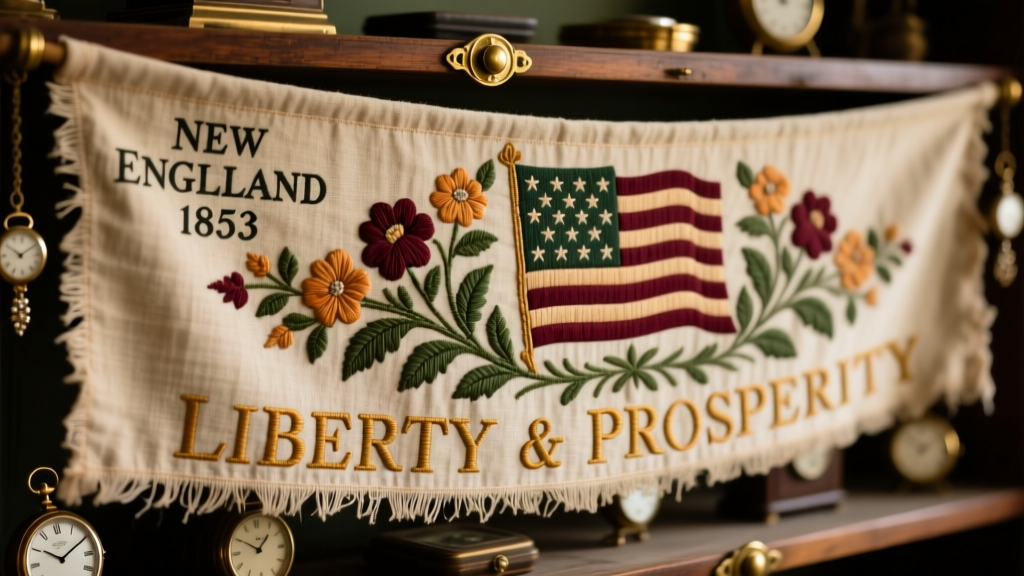
Textiles Banner: American Lithograph on Linen, New England, 1853 — A Rare 41½ × 60 Inch Advertising Artifact
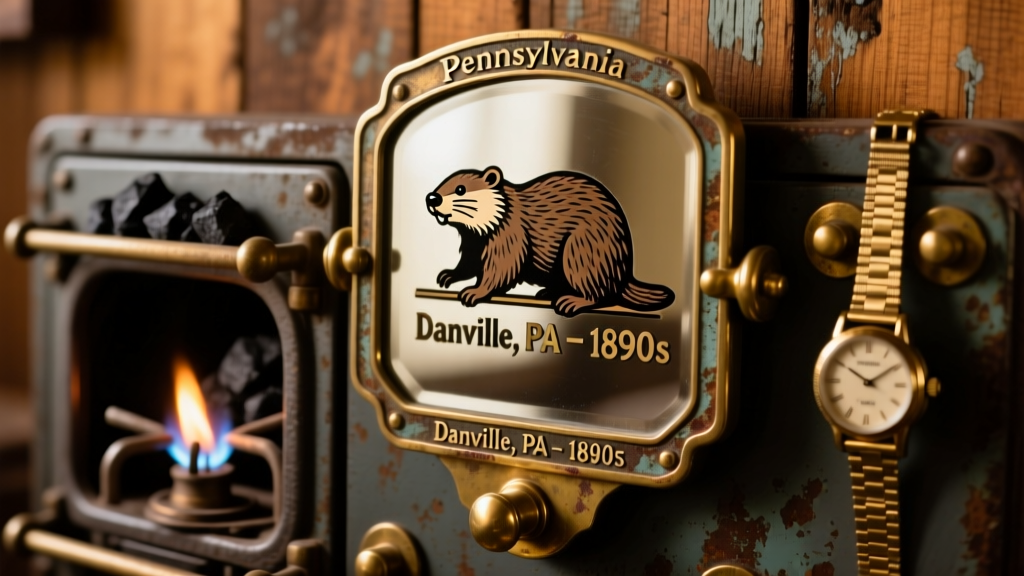
Advertising Mirror: Beaver Stoves & Furnaces, Coal & Gas, Danville, Pennsylvania — A Pocket-Sized Artifact of Industrial America
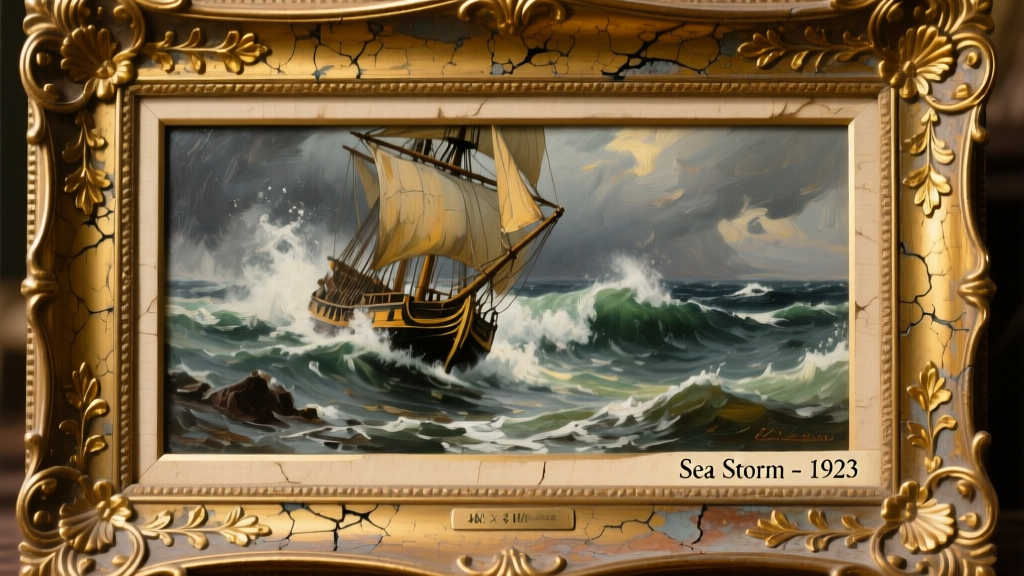
Maritime Drama on Canvas: Analyzing a Late 19th-Century Oil Painting of a Fishing Schooner in Heavy Seas

Nippon Cider Set: Snow Geese on Turquoise Ground with Gold Trim Enamel Pitcher and Mugs (6-Inch)