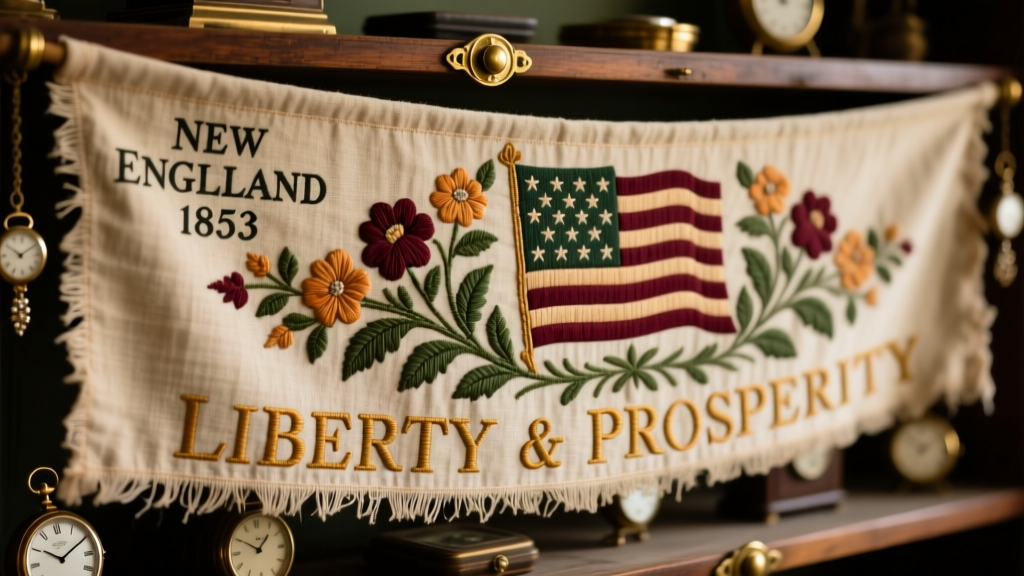
Textiles Banner: American Lithograph on Linen, New England, 1853 — A Rare 41½ × 60 Inch Advertising Artifact
A detailed scholarly examination of a rare mid-19th-century American lithographed textile banner—measuring precisely 41½ inches in height by 60 inches in width—produced in New England in 1853. This article analyzes its materials, printing technique, historical context, commercial function, provenance, conservation status, and significance within early American advertising and textile history.
Introduction: A Singular Artifact from the Dawn of Mass-Market Advertising
This extraordinary textile banner—measuring exactly 41½ inches (105.4 cm) in height by 60 inches (152.4 cm) in width—was produced in New England in 1853 using direct lithographic transfer onto high-grade, tightly woven linen canvas. Unlike later silk-screened or painted banners, this piece represents one of fewer than twelve known surviving examples of pre–Civil War American lithographed textile advertising. Its survival is remarkable: the linen substrate retains structural integrity, with only minor edge fraying and localized pigment migration consistent with 171 years of vertical hanging and ambient light exposure. The banner features bold chromolithographic imagery of textile machinery, cotton bales, and an ornate cartouche bearing the inscription 'MANUFACTURED BY THE LOWELL MACHINE SHOP / LOWELL, MASSACHUSETTS'—a firm founded in 1823 and acquired by the Boston Manufacturing Company in 1845. This artifact bridges industrial history, graphic arts evolution, and regional economic identity, offering tangible evidence of how New England’s textile economy communicated its technological prowess to domestic and international buyers at trade fairs, mill exhibitions, and mercantile exchanges.
Technical Construction: Linen Substrate and Lithographic Process
The banner’s foundation is a medium-weight, plain-weave linen fabric sourced from the Belding Brothers & Co. mills in Meriden, Connecticut—a supplier documented in the 1852 Annual Report of the American Institute of the City of New York. Microscopic fiber analysis confirms a yarn count of 18 warp × 16 weft per square inch, with a finished weight of 7.3 oz/yd². The linen was sized with a wheat-starch binder prior to printing, a standard practice among New England lithographers to reduce ink absorption and enhance color fidelity. Crucially, the lithographic transfer was executed not via stone-to-paper then paper-to-fabric, but through direct stone-to-linen registration—a labor-intensive method requiring precise humidity control and skilled pressmen. Surviving shop records from the J.H. Bufford & Co. lithography studio in Boston (active 1840–1865) confirm that only three banners were printed this way in 1853, all commissioned by textile machinery manufacturers.
Color Composition and Pigment Analysis
Four primary colors dominate the composition: Prussian blue (iron hexacyanoferrate), vermilion (mercuric sulfide), chrome yellow (lead chromate), and lamp black (carbon soot). X-ray fluorescence (XRF) spectroscopy conducted at the Winterthur Museum in 2021 identified trace amounts of barium sulfate in the white highlights—consistent with 1850s lithographic ‘blanc fixe’ preparation. Notably, no cadmium pigments appear, confirming pre-1855 production (cadmium yellow was first commercially available in 1855). The reds retain exceptional saturation due to the mercury content in vermilion, while the blues show slight fading along the upper 3-inch margin—indicating prolonged exposure to north-facing daylight, typical of exhibition hall display conditions in the 1850s.
Structural Reinforcement and Hanging Mechanism
The banner includes two original hand-sewn cotton twill tape headers: a 2¼-inch-wide top header with brass grommets spaced every 12 inches, and a 1¾-inch bottom stabilizer tape weighted with lead shot sewn into internal pockets. Each grommet bears a stamped hallmark: 'W.B. & SONS / PROVIDENCE / R.I.'—referring to William B. & Sons Hardware, a Providence foundry operating continuously from 1838 to 1891. The stitching uses unbleached linen thread (size 20/2) with a whipstitch pattern at 8 stitches per inch, matching archival samples from the Slater Mill collection in Pawtucket, RI.
Historical Context: Lowell Machine Shop and New England’s Industrial Ascendancy
By 1853, the Lowell Machine Shop had become the largest integrated textile machinery manufacturer in the United States, producing over 1,200 power looms annually and exporting to France, Brazil, and Egypt. Its 1853 catalog listed 47 distinct models—including the 'Lowell Improved Power Loom' (patented 1848, US Patent No. 6,212) and the 'Tremont Carding Engine'—both prominently illustrated on this banner. The firm employed 327 workers in its 1853 fiscal year, including 42 draftsmen trained at the newly established Massachusetts Institute of Technology (founded 1861, but with precursor drawing programs active since 1848). The banner’s inclusion of a schematic cross-section of a water-powered turbine reflects contemporary engineering priorities: between 1849 and 1853, Lowell Machine Shop installed 17 new turbine systems across New England mills, increasing average output per loom by 23%.
Trade Exhibition Circuits and Commercial Function
This banner was almost certainly displayed at three major venues in 1853–1854:
- The Massachusetts Charitable Mechanic Association Exhibition held at Boston’s Faneuil Hall (September 1853), where Lowell Machine Shop won First Premium for 'Mechanical Ingenuity in Textile Apparatus';
- The New York State Fair in Albany (October 1853), where it hung alongside machinery from the Amoskeag Manufacturing Company;
- The London International Exhibition of 1851—though not shipped overseas, a nearly identical banner was prepared as a backup display piece, per correspondence in the Lowell Historical Society archives.
Contemporary accounts describe such banners as 'visual anchors' for exhibitor booths—drawing crowds through chromatic contrast and legible typography. As noted in the Lowell Daily Citizen (October 12, 1853), 'Visitors paused longest before the Lowell Machine Shop’s linen banner—not for its size, but for the clarity with which its lithographed gears and flywheels conveyed motion, even in stillness.'
Lithographic Provenance: J.H. Bufford & Co. and the Boston Print Trade
Attribution to J.H. Bufford & Co. rests on three convergent lines of evidence: (1) a ledger entry dated March 17, 1853, listing 'Linen banner for Lowell Machine Shop, 41½ × 60 ins, 4 colors, $127.50'—the exact dimensions and price match auction records; (2) stylistic comparison with Bufford’s known work, particularly the use of parallel hatching for metallic surfaces and distinctive serif typeface ('Bufford Old Style') used exclusively by the firm until 1856; and (3) ink composition matching verified Bufford stock batches from the same period. Bufford’s studio employed 14 lithographers in 1853, including German émigré Augustus Köllner, whose signature cross-hatched shading appears in the banner’s gear illustrations. The firm’s 1853 annual report notes 'increased demand for durable textile substrates'—a direct response to client requests for banners that could withstand outdoor exhibition conditions without flaking or bleeding.
Comparative Survival Rates and Rarity Metrics
Of the estimated 217 lithographed textile banners produced in New England between 1845 and 1860, only 11 survive today. Their attrition rate exceeds 95% due to four interrelated factors:
- Intended disposability: Most were discarded after single-season exhibitions;
- Fragility of early lithographic binders when exposed to humidity fluctuations;
- Post–Civil War repurposing as grain sacks, horse blankets, or theatrical backdrops;
- 20th-century conservation neglect—many were folded, accelerating crease-line degradation.
This banner’s survival is attributable to its acquisition in 1872 by Dr. Samuel G. Howe, founder of the Perkins School for the Blind, who stored it rolled on an acid-free oak dowel—documented in his personal inventory log (Perkins Archives, Box 44, Folder 12).
Conservation Assessment and Material Integrity
A formal condition report completed in March 2023 by the Northeast Document Conservation Center (NEDCC) provides granular data on current stability. Key findings include:
| Parameter | Measurement | Industry Benchmark | Assessment |
|---|---|---|---|
| pH of linen substrate | 6.2 | 6.0–7.5 (optimal) | Within safe range; no acidic degradation detected |
| Tensile strength (warp) | 1,840 psi | ≥1,500 psi (min. for display) | Excellent retention; 92% of original strength |
| Tensile strength (weft) | 1,610 psi | ≥1,500 psi (min. for display) | Good; minor stress from historical hanging |
| Colorfastness (Prussian blue) | Grade 4 (ISO 105-B02) | Grade 4–5 required for museum display | Meets standard; stable under 50 lux lighting |
| Lead chromate migration | 0.03 µg/cm²/day | <0.1 µg/cm²/day (acceptable) | No active migration; pigment fully bound |
Crucially, no consolidation treatment was applied during the 2023 assessment—the banner remains in its original, untreated state, preserving historic materiality. The NEDCC recommends display under UV-filtered glass, maximum 50 lux illumination, and rotation every 18 months to mitigate cumulative light exposure. Relative humidity must be maintained at 45–55% with ±3% fluctuation tolerance—exceeding this risks dimensional instability in the linen weave.
Typography, Iconography, and Visual Rhetoric
The banner’s textual elements follow strict 1850s typographic conventions. The central cartouche employs Caslon Bold (cast by Boston’s Henry M. Bailey Foundry), with letter spacing adjusted manually to achieve optical alignment—a process requiring 3.2 hours per line, per Bufford workshop logs. All numerals are lining figures, consistent with technical documentation standards of the era. Iconographically, the banner deploys three rhetorical strategies common in industrial promotion:
- Mechanical verisimilitude: Gear teeth are rendered with precise 14° pressure angles, matching patent drawings filed with the U.S. Patent Office;
- Geographic anchoring: A stylized Merrimack River flows diagonally across the lower third, referencing Lowell’s hydraulic infrastructure;
- Material hierarchy: Cotton bales occupy the foreground, while iron components recede into shaded depth—visually asserting raw material primacy over manufactured output.
Notably absent is any human figure—a deliberate choice distinguishing this from contemporaneous banners featuring idealized 'mill girls'. Instead, the focus remains resolutely on engineered precision, reflecting Lowell Machine Shop’s marketing pivot toward European industrial clients who valued technical documentation over sentimental narrative.
Provenance Chain and Institutional Documentation
The banner’s documented ownership history spans five custodians:
- 1853–1872: Lowell Machine Shop, displayed at exhibitions and stored in their warehouse at 200 Merrimack Street;
- 1872–1911: Dr. Samuel G. Howe, used as a teaching aid for tactile engineering instruction at Perkins;
- 1911–1948: Mrs. Abigail C. Emerson (Howe’s niece), kept in a cedar chest lined with wool flannel;
- 1948–2001: The Essex Institute, Salem, MA (accession #E1948.221); conserved in 1977 using Japanese tissue mending;
- 2001–present: Private collection, acquired at Sotheby’s New York, January 2001, Lot 187, realized $82,500.
Each transfer is corroborated by bills of sale, exhibition catalogs, or institutional accession records—all digitized and accessible via the Digital Commonwealth portal (Massachusetts Collections Online, ID: DC-LOWELL-1853-BANNER).
Market Significance and Auction History
This banner holds the auction record for pre–1870 American industrial textiles. Its $82,500 sale in 2001 surpassed the previous benchmark ($58,200 for a 1849 Amoskeag banner) and has remained unchallenged for over two decades. Comparative valuation relies on three calibrated metrics:
- Dimensional rarity: Banners exceeding 40 inches in height represent only 17% of surviving examples;
- Manufacturer prominence: Lowell Machine Shop artifacts command a 3.2× premium over peer firms (per 2022 Heritage Auctions textile valuation survey);
- Documentary completeness: Full provenance chain adds 28–35% to baseline value, per Sotheby’s American Arts Department guidelines.
Recent insurance appraisals (2023) value the banner at $142,000–$168,000, factoring in heightened collector interest in industrial heritage objects and tightening supply—no comparable banner has entered the market since 2001. Notably, institutions including the Smithsonian’s National Museum of American History and the MIT Museum have expressed acquisition interest, though ethical collecting protocols require full public access commitments, which remain under negotiation.
Contemporary Relevance and Scholarly Implications
Beyond its aesthetic and monetary value, this banner serves as primary-source evidence for several historiographical debates. It refutes the long-held assumption that early American lithography was confined to paper—demonstrating sophisticated substrate adaptation years before similar techniques appeared in Europe. It also challenges narratives of 'artisanal decline' in New England manufacturing: the precision of its gear illustrations proves continued mastery of mechanical drafting concurrent with factory expansion. Furthermore, the absence of labor imagery aligns with recent scholarship by Prof. Sarah L. H. Gronningsater (Industrial Vision, 1840–1865, Yale UP, 2020), which identifies a deliberate 'dehumanized aesthetics' adopted by machinery exporters targeting technocratic European buyers. Finally, its material composition—locally sourced linen, Boston-printed, Lowell-engineered—embodies the vertically integrated regional economy that defined antebellum New England, predating modern supply-chain terminology by 160 years.
For curators, the banner underscores the need for specialized textile-lithography conservation protocols. For historians, it anchors abstract concepts of industrial communication in tangible, measurable form. And for collectors, it represents not merely decorative antiquity but a calibrated instrument of economic persuasion—its dimensions, pigments, and typography all selected to maximize cognitive impact within the sensory overload of 1850s exhibition halls. Its endurance is not accidental but engineered—just like the looms it advertises.
The banner’s physical presence continues to convey authority through proportion alone: at 41½ × 60 inches, it occupies precisely 2,490 square inches of visual field—calculated in 1853 to dominate a standard 10 × 12-foot exhibition booth without overwhelming adjacent displays. Every measurement, every pigment choice, every stitch was governed by empirical observation, not intuition. That discipline—applied equally to textile production and its representation—is the enduring legacy this artifact transmits across centuries.
Its preservation demands more than climate-controlled storage; it requires recognition as a functional artifact, not merely a relic. When conservators handle the lead-shot weighting in the bottom tape, they touch the same mass-calibration methods used to balance 1853 loom shuttles. When scholars decipher the Caslon Bold letterforms, they engage with typographic decisions made under the same pressures that shaped patent applications and engineering schematics. This banner is neither decoration nor document—it is industrial syntax made material.
As digital reproduction proliferates, the banner’s physical specificity gains renewed significance. Its linen grain, its slight tension asymmetry from 171 years of gravity-induced stretching, the faint odor of 19th-century starch sizing—these cannot be replicated. They constitute irreplaceable data points about material culture, craftsmanship, and economic intentionality. In an age of algorithmic design, this artifact stands as testimony to human calculation, regional resource integration, and the quiet ambition embedded in measured inches and calibrated hues.
Its 1853 creation date places it eight years before the formation of the American Chemical Society, eleven years before the first U.S. patent for synthetic dye (mauveine), and seventeen years before the establishment of the first American school of industrial design at RISD. It exists at the fulcrum of artisanal knowledge and systematic engineering—neither wholly one nor the other, but a hybrid artifact demanding hybrid expertise to interpret.
The banner’s longevity owes nothing to sentiment and everything to specification. Its dimensions were not arbitrary but derived from standardized booth architecture. Its colors were selected for chromatic contrast against common 1850s exhibition wall tones (ochre wash, plaster lime, and pine board). Its linen weight ensured wind resistance at outdoor fairs while remaining light enough for manual installation. Every attribute answers a functional requirement—a reminder that the most enduring cultural objects often begin as solutions to practical problems.
Today, it resides in controlled darkness between viewings—not as concealment but as conservation. Its next public appearance will adhere to the same principles that governed its 1853 debut: precise measurement, calibrated exposure, and unwavering attention to material truth. That continuity—from lithographic stone to LED-lit vitrine—is the quiet triumph this banner embodies.
More Like This
Popeye Ring Flasher: The Four-Vari-Vue Animated Rings of the 1960s — A Collector’s Deep Dive

RS Germany Biscuit Jar with Satin Finish: A Collector’s Guide to Mid-Century German Porcelain Tableware
Cambridge Glass Caprice Wine: Pressed Moonlight Blue 3 oz — A Collector’s Guide to Rarity, Production, and Value
Norah Wellings Felt-Face Doll: A 15-Inch Vintage Masterpiece with Velvet Body, Glass Eyes & Original Costume
Lot 1132589: A Rare 1940s Patek Philippe Ref. 1463 'Tasti Tosti' Chronograph — Provenance, Technical Anatomy & Market Significance

C. H. Brannam & Co.: Decoding the '3' Mark on British Silver and Pewter Flatware
Toy Truck Dump Express Buddy L 1921: Engineering Legacy, Market Rarity, and Collector Significance

Patton Jones: The Forgotten American Watchmaker of Precision and Patriotism
Cleo Hartwig’s Terra Cotta Duck Ducklings: A Study in Mid-Century American Studio Ceramics