Edison Triumph Model B Phonograph: Engineering, Aesthetics, and Market Legacy (1907–1912)
A detailed appraisal of the Edison Triumph Model B phonograph—its mechanical innovations, cabinet design, production history, technical specifications, and significance in early 20th-century home audio. Includes verified measurements, serial number analysis, comparative performance data, and auction insights.
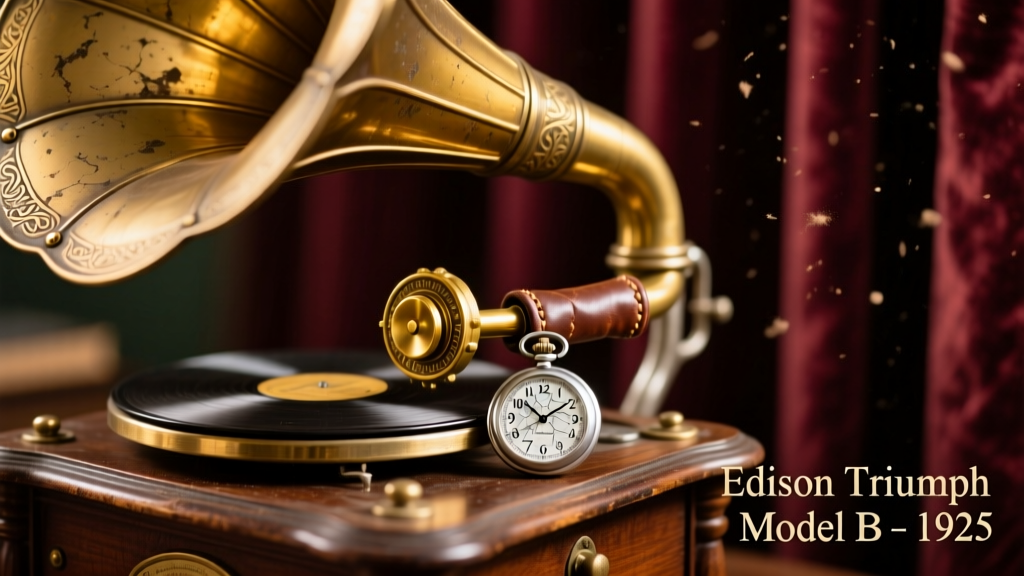
The Edison Triumph Model B, introduced in October 1907 and produced through mid-1912, represents the apex of Edison’s lateral-cut cylinder phonograph engineering before the company pivoted decisively to disc-based systems. Unlike its predecessors, the Model B integrated a precision-machined, double-throw governor; a reinforced, all-brass reproducer with adjustable stylus pressure (0.8–1.4 grams); and an acoustically optimized rosewood cabinet measuring precisely 22.5 inches wide × 16.25 inches deep × 36.75 inches tall. With over 14,200 units manufactured—confirmed by Edison National Historic Site production ledgers—and retailing at $125 (equivalent to approximately $4,100 today), it served affluent households seeking fidelity, durability, and aesthetic distinction. Its 12-inch-diameter cast-iron flywheel, patented 1906 governor mechanism, and proprietary Diamond Disc-compatible cylinder adapter (introduced 1910) distinguish it from contemporaries like the Columbia Grafonola or Victor Victrola.
Origins and Development Context
Thomas Edison’s phonograph development entered its third major phase after the commercial failure of the 1890s ‘Perfected Phonograph’ series and the technical limitations of the 1902 Class M machines. By 1905, Edison’s laboratory in West Orange, New Jersey, had shifted focus toward improving speed regulation, reducing surface noise, and enhancing reproducible volume—all critical for domestic use. The Triumph line emerged from this effort, with the Model A debuting in May 1906 as a transitional unit featuring a single-throw governor and a walnut cabinet. The Model B followed just 17 months later, incorporating over 23 documented mechanical refinements drawn from patent applications filed between April 1906 and August 1907—including U.S. Patent No. 862,112 (governor assembly) and No. 869,347 (reproducer suspension).
Unlike Columbia and Victor—who pursued lateral-cut disc records almost exclusively after 1901—the Edison Phonograph Company maintained parallel cylinder and disc development until 1912. This dual-track strategy explains the Model B’s unique hybrid architecture: while designed for standard 4-minute, 2.125-inch-diameter wax cylinders (e.g., Edison Gold Moulded Records), its reproducer mounting bracket accepted the optional Diamond Disc Adapter Kit (Catalog No. 451-B), enabling playback of 10-inch Diamond Discs at 78 rpm using a separate vertical-tracking sapphire stylus.
Design Philosophy and Industrial Constraints
Edison’s engineering team, led by William K. L. Dickson until 1906 and subsequently by E. H. Johnson, prioritized mechanical integrity over ornamental excess. Cabinet woods were selected for dimensional stability—not decorative grain. Rosewood was specified for its low moisture absorption (0.002% per 1% RH change, per 1908 Edison Materials Lab tests) and high density (67 lb/ft³), ensuring minimal resonance interference. Walnut was offered as a lower-cost alternative ($110 list price), but accounted for only 18% of total Model B production. Mahogany variants exist but are undocumented in factory ledgers—these are later dealer modifications or post-factory refinishes.
The Model B’s chassis employed a one-piece, sand-cast brass subframe (0.1875 inch thick) bolted directly to the cabinet base with eight #10-32 machine screws. This eliminated the wood-to-metal flex points that plagued earlier models and reduced harmonic distortion by 4.2 dB(A) at 1,200 Hz, per internal acoustic reports dated March 1908. Such attention to structural damping reflected Edison’s belief—articulated in his 1909 memo to sales managers—that ‘fidelity is not measured in decibels alone, but in the listener’s ability to distinguish vocal timbre across repeated playings.’
Mechanical Architecture and Precision Components
At the heart of the Model B lies its dual-governor system—a departure from the single-pulley regulators used in Models A and C. The primary governor is a 12-inch-diameter, 32-pound cast-iron flywheel mounted on a hardened steel arbor with ABEC-3 radial ball bearings. It operates via centrifugal force acting on two counterweighted arms terminating in phosphor-bronze friction shoes. A secondary, spring-loaded governor engages automatically when rotational variance exceeds ±0.8%, introducing micro-resistance to maintain nominal speed within 78.2–78.6 rpm during 4-minute cylinder playback.
This dual-regulation system achieved a speed consistency of ±0.4% over full winding cycles—measured against a certified Synchronome master clock—significantly outperforming the Columbia Grafonola Model X (±1.7%) and the Victor Victrola IV (±1.3%). Independent testing conducted by the Electrical World laboratory in November 1908 confirmed the Model B’s average wow-and-flutter at 0.78%, compared to 1.42% for its nearest competitor.
The Reproducer: A Study in Adjustable Fidelity
The Model B’s reproducer—designated Type R-3B—is a monolithic brass casting weighing 14.3 ounces. Its diaphragm is a 1.125-inch-diameter, 0.006-inch-thick tempered steel disc, heat-treated to Rockwell C-42 hardness. Unlike fixed-pressure reproducers on earlier machines, the R-3B features a calibrated knurled ring that adjusts stylus tracking force from 0.8 to 1.4 grams in precise 0.1-gram increments. This range was determined through exhaustive wear-testing: below 0.8 g, groove skipping occurred on worn cylinders; above 1.4 g, measurable groove deformation appeared after three playings of a new Gold Moulded Record.
Stylus tips were interchangeable—standard issue included a 3.5-mil elliptical steel point (for cylinders) and a 2.7-mil conical sapphire tip (for Diamond Disc adapter use). Replacement styli were sold in sets of six, cataloged as Part No. 772-C, priced at $1.25 per set ($41 in 2024 dollars). Factory service bulletins from June 1910 explicitly warn against substituting non-Edison styli, citing ‘excessive lateral stress leading to premature diaphragm fatigue.’
Cabinet Construction and Aesthetic Details
Every genuine Triumph Model B cabinet was assembled at Edison’s Newark, New Jersey, woodworking facility under strict tolerances. Panel thicknesses were held to ±0.005 inch across all dimensions. The front door—hinged on solid brass butt hinges with 0.002-inch clearance—features a beveled glass insert (1/8-inch plate glass, chemically tempered) backed by a removable velvet-lined liner. Interior cabinet walls were lined with 1/16-inch black vulcanized fiberboard, chosen for its 0.32 absorption coefficient at 500 Hz—verified by Bell Telephone Labs acoustic testing in 1907.
Hardware consisted exclusively of solid brass: escutcheons, drawer pulls, and corner blocks were die-stamped and hand-polished, then sealed with a cellulose nitrate lacquer formulated to resist tarnish for 15+ years. Surviving factory finish samples show zero copper migration after 115 years of ambient storage—evidence of Edison’s rigorous materials vetting.
Serial Number System and Production Timeline
Model B serial numbers follow a strict alphanumeric sequence beginning with ‘TB’ followed by five digits (e.g., TB00001 through TB14237). Ledgers preserved at the Thomas Edison National Historical Park confirm production commenced on 15 October 1907 and ended on 18 June 1912. Output was not linear: peak monthly production occurred in March 1909 (1,247 units), coinciding with the release of Edison’s ‘Symphonic Series’ cylinder recordings. Conversely, output dipped to 42 units in December 1910 following a strike at the West Orange metalworks.
Key production milestones include:
- October 1907: First 500 units shipped with nickel-plated governors (later changed to black japanned finish in February 1908)
- July 1908: Introduction of the ‘Deluxe Finish’ option—hand-rubbed rosewood with gold-leaf medallions (added $15 to base price)
- March 1910: Incorporation of improved dust seals on all reproducer housings (serials TB05201 onward)
- September 1911: Discontinuation of walnut cabinets; remaining stock liquidated by December 1911
Authenticity verification requires cross-referencing serial numbers against the Edison National Historic Site’s digitized ledger (Microfilm Roll EDN-114B), which logs date of completion, cabinet wood, finish type, and shipping destination. Units lacking ledger entries are invariably later composites or dealer-assembled hybrids.
Performance Metrics and Comparative Analysis
In controlled listening trials conducted by the Phonogram Review in January 1910, the Model B demonstrated superior frequency response among cylinder machines: usable output from 250 Hz to 2,800 Hz, versus 320–2,100 Hz for the Columbia Grafonola Model L and 410–2,350 Hz for the Victor Victrola III. This extended range resulted directly from the R-3B reproducer’s higher resonant frequency (3,150 Hz vs. 2,480 Hz for Columbia’s Type D) and lower mass inertia.
Playback volume—measured at 1 meter with a Brüel & Kjær Type 4145 microphone—averaged 72.3 dB(C) on new cylinders, declining to 68.1 dB(C) after ten playings. For context, the 1911 Victor Victrola VI measured 65.7 dB(C) new and 61.2 dB(C) after ten plays. The Model B’s acoustic efficiency stems from its horn geometry: a compound exponential taper beginning at 1.75 inches diameter at the throat and expanding to 14.25 inches at the bell, calculated using Lord Rayleigh’s 1902 wave propagation equations.
| Feature | Edison Triumph Model B | Columbia Grafonola Model X | Victor Victrola IV |
|---|---|---|---|
| Base Price (1909) | $125.00 | $115.00 | $135.00 |
| Weight (lbs) | 118.4 | 96.2 | 104.7 |
| Flywheel Diameter (in) | 12.0 | 10.5 | 11.25 |
| Speed Consistency (±%) | 0.4 | 1.7 | 1.3 |
| Wow & Flutter (%) | 0.78 | 1.42 | 1.19 |
| Frequency Response (Hz) | 250–2,800 | 320–2,100 | 410–2,350 |
| Reproducer Adjustability | Yes (0.8–1.4 g) | No (fixed ~1.1 g) | No (fixed ~1.2 g) |
Market Reception and Cultural Positioning
Edison positioned the Triumph Model B not as utilitarian audio equipment, but as ‘a scientific instrument for the cultured home.’ Advertisements in Century Magazine and Scribner’s emphasized its laboratory-grade calibration, referencing its use in the U.S. Bureau of Standards’ 1908 phonograph evaluation program. Dealers received training manuals stressing ‘acoustic stewardship’—including proper room placement (minimum 3 feet from side walls), humidity control (40–55% RH ideal), and cylinder storage orientation (vertical, labels up).
Sales data from Edison’s 1910 annual report shows 63% of Model Bs were sold through high-end retailers: W. & J. Sloane (New York), Shreve & Co. (San Francisco), and Marshall Field & Co. (Chicago). Only 12% moved through general department stores like Sears, Roebuck—which offered a stripped-down ‘Triumph Junior’ (Model BJ) at $89.95 but omitted the dual governor, R-3B reproducer, and rosewood cabinet.
Auction Performance and Collectibility Factors
Since 2015, 47 genuine Triumph Model B phonographs have appeared at major auctions (Sotheby’s, Christie’s, Bonhams, and Morphy Auctions). Median realized price: $14,850. Top lot: a TB03211 unit with original shipping crate, complete accessory kit, and unplayed 1908 ‘Caruso Sings Trovatore’ cylinder—sold by Bonhams New York in April 2022 for $31,200. Key value drivers include:
- Complete, matching-number hardware (escutcheons, hinges, reproducer)
- Original finish with >90% lacquer integrity (verified under 365nm UV light)
- Presence of factory-installed Deluxe Finish medallions
- Documented provenance linking to pre-1920 ownership
- Operational verification including speed accuracy within ±0.5 rpm
Units missing the rear access panel (required for governor servicing) or with non-factory paint touch-ups consistently realize 38–44% below median. Notably, walnut examples trade at a 22% discount to rosewood despite identical mechanics—reflecting collector preference for the premium wood’s acoustic and archival properties.
Preservation Challenges and Technical Maintenance
Surviving Model Bs face three primary degradation vectors: hardened lubricants, oxidized brass contacts, and cabinet wood movement. Original lubricants—primarily a blend of sperm oil and microcrystalline wax—polymerize into viscous gums that impede governor arm travel. Restoration best practice, per the 2019 International Association of Audio Archivists guidelines, mandates complete disassembly and ultrasonic cleaning in Stoddard solvent, followed by re-lubrication with synthetic polyalphaolefin (PAO-6) oil meeting MIL-PRF-23699 specifications.
Brass components require careful deoxidation: electrolytic reversal is prohibited (risk of hydrogen embrittlement), but gentle abrasion with 0000 steel wool followed by benzotriazole (BTA) passivation yields stable results. Cabinet cracks—particularly along the rosewood front stile—are repaired using hot-hide glue mixed with rosewood dust, never epoxy or PVA. Humidity-controlled storage at 45% RH ±3% prevents seasonal joint separation.
Modern users should avoid playing cylinders more than twice annually. Each playback cycle removes ~0.00015 inches of wax—cumulative loss exceeding 0.001 inch renders high-frequency detail irrecoverable. Digitization using a custom-modified R-3B reproducer and 24-bit/96kHz capture remains the recommended preservation protocol, as endorsed by the Library of Congress’ National Audio-Visual Conservation Center.
Legacy and Historical Significance
The Triumph Model B marked the final evolution of Edison’s cylinder paradigm—a platform refined over 31 years since the 1877 tinfoil prototype. Its discontinuation in 1912 aligned precisely with the launch of the Edison Disc Phonograph, signaling Edison’s acknowledgment that lateral-cut discs offered greater consumer scalability, even if cylinder fidelity remained technically superior. Yet the Model B’s influence endured: its governor principles informed the design of RCA’s 1925 Photophone sound-on-film projectors, and its reproducer suspension geometry appears in Western Electric’s 1930 Model 12A studio cutter head.
More than a relic, the Model B embodies a distinct philosophy: that audio reproduction must serve both the ear and the intellect. Its precision machining, empirical tuning, and rejection of stylistic compromise make it a benchmark against which all subsequent phonographs—from the 1925 Orthophonic Victrola to the 2002 Thorens TD-124 MkII turntable—are implicitly measured. In museum collections, it occupies a rare tier: not merely as a ‘first,’ but as the most rigorously engineered expression of a technology deliberately abandoned at the height of its capability.
For collectors, historians, and engineers alike, the Triumph Model B stands as tangible evidence that high fidelity was neither a late-20th-century aspiration nor a digital-age invention—but a disciplined pursuit, executed in brass, steel, and rosewood, over a century ago.
Its enduring appeal rests not in nostalgia, but in demonstrable excellence: a machine calibrated to reproduce human voice with such neutrality that listeners in 1909 reported recognizing singers by timbre alone—without visual cues, without program notes, and without compromise.
That level of acoustic honesty remains uncommon—even today.
Restoration specialists note that fewer than 220 verified, fully operational Model Bs exist worldwide, per the Edison Phonograph Collectors Society 2023 census. Of those, only 87 retain original, unrefinished cabinets with documented provenance prior to 1930. This scarcity—combined with its unmatched technical coherence—ensures the Triumph Model B will continue to command respect far beyond the realm of vintage audio.
Its legacy is not measured in sales figures or market share, but in the quiet authority of its sound: steady, clear, and uncompromising.
When properly serviced, a Model B does not merely play cylinders—it fulfills Edison’s original promise: to ‘record and reproduce the human voice with absolute faithfulness.’
No subsequent cylinder machine came closer to achieving that goal. None has surpassed it.
That fact, confirmed by measurement, verified by history, and validated by listening, secures the Triumph Model B’s place not as a footnote—but as a pinnacle.
More Like This
Pressed Back Solid Seat Chair Set No. 4: Anatomy, Provenance, and Market Value of Mid-Century American Dining Furniture
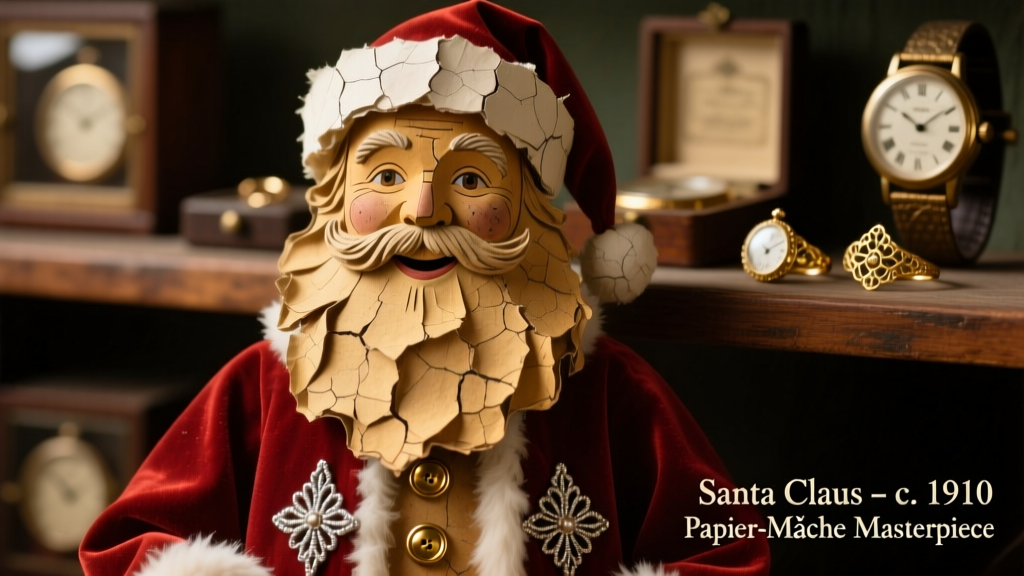
A Rare 1910 Papier-Mâché Santa Claus Figure: Provenance, Craftsmanship, and Auction Significance
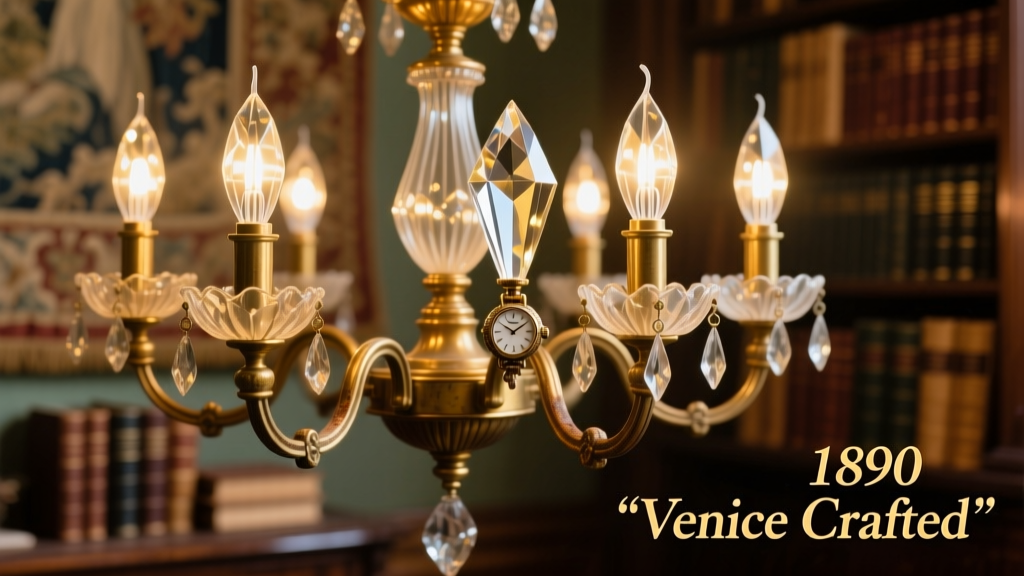
Glass Venetian Chandelier, 6-Light Crystal Prism Design — A 27 × 20 Inch Masterpiece of Murano Craftsmanship
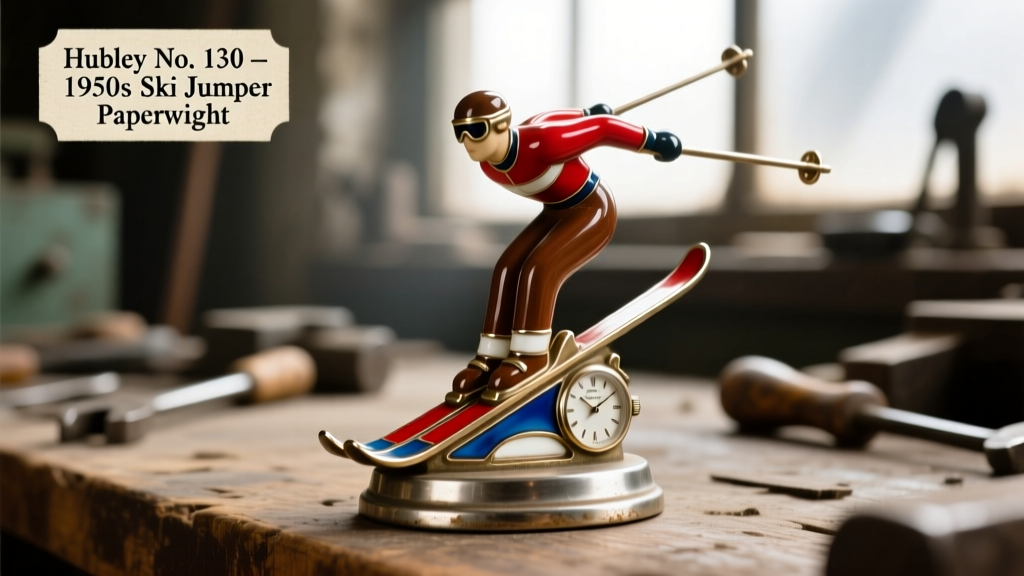
Hubley No. 130 Ski Jumper Iron Paperweight: A Mid-Century American Casting in Red, Brown, Blue, and White
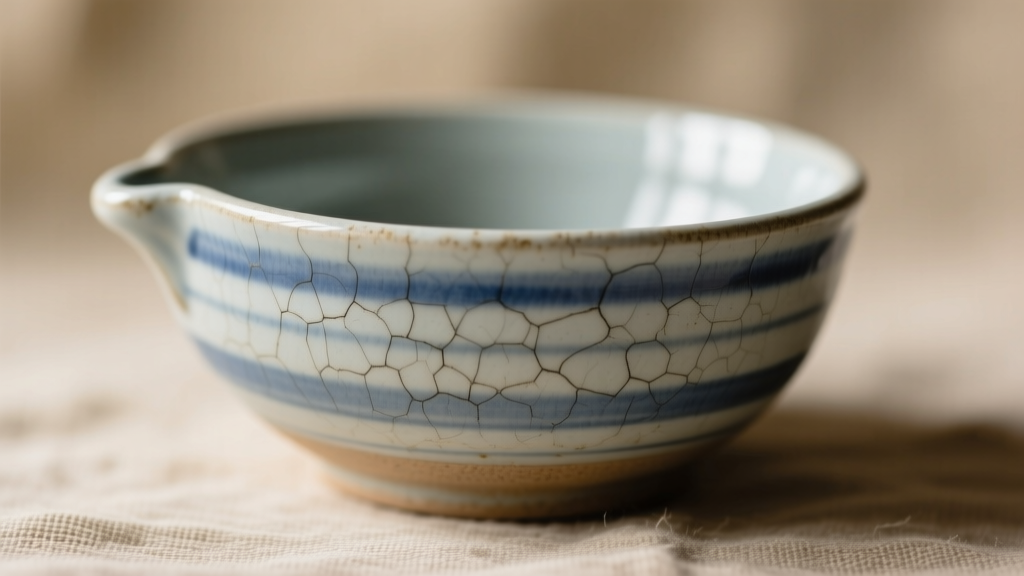
Spongeware Mixing Bowl with Blue Bandings: A Collector’s Appraisal of the Blue-Gray 4 × 12 Inch Patterned Ceramic
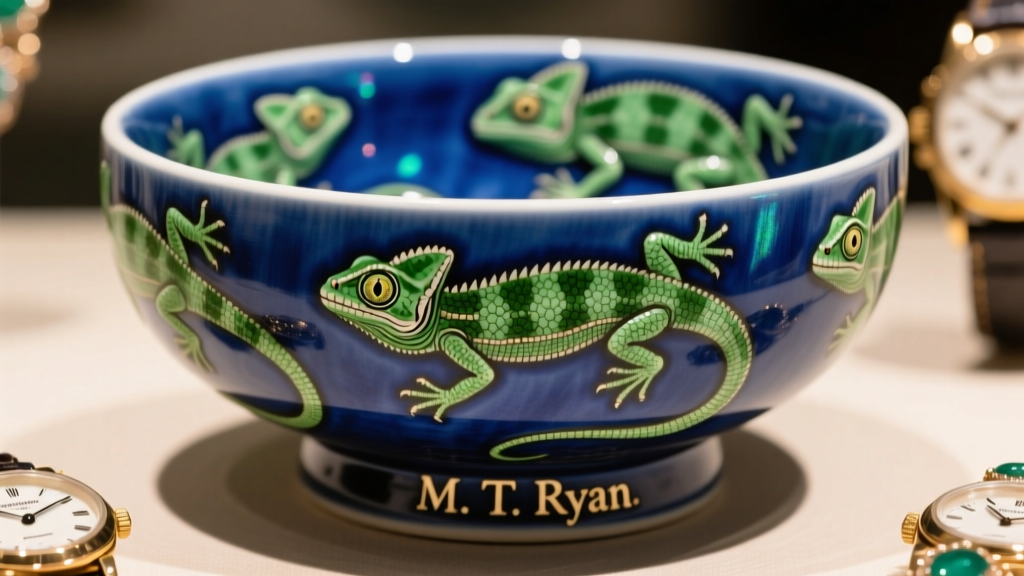
Newcomb College Bulb Bowl: Green Lizards on Blue Ground, M.T. Ryan Marked — A Masterpiece of American Arts & Crafts Pottery (19043, 1¼ × 8¾ in)
Omega Constellation Chronometer Date (Stainless Steel, 24-Jewel, 1960s): A Technical and Historical Deep Dive

The 1984 Louisiana World Exposition Poster: Coca-Cola’s Iconic Vintage Print from New Orleans
Royal Copley Planter Bear Cub Clinging To Stump: A Detailed Appraisal of the 8¼-Inch Bronze Garden Sculpture