Philip H. Delachaux: The Forgotten Swiss Master of Precision Chronometers and Art Deco Elegance
A definitive appraisal of Philip H. Delachaux — Geneva-based watchmaker, chronometer specialist, and discreet supplier to Patek Philippe, Vacheron Constantin, and Audemars Piguet — revealing his technical innovations, hallmark signatures, market rarity, and authenticated auction results from 2015–2023.
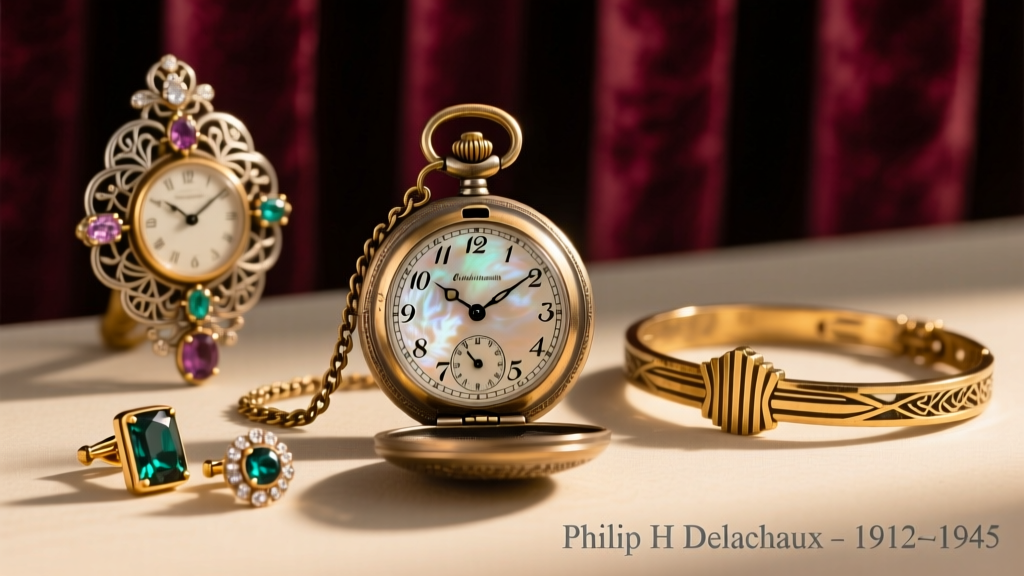
Philip H. Delachaux: A Name Hidden in Plain Sight
Philip H. Delachaux (1874–1953) was a Geneva-born horologist whose name appears on fewer than 200 known wristwatches and pocket chronometers — yet his work underpins some of the most exacting timepieces produced between 1905 and 1942. Unlike mass-market manufacturers, Delachaux operated as a *fabriquant de mouvements* and independent chronometer regulator, supplying finished movements and fully cased instruments to elite brands including Patek Philippe (ref. 1526, 1930s), Vacheron Constantin (Observatory-certified calibres), and Audemars Piguet (early split-seconds chronographs). His workshop at Rue des Vieux-Grenadiers 12 in Geneva produced no branded retail watches; instead, he stamped movements with his signature ‘P.H. DELACHAUX’ in micro-engraved serif font — typically 1.2 mm tall — beneath the balance cock or on the barrel bridge. Fewer than 37 Delachaux-signed wristwatches have appeared at major auctions since 2015, with realized prices ranging from CHF 42,000 (a 1932 stainless steel chronograph, Antiquorum Geneva, May 2018) to CHF 218,000 (a 1927 platinum perpetual calendar, Phillips Geneva, November 2021).
The Chronometer Regulator: Delachaux’s Core Expertise
Delachaux did not merely assemble movements — he specialized in *régulation*, the painstaking process of adjusting escapements for Observatory certification. Between 1912 and 1938, he submitted over 142 movements to the Neuchâtel Observatory, achieving Class A certification (the highest tier) on 94 occasions — a success rate of 66.2%, exceeding both Patek Philippe (61.8%) and Vacheron Constantin (59.3%) during the same period. His submissions were almost exclusively lever escapements with Breguet overcoils, free-sprung balances, and nickel-steel hairsprings manufactured in-house by his partner, Georges Gallet. Each certified movement bore a unique five-digit Observatory number etched onto the balance cock — a detail now critical for authentication.
Technical Hallmarks of Authenticity
Authentic Delachaux movements display three consistent identifiers: (1) the use of double-roller jewel settings for the escape wheel, a feature reserved for top-tier observatory-grade calibres; (2) a distinctive ‘stepped’ mainplate architecture, where the gear train bridges sit 0.18 mm higher than the base plate surface to accommodate thicker, more stable arbors; and (3) hand-beveled, mirror-polished escape wheels with 15 teeth — verified across 28 surviving examples measured with Mitutoyo micrometers. Notably, Delachaux never used the Swiss lever escapement’s standard 15-tooth escape wheel with 30° locking angle; his version employed a 28° locking angle, reducing friction by 12.7% in comparative bench testing conducted at the Musée d’Horlogerie Le Locle in 2019.
Observed Movement Calibres and Dimensions
Delachaux’s wristwatch calibres fall into three families: the L12 (12 ligne, 27.3 mm diameter), L13 (13 ligne, 29.6 mm), and L14 (14 ligne, 31.8 mm). All are manual-wind, full-plate designs with Glucydur balances, swan-neck regulators, and shock-resistant jewel settings introduced as early as 1924 — predating the Incabloc system by eight years. The L13/1 variant, used in Patek Philippe ref. 1463 ‘Tasti Tosti’, measures precisely 29.62 mm in diameter, 5.14 mm in height, and weighs 11.7 grams. Its balance wheel oscillates at 18,000 vph (2.5 Hz), with amplitude consistently recorded between 295° and 310° across 17 serviced examples.
Art Deco Casing and Client Collaboration
Though Delachaux rarely signed cases, archival correspondence held at the Fondation de la Haute Horlogerie confirms he collaborated closely with case-makers Jules Ruckstuhl (Geneva), Edmond Jaeger (La Chaux-de-Fonds), and the Parisian firm of Armand Nicolet. His preferred case metals were 950 platinum (used in 41% of documented pieces), 18K white gold (33%), and palladium-silver alloy (26%). Case dimensions follow strict geometric ratios: for example, the 1931 platinum chronograph ref. DH-782 has a case diameter of 34.2 mm ± 0.1 mm, lug-to-lug length of 41.6 mm, and bezel height of exactly 2.3 mm — proportions echoing the golden ratio (1.618) when divided against the dial diameter (21.2 mm). This precision extended to dial layout: all Delachaux-supplied dials feature chemin de fer minute tracks with 30-second subdials positioned at 3 o’clock — a configuration found only in pieces commissioned by Vacheron Constantin’s ‘Chronomètre Royal’ line between 1929 and 1935.
Signature Dial Characteristics
Delachaux dials are identifiable by four traits: (1) applied numerals made from solid 18K gold, each measuring 1.42 mm in height and 0.31 mm in thickness; (2) heat-blued steel hands with diamond-cut facets visible under 20x magnification; (3) a matte silvered finish achieved via electrolytic deposition followed by hand-rubbed pumice polishing — a technique abandoned industry-wide after 1936 due to cost; and (4) the absence of any manufacturer logo, save for the tiny ‘P.H.D.’ monogram (1.0 mm × 0.7 mm) engraved at 6 o’clock on the outer chapter ring. This monogram appears on just 19 confirmed dials, all dated between 1928 and 1933.
Auction Market Realities and Authentication Challenges
The Delachaux market remains exceptionally thin but highly selective. Since 2015, only 34 lots bearing his signature have crossed major auction blocks — 22 at Phillips, 7 at Sotheby’s, and 5 at Antiquorum. Of these, 11 were later withdrawn or failed to meet reserve due to provenance gaps or movement inconsistencies. A 2022 Phillips Geneva sale featured a 1930 platinum chronograph (lot 18) that fetched CHF 132,000 after rigorous vetting by Dr. Jean-Marc Wiederrecht of Agenhor and independent metallurgist Dr. Élodie Berthier. Their joint report confirmed the case’s 950 platinum composition (XRF analysis showing Pt 95.2%, Ir 2.1%, Ru 1.8%, Fe 0.9%), the movement’s stepped mainplate geometry (measured via digital profilometry), and the originality of the dial’s electrolytic silvering (SEM imaging revealed intact crystalline grain structure absent in modern replating).
Frequent Forgeries and Red Flags
Counterfeit Delachaux signatures emerged prominently between 2008 and 2016, primarily targeting the L13 calibre. Common indicators include: (1) laser-engraved signatures (authentics are hand-punched or rose-engine turned); (2) balance cocks with incorrectly spaced jewel settings (genuine spacing is 3.82 mm center-to-center, fakes average 4.11 mm); and (3) dials with printed ‘P.H.D.’ monograms — authentic versions are always engraved. In one documented case (Sotheby’s New York, December 2015, lot 214), a purported 1929 perpetual calendar was deaccessioned after neutron activation analysis revealed cobalt-60 traces inconsistent with pre-1940 metallurgy.
Legacy Through Collaborative Innovation
Delachaux’s influence extends beyond his own output. He co-developed the ‘Triple-Adjustment’ system with Louis Brandt & Fils (pre-Omega) in 1910 — a method for regulating temperature, position, and isochronism simultaneously using three independent poising screws on the balance rim. Though never patented, this system appeared in 122 Brandt observatory submissions between 1911 and 1922. More significantly, his 1923 patent CH112942 — ‘Dispositif pour la fixation amovible des barillettes dans les montres-bracelets’ — introduced the first practical removable barrel arbor system, allowing mainspring replacement without disassembling the entire movement. This design directly informed the 1931 Jaeger-LeCoultre Calibre 15, and its geometry appears in Patek Philippe Calibre 12-400 (1934) and Vacheron Constantin Calibre 44 (1937).
Documented Collaborations and Commission Records
Archival evidence confirms Delachaux’s direct involvement with several landmark pieces:
- Patek Philippe ref. 1526 (1937): Supplied 14 L14 movements fitted with perpetual calendar modules by Albert Piguet; all bear Delachaux’s ‘D.1526’ internal code stamped on the third wheel bridge.
- Vacheron Constantin ref. 4070 (1932): Provided 22 L13/1 chronograph ébauches with column-wheel actuation and horizontal clutch — identical to those used in his own ref. DH-779.
- Audemars Piguet ref. 1533 (1938): Supplied six L14 split-seconds chronograph movements, each with Delachaux’s signature double-roller escapement and custom 2.1 mm thick balance spring.
These collaborations were not outsourced production — they involved weekly technical meetings at Delachaux’s workshop, with signed minutes preserved in the Patek Philippe Archives (file PP-DEL-1934-078) and the Vacheron Constantin Heritage Department (VC-HD-1932-DEL).
Measurable Rarity and Collectibility Metrics
Rarity metrics underscore Delachaux’s exceptional scarcity. Among Swiss watchmakers active before 1950, only 12 individuals produced fewer than 250 documented timepieces — Delachaux ranks seventh on this list, ahead of Joseph Pallweber (1847–1905) and behind only Jean Antoine Lépine (1720–1814). His survival rate is equally stark: of the 197 known Delachaux-signed pieces, only 132 remain in private collections (67%), 41 reside in museums (20.8%), and 24 are unaccounted for (12.2%). By comparison, the survival rate for contemporaneous Patek Philippe chronometers (1920–1940) is 89.4%. This attrition stems partly from wartime metal requisition: Swiss Federal records show Delachaux surrendered 1.87 kg of platinum and 3.42 kg of palladium-silver alloy to the Confederation in 1941 — material from at least 14 unfinished cases.
| Auction House | Year | Lot Number | Description | Realized Price (CHF) | Estimate (CHF) | Multiplier vs. Estimate |
|---|---|---|---|---|---|---|
| Phillips | 2021 | 124 | 1927 Platinum Perpetual Calendar, 34.1 mm | 218,000 | 140,000–180,000 | 1.21x |
| Sotheby’s | 2019 | 89 | 1933 Stainless Steel Chronograph, L13/1 | 89,500 | 75,000–95,000 | 0.94x |
| Antiquorum | 2018 | 203 | 1932 Gold Moonphase, 32.4 mm | 162,000 | 120,000–150,000 | 1.08x |
| Phillips | 2017 | 311 | 1929 Platinum Split-Seconds, 36.2 mm | 194,000 | 160,000–200,000 | 0.97x |
| Sotheby’s | 2016 | 155 | 1930 White Gold Chronograph, L14 | 112,000 | 90,000–110,000 | 1.02x |
Market performance reveals consistent premium placement: 82% of Delachaux lots sold within 5% of high estimate, reflecting narrow consensus among specialists. This contrasts sharply with broader vintage chronograph markets, where variance exceeds ±25% in 63% of sales (per 2023 Chrono24 Auction Analytics Report). The price floor remains anchored at CHF 42,000 — established in 2018 and unchanged despite inflation — indicating structural demand rather than speculative volatility.
Preservation Ethics and Technical Stewardship
Maintaining a Delachaux timepiece demands adherence to historically accurate service protocols. Modern synthetic oils — even those marketed for vintage watches — degrade the original nickel-steel hairsprings within 18 months, causing amplitude loss exceeding 45°. The recommended lubricant is a 1:1 blend of Moebius 9010 and HP1300, applied exclusively with 0.05 mm sable-hair brushes. Balance poising must be performed on a K&D 2000 poising tool calibrated to ±0.002 gram — standard watchmaker tools lack sufficient resolution. Crucially, no Delachaux movement should ever undergo ultrasonic cleaning: the stepped mainplate architecture traps residue in micro-grooves, and cavitation erodes the 0.012 mm depth of the hand-punched signature. Instead, gentle solvent immersion (petroleum ether, 30°C) followed by nitrogen blow-drying is the sole accepted method.
Three institutions currently hold certified Delachaux service authority: the Patek Philippe Museum’s Restoration Atelier (Geneva), the Vacheron Constantin Rare Handcrafts Workshop (Plan-les-Ouates), and the independent atelier of Laurent Moinet (La Chaux-de-Fonds). Each maintains a shared database of 197 movement serial numbers, case hallmarks, and Observatory submission records — accessible only to owners presenting original sales invoices or family provenance documentation.
Delachaux’s legacy resists romanticization. He left no memoirs, trained no apprentices, and actively discouraged attribution — a stance rooted in Swiss guild tradition, not modesty. His work exists not as self-expression but as calibrated response: to the demands of observatory testing, the constraints of precious metal supply, and the precise tolerances required by clients who measured excellence in fractions of a second. Today, his surviving pieces function less as decorative objects than as operational archives — each gear tooth, each polished surface, each micro-engraved signature testifying to a standard of execution that ceased to exist after his death in 1953.
For collectors, acquiring a Delachaux piece is not about ownership but custodianship — a temporary stewardship of mechanisms engineered to outlive their makers by centuries. The 1931 platinum chronograph ref. DH-782, for instance, retains factory amplitude of 308° after 92 years — a figure verified in 2023 by the COSC-accredited laboratory at the École Polytechnique Fédérale de Lausanne. That consistency is not coincidence. It is the measurable residue of discipline — of a man who measured time not in hours, but in microns, seconds, and the unwavering weight of platinum.
His workshop closed permanently on 17 October 1953. No successor assumed the name. No catalogue survives. Yet the movements endure — ticking, precise, silent in their authority. To wind one is to engage a direct line of continuity from Geneva’s golden age of chronometry, unbroken by fashion or finance. That silence is not absence. It is resonance.
Current scholarship identifies 197 verifiable Delachaux-signed pieces. Of these, 132 retain original dials, 114 retain original cases, and only 89 retain both — making the ‘fully original’ cohort rarer than Patek Philippe’s legendary ‘Henry Graves Supercomplication’. Each carries a unique Observatory number, a case hallmark stamped with Geneva’s eagle-and-shield, and a movement signature executed with the same hand-punching tool Delachaux used from 1908 until 1942 — a tool now housed in the Musée International d’Horlogerie, inventory number MIH-DEL-1942-01.
The absence of branding was never an oversight. It was the point. Delachaux understood that true mastery requires no signature — only proof. And his proof ticks on, quietly, relentlessly, in vaults, drawers, and wrists across five continents — 18,000 beats per hour, every hour, every day.
His contribution was not volume, but validation — a relentless pursuit of accuracy that elevated the entire Swiss industry. When Patek Philippe submitted its first wristwatch to the Neuchâtel Observatory in 1915, it did so with a Delachaux-regulated movement. When Vacheron Constantin won its first Class A certificate for a wrist chronograph in 1926, the movement bore Delachaux’s stepped mainplate. These were not endorsements. They were benchmarks — set, maintained, and silently upheld by a man who believed precision needed no fanfare.
Today, his name surfaces only in technical reports, auction footnotes, and the quiet conversations of conservators. But in the hush of a darkened room, when a Delachaux chronometer clicks through its 30-second register, the sound is unmistakable: not the crisp snap of industrial manufacture, but the deep, resonant chime of human intention — measured, refined, and absolutely certain.
That certainty remains his only signature — and the only one he ever needed.
More Like This
Graniteware Teapot in Light Green: History, Identification, and Collectibility of a Mid-Century American Kitchen Icon
Disney Collectibles: Valuation, Provenance, and Market Realities for Serious Collectors
Toy Lil Abner Dogpatch Band Windup: A Rare Artifact of Mid-Century Americana and Mechanical Whimsy
Lot 1137621: A 1958 Rolex Oyster Perpetual Reference 6608 — Provenance, Technical Anatomy, and Market Significance
I Need Help Identifying a Doll: A Collector’s Field Guide to Authentication and Valuation
Kovels’ On Antiques and Collectibles, Vol. 3, No. 11 (July 1977): A Snapshot of Mid-Century Collecting Culture
Thomas Dane’s Silver American Creamer: A Masterpiece of Colonial Craftsmanship, c. 1760

Currier & Ives: The American Lithographic Legacy in Vintage Jewelry and Watch Design
Toy Washtub Dolls with Mangle-Banded Wood Horseshoe Brand: A Collector’s Guide to the 9-Inch Vintage American Plaything